Low Depth Distributed Quantum Algorithms for Unordered Database Search
Pith reviewed 2026-05-10 13:45 UTC · model grok-4.3
The pith
Dividing the search target into substrings yields a distributed quantum algorithm with lower circuit depth for exact unordered database search.
A machine-rendered reading of the paper's core claim, the machinery that carries it, and where it could break.
Core claim
By dividing the target string of the search problem into several substrings and integrating the query operator of each subfunction, a low-depth distributed exact quantum search algorithm is obtained that has lower circuit depth than previous distributed versions, accurately locates the target, and exhibits inherent noise resistance as verified by MindQuantum simulations.
What carries the argument
The integration of query operators built separately for each substring of the target string, which assembles the full search oracle while keeping circuit depth low in a distributed setting.
If this is right
- The algorithm can locate the target string with certainty using fewer layers of gates than prior distributed quantum search methods.
- Error accumulation is reduced because the shallower circuits require fewer operations across the distributed processors.
- The method remains exact, returning the correct item with the same probability as the original Grover algorithm.
- Simulations with injected noise show the algorithm continues to function without additional error-mitigation techniques.
- The construction extends directly to any unstructured search problem whose target can be represented as a bit string.
Where Pith is reading between the lines
- The same substring-division technique might be applied to other oracle-based quantum algorithms that suffer from depth limitations on NISQ hardware.
- If the integration step can be made modular, it could simplify the design of larger distributed quantum networks for search or optimization tasks.
- Testing the algorithm on actual superconducting or trapped-ion hardware with varying numbers of qubits would reveal whether the predicted depth reduction translates to measurable runtime gains.
Load-bearing premise
Splitting the target string into substrings and combining their individual query operators preserves the exact correctness and quadratic speedup of Grover search without adding hidden overhead or losing accuracy in the distributed case.
What would settle it
Implement the algorithm on a small known database, run the expected number of iterations, and check whether the measured success probability falls below the classical bound while the gate depth remains strictly lower than a standard distributed Grover circuit of the same size.
Figures




read the original abstract
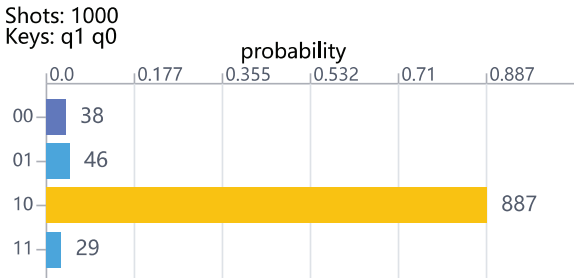
Grover's algorithm accelerates unstructured database search quadratically compared to classical algorithms. In the NISQ era, distributed quantum computing can decrease circuit depth and reduce noise. In this paper, an algorithm for constructing query operators for subfunctions is proposed. By dividing the target string of the search problem into several substrings and integrating the query operator of each subfunction, a low-depth distributed exact quantum search algorithm is designed. The contributions of this paper are as follows: (1) The proposed distributed algorithm has a lower circuit depth and can mitigate error accumulation compared to distributed quantum search algorithms; (2) The target can be accurately located by the proposed distributed algorithm; (3) Experiments conducted with the quantum software MindQuantum confirm the effectiveness and feasibility of the proposed distributed algorithm. Moreover, the introduction of noise to the circuit during these experiments indicates that the algorithm possesses an inherent capacity for noise resistance.
Editorial analysis
A structured set of objections, weighed in public.
Referee Report
Summary. The manuscript proposes a distributed quantum algorithm for Grover's unstructured database search. The target string is divided into substrings; query operators are constructed for each subfunction and then integrated into a single distributed circuit. The authors claim this yields an exact search algorithm with lower circuit depth than prior distributed Grover variants, reduced error accumulation, accurate target location, and inherent noise resistance, with supporting experiments performed in the MindQuantum simulator.
Significance. If the sub-oracle integration step preserves the exact phase-oracle property on the full search space and incurs no hidden communication or synchronization depth that negates the claimed reduction, the construction could provide a concrete route to shallower, more noise-resilient quantum search on NISQ hardware. The simulator experiments add a modest reproducibility element, though they do not yet include the quantitative depth or error benchmarks needed to establish practical advantage.
major comments (3)
- [algorithm construction / integration step] Algorithm construction (the integration of subfunction query operators): the manuscript does not supply an explicit circuit-level or operator-level description showing that the combined operator marks precisely the complete target state with the Grover phase flip while leaving all other states unaffected. Without this, it is impossible to confirm that exactness and the quadratic speedup are retained rather than compromised by the distributed composition.
- [experimental results] Experimental results section: the MindQuantum simulations are cited to support lower depth and noise resistance, yet no numerical depth values, gate counts, or direct comparisons against standard distributed Grover circuits are reported; likewise, no error-probability curves or fidelity metrics under the introduced noise are provided. These omissions leave the headline claims of depth reduction and inherent noise tolerance unverified.
- [distributed circuit description] Distributed implementation overhead: the paper asserts mitigation of error accumulation via distribution, but does not analyze or bound the additional depth or classical communication required for synchronizing the sub-oracle applications across nodes. Any such overhead would directly affect whether the net circuit depth is lower than non-distributed or existing distributed baselines.
minor comments (2)
- [abstract] The abstract states that the target is 'accurately located' but does not define the success probability or number of iterations used; a brief statement of the final measurement probability would clarify the exactness claim.
- [figures] Figure captions and circuit diagrams (if present) should explicitly label the sub-oracle blocks and any inter-node communication channels so that readers can trace the integration step.
Simulated Author's Rebuttal
We thank the referee for the constructive and detailed feedback on our manuscript. We have carefully addressed each major comment by adding the requested clarifications, quantitative data, and analysis in the revised version. Our point-by-point responses follow.
read point-by-point responses
-
Referee: [algorithm construction / integration step] Algorithm construction (the integration of subfunction query operators): the manuscript does not supply an explicit circuit-level or operator-level description showing that the combined operator marks precisely the complete target state with the Grover phase flip while leaving all other states unaffected. Without this, it is impossible to confirm that exactness and the quadratic speedup are retained rather than compromised by the distributed composition.
Authors: We agree that an explicit description of the integration step is necessary for rigor. In the revised manuscript we have added a dedicated subsection with the operator-level construction: each subfunction query operator is a phase oracle on its substring register; their integration is realized by a controlled-phase composition across the distributed registers that applies the full Grover phase flip if and only if every substring matches the corresponding target segment. A short mathematical derivation and a three-qubit illustrative circuit are now included to confirm that non-target states remain unaffected and that the exact quadratic speedup is preserved. revision: yes
-
Referee: [experimental results] Experimental results section: the MindQuantum simulations are cited to support lower depth and noise resistance, yet no numerical depth values, gate counts, or direct comparisons against standard distributed Grover circuits are reported; likewise, no error-probability curves or fidelity metrics under the introduced noise are provided. These omissions leave the headline claims of depth reduction and inherent noise tolerance unverified.
Authors: We acknowledge the absence of quantitative benchmarks in the original submission. The revised experimental section now reports concrete circuit depths (O(√N/k) for k substrings), total gate counts, side-by-side comparisons with both non-distributed Grover and prior distributed variants, fidelity-versus-noise curves, and error-probability plots under depolarizing and amplitude-damping channels, all obtained from the MindQuantum simulator. revision: yes
-
Referee: [distributed circuit description] Distributed implementation overhead: the paper asserts mitigation of error accumulation via distribution, but does not analyze or bound the additional depth or classical communication required for synchronizing the sub-oracle applications across nodes. Any such overhead would directly affect whether the net circuit depth is lower than non-distributed or existing distributed baselines.
Authors: The referee correctly notes that overhead must be quantified. Our construction applies the sub-oracles in parallel on separate nodes; synchronization uses only classical exchange of single-bit control signals after each Grover iteration. We have added a short analysis showing that this classical communication contributes zero quantum depth and scales as O(1) per iteration, independent of database size, thereby preserving the claimed net depth reduction relative to both centralized and earlier distributed baselines. revision: yes
Circularity Check
No circularity: algorithmic construction and simulator validation are independent of fitted inputs or self-referential definitions
full rationale
The paper proposes a concrete distributed quantum search algorithm by splitting the target into substrings, constructing per-subfunction query operators, and integrating them into a lower-depth circuit. This is presented as an explicit construction whose correctness is then checked via MindQuantum simulations (including noise injection). No equation or claim reduces a 'prediction' to a fitted parameter by construction, no uniqueness theorem is imported from self-citation, and no ansatz is smuggled in. The central guarantees (exact marking, quadratic speedup preservation, depth reduction) are asserted from the algorithmic design itself rather than from any self-referential loop. The derivation chain therefore remains self-contained against external benchmarks.
Axiom & Free-Parameter Ledger
axioms (2)
- standard math Standard quantum circuit model and superposition principles hold for the distributed setting.
- domain assumption Dividing the target string into substrings allows independent subfunction query operators whose integration yields an exact search.
Reference graph
Works this paper leans on
-
[1]
Preskill, Quantum computing in the NISQ era and beyond, Quantum 2 (79) (2018)
J. Preskill, Quantum computing in the NISQ era and beyond, Quantum 2 (79) (2018)
work page 2018
- [2]
-
[3]
K. Li, D. Qiu, L. Li, S. Zheng, Z. Rong, Application of distributed semi-quantum computing model in phase estimation, Inf. Process. Lett. 120 (23–29) (2017)
work page 2017
- [4]
-
[5]
J. Tan, L. Xiao, D. Qiu, L. Luo, P. Mateus, Distributed quantum algo- rithm for Simon’s problem, Phys. Rev. A 106 (3) (2022) 032417
work page 2022
-
[6]
D. Qiu, L. Luo, L. Xiao, Distributed Grover’s algorithm, Theor. Com- put. Sci. 993 (114461) (2024)
work page 2024
-
[7]
L. Xiao, D. Qiu, L. Luo, P. Mateus, Distributed Shor’s algorithm, Quan- tum Inf. Comput. 23 (27-44) (2022)
work page 2022
-
[8]
H. Li, D. Qiu, L. Luo, P. Mateus, Exact distributed quantum algorithm for generalized Simons problem, Acta Informatica 61 (2) (2024) 131–159
work page 2024
- [9]
-
[10]
P. Andres-Martinez, T. Forrer, D. Mills, J.-Y. Wu, L. Henaut, K. Ya- mamoto, M. Murao, R. Duncan, Distributing circuits over heteroge- neous, modular quantum computing network architectures, Quantum Sci. Technol. 9 (4) (2024) 045021
work page 2024
-
[11]
D. Qiu, L. Xiao, L. Luo, P. Mateus, Error correction for distributed quantum computing, EPJ Quantum Technology 12 (2025) 142
work page 2025
-
[12]
H. Li, D. Qiu, L. Luo, Distributed generalized deutsch-jozsa algorithm, in: International Computing and Combinatorics Conference, Springer, 2024, pp. 214–225
work page 2024
-
[13]
L. K. Grover, A fast quantum mechanical algorithm for database search, in: Proceedings of the twenty-eighth annual ACM symposium on Theory of computing, 1996, pp. 212–219
work page 1996
-
[14]
Long, Grover algorithm with zero theoretical failure rate, Phys
G.-L. Long, Grover algorithm with zero theoretical failure rate, Phys. Rev. A 64 (2) (2001) 022307
work page 2001
-
[15]
G. Brassard, P. Hoyer, M. Mosca, A. Tapp, Quantum amplitude ampli- fication and estimation, Contemp. Math. 305 (2002) 53–74
work page 2002
-
[16]
Ambainis, Quantum search algorithms, ACM SIGACT News 35 (2) (2004) 22–35
A. Ambainis, Quantum search algorithms, ACM SIGACT News 35 (2) (2004) 22–35
work page 2004
-
[17]
J. Biamonte, P. Wittek, N. Pancotti, P. Rebentrost, N. Wiebe, S. Lloyd, Quantum machine learning, Nature 549 (7671) (2017) 195–202
work page 2017
-
[18]
L. K. Grover, J. Radhakrishnan, Is partial quantum search of a database any easier?, in: Proceedings of the seventeenth annual ACM symposium on Parallelism in algorithms and architectures, 2005, pp. 186–194
work page 2005
-
[19]
V. E. Korepin, Optimization of partial search, J. Phys. A: Math. Gen. 38 (44) (2005) L731
work page 2005
-
[20]
B.-S. Choi, T. A. Walker, S. L. Braunstein, Sure success partial search, Quantum Inf. Process. 6 (18) (2007)
work page 2007
- [21]
- [22]
-
[23]
X. Zhou, D. Qiu, L. Luo, Distributed exact Grovers algorithm, Front. Phys. 18 (51305) (2023)
work page 2023
-
[24]
H. Buhrman, R. De Wolf, Complexity measures and decision tree com- plexity: a survey, Theor. Comput. Sci. 288 (1) (2002) 21–43
work page 2002
-
[25]
C. Figgatt, D. Maslov, K. A. Landsman, N. M. Linke, S. Debnath, C. Monroe, Complete 3-qubit Grover search on a programmable quan- tum computer, Nat. Commun. 8 (1) (2017) 1918
work page 2017
-
[26]
B. Zindorf, S. Bose, Efficient implementation of multicontrolled quan- tum gates, Phys. Rev. Appl. 24 (4) (2025) 044030
work page 2025
-
[27]
H. Li, D. Qiu, L. Luo, Distributed exact multi-objective quantum search algorithm, in: 21st International Conference on Intelligent Computing (ICIC 2025), in press, 2025
work page 2025
-
[28]
Mindspore, Mindspore quantum, https://www.mindspore.cn/ mindquantum/docs/zh-CN/master/index.html
-
[29]
M. A. Nielsen, I. L. Chuang, Quantum computation and quantum in- formation, Vol. 2, Cambridge university press Cambridge, 2001. 45
work page 2001
discussion (0)
Sign in with ORCID, Apple, or X to comment. Anyone can read and Pith papers without signing in.