Recognition: unknown
TDCOSMO XXV: A "soup-to-nuts" 6.5% H₀ measurement - strong lensing and dynamics with a maximally flexible mass sheet
Pith reviewed 2026-05-10 12:23 UTC · model grok-4.3
The pith
A joint lensing and dynamics analysis of the quadruply imaged quasar SDSSJ1433+6007 yields H0 = 73.2 km s^{-1} Mpc^{-1} at 6.5% precision while treating the internal mass sheet as a free parameter.
A machine-rendered reading of the paper's core claim, the machinery that carries it, and where it could break.
Core claim
Accounting for maximal flexibility of the mass-sheet transformation, and assuming a flat Lambda-CDM cosmology and an Omega_m,0 prior from DESI data release 2, we infer H0 = 73.2^{+4.8}_{-4.7} km s^{-1} Mpc^{-1} (a 6.5% precision), and an internal mass-sheet parameter lambda_int = 1.12^{+0.05}_{-0.06}. Notably, lambda_int is 2 sigma away from unity for this system, highlighting the importance of treating it as a free parameter.
What carries the argument
The internal mass-sheet parameter lambda_int, introduced as a free parameter in the joint lensing and dynamical model to allow maximal flexibility in the mass-sheet transformation while incorporating spatially resolved kinematics, oblateness, rotation, anisotropy, and external convergence from DESI.
If this is right
- The measured H0 is consistent with the result from the 2025 milestone paper and will be folded into the next hierarchical TDCOSMO analysis to improve overall precision.
- The 2-sigma deviation of lambda_int from unity demonstrates that fixing the internal mass sheet to unity can bias H0 in this system.
- The end-to-end pipeline of imaging, time-delay monitoring, kinematics, and external environment characterization provides a template that can be applied directly to additional strongly lensed quasars.
- The 6.5 percent precision on a single system shows that careful treatment of the mass-sheet transformation can deliver competitive cosmological constraints from individual lenses.
Where Pith is reading between the lines
- If the same flexible mass-sheet treatment is applied to the rest of the TDCOSMO sample, the combined H0 uncertainty could drop below the current few-percent level without requiring new data.
- The non-unity lambda_int may reflect real structural features of the lens galaxy that could be tested by comparing predicted and observed stellar orbits in higher-resolution integral-field data.
- Because the analysis assumes flat Lambda-CDM, repeating it under alternative cosmologies would test whether the inferred lambda_int remains stable or absorbs curvature or dark-energy deviations.
Load-bearing premise
The combination of spatially resolved stellar kinematics, explicit modeling of oblateness rotation and anisotropy, and DESI-based external convergence fully breaks the mass-sheet degeneracy without residual bias in the joint fit.
What would settle it
Repeating the joint lensing-dynamics fit with an independent set of kinematic maps or a different line-of-sight convergence prior that shifts the inferred H0 outside the reported 6.5 percent uncertainty range would falsify the central measurement.
Figures




read the original abstract
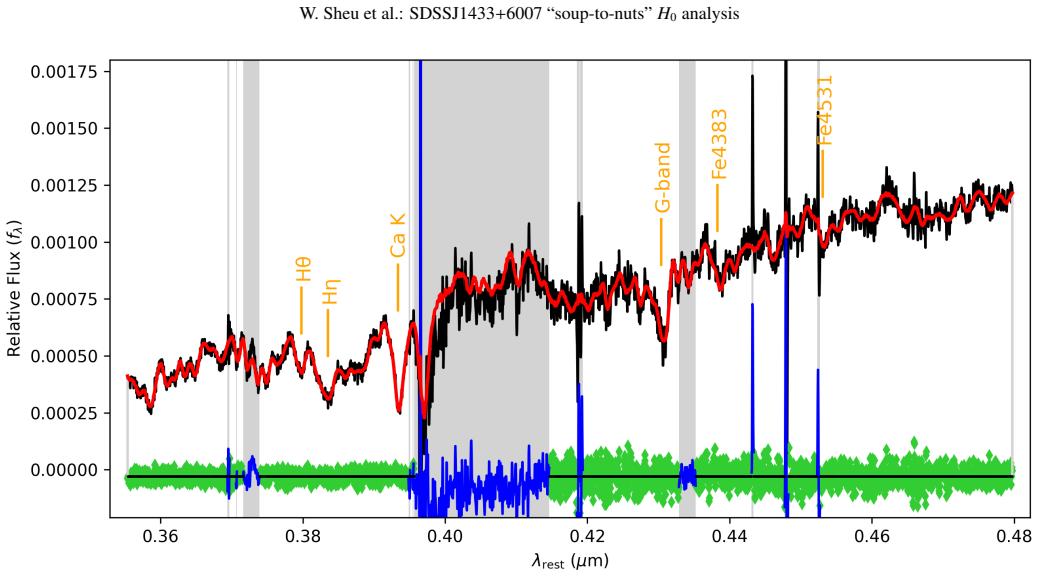
We present a blind time-delay cosmography measurement of the Hubble constant $H_0$ based on the quadruply imaged quasar SDSSJ1433+6007. Our analysis combines deep Hubble Space Telescope imaging, extended time-delay monitoring from the Wendelstein and Maidanak Observatories, and spatially resolved stellar kinematics from the Keck Cosmic Web Imager and Reionization Mapper. We build a robust lens model to reconstruct the mass distribution and high-signal-to-noise kinematic maps to break the mass-sheet degeneracy (MSD), explicitly accounting for the lens galaxy's oblateness, rotation, and anisotropy. Furthermore, we constrain the external convergence ($\kappa_{\rm ext}$) by characterizing the line-of-sight environment using wide-field photometry from the Dark Energy Spectroscopic Instrument (DESI) Legacy Survey data release 10. We incorporate these constraints into our joint lensing and dynamical model, running multiple iterations to estimate random and systematic uncertainties. Accounting for maximal flexibility of the mass-sheet transformation, and assuming a flat $\Lambda$CDM cosmology and an $\Omega_{\rm m, 0}$ prior from DESI data release 2, we infer $H_0 = 73.2^{+4.8}_{-4.7}$ km s$^{-1}$ Mpc$^{-1}$ (a $6.5\%$ precision), and an internal mass-sheet parameter $\lambda_{\rm int}=1.12^{+0.05}_{-0.06}$. Notably, $\lambda_{\rm int}$ is $2\sigma$ away from unity for this system, highlighting the importance of treating it as a free parameter. Our $H_0$ measurement is consistent with the result from our 2025 milestone paper, and it will be included in our next hierarchical analysis to improve the overall precision. Moving forward, the comprehensive pipeline demonstrated herein establishes a robust framework that can be readily applied to future strongly lensed systems to further refine cosmological constraints.
Editorial analysis
A structured set of objections, weighed in public.
Referee Report
Summary. The manuscript presents a blind time-delay cosmography analysis of the quadruply imaged quasar SDSS J1433+6007. It integrates deep HST imaging, time-delay measurements from Wendelstein and Maidanak observatories, spatially resolved stellar kinematics from Keck Cosmic Web Imager and Reionization Mapper, and external convergence constraints derived from DESI Legacy Survey photometry. The lens model incorporates maximal flexibility in the mass-sheet transformation by treating the internal mass-sheet parameter λ_int as free and explicitly accounting for the lens galaxy's oblateness, rotation, and anisotropy. Using a joint lensing and dynamics fit with an Ω_m,0 prior from DESI DR2 in a flat ΛCDM cosmology, the authors infer H0 = 73.2^{+4.8}_{-4.7} km s^{-1} Mpc^{-1} (6.5% precision) and λ_int = 1.12^{+0.05}_{-0.06} (2σ from unity). The result is consistent with their 2025 milestone paper and is intended for inclusion in a future hierarchical analysis.
Significance. This work offers a high-precision, single-system H0 measurement that explicitly addresses the mass-sheet degeneracy through flexible modeling and high-quality kinematic data. The deviation of λ_int from unity at 2σ is noteworthy and supports the decision to fit it rather than fix it. The comprehensive 'soup-to-nuts' pipeline, including multiple iterations for uncertainty estimation and use of external data, provides a valuable template for analyzing future lensed systems. If the MSD is robustly broken, this strengthens the TDCOSMO series' contribution to resolving the Hubble tension. The blind nature and consistency with prior results are positive aspects.
major comments (1)
- [Joint lensing and dynamical modeling] The central claim of 6.5% precision on H0 relies on the assertion that the combination of spatially resolved kinematics, explicit oblateness/rotation/anisotropy modeling, and DESI κ_ext fully breaks the mass-sheet degeneracy. The manuscript reports λ_int = 1.12^{+0.05}_{-0.06} but does not appear to include diagnostic plots or quantitative measures (e.g., correlation coefficients or marginalized posteriors) demonstrating the independence of λ_int from anisotropy parameters in the dynamical model. If unaccounted degeneracies persist, they could systematically shift λ_int and propagate to H0. Please add such validation in the results or appendix.
minor comments (2)
- [Abstract] The quoted 6.5% precision is approximate given the asymmetric uncertainties; consider stating the exact fractional uncertainty for clarity.
- [Methods] Clarify the number of iterations performed for systematics estimation and which parameters were varied in each.
Simulated Author's Rebuttal
We thank the referee for their careful reading and constructive feedback on our manuscript. We address the single major comment below and will incorporate the requested validation to strengthen the presentation of our results.
read point-by-point responses
-
Referee: [Joint lensing and dynamical modeling] The central claim of 6.5% precision on H0 relies on the assertion that the combination of spatially resolved kinematics, explicit oblateness/rotation/anisotropy modeling, and DESI κ_ext fully breaks the mass-sheet degeneracy. The manuscript reports λ_int = 1.12^{+0.05}_{-0.06} but does not appear to include diagnostic plots or quantitative measures (e.g., correlation coefficients or marginalized posteriors) demonstrating the independence of λ_int from anisotropy parameters in the dynamical model. If unaccounted degeneracies persist, they could systematically shift λ_int and propagate to H0. Please add such validation in the results or appendix.
Authors: We agree that explicit diagnostics would make the breaking of the mass-sheet degeneracy more transparent. The submitted manuscript presents the full joint posterior from the MCMC sampling of the combined lensing+dynamics model (which already marginalizes over all anisotropy, oblateness, and rotation parameters simultaneously with λ_int), but does not include dedicated 2D contour plots or tabulated correlation coefficients. We will add a new appendix figure showing the 2D marginalized posteriors between λ_int and the primary dynamical parameters (β, γ, and the oblateness/rotation terms), together with the Pearson correlation coefficients. These diagnostics confirm that the spatially resolved KCWI+Reionization Mapper kinematics break the degeneracy, with |ρ| < 0.25 for all relevant pairs. The updated manuscript will therefore include this validation. revision: yes
Circularity Check
No significant circularity; H0 inference uses independent data and fitted parameters
full rationale
The derivation relies on new observations (HST imaging, time-delay monitoring from Wendelstein/Maidanak, KCWI/RM kinematics) and external DESI DR2 Ω_m prior plus DESI Legacy Survey photometry for κ_ext. λ_int is explicitly fitted as a free parameter in the joint lensing+dynamics model after accounting for oblateness/rotation/anisotropy; the reported H0 value is an inference from this fit rather than a prediction or renaming of any input. Self-reference to the 2025 milestone paper is limited to a consistency statement and does not support any load-bearing step. No equation or claim reduces by construction to a prior fit or self-citation chain.
Axiom & Free-Parameter Ledger
free parameters (1)
- λ_int
axioms (2)
- domain assumption flat ΛCDM cosmology
- domain assumption Ω_m,0 prior from DESI DR2
Reference graph
Works this paper leans on
-
[1]
N., Adelman-McCarthy, J
Abazajian, K. N., Adelman-McCarthy, J. K., Agüeros, M. A., et al. 2009, The Astrophysical Journal Supplement Series, 182, 543–558
2009
-
[2]
2017, Monthly Notices of the Royal Astronomical Society, 474, 3391–3396
Agnello, A., Grillo, C., Jones, T., et al. 2017, Monthly Notices of the Royal Astronomical Society, 474, 3391–3396
2017
-
[3]
& Amara, A
Birrer, S. & Amara, A. 2018, Physics of the Dark Universe, 22, 189
2018
-
[4]
2024, Time-Delay Cosmography: Mea- suring the Hubble Constant and other cosmological parameters with strong gravitational lensing
Birrer, S., Millon, M., Sluse, D., et al. 2024, Time-Delay Cosmography: Mea- suring the Hubble Constant and other cosmological parameters with strong gravitational lensing
2024
-
[5]
2021, The Journal of Open Source Soft- ware, 6, 3283
Birrer, S., Shajib, A., Gilman, D., et al. 2021, The Journal of Open Source Soft- ware, 6, 3283
2021
-
[6]
J., Galan, A., et al
Birrer, S., Shajib, A. J., Galan, A., et al. 2020, Astronomy & Astrophysics, 643, A165
2020
-
[7]
& Treu, T
Birrer, S. & Treu, T. 2021, A&A, 649, A61
2021
-
[8]
2020, ApJ, 892, L27
Blum, K., Castorina, E., & Simonovi´c, M. 2020, ApJ, 892, L27
2020
-
[9]
2022, The Astrophysical Journal, 938, 110
Brout, D., Scolnic, D., Popovic, B., et al. 2022, The Astrophysical Journal, 938, 110
2022
-
[10]
Brown, A. G. A., Vallenari, A., Prusti, T., et al. 2018, Astronomy & Astrophysics, 616, A1
2018
-
[11]
A., Shalyapin, V
Burkhonov, O. A., Shalyapin, V . N., Sergeyev, A. V ., et al. 2026, MNRAS, 546, stag023
2026
-
[12]
2002, MNRAS, 333, 400
Cappellari, M. 2002, MNRAS, 333, 400
2002
-
[13]
2008, MNRAS, 390, 71
Cappellari, M. 2008, MNRAS, 390, 71
2008
-
[14]
2016, ARA&A, 54, 597
Cappellari, M. 2016, ARA&A, 54, 597
2016
-
[15]
2017, MNRAS, 466, 798
Cappellari, M. 2017, MNRAS, 466, 798
2017
-
[16]
2020, MNRAS, 494, 4819
Cappellari, M. 2020, MNRAS, 494, 4819
2020
-
[17]
2023, MNRAS, 526, 3273
Cappellari, M. 2023, MNRAS, 526, 3273
2023
-
[18]
2026, in Encyclopedia of Astrophysics, V olume 4, V ol
Cappellari, M. 2026, in Encyclopedia of Astrophysics, V olume 4, V ol. 4, 122– 152
2026
-
[19]
& Copin, Y
Cappellari, M. & Copin, Y . 2003, MNRAS, 342, 345
2003
-
[20]
2007, MNRAS, 379, 418
Cappellari, M., Emsellem, E., Bacon, R., et al. 2007, MNRAS, 379, 418
2007
-
[21]
S., Schlegel, D
Dawson, K. S., Schlegel, D. J., Ahn, C. P., et al. 2012, The Astronomical Journal, 145, 10 de Vaucouleurs, G. 1948, Annales d’Astrophysique, 11, 247 DESI Collaboration, Abdul Karim, M., Aguilar, J., et al. 2025, Phys. Rev. D, 112, 083515
2012
-
[22]
J., Lang, D., et al
Dey, A., Schlegel, D. J., Lang, D., et al. 2019, The Astronomical Journal, 157, 168
2019
-
[23]
2021, Monthly Notices of the Royal Astro- nomical Society, 503, 1096–1123
Ding, X., Treu, T., Birrer, S., et al. 2021, Monthly Notices of the Royal Astro- nomical Society, 503, 1096–1123
2021
-
[24]
2024, Journal of Open Source Software, 9, 6775
Dux, F. 2024, Journal of Open Source Software, 9, 6775
2024
-
[25]
2025, Astronomy & Astrophysics, 697, A139
Dux, F., Millon, M., Galan, A., et al. 2025, Astronomy & Astrophysics, 697, A139
2025
-
[26]
2018, Nature Astronomy, 2, 349
Ehgamberdiev, S. 2018, Nature Astronomy, 2, 349
2018
-
[27]
2007, Monthly Notices of the Royal Astronomical Society, 379, 401–417
Emsellem, E., Cappellari, M., Krajnovi , D., et al. 2007, Monthly Notices of the Royal Astronomical Society, 379, 401–417
2007
-
[28]
H., et al
Ertl, S., Schuldt, S., Suyu, S. H., et al. 2023, Astronomy & Astrophysics, 672, A2
2023
-
[29]
E., Gorenstein, M
Falco, E. E., Gorenstein, M. V ., & Shapiro, I. I. 1985, ApJ, 289, L1 Falcón-Barroso, J., Sánchez-Blázquez, P., Vazdekis, A., et al. 2011, Astronomy & Astrophysics, 532, A95
1985
-
[30]
Foreman-Mackey, D., Hogg, D. W., Lang, D., & Goodman, J. 2013, Publications of the Astronomical Society of the Pacific, 125, 306–312 Forés-Toribio, R., Kochanek, C. S., & Muñoz, J. A. 2026, arXiv e-prints, arXiv:2602.03934
-
[31]
Freedman, W. L. 2021, ApJ, 919, 16
2021
-
[32]
L., Madore, B
Freedman, W. L., Madore, B. F., Hoyt, T. J., et al. 2025, The Astrophysical Jour- nal, 985, 203
2025
-
[33]
Graham, A. W. & Scott, N. 2013, ApJ, 764, 151
2013
-
[34]
Hoyt, T. J., Jang, I. S., Freedman, W. L., et al. 2025, arXiv e-prints, arXiv:2503.11769
work page internal anchor Pith review arXiv 2025
-
[35]
B., Blakeslee, J
Jensen, J. B., Blakeslee, J. P., Cantiello, M., et al. 2025, ApJ, 987, 87
2025
-
[36]
L., Rodney, S., Treu, T., et al
Kelly, P. L., Rodney, S., Treu, T., et al. 2023, Science, 380, abh1322
2023
-
[37]
L., Rodney, S
Kelly, P. L., Rodney, S. A., Treu, T., et al. 2015, Science, 347, 1123
2015
-
[38]
& Eberhart, R
Kennedy, J. & Eberhart, R. 1995, in Proceedings of ICNN’95 - International Conference on Neural Networks, V ol. 4, 1942–1948 vol.4
1995
-
[39]
J., et al
Knabel, S., Mozumdar, P., Shajib, A. J., et al. 2025, Astronomy & Astrophysics, 703, A117
2025
-
[40]
Knabel, S., Treu, T., Cappellari, M., et al. 2026, arXiv e-prints, arXiv:2604.12155
work page internal anchor Pith review Pith/arXiv arXiv 2026
-
[41]
2025, ApJ, 990, 51
Knabel, S., Treu, T., Cappellari, M., et al. 2025, ApJ, 990, 51
2025
-
[42]
& Millea, M
Knox, L. & Millea, M. 2020, Physical Review D, 101 Krajnovi´c, D., Cappellari, M., de Zeeuw, P. T., & Copin, Y . 2006, MNRAS, 366, 787
2020
-
[43]
J., & Woodfinden, A
Krolewski, A., Percival, W. J., & Woodfinden, A. 2025, Phys. Rev. Lett., 134, 101002
2025
-
[44]
W., et al
Lemon, C., Anguita, T., Auger-Williams, M. W., et al. 2022, Monthly Notices of the Royal Astronomical Society, 520, 3305–3328
2022
-
[45]
A., Auger, M
Lemon, C. A., Auger, M. W., McMahon, R. G., & Ostrovski, F. 2018, Monthly Notices of the Royal Astronomical Society, 479, 5060–5074
2018
-
[46]
2018, The Astrophysical Journal Letters, 863, L19
Li, H., Mao, S., Cappellari, M., et al. 2018, The Astrophysical Journal Letters, 863, L19
2018
-
[47]
R., Wong, K
McCully, C., Keeton, C. R., Wong, K. C., & Zabludoff, A. I. 2017, The Astro- physical Journal, 836, 141
2017
-
[48]
C., Matuszewski, M., Neill, J
McGurk, R. C., Matuszewski, M., Neill, J. D., et al. 2024, in Society of Photo- Optical Instrumentation Engineers (SPIE) Conference Series, V ol. 13096, Ground-based and Airborne Instrumentation for Astronomy X, ed. J. J
2024
-
[49]
1985, AJ, 90, 1027
Merritt, D. 1985, AJ, 90, 1027
1985
-
[50]
2023, The Journal of Open Source Software, 8, 5340
Michalewicz, K., Millon, M., Dux, F., & Courbin, F. 2023, The Journal of Open Source Software, 8, 5340
2023
-
[51]
Millon, M., Michalewicz, K., Dux, F., Courbin, F., & Marshall, P. J. 2024, AJ, 168, 55
2024
-
[52]
Moffat, A. F. J. 1969, A&A, 3, 455
1969
-
[53]
C., et al
Morrissey, P., Matuszewski, M., Martin, D. C., et al. 2018, The Astrophysical Journal, 864, 93
2018
-
[54]
D., Treu, T., Spiniello, C., & Shajib, A
Mozumdar, P., Fassnacht, C. D., Treu, T., Spiniello, C., & Shajib, A. J. 2023, Astronomy & Astrophysics, 672, A20
2023
-
[55]
Osipkov, L. P. 1979, Soviet Astronomy Letters, 5, 42
1979
-
[56]
D., et al
Paic, E., Courbin, F., Fassnacht, C. D., et al. 2026, A&A, 706, A270
2026
-
[57]
L., Pierel, J
Pascale, M., Frye, B. L., Pierel, J. D. R., et al. 2025, ApJ, 979, 13
2025
-
[58]
W., Braatz, J
Pesce, D. W., Braatz, J. A., Reid, M. J., et al. 2020, ApJ, 891, L1 Planck Collaboration, Aghanim, N., Akrami, Y ., et al. 2020, Astronomy & As- trophysics, 641, A6
2020
-
[59]
L., Karwal, T., & Kamionkowski, M
Poulin, V ., Smith, T. L., Karwal, T., & Kamionkowski, M. 2019, Physical Review Letters, 122
2019
-
[60]
2025, Monthly Notices of the Royal Astronomical Society, 542, 170–202
Queirolo, G., Seitz, S., Riffeser, A., et al. 2025, Monthly Notices of the Royal Astronomical Society, 542, 170–202
2025
-
[61]
M., Oguri, M., More, A., et al
Quimby, R. M., Oguri, M., More, A., et al. 2014, Science, 344, 396–399
2014
-
[62]
2003, Monthly Notices of the Royal Astronomical Society, 338, 35–47
Refregier, A. 2003, Monthly Notices of the Royal Astronomical Society, 338, 35–47
2003
-
[63]
& Bacon, D
Refregier, A. & Bacon, D. 2003, Monthly Notices of the Royal Astronomical Society, 338, 48–56
2003
-
[64]
1964, MNRAS, 128, 307
Refsdal, S. 1964, MNRAS, 128, 307
1964
-
[65]
G., Yuan, W., Macri, L
Riess, A. G., Yuan, W., Macri, L. M., et al. 2022, The Astrophysical Journal Letters, 934, L7
2022
-
[66]
E., Fassnacht, C
Rusu, C. E., Fassnacht, C. D., Sluse, D., et al. 2017, Monthly Notices of the Royal Astronomical Society, 467, 4220–4242
2017
-
[67]
2022, Monthly Notices of the Royal As- tronomical Society, 518, 1260–1300
Schmidt, T., Treu, T., Birrer, S., et al. 2022, Monthly Notices of the Royal As- tronomical Society, 518, 1260–1300
2022
-
[68]
& Sluse, D
Schneider, P. & Sluse, D. 2013, A&A, 559, A37
2013
-
[69]
1979, ApJ, 232, 236 Sérsic, J
Schwarzschild, M. 1979, ApJ, 232, 236 Sérsic, J. L. 1963, Boletin de la Asociacion Argentina de Astronomia La Plata Argentina, 6, 41
1979
-
[70]
J., Mozumdar, P., Chen, G
Shajib, A. J., Mozumdar, P., Chen, G. C.-F., et al. 2023, Astronomy & Astro- physics, 673, A9
2023
-
[71]
J., Wong, K
Shajib, A. J., Wong, K. C., Birrer, S., et al. 2022, Astronomy & Astrophysics, 667, A123
2022
-
[72]
2023, The Astrophysical Journal, 952, 10
Sheu, W., Huang, X., Cikota, A., et al. 2023, The Astrophysical Journal, 952, 10
2023
-
[73]
J., Treu, T., et al
Sheu, W., Shajib, A. J., Treu, T., et al. 2025, MNRAS, 541, 1
2025
-
[74]
R., Blum, R
Silva, D. R., Blum, R. D., Allen, L., et al. 2016, in American Astronomical So- ciety Meeting Abstracts, V ol. 228, American Astronomical Society Meeting Abstracts #228, 317.02
2016
-
[75]
Springel, V ., White, S. D. M., Jenkins, A., et al. 2005, Nature, 435, 629
2005
-
[76]
H., Bonvin, V ., Courbin, F., et al
Suyu, S. H., Bonvin, V ., Courbin, F., et al. 2017, Monthly Notices of the Royal Astronomical Society, 468, 2590–2604
2017
-
[77]
H., Marshall, P
Suyu, S. H., Marshall, P. J., Auger, M. W., et al. 2010, ApJ, 711, 201
2010
-
[78]
Y ., Shajib, A
Tan, C. Y ., Shajib, A. J., Birrer, S., et al. 2024, MNRAS, 530, 1474 TDCOSMO Collaboration, Birrer, S., Buckley-Geer, E. J., et al. 2025, Astron- omy & Astrophysics, 704, A63
2024
-
[79]
& Benton Metcalf, R
Tessore, N. & Benton Metcalf, R. 2015, Astronomy & Astrophysics, 580, A79
2015
-
[80]
2013, A&A, 553, A120
Tewes, M., Courbin, F., & Meylan, G. 2013, A&A, 553, A120
2013
discussion (0)
Sign in with ORCID, Apple, or X to comment. Anyone can read and Pith papers without signing in.