Recognition: unknown
Spatially Resolved Kinematics of SLACS Lens Galaxies. II: Breaking Degeneracies with Lensing and Dynamical Models
Pith reviewed 2026-05-10 16:36 UTC · model grok-4.3
The pith
Combined lensing and dynamical models show SLACS lens galaxies have nearly isothermal power-law mass profiles with mean slope 2.04 and no measurable bias in time-delay cosmography.
A machine-rendered reading of the paper's core claim, the machinery that carries it, and where it could break.
Core claim
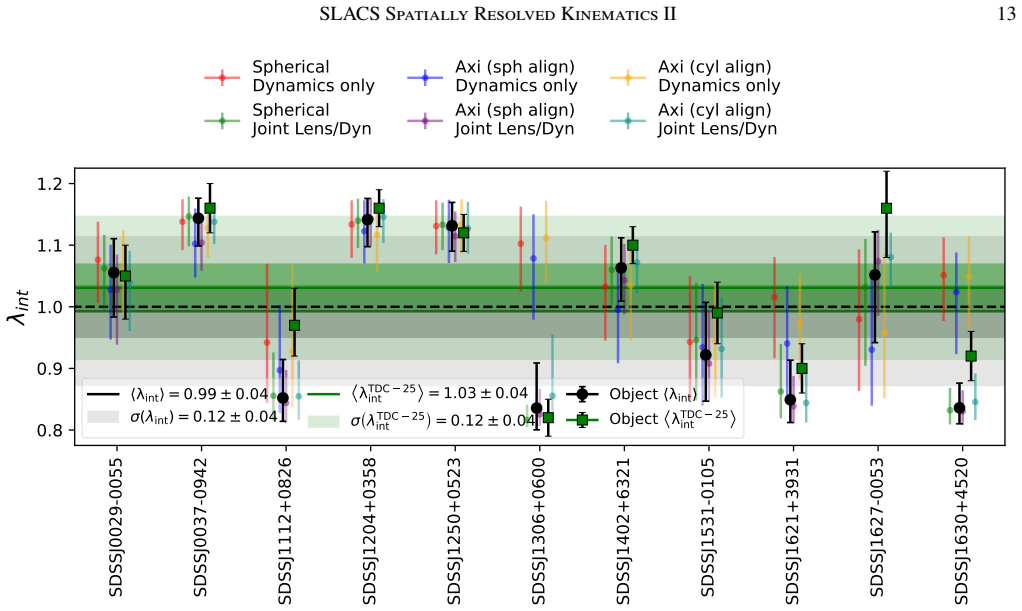
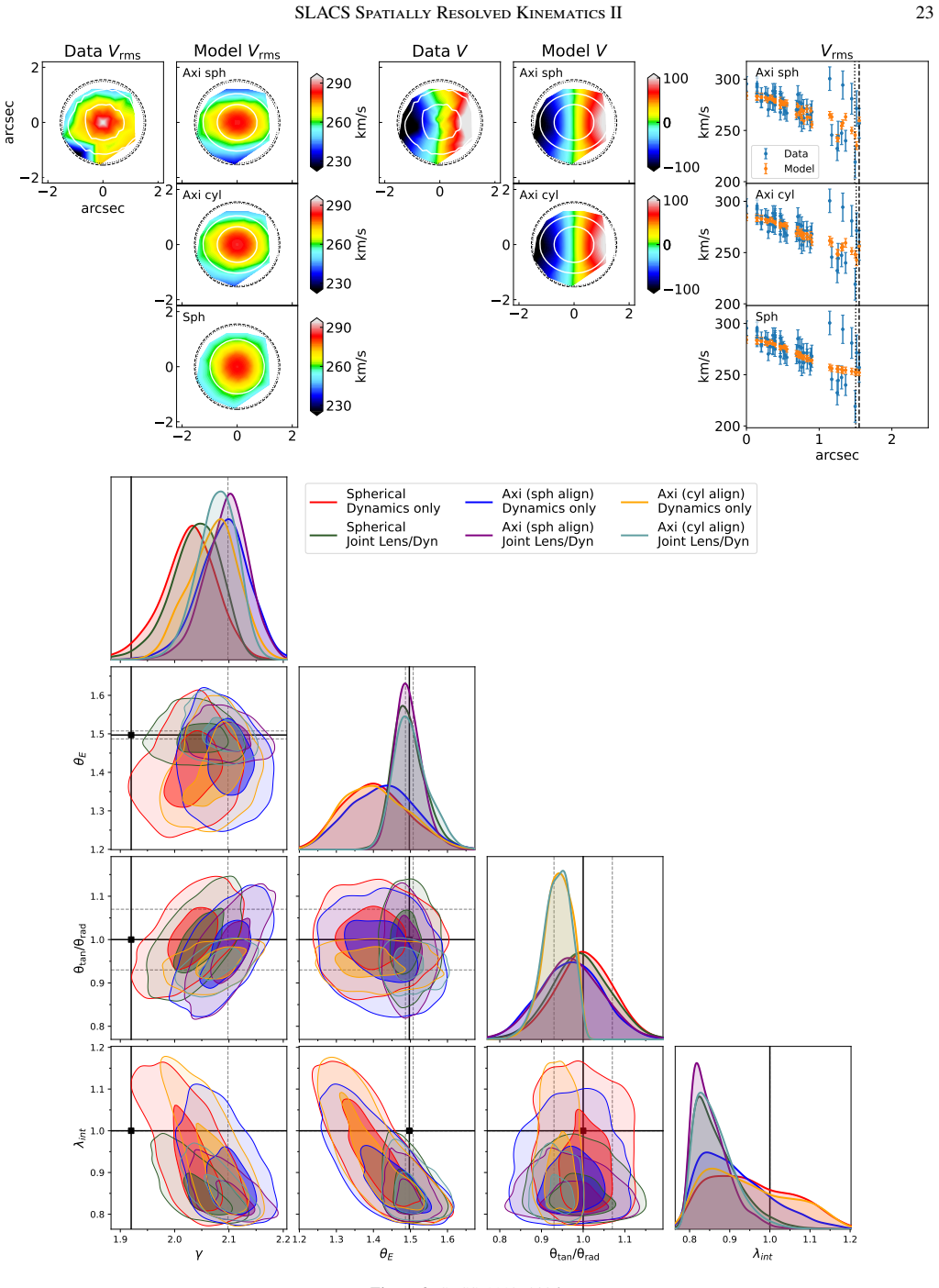
We find nearly isothermal power-law total mass density slopes (ρ_tot ∝ r^{-γ}) for the sample with a mean of γ = 2.04±0.02 with intrinsic scatter of 0.08^{+0.03}_{-0.02}. The mean value of λ_int for the sample is 1.01±0.03, with intrinsic scatter of 0.11±0.03. On average power-law mass profiles are a good first-order description of the SLACS sample and do not introduce measurable bias in time-delay cosmography, although more flexible mass models should be able to reproduce the highly detailed kinematic datasets more accurately.
What carries the argument
Jeans Anisotropic Modeling (JAM) applied to 2D kinematic maps jointly with lens models, using priors on anisotropy and shape to break the mass-anisotropy degeneracy and explicitly fitting the mass-sheet parameter λ_int sensitive to the mass-sheet degeneracy.
Load-bearing premise
Informative priors on velocity anisotropy and intrinsic galaxy shape from local galaxy samples are required to break the residual mass-anisotropy degeneracy.
What would settle it
A measurement finding the sample mean λ_int significantly different from 1 or the mean γ far from 2 in an independent analysis of similar quality data would indicate that power-law profiles introduce bias.
Figures





read the original abstract
We model the dynamical mass density profiles of 14 strong gravitational lens galaxies from the Sloan Lens ACS (SLACS) sample using spatially resolved kinematics obtained from Keck KCWI integral-field spectroscopy. We use the Jeans Anisotropic Modeling (JAM) method, combining 2D kinematic maps with joint constraints from lens models from Hubble Space Telescope imaging. We use informative priors on the anisotropy and intrinsic shape from local galaxies to help break the residual mass-anisotropy degeneracy (MAD). We find nearly isothermal power-law total mass density slopes ($\rho_{\rm tot}\propto r^{-\gamma}$) for the sample with a mean of $\gamma = 2.04\pm0.02$ with intrinsic scatter of $0.08^{+0.03}_{-0.02}$. We fit explicitly for deviations from the pure power-law form that are fully sensitive to the mass-sheet degeneracy (MSD) and constrain the value of the mass-sheet parameter $\rm \lambda_{int}$ for each individual galaxy to an average precision of 5.8%. The mean value of $\rm \lambda_{int}$ for the sample is $1.01\pm0.03$, with intrinsic scatter of $0.11\pm0.03$. Values of $\rm \lambda_{int}$ for individual objects and the scatter in the sample are consistent to $1\sigma$ uncertainty with those found by the Time-Delay COSMOgraphy collaboration's 2025 milestone analysis, which used a spherical analysis of the same dataset, but azimuthally averaged. We thus conclude that on average power-law mass profiles are a good first-order description of the SLACS sample and do not introduce measureable bias in time-delay cosmography. However, our analysis indicates that more flexible mass models should be able to reproduce the highly detailed kinematic datasets more accurately.
Editorial analysis
A structured set of objections, weighed in public.
Referee Report
Summary. The paper models the dynamical mass density profiles of 14 SLACS strong gravitational lens galaxies using spatially resolved KCWI integral-field spectroscopy combined with joint constraints from HST lens models. Employing the Jeans Anisotropic Modeling (JAM) method with informative priors on anisotropy and intrinsic shape from local galaxies, it reports a mean power-law total mass density slope of γ = 2.04 ± 0.02 with intrinsic scatter 0.08^{+0.03}_{-0.02} and a mean mass-sheet parameter λ_int = 1.01 ± 0.03 with scatter 0.11 ± 0.03, concluding that power-law profiles are a good first-order description and introduce no measurable bias in time-delay cosmography.
Significance. If the central results hold after addressing the prior robustness, this work strengthens the foundation for time-delay cosmography by validating the power-law assumption on a sample with spatially resolved 2D kinematics, achieving ~5.8% precision on individual λ_int values. The consistency check against the TDCOSMO 2025 spherical analysis of the same dataset adds value, and the explicit fitting for MSD-sensitive deviations from power-law form is a methodological strength that could inform more flexible models in future analyses.
major comments (2)
- The central claim that power-law profiles introduce no measurable bias rests on the sample-mean λ_int = 1.01 ± 0.03 being an unbiased estimator. This depends on the informative priors on velocity anisotropy and intrinsic shape (drawn from local galaxies) correctly breaking the mass-anisotropy degeneracy in the JAM fits. The manuscript provides no test of whether these priors apply to the SLACS sample (0.1 < z < 0.5, lensing-selected massive early-types), which could introduce a systematic shift in λ_int even while γ remains near 2. This is load-bearing for the no-bias conclusion.
- The reported consistency with the 2025 TDCOSMO spherical analysis (azimuthally averaged on the same dataset) is noted, but both share the same dataset and similar prior assumptions, so it does not independently validate that λ_int is free of prior-induced bias. A robustness test (e.g., results with non-informative priors or prior variation) is needed to support the claim.
minor comments (2)
- The abstract reports numerical results (γ, λ_int, scatters, and 5.8% precision) without reference to data quality metrics, number of kinematic spatial bins, model convergence criteria, or covariance between parameters, which limits evaluation of the quoted uncertainties.
- Individual galaxy values of γ and λ_int are summarized at the sample level but not tabulated with per-object uncertainties, reduced χ², or posterior covariances; adding such a table would improve transparency and allow readers to assess outliers.
Simulated Author's Rebuttal
We thank the referee for their careful reading and insightful comments on our manuscript. We address each of the major comments below and have revised the manuscript accordingly to improve the robustness discussion.
read point-by-point responses
-
Referee: The central claim that power-law profiles introduce no measurable bias rests on the sample-mean λ_int = 1.01 ± 0.03 being an unbiased estimator. This depends on the informative priors on velocity anisotropy and intrinsic shape (drawn from local galaxies) correctly breaking the mass-anisotropy degeneracy in the JAM fits. The manuscript provides no test of whether these priors apply to the SLACS sample (0.1 < z < 0.5, lensing-selected massive early-types), which could introduce a systematic shift in λ_int even while γ remains near 2. This is load-bearing for the no-bias conclusion.
Authors: We agree that the applicability of local galaxy priors to the SLACS sample at intermediate redshifts is an important consideration for the robustness of our results. The SLACS galaxies are massive early-type galaxies, and multiple studies have demonstrated that the stellar kinematic properties and dynamical structure of such systems show little evolution between z=0 and z~0.5. Nevertheless, to directly address this concern, we have added a new paragraph in Section 4.2 discussing the justification for the priors, including references to literature showing consistency in anisotropy distributions for lensing-selected samples. We also note that any systematic mismatch in priors would primarily affect the inferred anisotropy rather than introducing a large bias in the mass-sheet parameter λ_int, as the lensing constraints help anchor the mass normalization. We have revised the text to make this explicit. revision: yes
-
Referee: The reported consistency with the 2025 TDCOSMO spherical analysis (azimuthally averaged on the same dataset) is noted, but both share the same dataset and similar prior assumptions, so it does not independently validate that λ_int is free of prior-induced bias. A robustness test (e.g., results with non-informative priors or prior variation) is needed to support the claim.
Authors: We acknowledge that the comparison with the TDCOSMO 2025 analysis, while using a different modeling approach (spherical vs. axisymmetric JAM), shares the underlying dataset and thus is not a fully independent validation. We agree that a test of prior sensitivity would strengthen the paper. However, using completely non-informative priors on anisotropy and shape would leave the mass-anisotropy degeneracy unbroken, resulting in highly uncertain λ_int values that do not provide a meaningful robustness check. Instead, we have performed a sensitivity analysis by broadening the prior widths by a factor of two and refitting the models for the full sample. The mean λ_int shifts by less than 0.02, remaining consistent with 1.01 within the uncertainties. These results have been added to the revised manuscript in a new subsection on prior robustness. We believe this addresses the concern without requiring a full non-informative prior analysis, which would not be constraining. revision: partial
Circularity Check
No circularity: primary results derived from independent kinematic and lensing data
full rationale
The derivation of γ = 2.04 ± 0.02 and λ_int = 1.01 ± 0.03 proceeds from explicit JAM fits to the new KCWI 2D kinematic maps jointly with HST lens models; informative priors on anisotropy and intrinsic shape are taken from external local-galaxy samples. The cited 2025 TDCOSMO spherical analysis on the same dataset is invoked only for a post-hoc consistency check and is not an input to the reported means, scatters, or the conclusion that power-law profiles introduce no measurable bias. No equation or claim reduces by construction to a fitted parameter, self-definition, or load-bearing self-citation.
Axiom & Free-Parameter Ledger
free parameters (3)
- velocity anisotropy parameters
- intrinsic shape parameters
- mass-sheet parameter λ_int
axioms (2)
- domain assumption The Jeans Anisotropic Modeling equations accurately describe the stellar kinematics in these early-type lens galaxies.
- domain assumption Priors on anisotropy and shape derived from local galaxies apply to the higher-redshift SLACS lenses.
Forward citations
Cited by 1 Pith paper
-
TDCOSMO XXV: A "soup-to-nuts" 6.5% $H_0$ measurement $-$ strong lensing and dynamics with a maximally flexible mass sheet
New 6.5% H0 = 73.2 km/s/Mpc measurement from strong lensing time delays and stellar dynamics in SDSSJ1433+6007, with fitted internal mass-sheet parameter λ_int = 1.12 away from unity at 2σ.
Reference graph
Works this paper leans on
-
[1]
Abdalla, E., Abell´an, G. F., Aboubrahim, A., et al. 2022, Journal of High Energy Astrophysics, 34, 49, doi: 10.1016/j.jheap.2022.04.002
work page internal anchor Pith review doi:10.1016/j.jheap.2022.04.002 2022
-
[2]
W., Treu, T., Bolton, A
Auger, M. W., Treu, T., Bolton, A. S., et al. 2010, ApJ, 724, 511 SLACS Spatially Resolved Kinematics II17
2010
-
[3]
Binney, J., & Mamon, G. A. 1982, MNRAS, 200, 361, doi: 10.1093/mnras/200.2.361
-
[4]
Birrer, S., Dhawan, S., & Shajib, A. J. 2022a, ApJ, 924, 2, doi: 10.3847/1538-4357/ac323a
-
[5]
2022b, arXiv e-prints, arXiv:2210.10833, doi: 10.48550/arXiv.2210.10833
Birrer, S., Millon, M., Sluse, D., et al. 2022b, arXiv e-prints, arXiv:2210.10833, doi: 10.48550/arXiv.2210.10833
-
[6]
2021, A&A, 649, A61, doi: 10.1051/0004-6361/202039179
Birrer, S., & Treu, T. 2021, A&A, 649, A61, doi: 10.1051/0004-6361/202039179
-
[7]
Birrer, S., Shajib, A. J., Galan, A., et al. 2020, A&A, 643, A165, doi: 10.1051/0004-6361/202038861
-
[8]
2020, ApJL, 892, L27, doi: 10.3847/2041-8213/ab8012
Blum, K., Castorina, E., & Simonovi´c, M. 2020, ApJL, 892, L27, doi: 10.3847/2041-8213/ab8012
-
[9]
Bolton, A. S., Burles, S., Koopmans, L. V. E., et al. 2008, ApJ, 682, 964, doi: 10.1086/589327
-
[10]
Moustakas, L. A. 2006, ApJ, 638, 703, doi: 10.1086/498884
-
[11]
Cappellari, M. 2002, MNRAS, 333, 400, doi: 10.1046/j.1365-8711.2002.05412.x
-
[12]
2008, MNRAS, 388, 1803, doi: 10.1111/j.1365-2966.2008.13522.x 30
Cappellari, M. 2008, MNRAS, 390, 71, doi: 10.1111/j.1365-2966.2008.13754.x
-
[13]
Cappellari, M. 2016, ARA&A, 54, 597, doi: 10.1146/annurev-astro-082214-122432
-
[14]
2017, MNRAS, 466, 798, doi: 10.1093/mnras/stw3020
Cappellari, M. 2017, MNRAS, 466, 798, doi: 10.1093/mnras/stw3020
work page internal anchor Pith review doi:10.1093/mnras/stw3020 2017
-
[15]
2020, MNRAS, 494, 4819, doi: 10.1093/mnras/staa959 Cervantes Sodi, B
Cappellari, M. 2020, MNRAS, 494, 4819, doi: 10.1093/mnras/staa959
-
[16]
Cappellari, M. 2023, MNRAS, 526, 3273, doi: 10.1093/mnras/stad2597
-
[18]
2026b, arXiv e-prints, arXiv:2601.16179, doi: 10.48550/arXiv.2601.16179
Cappellari, M. 2026b, arXiv e-prints, arXiv:2601.16179, doi: 10.48550/arXiv.2601.16179
-
[19]
Cappellari, M. 2026c, in Encyclopedia of Astrophysics, Volume 4, Vol. 4, 122–152, doi: 10.1016/B978-0-443-21439-4.00109-7
-
[20]
2003, MNRAS, 341, 1179, doi: 10.1046/j.1365-8711.2003.06473.x
Cappellari, M., & Copin, Y. 2003, MNRAS, 342, 345, doi: 10.1046/j.1365-8711.2003.06541.x
-
[21]
2004, PASP, 116, 138, doi: 10.1086/381875
Cappellari, M., & Emsellem, E. 2004, PASP, 116, 138, doi: 10.1086/381875
-
[22]
Cappellari, M., Emsellem, E., Bacon, R., et al. 2007, MNRAS, 379, 418, doi: 10.1111/j.1365-2966.2007.11963.x
-
[23]
Cappellari, M., Romanowsky, A. J., Brodie, J. P., et al. 2015, ApJL, 804, L21, doi: 10.1088/2041-8205/804/1/L21
-
[24]
Chen, G. C.-F., Fassnacht, C. D., Suyu, S. H., et al. 2021, A&A, 652, A7, doi: 10.1051/0004-6361/202039895 Di Valentino, E., Said, J. L., Riess, A., et al. 2025, Physics of the Dark Universe, 49, 101965, doi: 10.1016/j.dark.2025.101965
-
[25]
Emsellem, E., Monnet, G., Bacon, R., & Nieto, J. L. 1994, A&A, 285, 739
1994
-
[26]
Emsellem, E., Cappellari, M., Krajnovi´c, D., et al. 2007, MNRAS, 379, 401, doi: 10.1111/j.1365-2966.2007.11752.x
-
[27]
W., Jin, C., Blaes, O., & Ward, M
Emsellem, E., Cappellari, M., Krajnovi´c, D., et al. 2011, MNRAS, 414, 888, doi: 10.1111/j.1365-2966.2011.18496.x
-
[28]
Escudero, H. G., & Abazajian, K. N. 2026, PhRvD, 113, 023508, doi: 10.1103/pwj3-2d26
-
[29]
Etherington, A., Nightingale, J. W., Massey, R., et al. 2022, MNRAS, 517, 3275, doi: 10.1093/mnras/stac2639
-
[30]
Etherington, A., Nightingale, J. W., Massey, R., et al. 2023, MNRAS, 521, 6005, doi: 10.1093/mnras/stad582
-
[31]
Falco, E. E., Gorenstein, M. V., & Shapiro, I. I. 1985, ApJL, 289, L1, doi: 10.1086/184422
-
[32]
Foreman-Mackey, D., Hogg, D. W., Lang, D., & Goodman, J. 2013, PASP, 125, 306, doi: 10.1086/670067
-
[33]
Freedman, W. L. 2021, ApJ, 919, 16, doi: 10.3847/1538-4357/ac0e95
-
[34]
Gerhard, O. E. 1993, MNRAS, 265, 213, doi: 10.1093/mnras/265.1.213
-
[35]
2020, A&A, 642, A194, doi: 10.1051/0004-6361/202038829
Gilman, D., Birrer, S., & Treu, T. 2020, A&A, 642, A194, doi: 10.1051/0004-6361/202038829
-
[36]
Holz, D. E. 2001, ApJL, 556, L71, doi: 10.1086/322947
-
[37]
2025, arXiv e-prints, arXiv:2503.00235, doi: 10.48550/arXiv.2503.00235
Huang, X.-Y., Birrer, S., Cappellari, M., et al. 2025, arXiv e-prints, arXiv:2503.00235, doi: 10.48550/arXiv.2503.00235
-
[38]
Knabel, S., Mozumdar, P., Shajib, A. J., et al. 2025a, A&A, 703, A117, doi: 10.1051/0004-6361/202554229
-
[39]
2025b, ApJ, 990, 51, doi: 10.3847/1538-4357/adea94
Knabel, S., Treu, T., Cappellari, M., et al. 2025b, ApJ, 990, 51, doi: 10.3847/1538-4357/adea94
-
[40]
Knox, L., & Millea, M. 2020, PhRvD, 101, 043533, doi: 10.1103/PhysRevD.101.043533
-
[41]
Kormendy, J., & Ho, L. C. 2013, ARA&A, 51, 511, doi: 10.1146/annurev-astro-082708-101811 Krajnovi´c, D., Cappellari, M., de Zeeuw, P. T., & Copin, Y. 2006, MNRAS, 366, 787, doi: 10.1111/j.1365-2966.2005.09902.x Krajnovi´c, D., Emsellem, E., den Brok, M., et al. 2018, MNRAS, 477, 5327, doi: 10.1093/mnras/sty1031 Krajnovi´c, D., Emsellem, E., Cappellari, M....
work page internal anchor Pith review doi:10.1146/annurev-astro-082708-101811 2013
-
[42]
2018, ApJL, 863, L19, doi: 10.3847/2041-8213/aad54b
Li, H., Mao, S., Cappellari, M., et al. 2018, ApJL, 863, L19, doi: 10.3847/2041-8213/aad54b
-
[43]
Liang, Y., Xu, D., Shajib, A. J., Shu, Y., & Li, R. 2026, ApJ, 998, 303, doi: 10.3847/1538-4357/ae3a99
-
[44]
2020, A&A, 639, A101, doi: 10.1051/0004-6361/201937351
Millon, M., Galan, A., Courbin, F., et al. 2020, A&A, 639, A101, doi: 10.1051/0004-6361/201937351
-
[45]
2012, in Society of Photo-Optical Instrumentation Engineers (SPIE) Conference
Morrissey, P., Matuszewski, M., Martin, C., et al. 2012, in Society of Photo-Optical Instrumentation Engineers (SPIE) Conference
2012
-
[46]
8446, Ground-based and Airborne Instrumentation for Astronomy IV, ed
Series, Vol. 8446, Ground-based and Airborne Instrumentation for Astronomy IV, ed. I. S. McLean, S. K. Ramsay, & H. Takami, 844613, doi: 10.1117/12.924729
-
[47]
Morrissey, P., Matuszewski, M., Martin, D. C., et al. 2018, ApJ, 864, 93, doi: 10.3847/1538-4357/aad597 18Knabel et al
-
[48]
Mozumdar, P., Cappellari, M., Fassnacht, C. D., & Treu, T. 2026a, arXiv e-prints, arXiv:2602.10347, doi: 10.48550/arXiv.2602.10347
-
[49]
2026b, A&A, 705, A13, doi: 10.1051/0004-6361/202555583
Mozumdar, P., Knabel, S., Treu, T., et al. 2026b, A&A, 705, A13, doi: 10.1051/0004-6361/202555583
-
[50]
Nguyen, D. D., Cappellari, M., Le, T. Q. T., et al. 2026, MNRAS, 546, stag238, doi: 10.1093/mnras/stag238
-
[51]
2024, PhRvD, 110, 083524, doi: 10.1103/PhysRevD.110.083524
Pan, S., Seto, O., Takahashi, T., & Toda, Y. 2024, PhRvD, 110, 083524, doi: 10.1103/PhysRevD.110.083524
-
[52]
, year = 1964, month = jan, volume =
Refsdal, S. 1964, MNRAS, 128, 307, doi: 10.1093/mnras/128.4.307
-
[53]
G., Yuan, W., Casertano, S., Macri, L
Riess, A. G., Yuan, W., Casertano, S., Macri, L. M., & Scolnic, D. 2020, ApJL, 896, L43, doi: 10.3847/2041-8213/ab9900
-
[54]
Riess, A. G., Yuan, W., Macri, L. M., et al. 2022, ApJL, 934, L7, doi: 10.3847/2041-8213/ac5c5b
-
[55]
2013, A&A, 559, A37, doi: 10.1051/0004-6361/201321882
Schneider, P., & Sluse, D. 2013, A&A, 559, A37, doi: 10.1051/0004-6361/201321882
-
[56]
2014, A&A, 564, A103, doi: 10.1051/0004-6361/201322106
Schneider, P., & Sluse, D. 2014, A&A, 564, A103, doi: 10.1051/0004-6361/201322106
-
[57]
Estimating the D imension of a M odel
Schwarz, G. 1978, Ann. Statist., 6, 461–464, doi: 10.1214/aos/1176344136
-
[58]
1979, ApJ, 232, 236, doi: 10.1086/157282
Schwarzschild, M. 1979, ApJ, 232, 236, doi: 10.1086/157282
-
[59]
Shajib, A. J., Treu, T., & Agnello, A. 2018, MNRAS, 473, 210, doi: 10.1093/mnras/stx2302
-
[60]
J., Treu, T., Birrer, S., & Sonnenfeld, A
Shajib, A. J., Treu, T., Birrer, S., & Sonnenfeld, A. 2021, MNRAS, 503, 2380, doi: 10.1093/mnras/stab536
-
[61]
Shajib, A. J., Wong, K. C., Birrer, S., et al. 2022, A&A, 667, A123, doi: 10.1051/0004-6361/202243401
-
[62]
Shajib, A. J., Mozumdar, P., Chen, G. C.-F., et al. 2023, A&A, 673, A9, doi: 10.1051/0004-6361/202345878
-
[63]
Shajib, A. J., Treu, T., Suyu, S. H., et al. 2026, A&A, 707, A314, doi: 10.1051/0004-6361/202556126
-
[64]
Sheu, W., Shajib, A. J., Treu, T., et al. 2025, MNRAS, 541, 1, doi: 10.1093/mnras/staf976
-
[65]
Suyu, S. H., Marshall, P. J., Auger, M. W., et al. 2010, ApJ, 711, 201, doi: 10.1088/0004-637X/711/1/201
-
[66]
Tan, C. Y., Shajib, A. J., Birrer, S., et al. 2023, arXiv e-prints, arXiv:2311.09307, doi: 10.48550/arXiv.2311.09307 TDCOSMO Collaboration, Birrer, S., Buckley-Geer, E. J., et al. 2025, A&A, 704, A63, doi: 10.1051/0004-6361/202555801
-
[67]
2008, MNRAS, 388, 1803, doi: 10.1111/j.1365-2966.2008.13522.x 30
Thomas, J., Jesseit, R., Saglia, R. P., et al. 2009, MNRAS, 393, 641, doi: 10.1111/j.1365-2966.2008.14238.x
-
[68]
2010, ARA&A, 48, 87, doi: 10.1146/annurev-astro-081309-130924
Treu, T. 2010, ARA&A, 48, 87, doi: 10.1146/annurev-astro-081309-130924
-
[69]
Treu, T., & Koopmans, L. V. E. 2002, MNRAS, 337, L6, doi: 10.1046/j.1365-8711.2002.06107.x
-
[70]
Treu, T., & Koopmans, L. V. E. 2004, ApJ, 611, 739, doi: 10.1086/422245
-
[71]
Treu, T., & Marshall, P. J. 2016, A&A Rv, 24, 11, doi: 10.1007/s00159-016-0096-8
-
[72]
Treu, T., Suyu, S. H., & Marshall, P. J. 2022, A&A Rv, 30, 8, doi: 10.1007/s00159-022-00145-y Van de Vyvere, L., Gomer, M. R., Sluse, D., et al. 2022a, A&A, 659, A127, doi: 10.1051/0004-6361/202141551 Van de Vyvere, L., Sluse, D., Gomer, M. R., & Mukherjee, S. 2022b, A&A, 663, A179, doi: 10.1051/0004-6361/202243382
-
[73]
Verde, L., Treu, T., & Riess, A. G. 2019, Nature Astronomy, 3, 891, doi: 10.1038/s41550-019-0902-0
work page internal anchor Pith review doi:10.1038/s41550-019-0902-0 2019
-
[74]
2026, arXiv e-prints, arXiv:2602.07159
Verma, V., & Minor, Q. 2026, arXiv e-prints, arXiv:2602.07159. https://arxiv.org/abs/2602.07159
-
[75]
Weijmans, A.-M., de Zeeuw, P. T., Emsellem, E., et al. 2014, MNRAS, 444, 3340, doi: 10.1093/mnras/stu1603
-
[76]
Wells, P. R., Fassnacht, C. D., Birrer, S., & Williams, D. 2024, A&A, 689, A87, doi: 10.1051/0004-6361/202450002 Yıldırım, A., Suyu, S. H., Chen, G. C. F., & Komatsu, E. 2021, arXiv e-prints, arXiv:2109.14615, doi: 10.48550/arXiv.2109.14615 Yıldırım, A., Suyu, S. H., & Halkola, A. 2020, MNRAS, 493, 4783, doi: 10.1093/mnras/staa498
-
[77]
Zhu, K., Lu, S., Cappellari, M., et al. 2023, arXiv e-prints, arXiv:2304.11714, doi: 10.48550/arXiv.2304.11714 SLACS Spatially Resolved Kinematics II19 ACKNOWLEDGMENTS We thank Pritom Mozumdar for helpful discussion and feedback during the writing of the manuscript. Some of the data presented herein were obtained at Keck Observatory, which is a private 50...
discussion (0)
Sign in with ORCID, Apple, or X to comment. Anyone can read and Pith papers without signing in.