Quantum correlation tests at cosmic distances
Pith reviewed 2026-05-10 13:53 UTC · model grok-4.3
The pith
A polarimeter on the Moon would test quantum correlations over 390,000 km.
A machine-rendered reading of the paper's core claim, the machinery that carries it, and where it could break.
Core claim
The authors state that installing one polarimeter on the Moon and pairing it with a detector on Earth would enable a Bell test of entangled photon pairs across 390,000 km, thereby providing a new verification of quantum correlations and tighter constraints on alternative theories while also opening discussion of violations at still larger distances.
What carries the argument
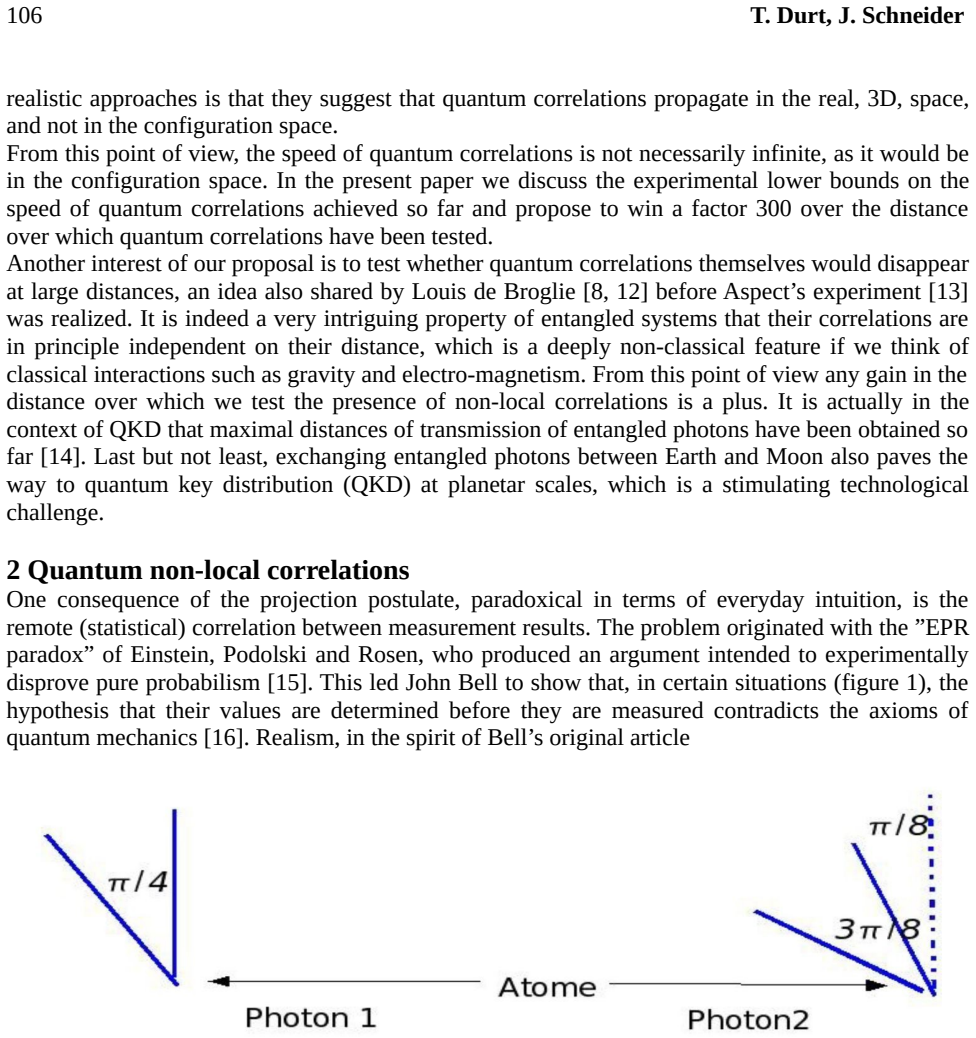
Polarization analysis of entangled photon pairs in a Bell inequality experiment, with one analyzer placed on the Moon to extend the separation to 390,000 km.
If this is right
- The test would constitute a new verification of quantum physics at a much larger scale.
- It would impose stricter limits on alternative theories and interpretations of quantum correlations.
- Bell inequalities could be violated at distances exceeding the Earth-Moon separation.
Where Pith is reading between the lines
- A positive result would encourage similar tests involving other solar-system bodies or spacecraft at greater separations.
- The technical demands of lunar timing and stability could drive improvements in space-based quantum communication systems.
Load-bearing premise
A polarimeter can be placed and operated on the Moon with the timing precision, long-term stability, and entanglement preservation needed to obtain statistically significant results without hidden decoherence or classical signaling paths.
What would settle it
Running the Earth-Moon experiment and finding that the observed correlations are consistent with local hidden-variable predictions rather than the quantum violation of Bell inequalities would show that the instantaneous correlations do not persist at that distance.
Figures

read the original abstract
It is commonly accepted that the results of measurements simultaneously realized over two entangled subsystems are statistically correlated instantaneously regardless of the distance between them. In accordance with Bell theorem, everything happens in such measurements as if there was a correlation propagating at infinite speed between the two subsystems.These correlations have been so far verified experimentally up to a distance of 1200 km. We discuss the interest and feasibility of extending this distance to 390,000 km, thus gaining a factor of 300. The idea is to install one of the polarimeters on the Moon, with the other on Earth. Such an experiment would provide a new test of Quantum Physics and allow to put higher constraints on alternative theories and interpretations. We also discuss the possibility to violate Bell inequalities beyond Earth-Moon distance.
Editorial analysis
A structured set of objections, weighed in public.
Referee Report
Summary. The manuscript proposes extending Bell inequality tests of quantum correlations to Earth-Moon distances of ~390,000 km by installing one polarimeter on the Moon and the other on Earth. It argues that this would extend current experimental records (up to 1200 km) by a factor of ~300, constitute a new test of quantum physics, impose higher constraints on alternative theories and interpretations, and discusses the possibility of such tests at even larger distances.
Significance. If realized with sufficient fidelity, the proposal would extend the spatial scale of Bell tests by two orders of magnitude, offering a concrete way to further close the locality loophole and potentially tighten bounds on local realistic models or superluminal signaling. The manuscript correctly identifies the scaling motivation from prior experiments but does not quantify the gain in constraints.
major comments (2)
- [Abstract] Abstract: The claim that the experiment would 'put higher constraints on alternative theories and interpretations' is not supported by any quantitative analysis, such as estimates of improved bounds on hypothetical influence speeds, required visibility thresholds, or how the 300-fold distance increase affects the statistical power to rule out alternatives.
- [Main text (feasibility discussion)] Main text (feasibility discussion): No error budget, timing synchronization requirements (sub-nanosecond precision needed to close the locality loophole over the ~1.28 s light-travel time), polarization stability, entanglement preservation estimates, source brightness, or coincidence window are provided. These omissions make it impossible to assess whether the central claim of a statistically significant Bell test at lunar distances is viable.
minor comments (2)
- The manuscript would benefit from citing specific prior works on lunar laser ranging or space-based quantum communication to ground the technical discussion.
- Clarify assumptions about lunar infrastructure (e.g., whether new hardware deployment is required) to make the feasibility discussion more precise.
Simulated Author's Rebuttal
We thank the referee for the careful reading and constructive comments on our proposal for Bell tests at Earth-Moon distances. The feedback highlights opportunities to strengthen the quantitative aspects and technical discussion. We address each major comment below and have revised the manuscript to incorporate additional analysis and details.
read point-by-point responses
-
Referee: [Abstract] Abstract: The claim that the experiment would 'put higher constraints on alternative theories and interpretations' is not supported by any quantitative analysis, such as estimates of improved bounds on hypothetical influence speeds, required visibility thresholds, or how the 300-fold distance increase affects the statistical power to rule out alternatives.
Authors: We agree that the original claim would be strengthened by quantitative support. The factor-of-300 distance increase extends the light-travel time to ~1.28 s, providing a substantially larger window for independent, space-like separated measurement settings and thereby closing the locality loophole more robustly than prior experiments (up to 1200 km). This directly constrains any hypothetical finite-speed influence or local realistic model to speeds at least 10^5 times c (depending on exact timing margins), far beyond current bounds. The required visibility for a CHSH violation remains ~70%, unchanged from shorter-distance tests, while statistical power scales with achievable coincidence rates (which modern sources can maintain). We have added a dedicated paragraph with these estimates in the revised manuscript. revision: yes
-
Referee: [Main text (feasibility discussion)] Main text (feasibility discussion): No error budget, timing synchronization requirements (sub-nanosecond precision needed to close the locality loophole over the ~1.28 s light-travel time), polarization stability, entanglement preservation estimates, source brightness, or coincidence window are provided. These omissions make it impossible to assess whether the central claim of a statistically significant Bell test at lunar distances is viable.
Authors: The manuscript is a concise conceptual proposal rather than a full technical design study. We acknowledge that additional specifics improve assessability. In revision we have added a feasibility section with order-of-magnitude estimates: sub-nanosecond timing is achievable via existing lunar laser ranging and atomic-clock synchronization; polarization stability follows from demonstrated satellite links with active compensation; entanglement preservation is feasible given vacuum propagation and low-loss Earth-side optics. A source rate of ~10^6 pairs/s with a ~10 ns coincidence window (adjusted for propagation) yields sufficient statistics in hours of integration. An outline error budget is now included, supported by references to lunar quantum-communication studies. revision: yes
Circularity Check
No derivations or self-referential predictions; proposal is self-contained
full rationale
The manuscript is a conceptual proposal for extending Bell tests to Earth-Moon distances. It cites prior experimental verifications up to 1200 km but contains no equations, fitted parameters, predictions, or derivation chains that reduce to the paper's own inputs or self-citations. Feasibility is discussed qualitatively without any self-definitional steps, fitted-input predictions, or load-bearing self-citation chains. The central claim rests on external experimental benchmarks and standard quantum mechanics rather than internal circular reductions.
Axiom & Free-Parameter Ledger
axioms (1)
- domain assumption Bell theorem implies that entangled measurements exhibit correlations as if propagating at infinite speed, independent of distance.
Reference graph
Works this paper leans on
-
[1]
de Broglie, La mécanique ondulatoire et la structure atomique de la matière et du rayonnement, J
L. de Broglie, La mécanique ondulatoire et la structure atomique de la matière et du rayonnement, J. Phys. Rad. 8 p. 225 (1927)
work page 1927
-
[2]
L. de Broglie, Une tentative d’interprétation causale et non linéaire de la mécanique ondulatoire : la théorie de la double solution Gauthier-Villars (1956)
work page 1956
- [3]
-
[4]
D. Fargue, Louis de Broglie’s “double solution” a promising but unfinished theory, Annales de la Fondation Louis de Broglie, 42, 19, (2017)
work page 2017
-
[5]
Durt, Testing de Broglie’s double solution in the mesoscopic regime, Found
T. Durt, Testing de Broglie’s double solution in the mesoscopic regime, Found. Phys. 53, 2, (2023), (special issue: The pilot-wave and beyond:Celebrating Louis de Broglie and David Bohm quest for a quantum ontology)
work page 2023
-
[6]
L. de Broglie and J. Andrade e Silva, Idées nouvelles concernant les systèmes de corpuscules dans l’interprétation causale de la Mécanique ondulatoire, Comptes rendus de l’Académie des Sciences, 244(5), 529–533, (1957)
work page 1957
- [7]
-
[8]
Durt, Do(es the Influence of) Empty Waves Survive in Configuration Space? Found
T. Durt, Do(es the Influence of) Empty Waves Survive in Configuration Space? Found. Phys. 53, 1, (2023), (special issue: The pilot-wave and beyond: Celebrating Louis de Broglie and David Bohm quest for a quantum ontology)
work page 2023
-
[9]
L. de Broglie. Interpretation of quantum mechanics by the double solution theory Annales de la Fondation Louis de Broglie, 12, 4, (1987), english translation from a paper originally published in the book Foundations of Quantum Mechanics- Rendiconti della Scuola Internazionale di Fisica Enrico Fermi, IL Corso, B. d’ Espagnat ed. Academic Press N.Y .1972
work page 1987
-
[10]
Vigier, Research on the causal theory of quantum theory, Gauthier- Villars, (1955)
J.-P. Vigier, Research on the causal theory of quantum theory, Gauthier- Villars, (1955)
work page 1955
-
[11]
D. Bohm and J.-P. Vigier, Model of the Causal Interpretation of Quantum Theory in Terms of a Fluid with Irregular Fluctuations Phys. Rev. 96, 208 (1954)
work page 1954
-
[12]
L. de Broglie, Réfutation du théorème de Bell, in Jalons pour une nouvelle microphysique : exposé d’ensemble sur l’interprétation de la mécanique ondulatoire , editor Gauthier-Villars (Paris), 1978
work page 1978
-
[13]
Aspect, Bell’s Theorem: The Naive View of an Experimentalist, in R
A. Aspect, Bell’s Theorem: The Naive View of an Experimentalist, in R. A. Bertlmann, A. Zeilinger (eds.), Quantum (Un)speakables - From Bell to Quantum Information, Springer, Berlin, 2002
work page 2002
-
[14]
J. Yin, Y . Cao, Y .-H. Li, S.-K. Liao, L. Zhang, et al. Satellite-Based Entanglement Distribution Over 1200 kilometres, Science 356, 114013 (2017)
work page 2017
-
[15]
A. Einstein, B. Podolsky and N. Rosen N. Can Quantum-Mechanical Description of Physical Reality Be Considered Complete? Phys. Rev., 47, 777 (1935)
work page 1935
-
[16]
J. S. Bell, J.S. On the Einstein Podolsky Rosen Paradox. Physics Physics Fizika, 1, 195 (1964)
work page 1964
-
[17]
N. Cufaro-Petroni and J.-P. Vigier, Dirac’s aether in relativistic quantum mechanics, Foundations of Physics, 13, 253 (1983) 114 T. Durt, J. Schneider
work page 1983
- [18]
-
[19]
J-W Pan, D. Bouwmeester, H. Weinfurter and A. Zeilinger, Experimental Entanglement Swapping: Entangling Photons That Never Interacted, Phys. Rev. Lett. 80, 3891 (1998)
work page 1998
- [20]
-
[21]
and Woodward R., A generic problem with purely metric formulations of MOND
Soussa M. and Woodward R., A generic problem with purely metric formulations of MOND. Phys. Lett. B, 578, 253 (2004)
work page 2004
-
[22]
Buonomano, V ., Summhammer’s experimental test of the non-ergodic interpretation of quantum mechanics, Found. Phys. Lett. 2, 565 (1989)
work page 1989
-
[23]
Buonomano, V ., and Bartmann, F. Testing the ergodic assumption in the low-intensity interference experiments, Nuovo Cimento, 95B, 99, (1986)
work page 1986
-
[24]
J. Schneider, P. Kervella and A. Labeyrie, Astronomy from the Moon Philos Trans A Math Phys Eng Sci 382, 20230071 (2024)
work page 2024
-
[25]
Schneider, Constraining the Correlation Distance in Quantum Measurements
J. Schneider, Constraining the Correlation Distance in Quantum Measurements. In Ecole de Physique Les Houches accessible at http://luth7.obspm.fr/Les-Houches09-Schneider.pdf (2009)
work page 2009
-
[26]
Schneider, Quantum correlations at earth-moon distance, Exp
J. Schneider, Quantum correlations at earth-moon distance, Exp. Astron., 51, 1767 (2021)
work page 2021
-
[27]
Cao et al., Bell Test over Extremely High-Loss Channels: Towards Distributing Entangled Photon Pairs between Earth and the Moon, Phys. Rev. Lett., 120, 140405 (2018)
work page 2018
-
[28]
Kaltenbaek et al.: https://https://doi.org/10.1117/12.506979/arxiv.org/abs/quant-ph/0308174 (2003)
work page doi:10.1117/12.506979/arxiv.org/abs/quant-ph/0308174 2003
-
[29]
F. Kubli, An interview with Louis de Broglie, Annales de la Fondation Louis de Broglie, 48, 21, (2023-2024)
work page 2023
-
[30]
T. Durt, Do dice remember?, Int. J. Theor. Phys., 38, 457 (1999)
work page 1999
-
[31]
Une nouvelle science de la vie
R. Sheldrake: “ Une nouvelle science de la vie.”, Eds. du Rocher, Monaco, 1985
work page 1985
-
[32]
Bo-Yang Qiu, Yang Li, Gao-Qiang Wang, Li-Ying Han, Hao-Bin Fu, Yang Zhang, Nan Wu, Na Xiao, Zhi-Lin Xie, Ren-De Liu, Dong-Dong Li, Chao-Ze Wang, Wen-Qi Cai, Juan Yin, Ji-Gang Ren, Sheng-Kai Liao, and Cheng-Zhi Peng, 7 km free-space time-bin quantum key distribution, Optics Express, 33, Issue 17, 35176 (2025)
work page 2025
-
[33]
L. Mazzarella, C. Lowe, D. Lowndes, et al.,Quarc: Quantum research cubesat-a constellation for quantum communication, Cryptography, 4 (1), 7 (2020)
work page 2020
-
[34]
https://www.esa.int/Applications/Connectivity− and− Secure− Communications/Eagle-1: Eagle-1 will be the first European space-based quantum key distribution system developed as a partnership between the European Space Agency (ESA), the European Commission and space companies in Europe, led by SES Techcom. The Eagle-1 project is paving the way towards an ul...
discussion (0)
Sign in with ORCID, Apple, or X to comment. Anyone can read and Pith papers without signing in.