Controlled Loop Expansion for the Topological Heavy Fermion Model
Pith reviewed 2026-05-10 12:10 UTC · model grok-4.3
The pith
A controlled loop expansion shows the flavor susceptibility obeys a Curie-Weiss law close to the Curie temperature in the topological heavy fermion model.
A machine-rendered reading of the paper's core claim, the machinery that carries it, and where it could break.
Core claim
Tracing out the localized electrons produces an effective theory for the conduction band electrons with interactions derived from single-site f-electron correlators. A small hybridization phase space parameter permits a loop expansion valid between the flavor ordering temperature and the charging energy scale. Within this expansion the flavor susceptibility is found to obey a Curie-Weiss law parametrically close to the Curie temperature, and the quasi-particle lifetime is obtained.
What carries the argument
The controlled loop expansion of the effective action for conduction electrons, obtained by tracing out the f-sites and controlled by a small hybridization-phase-space parameter.
Load-bearing premise
There exists a small hybridization-phase-space parameter that makes the loop expansion controlled for temperatures above the flavor ordering temperature but below the on-site charging energy.
What would settle it
A measurement of the flavor susceptibility in a device realizing the topological heavy fermion model that shows clear deviation from Curie-Weiss form at temperatures slightly above the ordering transition would falsify the claim.
Figures



read the original abstract
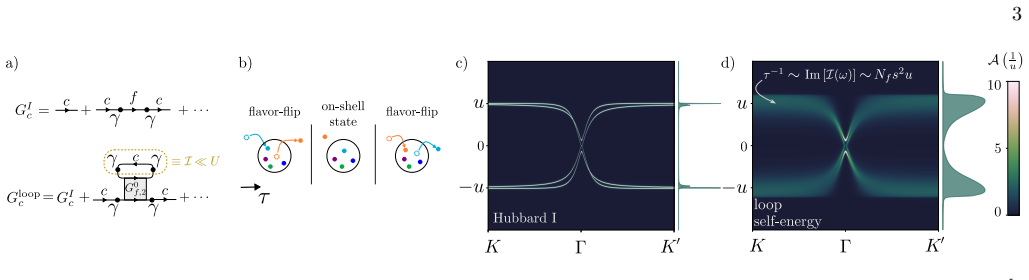
We develop a controlled theoretical framework for the topological heavy fermion model relevant to magic-angle twisted bilayer graphene, where low density conduction electrons hybridize with a lattice of strongly interacting f-sites. By tracing out the localized electrons, we derive an effective action for the conduction electrons with long-range in time effective interactions, built from correlators of the single f-site problem. We identify a small hybridization-phase-space parameter resulting in a controlled loop expansion, enabling the derivation of nonperturbative results in either the interaction or the hybridization strength. To tree-level, the results are equivalent to the Hubbard I approximation. At higher loop order, we derive two key results applicable to temperatures above the flavor ordering temperature and below the on-site charging energy: 1) the quasi-particle lifetime, 2) the flavor susceptibility of the system. Remarkably, despite being strongly interacting, we find the susceptibility to accurately obey a Curie-Weiss law parametrically close to the Curie temperature.
Editorial analysis
A structured set of objections, weighed in public.
Referee Report
Summary. The paper develops a controlled loop expansion for the topological heavy fermion model relevant to magic-angle twisted bilayer graphene. By tracing out the localized f-electrons, it derives an effective action for conduction electrons with long-range temporal interactions constructed from single-site f-correlators. A small hybridization-phase-space parameter is identified that controls the expansion, with tree-level results equivalent to the Hubbard-I approximation. At higher loop orders, the quasi-particle lifetime and flavor susceptibility are computed for temperatures above the flavor-ordering temperature and below the on-site charging energy U; the susceptibility is found to obey a Curie-Weiss law accurately and parametrically close to the Curie temperature.
Significance. If the claimed control of the loop expansion holds, the work supplies a valuable analytic framework for strongly interacting moiré systems that bridges perturbative and non-perturbative regimes without ad-hoc fitting. The explicit construction of the effective interaction from the isolated f-site problem and the resulting non-perturbative susceptibility result constitute clear strengths. The approach is potentially generalizable to other heavy-fermion models and could guide numerical studies of magic-angle graphene.
major comments (2)
- [Abstract; section on effective action and loop expansion] The hybridization-phase-space parameter whose smallness is asserted to control the loop expansion is introduced in the abstract and the section deriving the effective action, but no explicit parametric bound or numerical evaluation of its magnitude is given inside the window T_flavor < T << U. This parameter is load-bearing for the central claim that higher-loop corrections to the susceptibility remain small and that the Curie-Weiss form is accurate parametrically close to the Curie temperature.
- [Section deriving higher-loop susceptibility] The higher-loop result for the flavor susceptibility (leading to the Curie-Weiss law) is presented without an accompanying estimate of the size of the first correction term relative to the tree-level contribution. An explicit check that this correction is parametrically suppressed near the Curie temperature is required to substantiate the claim of accurate adherence to Curie-Weiss despite strong interactions.
minor comments (1)
- [Notation and definitions] The notation for the hybridization-phase-space parameter and the flavor indices could be introduced with an explicit equation number at first appearance to improve readability.
Simulated Author's Rebuttal
We thank the referee for the positive assessment of our work and for the constructive major comments. We agree that the control of the loop expansion would be more convincingly demonstrated with explicit bounds and estimates, and we will revise the manuscript to address both points.
read point-by-point responses
-
Referee: [Abstract; section on effective action and loop expansion] The hybridization-phase-space parameter whose smallness is asserted to control the loop expansion is introduced in the abstract and the section deriving the effective action, but no explicit parametric bound or numerical evaluation of its magnitude is given inside the window T_flavor < T << U. This parameter is load-bearing for the central claim that higher-loop corrections to the susceptibility remain small and that the Curie-Weiss form is accurate parametrically close to the Curie temperature.
Authors: We agree that an explicit parametric bound and evaluation of the hybridization-phase-space parameter in the window T_flavor < T << U is needed to substantiate the control of the expansion. Although the smallness follows from the separation between the hybridization scale and the on-site U (with the parameter scaling as the phase space available for hybridization processes), this was not quantified numerically or parametrically in the relevant temperature range. In the revised manuscript we will add a short derivation and estimate showing that the parameter remains O(0.1) or smaller throughout the window, thereby justifying the truncation at low loop orders. revision: yes
-
Referee: [Section deriving higher-loop susceptibility] The higher-loop result for the flavor susceptibility (leading to the Curie-Weiss law) is presented without an accompanying estimate of the size of the first correction term relative to the tree-level contribution. An explicit check that this correction is parametrically suppressed near the Curie temperature is required to substantiate the claim of accurate adherence to Curie-Weiss despite strong interactions.
Authors: We concur that the absence of an explicit estimate for the leading correction leaves the claim of parametric accuracy near the Curie temperature incompletely supported. In the revision we will evaluate the first higher-loop diagram for the susceptibility, compare its magnitude to the tree-level (Hubbard-I) term, and show that the relative correction remains small (suppressed by the hybridization-phase-space parameter) as T approaches T_Curie from above, consistent with the controlled expansion. revision: yes
Circularity Check
No significant circularity; derivation proceeds from Hamiltonian via integration and loop expansion without reducing to inputs or self-citations.
full rationale
The paper constructs the effective action by tracing out f-electrons from the model Hamiltonian, using single-site correlators to generate long-range interactions for conduction electrons. A hybridization-phase-space parameter is identified to control the loop expansion, with tree-level results matching the known Hubbard-I approximation and higher orders yielding lifetime and susceptibility expressions. The Curie-Weiss form for susceptibility emerges from this controlled expansion above the flavor-ordering temperature, rather than being assumed or fitted. No equations reduce the claimed results to the inputs by construction, no load-bearing self-citations are invoked for uniqueness or ansatz, and the central claims remain independent of the target observables. This is a standard non-circular derivation from first principles.
Axiom & Free-Parameter Ledger
axioms (2)
- domain assumption The topological heavy fermion model accurately captures the low-energy physics of magic-angle twisted bilayer graphene
- ad hoc to paper A small hybridization-phase-space parameter exists and renders the loop expansion controlled
Forward citations
Cited by 1 Pith paper
-
Controlled expansion for correlated electrons with concentrated kinematics
A controlled expansion in s² for electrons with concentrated kinematics allows analytical calculations of spectral broadening, T-linear resistivity in bad metals, and spectral functions in Mott semimetals for Hubbard ...
Reference graph
Works this paper leans on
-
[1]
¯f1 (τ ′ 1)⟩c,0 ≡ ⟨f1f2 ¯f2 ¯f1⟩0 − ⟨f1 ¯f1⟩0 ⟨f2 ¯f2⟩0 +⟨f 2 ¯f1⟩0 ⟨f1 ¯f2⟩0 .(31) We implicitly take allfand ¯fto be at the same position Ri, as the cumulant vanishes otherwise. We hereby focus on the long-time behavior leading to a finite scattering rate at one-loop order, with the full expression given in App. C. The dominant contribution to this cumu...
-
[2]
¯f1 (τ ′ 1)⟩c,0 ≈ − 1−(2ν/N f)2 4(1−N −1 f ) × h Θ(τ2 −τ ′ 1)e−E+(τ2−τ ′
-
[3]
+ Θ(τ′ 1 −τ 2)e−E−(τ ′ 1−τ2) i × h Θ(τ1 −τ ′ 2)e−E+(τ1−τ ′
-
[4]
+ Θ(τ′ 2 −τ 1)e−E−(τ ′ 2−τ1) i . (32) The filling dependent pre-factor accounts for the proba- bility to finds a state with (b 1, λ1) occupied and (b 2, λ2) empty or vice versa. The case of (b 1, λ1) = (b 2, λ2) is different due to the non-vanishing disconnected part (see App. C for details). We will neglect contribution of the same flavor-orbital type, a...
-
[5]
(33), neglecting other contri- butions to⟨f 1f2 ¯f2 ¯f1⟩
¯f1 (τ ′ 1)⟩c,0 →0.(34) Following these arguments we will approximate Γ (2) using the expression in Eq. (33), neglecting other contri- butions to⟨f 1f2 ¯f2 ¯f1⟩. Later in the text we take a similar approach to analyze contribution from Γ (n) withn >2 by considering similar multiple flavor-flips processes. C. One Loop Order To one loop order, the only diag...
-
[6]
In the limitβE ±, Nf ≫1, the dominant contributions toDfrom a single Γ (m) vertex insertion (see Fig. 3.b) is described by multi-instanton (flavor-flip) processes. 2) These instantons admit a canonical ordering according to the flavors of the created and annihilatedfelectrons, in- dependently of their time ordering. 3) Within this canon- ical ordering, ex...
-
[7]
In the third line we took the limit of temperatures far below the charging energy βE± ≫1
-
[8]
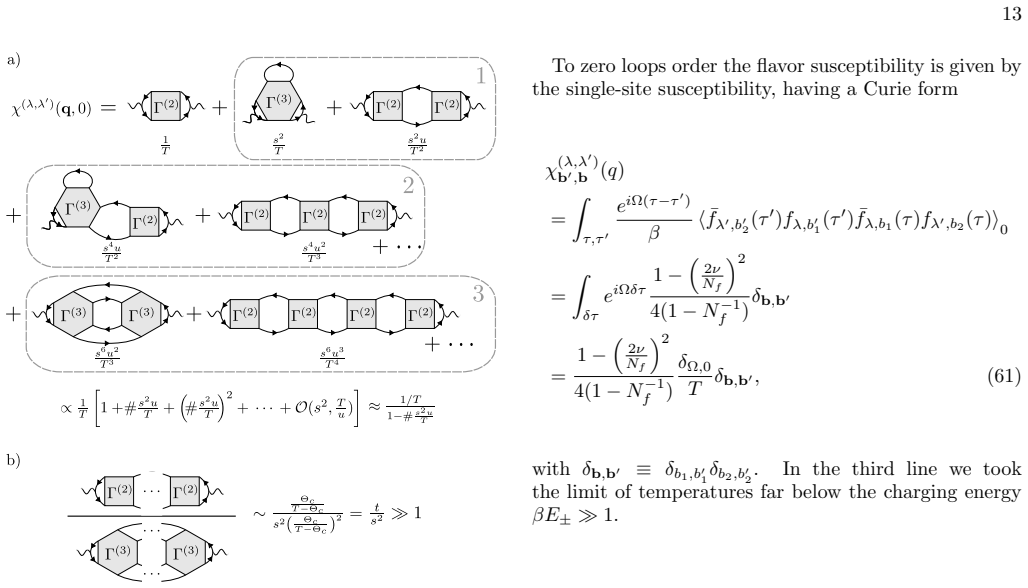
One-Loop Corrections Within one-loop order we have two contributing dia- grams, given in the first line of Fig. 6.a. We can infer the maximal power of 1 T contributed by each diagram by considering the number of free (unconstrained) times we integrate over. For example: the zero-loops contribution has a term independent ofδτ=τ−τ ′, and therefore scales as...
-
[9]
χsingle-site 1−β ˆΘ(λ,λ′) q # b,b′ = 1− 2ν Nf 2 4(1−N −1 f )
Ladder-Resummation We assume thatT∼s 2u, and search for all diagrams which contribution scale as 1 T s2u T nloops ∼ 1 T . As men- tioned before, the power of 1/Tcan be identified by counting the number of unconstrained times integrated over, whereas the power ofs 2 is the number of loops. In Fig. 6.a we specify the scaling of each of the new type of diagr...
-
[10]
(65) cannot be correct all the way down to the phase tran- sition att≡ T−T c Tc = 0
Critical fluctuation Regime Universality of critical behavior tells us that Eq. (65) cannot be correct all the way down to the phase tran- sition att≡ T−T c Tc = 0. Motivated by this fact we look for sets of diagrams which amount to non-negligible corrections to the susceptibility at small reduced tem- peratures. To find these diagrams we replace bubbles ...
-
[11]
,Γ(mn) drawn from the effective action (14), withm i ≥1
Setup: general self-energy diagram A general diagram contributing to Σ c is built fromninteraction vertices Γ (m1), . . . ,Γ(mn) drawn from the effective action (14), withm i ≥1. Each vertex Γ (mi) carriesm i incoming andm i outgoingc-electron legs. For a self-energy diagram, twoc-legs (one incoming, one outgoing) are left external and all remaining legs ...
-
[12]
Counting propagators and loops Thenvertices contribute a total of 2 Pn i=1 mi c-leg endpoints. Subtracting the 2 external endpoints and pairing the remainder into internalc-propagators gives P= nX i=1 mi −1 (B2) internalc-electron propagators. For a connected diagram the number of independent loops is then nl =P−n+ 1 = nX i=1 mi −n.(B3)
-
[13]
Scaling form ofG c in the flat-chiral limit In the flat-chiral limit the Hubbard-Ic-propagator takes the form (Eq. (24)) Gc,λ(k, iω) = −iω ω2 1 + γ2 ω2 +u 2 +v 2⋆|k|2 .(B4) Introducing the dimensionless variables ˜ω=ω/uand ˜k=k/k BZ, and usings 2 =γ 2/(v⋆kBZ)2 whereπk 2 BZ =A BZ (Eq. (27)), the denominator can be rewritten to read Gc,λ(k, iω) = u γ2 gc ˜k...
-
[14]
Power counting We now assemble the scaling of a general self-energy diagram. 18 a. Vertices.From the definition Eq. (15), each vertex Γ (mi) contains 2m i hybridization factors (contributing γ2mi) multiplied by the connectedf-electron 2m i-point correlator, with units of (energy) −mi. Since the only energy scales in the 2m i-point correlator areuandT, we ...
-
[15]
¯f1 (τ ′ 1)⟩c,0 = ⟨f1 (τ1)f 2 (τ2) ¯f2 (τ ′
-
[16]
Below we give the expression for the full four-point function
¯f1 (τ ′ 1)⟩0 − ⟨f1(τ1) ¯f1(τ ′ 1)⟩0 ⟨f2(τ2) ¯f2(τ ′ 2)⟩0 +⟨f 1(τ1) ¯f2(τ ′ 2)⟩0 ⟨f2(τ2) ¯f1(τ ′ 1)⟩0 .(C1) The two-point function is given by⟨f 1(τ) ¯f2(τ ′)⟩0 =δ λ1,λ2 δb1,b2 ˜G0 f(τ−τ ′), with ˜G0 f(τ−τ ′) defined in the text. Below we give the expression for the full four-point function. 7 Such a logarithmic factor appears in the one-loop diagram; see...
-
[17]
Different Flavor-Orbitals The four point function with different flavor-orbital combinations (λ 1, b1)̸= (λ 2, b2) is given by ⟨f1 (τ1)f 2 (τ2) ¯f2 (τ ′
-
[18]
¯f1 (τ ′ 1)⟩0 = A1 exp [−E+ (τ1 −τ ′ 1 +τ 2 −τ ′ 2)−U(min{τ 1, τ2} −max{τ ′ 1, τ ′ 2})] (τ 1, τ2)>(τ ′ 1, τ ′
-
[19]
(a) A2 exp [−E− (τ ′ 1 −τ 1 +τ ′ 2 −τ 2)−U(min{τ ′ 1, τ ′ 2} −max{τ 1, τ2})] (τ ′ 1, τ ′ 2)>(τ 1, τ2) (b) −A3 ˜Gins (τ2 −τ ′
-
[20]
(τ 1, τ ′ 2)≷(τ ′ 1, τ2) (c) A4 ˜G0 f (τ2 −τ ′
-
[21]
(τ 2, τ ′ 2)≷(τ ′ 1, τ1) (d) (C2) whereE ± are the single-body doublon like and holon like excitation energies as defined in the main text. ˜Gins and ˜Gf,0 are the flavor-flip instanton propagator and single-bodyfpropagator defined in the main text. (a, b)>(c, d) denotes min{a, b}>max{c, d}. The combinatorial factors are given byA 1 = (1−n)(1−n−N −1 f ) 1...
-
[22]
¯f1 (ω′ 1)⟩0 ≡2πδ(ω 1 +ω 2 −ω ′ 1 −ω ′ 2)G↑↓(ω1, ω2;ω ′ 1, ω′ 2), we find G(ω1, ω2;ω ′ 1, ω′
-
[23]
= A1 2 (U−δµ)−i(ω 1 +ω 2) 1 E+ −iω 1 + 1 E+ −iω 2 1 E+ −iω ′ 1 + 1 E+ −iω ′ 2 + A2 2 (U+δµ) +i(ω ′ 1 +ω ′ 2) 1 E− +iω 1 + 1 E− +iω 2 1 E− +iω ′ 1 + 1 E− +iω ′ 2 −A3δω1,ω′ 2 Gins (ω2)G ins (ω1) + A3 (E+ −iω 1) (E+ −iω ′
-
[24]
+ A3 (E− +iω 1) (E− +iω ′
-
[25]
(E− +iω ′ 2) + A3 (E+ −iω 1) (E− +iω ′ 1) 1 E+ −iω ′ 2 + 1 E− +iω 2 + A3 (E+ −iω 2) (E− +iω ′ 2) 1 E+ −iω ′ 1 + 1 E− +iω 1 + 1 i(ω 1 −ω ′ 1) A1 (E+ −iω 1) (E+ −iω ′
-
[26]
(E+ −iω 2) + A2 (E− +iω ′
-
[27]
(E− +iω 2) − A2 (E− +iω 1) (E− +iω ′
-
[28]
+ A3 (E+ −iω 1) (E− +iω 2) − A3 (E+ −iω ′
-
[29]
(E− +iω ′ 2) + A3 (E− +iω ′
-
[30]
− A3 (E− +iω 1) (E+ −iω 2) (C3) Physically, time orderings (a),(b) correspond to a double excitation by injecting two electrons/holes to a single site. Time ordering (c) correspond to a generalized flavor flip, where at timeτ ′ 1 ∼τ 2 an electron of flavor-orbital (λ 1, b1) is added and an electron of flavor-orbital (λ 2, b2) is taken out of the site, whi...
-
[31]
We have ⟨f1 (τ1)f 1 (τ2) ¯f1 (τ ′
Same Flavor-Orbitals For completeness we hereby give the expression for the four-point function at identical flavor-orbitals (λ 1, b1) = (λ2, b2). We have ⟨f1 (τ1)f 1 (τ2) ¯f1 (τ ′
-
[32]
¯f1 (τ ′ 1)⟩0 = ( 1+sgn(τ1−τ ′
-
[33]
sgn(τ2−τ ′ 2) 1+(1−2n) sgn(τ1−τ ′ 1) ˜G0 f (τ2 −τ ′
-
[34]
(τ 2, τ ′ 2)≷(τ 1, τ ′ 1) − 1+sgn(τ2−τ ′
-
[35]
sgn(τ1−τ ′ 2) 1+(1−2n) sgn(τ2−τ ′ 1) ˜G0 f (τ1 −τ ′
-
[36]
Any other process is forbidden by fermionic statistics
(τ 1, τ ′ 2)≷(τ 2, τ ′ 1) .(C4) Physically this amounts to two consecutive electron-like or two consecutive holon-like excitations. Any other process is forbidden by fermionic statistics. In Matsubara frequencies, expressing⟨f 1 (ω1)f 1 (ω2) ¯f1 (ω′
-
[37]
¯f1 (ω′ 1)⟩0 ≡2πδ(ω 1 +ω 2 −ω ′ 1 −ω ′ 2)G↑↑(ω1, ω2;ω ′ 1, ω′ 2), we find G(ω1, ω2;ω ′ 1, ω′
-
[38]
= 1 i(ω 1 −ω ′ 1) 1−n (E+ −iω 1) (E+ −iω ′
-
[39]
(E+ −iω 2) + n (E− +iω ′
-
[40]
(E− +iω 2) − n (E− +iω 1) (E− +iω ′ 2) −(ω 1 ↔ω 2).(C5) Appendix D: LargeNVertex Resummation Consider them−1 loops contribution to the self energy from inserting a single Γ (m) vertex. Denotingx= (τ,R) we have X R,R′ ˆ τ,τ ′ ˜G0 c(x′ 0 −x) ˜Σm−1(x−x ′) ˜G0 c(x′ −x 0) = 1 (m!)2 ˆ {τi},{τ ′ i } X {λi,ai,Ri} {λ′ i,a′ i,R′ i} Γ(m) 1···m 1′···m′ [⟨¯c0c0′¯cm · ...
-
[41]
analytical continuation of convolution Consider a functiong(ω) and its spectral functionA g(ω) =− 1 π Im [g(ω+i0 +)] admitting Lehmann’s representation, such that we can expressg(z) = ´ dω′ Ag(ω′) z−ω ′ (withzbeing an abitrary complex number). We find 2 iΩ ⊛g(iΩ) = ˆ dΩ′ 2π 2 i(Ω−Ω ′) ˆ dω′′ Ag(ω′′) iΩ′ −ω ′′ = ˆ dω′′ Ag(ω′′) iΩ−ω ′′ sgn(ω′′).(D4) After W...
-
[42]
Y. Cao, V. Fatemi, A. Demir, S. Fang, S. L. Tomarken, J. Y. Luo, J. D. Sanchez-Yamagishi, K. Watanabe, T. Taniguchi, E. Kaxiras,et al., Correlated insulator be- haviour at half-filling in magic-angle graphene superlat- tices, Nature556, 80 (2018)
work page 2018
-
[43]
X. Lu, P. Stepanov, W. Yang, M. Xie, M. A. Aamir, I. Das, C. Urgell, K. Watanabe, T. Taniguchi, G. Zhang, et al., Superconductors, orbital magnets and correlated states in magic-angle bilayer graphene, Nature574, 653 (2019)
work page 2019
-
[44]
E. Codecido, Q. Wang, R. Koester, S. Che, H. Tian, R. Lv, S. Tran, K. Watanabe, T. Taniguchi, F. Zhang, et al., Correlated insulating and superconducting states in twisted bilayer graphene below the magic angle, Sci- ence Advances5, eaaw9770 (2019)
work page 2019
- [45]
-
[46]
A. T. Pierce, Y. Xie, J. M. Park, E. Khalaf, S. H. Lee, Y. Cao, D. E. Parker, P. R. Forrester, S. Chen, K. Watan- abe,et al., Unconventional sequence of correlated chern 24 insulators in magic-angle twisted bilayer graphene, Na- ture Physics17, 1210 (2021)
work page 2021
-
[47]
Y. Cao, D. Rodan-Legrain, O. Rubies-Bigorda, J. M. Park, K. Watanabe, T. Taniguchi, and P. Jarillo-Herrero, Tunable correlated states and spin-polarized phases in twisted bilayer–bilayer graphene, Nature583, 215 (2020)
work page 2020
-
[48]
H. Kim, Y. Choi, ´E. Lantagne-Hurtubise, C. Lewandowski, A. Thomson, L. Kong, H. Zhou, E. Baum, Y. Zhang, L. Holleis,et al., Imaging inter- valley coherent order in magic-angle twisted trilayer graphene, Nature623, 942 (2023)
work page 2023
-
[49]
Y. Cao, V. Fatemi, S. Fang, K. Watanabe, T. Taniguchi, E. Kaxiras, and P. Jarillo-Herrero, Unconventional super- conductivity in magic-angle graphene superlattices, Na- ture556, 43 (2018)
work page 2018
-
[50]
M. Yankowitz, S. Chen, H. Polshyn, Y. Zhang, K. Watan- abe, T. Taniguchi, D. Graf, A. F. Young, and C. R. Dean, Tuning superconductivity in twisted bilayer graphene, Science363, 1059 (2019)
work page 2019
-
[51]
Y. Cao, D. Rodan-Legrain, J. M. Park, N. F. Yuan, K. Watanabe, T. Taniguchi, R. M. Fernandes, L. Fu, and P. Jarillo-Herrero, Nematicity and competing orders in superconducting magic-angle graphene, science372, 264 (2021)
work page 2021
-
[52]
H. Tian, X. Gao, Y. Zhang, S. Che, T. Xu, P. Che- ung, K. Watanabe, T. Taniguchi, M. Randeria, F. Zhang, et al., Evidence for dirac flat band superconductivity en- abled by quantum geometry, Nature614, 440 (2023)
work page 2023
-
[53]
P. Stepanov, I. Das, X. Lu, A. Fahimniya, K. Watanabe, T. Taniguchi, F. H. Koppens, J. Lischner, L. Levitov, and D. K. Efetov, Untying the insulating and supercon- ducting orders in magic-angle graphene, Nature583, 375 (2020)
work page 2020
-
[54]
H. S. Arora, R. Polski, Y. Zhang, A. Thomson, Y. Choi, H. Kim, Z. Lin, I. Z. Wilson, X. Xu, J.-H. Chu,et al., Superconductivity in metallic twisted bilayer graphene stabilized by wse2, Nature583, 379 (2020)
work page 2020
-
[55]
X. Liu, Z. Hao, E. Khalaf, J. Y. Lee, Y. Ronen, H. Yoo, D. Haei Najafabadi, K. Watanabe, T. Taniguchi, A. Vish- wanath,et al., Tunable spin-polarized correlated states in twisted double bilayer graphene, Nature583, 221 (2020)
work page 2020
-
[56]
Z. Hao, A. Zimmerman, P. Ledwith, E. Khalaf, D. H. Najafabadi, K. Watanabe, T. Taniguchi, A. Vishwanath, and P. Kim, Electric field–tunable superconductivity in alternating-twist magic-angle trilayer graphene, Science 371, 1133 (2021)
work page 2021
-
[57]
J. M. Park, Y. Cao, L.-Q. Xia, S. Sun, K. Watanabe, T. Taniguchi, and P. Jarillo-Herrero, Robust supercon- ductivity in magic-angle multilayer graphene family, Na- ture Materials21, 877 (2022)
work page 2022
-
[58]
Y. Cao, J. M. Park, K. Watanabe, T. Taniguchi, and P. Jarillo-Herrero, Pauli-limit violation and re-entrant superconductivity in moir´ e graphene, Nature595, 526 (2021)
work page 2021
-
[59]
A. Banerjee, Z. Hao, M. Kreidel, P. Ledwith, I. Phinney, J. M. Park, A. Zimmerman, M. E. Wesson, K. Watanabe, T. Taniguchi,et al., Superfluid stiffness of twisted trilayer graphene superconductors, Nature638, 93 (2025)
work page 2025
-
[60]
H. Kim, Y. Choi, C. Lewandowski, A. Thomson, Y. Zhang, R. Polski, K. Watanabe, T. Taniguchi, J. Al- icea, and S. Nadj-Perge, Evidence for unconventional su- perconductivity in twisted trilayer graphene, Nature606, 494 (2022)
work page 2022
-
[61]
H. Kim, G. Rai, L. Crippa, D. C˘ alug˘ aru, H. Hu, Y. Choi, L. Kong, E. Baum, Y. Zhang, L. Holleis,et al., Resolv- ing intervalley gaps and many-body resonances in moir´ e superconductors, Nature , 1 (2026)
work page 2026
-
[62]
U. Zondiner, A. Rozen, D. Rodan-Legrain, Y. Cao, R. Queiroz, T. Taniguchi, K. Watanabe, Y. Oreg, F. von Oppen, A. Stern,et al., Cascade of phase transitions and dirac revivals in magic-angle graphene, Nature582, 203 (2020)
work page 2020
- [63]
- [64]
-
[65]
Z. Zhang, S. Wu, D. C˘ alug˘ aru, H. Hu, T. Taniguchi, K. Wanatabe, A. B. Bernevig, and E. Y. Andrei, Heavy fermions, mass renormalization and local moments in magic-angle twisted bilayer graphene via planar tun- neling spectroscopy, arXiv preprint arXiv:2503.17875 (2025)
-
[66]
Y. Choi, J. Kemmer, Y. Peng, A. Thomson, H. Arora, R. Polski, Y. Zhang, H. Ren, J. Alicea, G. Refael,et al., Electronic correlations in twisted bilayer graphene near the magic angle, Nature physics15, 1174 (2019)
work page 2019
-
[67]
H. Polshyn, M. Yankowitz, S. Chen, Y. Zhang, K. Watan- abe, T. Taniguchi, C. R. Dean, and A. F. Young, Large linear-in-temperature resistivity in twisted bilayer graphene, Nature Physics15, 1011 (2019)
work page 2019
-
[68]
Y. Cao, D. Chowdhury, D. Rodan-Legrain, O. Rubies- Bigorda, K. Watanabe, T. Taniguchi, T. Senthil, and P. Jarillo-Herrero, Strange metal in magic-angle graphene with near planckian dissipation, Physical review letters 124, 076801 (2020)
work page 2020
- [69]
- [70]
-
[71]
S. Wu, Z. Zhang, K. Watanabe, T. Taniguchi, and E. Y. Andrei, Chern insulators, van hove singularities and topological flat bands in magic-angle twisted bilayer graphene, Nature materials20, 488 (2021)
work page 2021
-
[72]
Y. Xie, A. T. Pierce, J. M. Park, D. E. Parker, E. Khalaf, P. Ledwith, Y. Cao, S. H. Lee, S. Chen, P. R. Forrester, et al., Fractional chern insulators in magic-angle twisted bilayer graphene, Nature600, 439 (2021)
work page 2021
-
[73]
A. L. Sharpe, E. J. Fox, A. W. Barnard, J. Finney, K. Watanabe, T. Taniguchi, M. Kastner, and D. Goldhaber-Gordon, Emergent ferromagnetism near three-quarters filling in twisted bilayer graphene, Science365, 605 (2019)
work page 2019
- [74]
-
[75]
P. Stepanov, M. Xie, T. Taniguchi, K. Watanabe, X. Lu, 25 A. H. MacDonald, B. A. Bernevig, and D. K. Efetov, Competing zero-field chern insulators in superconduct- ing twisted bilayer graphene, Physical review letters127, 197701 (2021)
work page 2021
-
[76]
R. Bistritzer and A. H. MacDonald, Moir´ e bands in twisted double-layer graphene, Proceedings of the Na- tional Academy of Sciences108, 12233 (2011)
work page 2011
-
[77]
F. Wu, A. H. MacDonald, and I. Martin, Theory of phonon-mediated superconductivity in twisted bilayer graphene, Physical review letters121, 257001 (2018)
work page 2018
-
[78]
G. Tarnopolsky, A. J. Kruchkov, and A. Vishwanath, Ori- gin of magic angles in twisted bilayer graphene, Physical review letters122, 106405 (2019)
work page 2019
-
[79]
H. C. Po, L. Zou, T. Senthil, and A. Vishwanath, Faithful tight-binding models and fragile topology of magic-angle bilayer graphene, Physical Review B99, 195455 (2019)
work page 2019
-
[80]
J. S. Hofmann, E. Khalaf, A. Vishwanath, E. Berg, and J. Y. Lee, Fermionic monte carlo study of a realistic model of twisted bilayer graphene, Physical Review X 12, 011061 (2022)
work page 2022
discussion (0)
Sign in with ORCID, Apple, or X to comment. Anyone can read and Pith papers without signing in.