Simulating hydrodynamic interactions in colloidal suspensions using multiparticle collision dynamics with rigid-body constraints
Pith reviewed 2026-05-10 11:51 UTC · model grok-4.3
The pith
A rigid-body model for discrete particles in multiparticle collision dynamics matches the accuracy of harmonic bonds for colloidal suspensions but runs nearly ten times faster.
A machine-rendered reading of the paper's core claim, the machinery that carries it, and where it could break.
Core claim
The rigid-body model produces the expected statistics for a single spherical particle and the same transport properties for a hard-sphere colloidal suspension as an equivalent model using harmonic bonds, while incurring less computational overhead and permitting a larger simulation timestep that yields a nearly order-of-magnitude speedup in benchmark runs.
What carries the argument
Pre-collision thermalization of the velocities of discrete sites followed by momentum transfer to the rigid body, which enforces rigid geometry inside the MPCD collision step.
Load-bearing premise
Thermalizing the velocities of the discrete sites before the collision step and then transferring momentum to the rigid body preserves correct hydrodynamic interactions, rigid geometry, and equilibrium statistics without introducing artifacts.
What would settle it
A measured mismatch between the rigid-body and harmonic-bond models in the long-time diffusion coefficient or the radial distribution function of a hard-sphere suspension at the same volume fraction.
Figures


read the original abstract
We develop a method for simulating colloidal suspensions using multiparticle collision dynamics (MPCD) with a discrete particle model represented as a rigid body. The key steps for incorporating the rigid-body constraints are to thermalize the velocities of the discrete sites before they participate in the MPCD collision step, then transfer momentum from the sites to the rigid body. We demonstrate that the rigid-body model produces the expected statistics for a single spherical particle and the same transport properties for a hard-sphere colloidal suspension as an equivalent model using harmonic bonds to maintain the site geometry. Importantly, the rigid-body model has less computational overhead and permits a larger simulation timestep than the harmonic-bond model, leading to a nearly order of magnitude speedup in benchmark simulations of hard-sphere colloidal suspensions. Our method is compatible with arbitrary discretization, so it enables more efficient MPCD simulations of suspensions of colloidal particles with complex shapes.
Editorial analysis
A structured set of objections, weighed in public.
Referee Report
Summary. The manuscript develops a rigid-body constraint method for multiparticle collision dynamics (MPCD) simulations of colloidal suspensions. Discrete sites are thermalized independently before the MPCD collision step, after which momentum changes are transferred to the rigid body's center-of-mass velocity and angular velocity. Numerical demonstrations are reported for a single spherical particle (correct statistics) and for hard-sphere suspensions (transport properties equivalent to a harmonic-bond reference model). The rigid-body approach is stated to incur lower overhead and to allow larger timesteps, yielding nearly an order-of-magnitude speedup, and is claimed to be compatible with arbitrary discretizations for complex particle shapes.
Significance. If the reported equivalence of transport properties and single-particle statistics holds without hidden artifacts, the method would provide a practical route to more efficient MPCD simulations of colloids with non-spherical or complex geometries. The claimed speedup and reduced overhead address a known computational bottleneck in MPCD colloidal work and could enable larger-scale studies.
major comments (1)
- The central correctness claim rests on the two-step procedure (independent site thermalization followed by momentum projection onto the rigid body). No derivation is supplied showing that this map simultaneously preserves the rigid velocity constraint v_i = v_cm + ω × r_i at every site, conserves total linear and angular momentum with the fluid, and maintains the fluctuation-dissipation relation required for correct hydrodynamic interactions. The abstract asserts numerical equivalence to the harmonic-bond model, but without an analytic argument or explicit verification that the projection step restores the rigid kinematics exactly, the equivalence could be numerical coincidence rather than guaranteed.
Simulated Author's Rebuttal
We thank the referee for their careful reading of the manuscript and for identifying the need for stronger theoretical support of the rigid-body constraint procedure. We address this point directly below and outline the revisions that will be incorporated.
read point-by-point responses
-
Referee: The central correctness claim rests on the two-step procedure (independent site thermalization followed by momentum projection onto the rigid body). No derivation is supplied showing that this map simultaneously preserves the rigid velocity constraint v_i = v_cm + ω × r_i at every site, conserves total linear and angular momentum with the fluid, and maintains the fluctuation-dissipation relation required for correct hydrodynamic interactions. The abstract asserts numerical equivalence to the harmonic-bond model, but without an analytic argument or explicit verification that the projection step restores the rigid kinematics exactly, the equivalence could be numerical coincidence rather than guaranteed.
Authors: We thank the referee for this substantive comment. The manuscript demonstrates numerical equivalence through direct comparisons of single-particle statistics and suspension transport coefficients, but we acknowledge that an explicit derivation would eliminate any ambiguity about whether the observed agreement is coincidental. In the revised manuscript we will add a new section that derives the properties of the projection step. We will show that, after independent thermalization of the discrete sites, the subsequent mapping of momentum increments onto the rigid-body center-of-mass velocity and angular velocity exactly restores v_i = v_cm + ω × r_i at every site while conserving the total linear and angular momentum exchanged with the fluid. We will further demonstrate that the procedure is consistent with the fluctuation-dissipation relation because the thermalization is performed in the instantaneous rigid-body frame before the projection. These analytic steps confirm that the method satisfies the required kinematic and conservation constraints by construction rather than by numerical accident. We will also augment the numerical results with explicit checks of constraint violation and momentum balance at each time step. revision: yes
Circularity Check
No significant circularity; method validated against external benchmarks and independent reference model
full rationale
The paper introduces a rigid-body MPCD coupling procedure (pre-collision site thermalization followed by momentum transfer to COM and angular velocity) and validates it by direct comparison to known single-particle statistics and to an independent harmonic-bond reference simulation for transport coefficients. No claimed result reduces by construction to a fitted parameter defined from the same data, nor does any load-bearing step rely on a self-citation chain whose content is unverified outside the present work. Benchmark timings and property comparisons are independent measurements, not tautological renamings or self-definitions.
Axiom & Free-Parameter Ledger
axioms (2)
- domain assumption MPCD collision rules produce correct hydrodynamics when particle velocities are properly thermalized before the collision step.
- domain assumption Momentum transfer from discrete sites to the rigid body conserves linear and angular momentum while maintaining rigid geometry.
Reference graph
Works this paper leans on
-
[1]
Harmonic-bond model Following established practice, 27 a network of har- monic bonds was used to maintain a nearly rigid con- figuration of surface sites. Each surface site was bonded to its three nearest-neighbor surface sites and to the cen- tral site using a harmonic potential: ub(r) = kb 2 (r−r b)2 (2) whereris the distance between sites,k b is the sp...
-
[2]
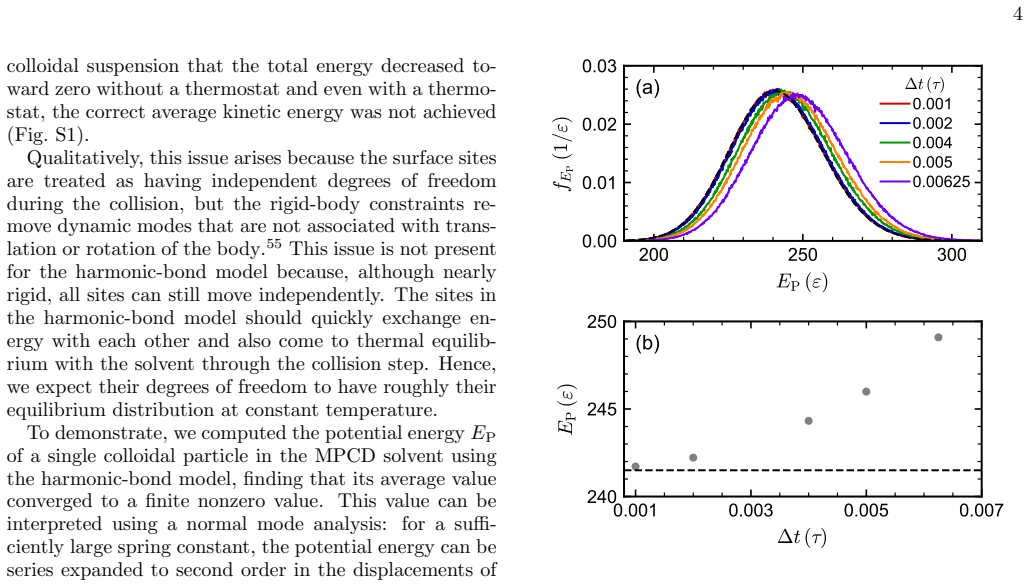
Rigid-body model A practical challenge of the harmonic-bond model is that ∆tmust be sufficiently small to faithfully integrate the dynamics of the sites, including the fast vibrations associated with the bonds; however, these vibrations are not of physical interest because the bonds are an artificial construction. We are instead interested in the collecti...
discussion (0)
Sign in with ORCID, Apple, or X to comment. Anyone can read and Pith papers without signing in.