The azimuthal structure of magnetically arrested disks during flux eruption events
Pith reviewed 2026-05-10 12:03 UTC · model grok-4.3
The pith
Vertical magnetic flux bundles formed by reconnection determine the inner structure of magnetically arrested disks during flux eruptions.
A machine-rendered reading of the paper's core claim, the machinery that carries it, and where it could break.
Core claim
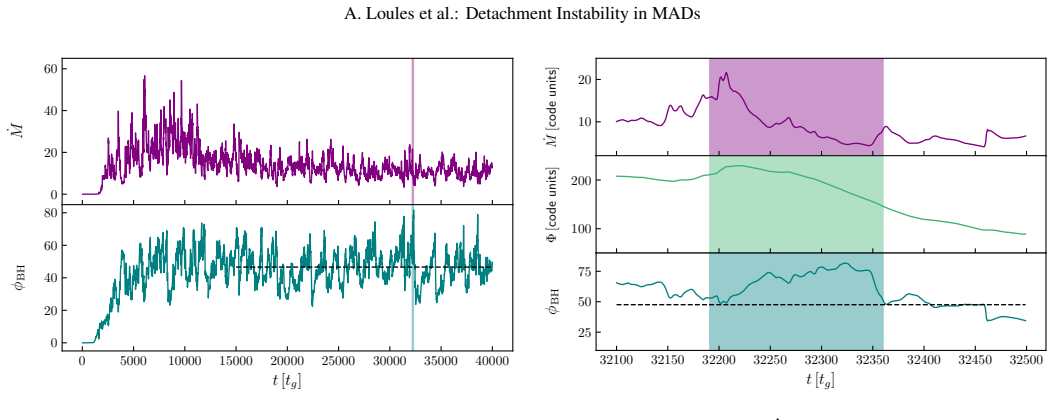
During flux eruption events the morphology of the equatorial accretion flow close to the black hole is mainly determined by the formation and motion of vertical magnetic flux bundles. These bundles arise when the initially horizontal magnetic field reconnects into a vertical configuration, detaching from the black hole horizon in a low-density, highly magnetized equatorial region that grows over time. The resulting vertical flux tubes, filled with low-density plasma, are carried outward by magnetic buoyancy, producing an enhancement of non-axisymmetric features that is strongest near the horizon and is carried by m=1 and m=2 modes.
What carries the argument
Vertical magnetic flux bundles created by reconnection of horizontal field lines, which detach from the horizon and are expelled by magnetic buoyancy.
If this is right
- The inner accretion flow becomes dominated by large-scale azimuthal features carried by m=1 and m=2 modes during eruptions.
- Excess magnetic flux is removed from the black hole through the formation and outward motion of these vertical bundles rather than other processes.
- The non-axisymmetry of the equatorial disk increases more strongly close to the horizon than at larger radii.
- The overall morphology of the inner disk is set by the timing and location of vertical flux-tube formation and buoyant transport.
Where Pith is reading between the lines
- The same reconnection-and-buoyancy sequence could produce periodic changes in accretion rate and therefore in observed luminosity or jet power.
- Full three-dimensional tracking of the bundles might reveal how they interact with or suppress jet launching.
- Polarimetric imaging of the black-hole shadow could detect the large-scale azimuthal asymmetries predicted by the m=1 and m=2 dominance.
- If the bundles carry low-density plasma outward, they may leave observable low-density channels or cavities in the inner disk.
Load-bearing premise
The GRMHD simulation accurately captures reconnection physics and buoyancy-driven transport without dominant numerical artifacts or missing non-ideal effects, and equatorial slices represent the full three-dimensional dynamics.
What would settle it
A higher-resolution run or a simulation with explicit resistivity that shows either no vertical bundles forming or higher azimuthal modes dominating near the horizon during eruptions would falsify the claim.
Figures


read the original abstract
We analyze data from a standard 3D general-relativistic magnetohydrodynamics (GRMHD) simulation, focusing on equatorial slices in order to examine the details and the evolution of the azimuthal structure of the accreting matter. During flux eruption events, the non-axisymmetric features of the equatorial inner accretion disk are considerably enhanced, with this enhancement being more prominent close to the black hole. Our analysis of the azimuthal structure of the equatorial accretion disk finds that the matter distribution in the vicinity of the horizon is dominated by low azimuthal mode numbers, specifically by the $m = 2$, and $m = 1$ modes, indicating that the non-axisymmetry of the disk during flux eruption events is enhanced due to the emergence of features with a large angular size on the equatorial plane. Our results suggest that the morphology of the equatorial accretion flow close to the black hole is mainly determined by the formation and motion of vertical magnetic flux bundles. These bundles are formed when the initially horizontal magnetic field reconnects into a vertical configuration, effectively detaching from the black hole horizon. This reconnection occurs in a low-density, highly magnetized region on the equatorial plane that expands over time as more field lines undergo vertical reconfiguration. The resulting vertical flux tubes, filled with low-density plasma, are then transported outwards due to magnetic buoyancy. Our results present a detailed quantitative description of the morphology of MADs and of its evolution during flux eruptions, complemented by a description of the physical process by which excess magnetic flux is detached from the black hole, vertically reconfigured, and expelled.
Editorial analysis
A structured set of objections, weighed in public.
Referee Report
Summary. The manuscript analyzes equatorial slices from a standard 3D GRMHD simulation of a magnetically arrested disk (MAD), focusing on flux eruption events. It reports that non-axisymmetric features are enhanced near the horizon, with the azimuthal structure dominated by low-order modes (m=1 and m=2). The authors interpret this morphology as arising from the formation of vertical magnetic flux bundles via reconnection of initially horizontal field lines in expanding low-density, high-magnetization regions, followed by outward buoyant transport that detaches excess flux from the horizon.
Significance. If the numerical structures prove robust, the work supplies a quantitative characterization of azimuthal mode evolution during MAD eruptions and a concrete physical picture for how excess magnetic flux is reconfigured and expelled. The emphasis on mode decomposition and the link between reconnection sites and large-scale equatorial features could aid interpretation of variability in accreting black-hole systems. The analysis draws on an existing simulation rather than introducing new runs, which limits the scope but allows focused post-processing.
major comments (2)
- [Abstract / reconnection description] Abstract and the description of the reconnection process: the central claim that vertical flux bundles 'mainly determine' the equatorial morphology rests on the assumption that the observed reconnection and buoyant detachment are physical rather than numerical. Because the simulation is ideal GRMHD, reconnection occurs only through grid-scale diffusion; no resolution study, scheme comparison, or explicit resistivity test is presented to show that the m=1/2 dominance and bundle formation converge or are insensitive to numerical dissipation.
- [Methods / equatorial-slice analysis] Analysis restricted to equatorial slices: the interpretation of vertical reconfiguration, detachment from the horizon, and outward transport relies on 2D equatorial cuts. Without accompanying vertical velocity maps, full 3D field-line tracing, or demonstration that the slices capture the dominant reconnection topology, it remains unclear whether the reported bundle motion accurately represents the 3D dynamics.
minor comments (2)
- [Abstract] The abstract repeats the phrase 'Our results suggest...' and could more cleanly separate the simulation measurements (mode amplitudes, density evolution) from the physical interpretation (reconnection and buoyancy).
- [Results] Quantitative mode analysis would benefit from reported uncertainties or sensitivity checks on the azimuthal Fourier decomposition (e.g., radial averaging range, time-window choice).
Simulated Author's Rebuttal
We thank the referee for their careful reading and constructive comments on our manuscript. We address each major comment point by point below, indicating the revisions we plan to make.
read point-by-point responses
-
Referee: [Abstract / reconnection description] Abstract and the description of the reconnection process: the central claim that vertical flux bundles 'mainly determine' the equatorial morphology rests on the assumption that the observed reconnection and buoyant detachment are physical rather than numerical. Because the simulation is ideal GRMHD, reconnection occurs only through grid-scale diffusion; no resolution study, scheme comparison, or explicit resistivity test is presented to show that the m=1/2 dominance and bundle formation converge or are insensitive to numerical dissipation.
Authors: We agree that reconnection in ideal GRMHD is numerical and occurs via grid-scale diffusion. Our work consists of post-processing analysis of an existing simulation from the literature rather than a new simulation campaign, so we do not include a dedicated resolution study or resistivity test. The flux eruption events and associated structures have been reported across multiple independent MAD simulations with varying codes and resolutions. We will revise the abstract and main text to moderate the phrasing (e.g., emphasizing that our results 'suggest' the morphology is determined by the bundles) and add an explicit discussion of the numerical nature of reconnection together with citations to supporting convergence studies in the MAD literature. revision: partial
-
Referee: [Methods / equatorial-slice analysis] Analysis restricted to equatorial slices: the interpretation of vertical reconfiguration, detachment from the horizon, and outward transport relies on 2D equatorial cuts. Without accompanying vertical velocity maps, full 3D field-line tracing, or demonstration that the slices capture the dominant reconnection topology, it remains unclear whether the reported bundle motion accurately represents the 3D dynamics.
Authors: The equatorial-slice focus is chosen because the primary scientific goal is a quantitative decomposition of azimuthal structure, which is naturally performed in the equatorial plane. We acknowledge that the 3D interpretation of bundle formation and buoyancy would be strengthened by additional visualizations. In the revised manuscript we will add vertical slices and vertical-velocity maps through representative reconnection regions to illustrate the 3D topology and confirm consistency with the equatorial features. Limited field-line tracing examples will also be included where the data permit. revision: yes
Circularity Check
No circularity: claims are direct interpretations of simulation outputs
full rationale
The paper performs post-processing analysis on equatorial slices from an existing 3D GRMHD simulation. It reports observed mode dominance (m=1,2), describes flux bundle formation via reconnection, and attributes morphology to buoyancy-driven transport. These statements are interpretive summaries of simulation data with no equations, fitted parameters, self-definitions, or load-bearing self-citations that reduce any result to its own inputs by construction. The derivation chain consists solely of data inspection and physical narrative; no step equates a claimed outcome to a fitted or redefined input.
Axiom & Free-Parameter Ledger
axioms (2)
- domain assumption Ideal GRMHD equations govern the plasma and magnetic field evolution
- domain assumption Magnetic reconnection and buoyancy dominate over other effects in the low-density equatorial region
invented entities (1)
-
vertical magnetic flux bundles
no independent evidence
Reference graph
Works this paper leans on
- [1]
- [2]
- [3]
-
[4]
Antonopoulou, E., Loules, A., & Nathanail, A. 2025, A&A, 696, A10
work page 2025
-
[5]
Begelman, M. C., Blandford, R. D., & Rees, M. J. 1984, Reviews of Modern Physics, 56, 255
work page 1984
-
[6]
Bisnovatyi-Kogan, G. S. & Ruzmaikin, A. A. 1974, Ap&SS, 28, 45
work page 1974
-
[7]
Bisnovatyi-Kogan, G. S. & Ruzmaikin, A. A. 1976, Ap&SS, 42, 401
work page 1976
-
[8]
Blandford, R. D. & Znajek, R. L. 1977, MNRAS, 179, 433
work page 1977
-
[9]
Blinova, A. A., Romanova, M. M., & Lovelace, R. V. E. 2016, MNRAS, 459, 2354
work page 2016
-
[10]
Chan, H.-S., Dhang, P., Dexter, J., & Begelman, M. C. 2025, ApJ, 985, 135
work page 2025
-
[11]
1961, Hydrodynamic and hydromagnetic stability
Chandrasekhar, S. 1961, Hydrodynamic and hydromagnetic stability
work page 1961
- [12]
-
[13]
Cruz-Osorio, A., Fromm, C. M., Mizuno, Y., et al. 2022, Nature Astronomy, 6, 103
work page 2022
-
[14]
2024, arXiv e-prints, arXiv:2411.16528 Del Zanna, L., Zanotti, O., Bucciantini, N., & Londrillo, P
Das, P., Salmi, T., Davelaar, J., Porth, O., & Watts, A. 2024, arXiv e-prints, arXiv:2411.16528 Del Zanna, L., Zanotti, O., Bucciantini, N., & Londrillo, P. 2007, A&A, 473, 11
-
[15]
Dexter, J., Tchekhovskoy, A., Jiménez-Rosales, A., et al. 2020, MNRAS, 497, 4999
work page 2020
-
[16]
Dhruv, V., Prather, B., Wong, G. N., & Gammie, C. F. 2025, ApJS, 277, 16
work page 2025
-
[17]
Dimitropoulos, I., Nathanail, A., Petropoulou, M., Contopoulos, I., & Fromm, C. M. 2025, A&A, 696, A36 El Mellah, I., Cerutti, B., & Crinquand, B. 2023, A&A, 677, A67 Event Horizon Telescope Collaboration, Akiyama, K., Alberdi, A., et al. 2024, ApJ, 964, L26 Event Horizon Telescope Collaboration, Akiyama, K., Algaba, J. C., et al. 2021, ApJ, 910, L13
work page 2025
-
[18]
Fishbone, L. G. & Moncrief, V. 1976, ApJ, 207, 962
work page 1976
-
[19]
Galishnikova, A., Philippov, A., Quataert, E., Chatterjee, K., & Liska, M. 2025, ApJ, 978, 148
work page 2025
-
[20]
Garain, S. K. & Kim, J. 2023, MNRAS, 519, 4550 GRAVITY Collaboration, Abuter, R., Amorim, A., et al. 2018, A&A, 618, L10
work page 2023
-
[21]
M., Quataert, E., & Springel, V
Guo, M., Stone, J. M., Quataert, E., & Springel, V. 2025, ApJ, 987, 202
work page 2025
-
[22]
Hakobyan, H., Ripperda, B., & Philippov, A. A. 2023, ApJ, 943, L29
work page 2023
-
[23]
Igumenshchev, I. V. 2008, ApJ, 677, 317
work page 2008
- [24]
-
[25]
Kulkarni, A. K. & Romanova, M. M. 2008, MNRAS, 386, 673
work page 2008
-
[26]
Kulkarni, A. K. & Romanova, M. M. 2009, MNRAS, 398, 701
work page 2009
-
[27]
Lalakos, A., Tchekhovskoy, A., Bromberg, O., et al. 2024, ApJ, 964, 79
work page 2024
- [28]
- [29]
-
[30]
Londrillo, P. & del Zanna, L. 2004, Journal of Computational Physics, 195, 17
work page 2004
-
[31]
McKinney, J. C. & Gammie, C. F. 2004, ApJ, 611, 977
work page 2004
-
[32]
C., Tchekhovskoy, A., & Blandford, R
McKinney, J. C., Tchekhovskoy, A., & Blandford, R. D. 2012, MNRAS, 423, 3083
work page 2012
-
[33]
Mpisketzis, V., Duqué, R., Nathanail, A., Cruz-Osorio, A., & Rezzolla, L. 2024, MNRAS, 527, 9159
work page 2024
- [34]
-
[35]
Narayan, R., Chael, A., Chatterjee, K., Ricarte, A., & Curd, B. 2022, MNRAS, 511, 3795
work page 2022
-
[36]
Narayan, R., Igumenshchev, I. V., & Abramowicz, M. A. 2003, PASJ, 55, L69
work page 2003
-
[37]
Nathanail, A., Fromm, C. M., Porth, O., et al. 2020, MNRAS, 495, 1549
work page 2020
-
[38]
Nathanail, A., Mizuno, Y., Contopoulos, I., et al. 2025, A&A, 693, A56
work page 2025
-
[39]
Nathanail, A., Mpisketzis, V., Porth, O., Fromm, C. M., & Rezzolla, L. 2022, MNRAS, 513, 4267
work page 2022
- [40]
-
[41]
Novikov, I. D. & Thorne, K. S. 1973, in Black Holes (Les Astres Occlus), ed. C. Dewitt & B. S. Dewitt, 343–450
work page 1973
-
[42]
Olivares, H., Porth, O., Davelaar, J., et al. 2019, A&A, 629, A61
work page 2019
- [43]
-
[44]
Parker, E. N. 1955, ApJ, 121, 491
work page 1955
-
[45]
Parker, E. N. 1966, ApJ, 145, 811
work page 1966
-
[46]
Porth, O., Chatterjee, K., Narayan, R., et al. 2019, ApJS, 243, 26
work page 2019
-
[47]
Porth, O., Mizuno, Y., Younsi, Z., & Fromm, C. M. 2021, MNRAS, 502, 2023 Porth,O.,Olivares,H.,Mizuno,Y.,etal.2017,ComputationalAstrophysicsand Cosmology, 4, 1
work page 2021
-
[48]
Pringle, J. E., Rees, M. J., & Pacholczyk, A. G. 1973, A&A, 29, 179 Ressler,S.M.,Quataert,E.,White,C.J.,&Blaes,O.2021,MNRAS,504,6076
work page 1973
-
[49]
Ripperda, B., Bacchini, F., & Philippov, A. A. 2020, ApJ, 900, 100
work page 2020
-
[50]
Ripperda, B., Liska, M., Chatterjee, K., et al. 2022, ApJ, 924, L32
work page 2022
-
[51]
Salas, L. D. S., Musoke, G., Chatterjee, K., et al. 2024, MNRAS, 533, 254
work page 2024
-
[52]
Shakura, N. I. & Sunyaev, R. A. 1973, A&A, 24, 337
work page 1973
- [53]
-
[54]
Takasao, S., Tomida, K., Iwasaki, K., & Suzuki, T. K. 2018, ApJ, 857, 4
work page 2018
-
[55]
Takasao, S., Tomida, K., Iwasaki, K., & Suzuki, T. K. 2019, ApJ, 878, L10
work page 2019
-
[56]
Takasao, S., Tomida, K., Iwasaki, K., & Suzuki, T. K. 2022, ApJ, 941, 73
work page 2022
-
[57]
Tchekhovskoy, A., Narayan, R., & McKinney, J. C. 2011, MNRAS, 418, L79
work page 2011
-
[58]
Particle Acceleration in Collisionless Magnetically Arrested Disks,
Vos, J., Cerutti, B., Moscibrodzka, M., & Parfrey, K. 2024, arXiv e-prints, arXiv:2410.19061
-
[59]
Werner, G. R. & Uzdensky, D. A. 2017, ApJ, 843, L27
work page 2017
-
[60]
Wong, G. N., Du, Y., Prather, B. S., & Gammie, C. F. 2021, ApJ, 914, 55
work page 2021
-
[61]
Younsi, Z. & Wu, K. 2015, MNRAS, 454, 3283
work page 2015
-
[62]
Q., Bégué, D., Pe’er, A., & Zhang, B
Zhang, G. Q., Bégué, D., Pe’er, A., & Zhang, B. B. 2024, ApJ, 962, 135
work page 2024
-
[63]
Zhu, Z., Stone, J. M., & Calvet, N. 2024, MNRAS, 528, 2883 Article number, page 10 A. Loules et al.: Detachment Instability in MADs Appendix A: Convergence of results with output frequency Fortheanalysisoftheazimuthalstructureoftheaccretiondiskduringfluxeruptionevents,wechoseanoutputfrequencyof1𝑡 𝑔 for the simulation results inside the time interval corre...
work page 2024
discussion (0)
Sign in with ORCID, Apple, or X to comment. Anyone can read and Pith papers without signing in.