Boson sampling beyond the dilute regime: second moments and anti-concentration
Pith reviewed 2026-05-10 12:48 UTC · model grok-4.3
The pith
Representation theory yields closed-form second moments for boson sampling observables even when photons bunch significantly.
A machine-rendered reading of the paper's core claim, the machinery that carries it, and where it could break.
Core claim
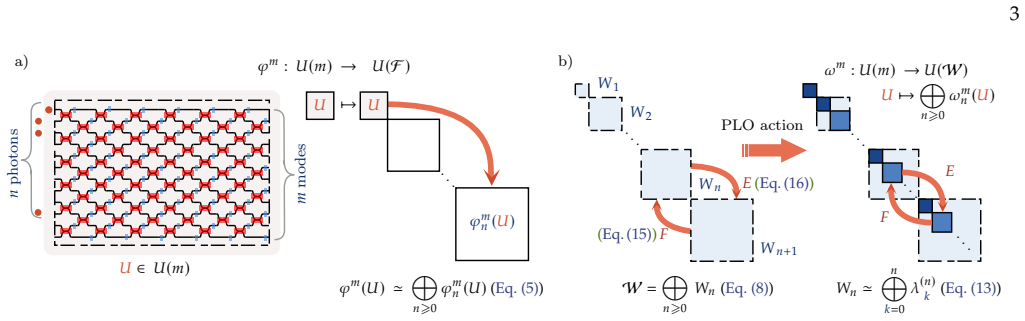
By leveraging representation-theoretic tools, closed-form expressions are obtained for the second moments of generic particle-number-preserving bosonic observables, expressed via the Hilbert-Schmidt norms of projections onto irreducible components of the operator space. These norms admit compact analytical expressions by exploiting the underlying symmetry structure of bosonic Fock space. Focusing on Fock state output probabilities, this framework establishes anti-concentration of the output distribution beyond the dilute regime. Together with recent complexity-theoretic results, the findings strengthen hardness guarantees for boson sampling in experimentally interesting settings where mode-1
What carries the argument
Hilbert-Schmidt norms of projections onto irreducible components of the operator space, which capture bosonic symmetries to produce closed-form second moments without regime-specific approximations.
Load-bearing premise
The symmetry structure of the bosonic Fock space permits compact analytical expressions for the Hilbert-Schmidt norms of projections onto irreducible components without additional approximations even when the number of modes grows linearly with the number of photons.
What would settle it
Direct numerical computation of the second moment for a small instance such as five photons in six modes, followed by comparison to the predicted closed-form value; a statistically significant deviation would falsify the expressions.
Figures
read the original abstract
Boson sampling is a leading candidate for demonstrating quantum advantage in photonic systems. Despite significant experimental and theoretical progress, a characterization of its output statistics remains incomplete. This is especially true beyond the dilute regime, where photon collisions and bunching become significant. The associated saturated regime, characterized by mode number growing linearly with photon number, or more generally sub-quadratically, is precisely the regime of greatest experimental interest. As a consequence, anti-concentration of the output distribution--a key ingredient in hardness arguments--remains poorly understood in boson sampling. In this work, we leverage representation-theoretic tools to address this gap, obtaining closed-form expressions for second moments of generic particle-number-preserving bosonic observables. We express these quantities in terms of Hilbert-Schmidt norms of projections onto irreducible components of the operator space and show that these projection norms admit compact analytical expressions by exploiting the underlying symmetry structure. Focusing on Fock state output probabilities, we further establish anti-concentration beyond the dilute regime. Together with recent complexity-theoretic results, our findings strengthen hardness guarantees for boson sampling in experimentally interesting settings.
Editorial analysis
A structured set of objections, weighed in public.
Referee Report
Summary. The manuscript claims that representation-theoretic methods yield closed-form expressions for the second moments of generic particle-number-preserving bosonic observables in boson sampling. These moments are rewritten as sums of squared Hilbert-Schmidt norms of projections onto irreducible components of the bosonic operator algebra; symmetry under the relevant group action is asserted to produce compact analytical formulae for the norms. The work then applies this to Fock-state output probabilities to establish anti-concentration beyond the dilute regime, specifically in the saturated regime where the number of modes m grows linearly with the number of photons n.
Significance. If the claimed closed-form expressions are exact and hold without hidden approximations when m scales linearly with n, the results would supply analytical control over output statistics in the experimentally relevant saturated regime. This would directly support anti-concentration bounds and, together with existing complexity results, strengthen hardness arguments for boson sampling. The symmetry-based reduction is a potentially valuable technical contribution if the derivations are fully rigorous.
major comments (2)
- [Abstract and central derivation of second moments] The central technical step asserts that Hilbert-Schmidt norms of projections onto irreps admit compact analytical expressions via symmetry. However, when m grows linearly with n the relevant irreps are labeled by partitions of n of length at most m; their dimensions and multiplicities are given by the hook-length or Weyl dimension formulas, and the sum over such diagrams does not in general collapse to an n-independent closed form. The manuscript must explicitly derive or verify (in the section presenting the second-moment formula) that the resulting expressions remain exact, without residual n-dependent sums or asymptotic cancellations whose error grows with the ratio m/n, because this simplification is load-bearing for the subsequent anti-concentration claim.
- [Anti-concentration section] The anti-concentration bound for Fock-state probabilities is stated to hold beyond the dilute regime. Because this bound rests on the second-moment expressions, the manuscript should supply a concrete error analysis or explicit check (e.g., for small n with m = cn, c constant) showing that any approximation error remains controlled when m/n is order-1; otherwise the bound may only be asymptotic in the dilute limit.
minor comments (1)
- [Preliminaries] Notation for the bosonic Fock space and the precise definition of the particle-number-preserving observable algebra should be introduced with an explicit reference to the representation of U(m) or the symmetric group action.
Simulated Author's Rebuttal
We thank the referee for their insightful comments and the opportunity to clarify our results. We provide detailed responses to the major comments below, indicating the revisions we will make to address the concerns.
read point-by-point responses
-
Referee: The central technical step asserts that Hilbert-Schmidt norms of projections onto irreps admit compact analytical expressions via symmetry. However, when m grows linearly with n the relevant irreps are labeled by partitions of n of length at most m; their dimensions and multiplicities are given by the hook-length or Weyl dimension formulas, and the sum over such diagrams does not in general collapse to an n-independent closed form. The manuscript must explicitly derive or verify (in the section presenting the second-moment formula) that the resulting expressions remain exact, without residual n-dependent sums or asymptotic cancellations whose error grows with the ratio m/n, because this simplification is load-bearing for the subsequent anti-concentration claim.
Authors: We are grateful for this observation, which helps us strengthen the exposition. The manuscript derives the second moments by decomposing the bosonic observables into irreducible components under the action of the unitary group U(m). The symmetry ensures that the Hilbert-Schmidt norm squared for each projection is given by a formula involving the dimension of the irrep and the multiplicity, but when summing over all partitions of n with at most m parts, the contributions combine using the completeness relation of the representation ring or the fact that the total space dimension is binomial, leading to an exact closed-form expression in terms of n and m only. This is not an approximation but follows from exact representation-theoretic identities. The formula presented is therefore exact for any ratio m/n. In response to the comment, we will revise the section to include an explicit step-by-step derivation of how the sum over partitions evaluates to the closed form, using the Weyl dimension formula and showing the cancellation explicitly. revision: yes
-
Referee: The anti-concentration bound for Fock-state probabilities is stated to hold beyond the dilute regime. Because this bound rests on the second-moment expressions, the manuscript should supply a concrete error analysis or explicit check (e.g., for small n with m = cn, c constant) showing that any approximation error remains controlled when m/n is order-1; otherwise the bound may only be asymptotic in the dilute limit.
Authors: The anti-concentration result is obtained by applying the exact second-moment formula to the observable corresponding to the projector onto a specific Fock state. Since the second moments are exact and closed-form without any approximation or asymptotic assumption, the anti-concentration bound holds rigorously in the saturated regime where m = Theta(n). There are no hidden approximations in the derivation. To provide the requested concrete check, we will add an appendix with numerical verification for small n (such as n=4, m=6 and n=6, m=8) where we compute the second moment both analytically and by enumerating all partitions, confirming exact agreement, and then compute the anti-concentration bound numerically to show it holds with the predicted constant. revision: yes
Circularity Check
No significant circularity: derivation uses standard representation theory on bosonic symmetry
full rationale
The paper derives closed-form second moments and anti-concentration bounds for boson sampling in the saturated regime by expressing observables via Hilbert-Schmidt norms of projections onto irreducible representations of the bosonic operator algebra, then invoking the underlying U(m) or symmetric group symmetry structure to obtain compact expressions. This is a direct application of standard representation-theoretic facts (dimensions, multiplicities via hook-length/Weyl formulas) to the Fock space, without defining any target quantity in terms of itself or renaming fitted inputs as predictions. No load-bearing step reduces by construction to the anti-concentration result, and the approach remains self-contained against external benchmarks from representation theory. The reader's preliminary score of 2.0 is consistent with possible minor self-citation of prior symmetry results, but none are shown to be the sole justification for the central claims.
Axiom & Free-Parameter Ledger
axioms (1)
- standard math Representation theory of the symmetric group and unitary group actions on bosonic Fock space yields irreducible decompositions whose dimensions admit closed-form expressions.
Reference graph
Works this paper leans on
-
[1]
Formally, let𝐿𝑘 and𝑅 𝑘 denote the following restricted maps,∀𝑘⩾0
Properties of restricted raising and lowering maps Inwhatfollows,wefurtheranalysetheloweringandraisingmapsmorelocallybyconsideringtheirrestrictionson fixed photon-number operator subspaces. Formally, let𝐿𝑘 and𝑅 𝑘 denote the following restricted maps,∀𝑘⩾0. 𝐿𝑘 :=𝐿|𝑊𝑘 ,(B80) 𝑅𝑘 :=𝑅|𝑊𝑘−1.(B81) Here, we adopt the convention that𝑅0 is the zero map. Henceforth, ...
-
[2]
Analysis of irreducible representations of the photon-number preserving subalgebra Inthissection,wefurthercharacterizetheirreduciblecomponents𝜆 (𝑘) 𝑟 arisinginthedecompositionoftheoperator subalgebra𝒲of photon-number preserving bosonic operators, given in Eq. (B9). In particular, by exploiting the raising and lowering maps, we provide an alternative and m...
-
[3]
Projection with CG coefficients Thestandardtechniqueforcomputingprojectionsintoirreduciblerepresentationsoftheoperatorspaceisbasedon theClebsch-Gordontransform. TheClebsch-Gordondecompositionappearsinthedecompositionofsumsofangular momenta in quantum mechanics [81]. In particular, the Clebsch-Gordon transformation is a unitary transformation 𝐶that realise...
-
[4]
Iterative projection procedure While the Clebsch–Gordan construction provides an explicit, basis-level realization of the irreducible decompo- sition, it relies on coefficient-level computations and becomes cumbersome at large system sizes. By contrast, the commuting𝑈(𝑚)and𝔰𝔩2 actions ensure, via Howe duality, that irreducible components can be characteri...
-
[5]
Closed form expression of irrep norms Having established the iterative projection procedure and its theoretical underpinnings in Theorem 4, we can now proceed to compute the Hilbert–Schmidt norm of irreducible components of a photon-number preserving operator appearing in the expression of the second moment in Proposition 2. Theorem5.(Irrepnorms). Let𝑂bea...
-
[6]
Anti-concentration in hardness arguments Inthissection,wereviewtheroleofanticoncentrationincomplexity-theoreticarguments,particularlyforhardness of boson sampling in the saturated regime, and clarify the distinction between forms of anticoncentration. a. Sampling-to-countingreductionanderrorstructure.Thehardnessofbosonsamplingisbasedonareductionfrom appro...
-
[7]
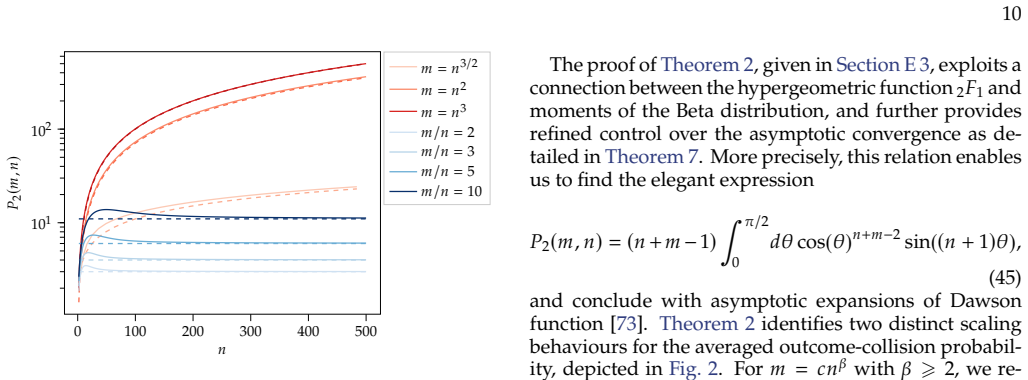
Normalized average outcome collision probability Theweakformofanti-concentrationdefinedinEq.(E6)isusuallydiagnosedthroughsecondmomentsoftheoutput distribution, and in particular through the normalized average outcome collision probability 𝑃2(𝑚, 𝑛)=|Φ𝑛 𝑚| Õ 𝑆∈Φ𝑛𝑚 E𝑈∼𝑈(𝑚)[𝑝𝑈(𝑆)2].(E13) Computing𝑃 2(𝑚, 𝑛)viasecond-momentmethodsallowsonetoestablishlowerbounds...
-
[8]
Proof of anti-concentration beyond the collision-free regime Inthissection,ourgoalistoestablishCorollary2,provinganti-concentrationofbosonsamplinginthelinearregime. To this end, we first derive a series of results on the average outcome collision probability, which will serve as the main ingredient in obtaining anti-concentration via an application of the...
discussion (0)
Sign in with ORCID, Apple, or X to comment. Anyone can read and Pith papers without signing in.