Configuration-dependent electronic and optical properties of 2D Mo_(1-x)W_xS₂ alloys across the full composition range
Pith reviewed 2026-05-10 12:42 UTC · model grok-4.3
The pith
In Mo1-xWxS2 alloys, local atomic configurations dictate electronic band splitting and optical properties across all compositions, even without spin-orbit coupling.
A machine-rendered reading of the paper's core claim, the machinery that carries it, and where it could break.
Core claim
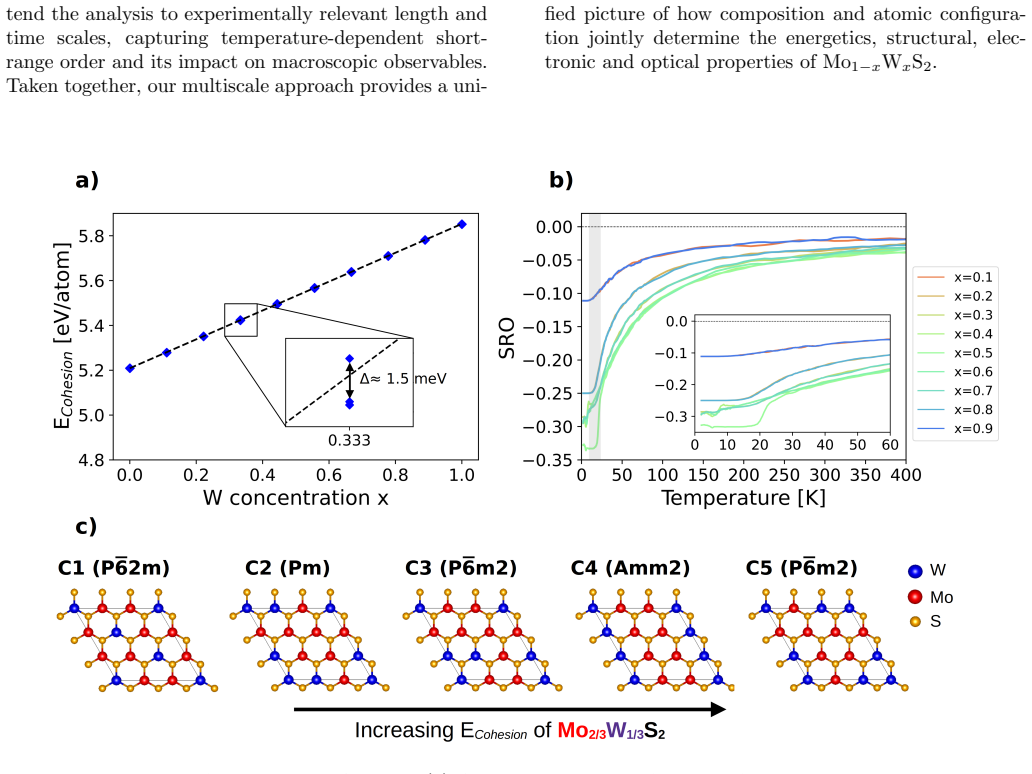
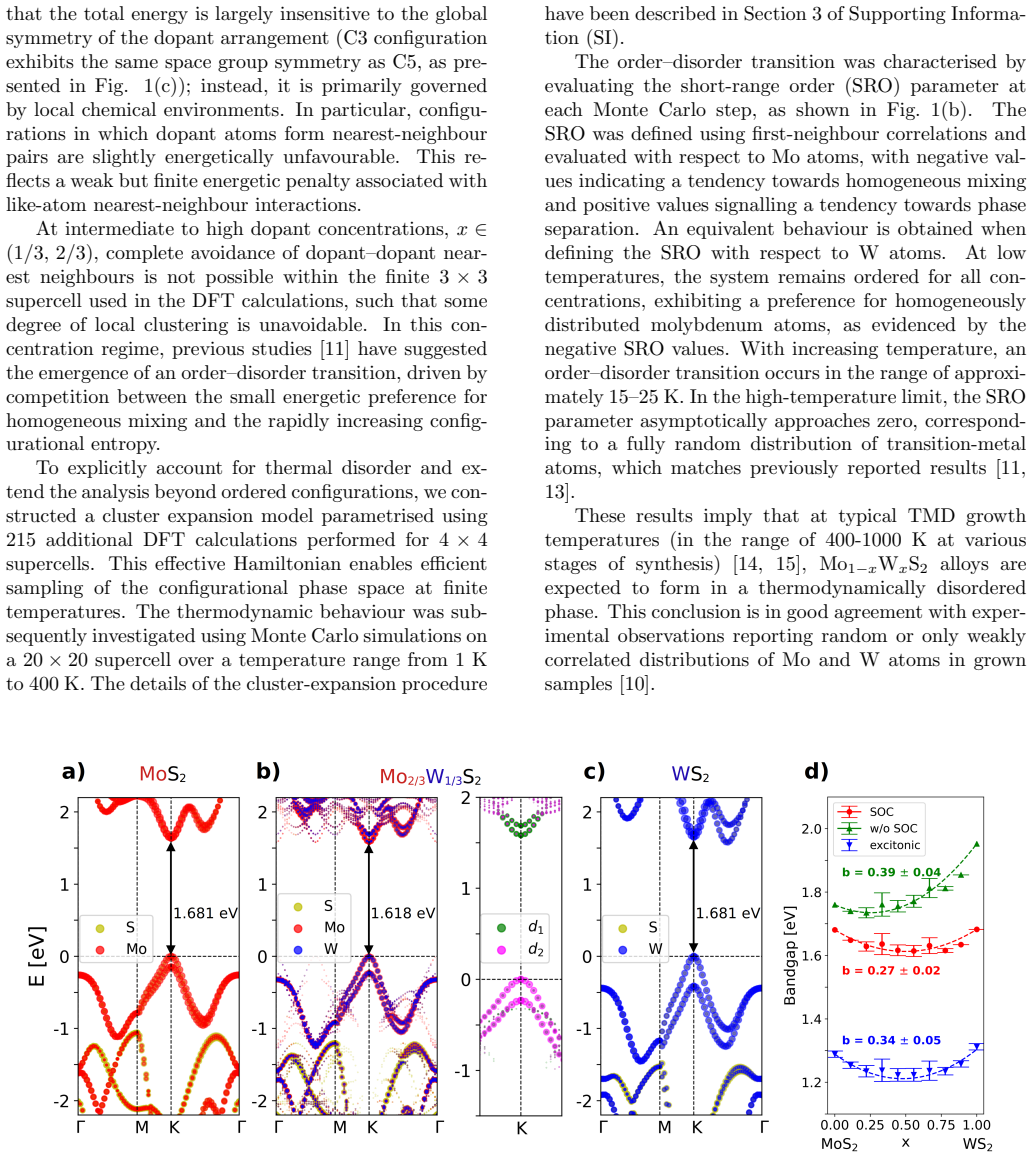
Although structural stability and energetics are largely composition-driven, the electronic and optical properties exhibit configuration dependence, with local atomic arrangements critically shaping band-edge splitting, valley structure, effective-mass anisotropy, and optical selection rules. In contrast to the pristine monolayers, even in the absence of spin-orbit coupling, splitting of the band edges at the K point is observed across the entire composition range. In particular, while the valence-band maximum remains largely robust, the conduction-band minimum shows strong configuration-dependent splitting from few meV up to hundredths of meV. This behaviour leads to a non-trivialdependence
What carries the argument
Symmetry-inequivalent atomic configurations of Mo and W atoms sampled across the composition range via DFT and Monte Carlo, which induce local symmetry breaking that produces the observed band-edge splittings and modified optical selection rules.
If this is right
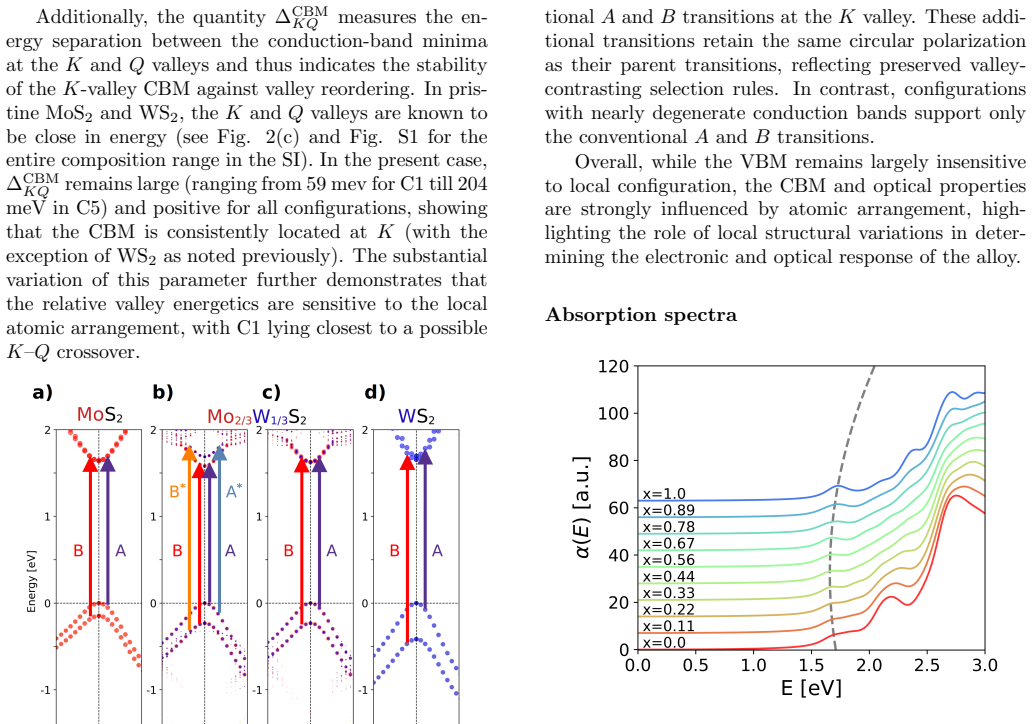
- Configurations with well-separated conduction bands support additional optically active transitions beyond the conventional A and B excitons.
- Nearly degenerate cases at x = 1/3 and x = 2/3 exhibit a reduced number of allowed optical transitions.
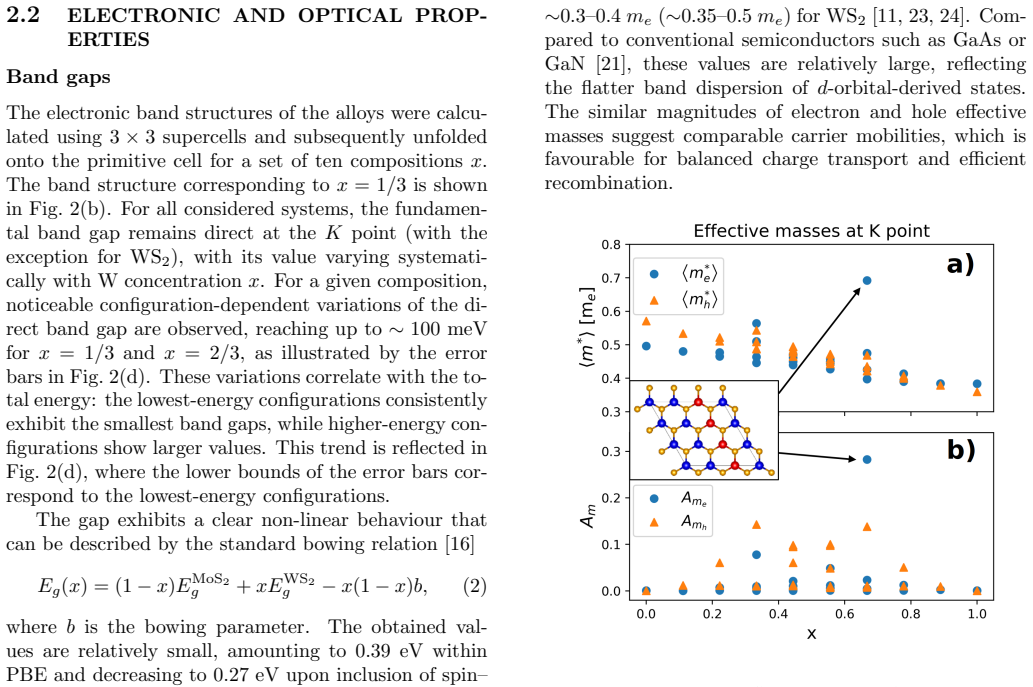
- Hole effective masses at the VBM show configuration-dependent anisotropy, implying direction-dependent transport.
- Valley energetics exhibit non-trivial dependence on microscopic atomic arrangement rather than composition alone.
Where Pith is reading between the lines
- Synthesis techniques that favor particular atomic orderings could be used to select specific optical or transport behaviors in devices.
- The same local-order sensitivity may appear in other isovalent 2D dichalcogenide alloys, affecting their valleytronic applications.
- This points to the value of experimental probes that resolve both composition and local configuration to test the predicted effects.
Load-bearing premise
The sampled symmetry-inequivalent atomic configurations and Monte Carlo sampling adequately represent physically relevant states, and DFT calculations without spin-orbit coupling capture the essential physics of the reported band-edge splitting and optical selection rules.
What would settle it
Experimental spectroscopy on Mo1-xWxS2 samples with controlled and characterized atomic configurations at fixed composition, such as x=0.5, to measure whether conduction-band splitting at K varies with arrangement and produces the predicted changes in allowed optical transitions.
Figures
read the original abstract
Here we analyze multiple symmetry-inequivalent atomic configurations across the entire composition range of the isovalent and isostructural Mo$_x$W$_{1-x}$S$_2$ alloy using density-functional theory and Monte Carlo simulations. Our results show that although structural stability and energetics are largely composition-driven, the electronic and optical properties exhibit configuration dependence, with local atomic arrangements critically shaping band-edge splitting, valley structure, effective-mass anisotropy, and optical selection rules. In contrast to the pristine monolayers, even in the absence of spin-orbit coupling (SOC), splitting of the band edges at the $K$ point is observed across the entire composition range. In particular, while the valence-band maximum (VBM) remains largely robust, the conduction-band minimum (CBM) shows strong configuration-dependent splitting from few meV up to hundredths of meV. This behaviour leads to a non-trivial dependence of the valley energetics. Configurations with well-separated conduction bands support additional optically active transitions beyond the conventional A and B excitons in MoS$_2$ and WS$_2$ monolayers, whereas nearly degenerate cases exhibit a reduced number of allowed transitions, observed for specific configurations at $x = 1/3$ and $x = 2/3$. These results demonstrate that the number and character of optically active transitions are governed not only by composition, but also by the microscopic arrangement of atoms. Moreover, we found the hole effective masses at the VBM show configuration-dependent anisotropy, reflecting sensitivity to local symmetry breaking and implying direction-dependent transport.
Editorial analysis
A structured set of objections, weighed in public.
Referee Report
Summary. The manuscript analyzes symmetry-inequivalent atomic configurations of 2D Mo_{1-x}W_x S_2 alloys over the full composition range using DFT and Monte Carlo simulations. It claims that structural stability and energetics are largely composition-driven, whereas electronic and optical properties exhibit strong configuration dependence: local arrangements induce K-point band-edge splitting (few meV to hundreds of meV at the CBM) even without SOC, alter valley energetics, produce effective-mass anisotropy, and change the number and character of optically active transitions beyond the conventional A/B excitons.
Significance. If the configuration-dependent effects hold, the work demonstrates that microscopic atomic ordering in TMD alloys can tune valley structure and optical selection rules independently of average composition, with potential implications for alloy-based valleytronics and optoelectronics. Credit is given for systematically sampling multiple symmetry-inequivalent configurations and coupling them to Monte Carlo energetics rather than relying on virtual-crystal or mean-field approximations.
major comments (2)
- [Abstract and main-text discussion of no-SOC results] Abstract and main-text discussion of no-SOC results: the central claim that local configurations produce K-point splitting (few meV to hundreds of meV at CBM) and modify optical selection rules even without SOC is load-bearing for the valley and exciton conclusions. TMD monolayers exhibit strong intrinsic SOC (150–400 meV valence splitting), which sets the dominant valley physics and A/B exciton rules. The manuscript must either include SOC calculations to show whether the reported configuration-induced splittings survive or are overshadowed, or provide a quantitative argument why the no-SOC limit remains experimentally relevant. Absent this, the physical applicability of the optical-transition claims is uncertain.
- [Methods and results sections on configuration sampling] Methods and results sections on configuration sampling: the robustness of the 'configuration dependence' claim rests on the assertion that the sampled symmetry-inequivalent configurations adequately represent physically accessible states. The manuscript should specify supercell sizes, the number of configurations per composition, the Monte Carlo acceptance criteria, and any convergence tests with respect to sampling. Without these details it is difficult to assess whether rare low-energy configurations that could dominate the reported splittings have been captured.
minor comments (2)
- The abstract states 'up to hundredths of meV'; this appears to be a typographical error for 'hundreds of meV' and should be corrected for clarity.
- Add explicit convergence tests (k-point density, plane-wave cutoff, supercell size) and error estimates on the reported splitting magnitudes to support the quantitative claims.
Simulated Author's Rebuttal
We thank the referee for the positive evaluation of our work and the constructive comments, which help strengthen the manuscript. We address each major comment point by point below.
read point-by-point responses
-
Referee: [Abstract and main-text discussion of no-SOC results] Abstract and main-text discussion of no-SOC results: the central claim that local configurations produce K-point splitting (few meV to hundreds of meV at CBM) and modify optical selection rules even without SOC is load-bearing for the valley and exciton conclusions. TMD monolayers exhibit strong intrinsic SOC (150–400 meV valence splitting), which sets the dominant valley physics and A/B exciton rules. The manuscript must either include SOC calculations to show whether the reported configuration-induced splittings survive or are overshadowed, or provide a quantitative argument why the no-SOC limit remains experimentally relevant. Absent this, the physical applicability of the optical-transition claims is uncertain.
Authors: We agree that SOC plays a dominant role in the valley physics and optical selection rules of TMD monolayers. The no-SOC calculations were presented specifically to isolate the purely configurational contributions to band-edge splitting and optical transitions arising from local symmetry breaking. However, to address the applicability concern, we will perform additional DFT calculations including SOC for representative low-energy configurations at key compositions. These results will be incorporated into the revised manuscript to demonstrate that the configuration-dependent CBM splittings (few to ~100 meV) persist alongside SOC effects, further modulating valley energetics and the number of optically active transitions. The abstract and main-text discussion will be updated to clarify this interplay and the continued relevance of the configurational effects. revision: yes
-
Referee: [Methods and results sections on configuration sampling] Methods and results sections on configuration sampling: the robustness of the 'configuration dependence' claim rests on the assertion that the sampled symmetry-inequivalent configurations adequately represent physically accessible states. The manuscript should specify supercell sizes, the number of configurations per composition, the Monte Carlo acceptance criteria, and any convergence tests with respect to sampling. Without these details it is difficult to assess whether rare low-energy configurations that could dominate the reported splittings have been captured.
Authors: We acknowledge that additional methodological details are required to fully substantiate the robustness of our configuration sampling. In the revised manuscript, we will expand the Methods section to explicitly state the supercell sizes used for each composition (e.g., 3x3 and 4x4 supercells for fractional x values), the total number of symmetry-inequivalent configurations enumerated and sampled per composition, the Monte Carlo parameters (Metropolis algorithm with Boltzmann acceptance probability, temperature range, and number of equilibration/production steps), and the results of convergence tests with respect to supercell size and sampling density. These additions will confirm that the low-energy configurations responsible for the observed splittings and optical variations are adequately represented. revision: yes
Circularity Check
No circularity: properties computed directly from DFT/MC on sampled configurations
full rationale
The paper's central results (configuration-dependent band-edge splitting, valley structure, effective masses, and optical transitions) are obtained by enumerating symmetry-inequivalent atomic arrangements, running independent DFT calculations (no SOC) on each, and using Monte Carlo sampling for energetics. No step equates a derived quantity to a fitted parameter or prior self-citation by construction; the splitting and selection-rule changes are outputs of the electronic-structure calculations, not inputs. The derivation chain is self-contained against external benchmarks and does not reduce any prediction to its own definition.
Axiom & Free-Parameter Ledger
axioms (1)
- domain assumption Density functional theory provides a reliable description of the electronic and optical properties of 2D Mo1-xWxS2 alloys
Reference graph
Works this paper leans on
-
[1]
& Fonari, A.Effective Mass Calculator2012
Sutton, C. & Fonari, A.Effective Mass Calculator2012
-
[2]
Ekborg-Tanner, P., Rosander, P., Fransson, E. & Erhart, P. Construction and sampling of alloy cluster expan- sions—a tutorial.PRX Energy3,042001 (2024). 12
work page 2024
discussion (0)
Sign in with ORCID, Apple, or X to comment. Anyone can read and Pith papers without signing in.