Recognition: unknown
Gravitational Lensing Signatures of Hayward-like Black Holes
Pith reviewed 2026-05-10 11:13 UTC · model grok-4.3
The pith
Hayward-like regular black holes modify strong-deflection lensing coefficients in ways that affect image separations, flux ratios and time delays.
A machine-rendered reading of the paper's core claim, the machinery that carries it, and where it could break.
Core claim
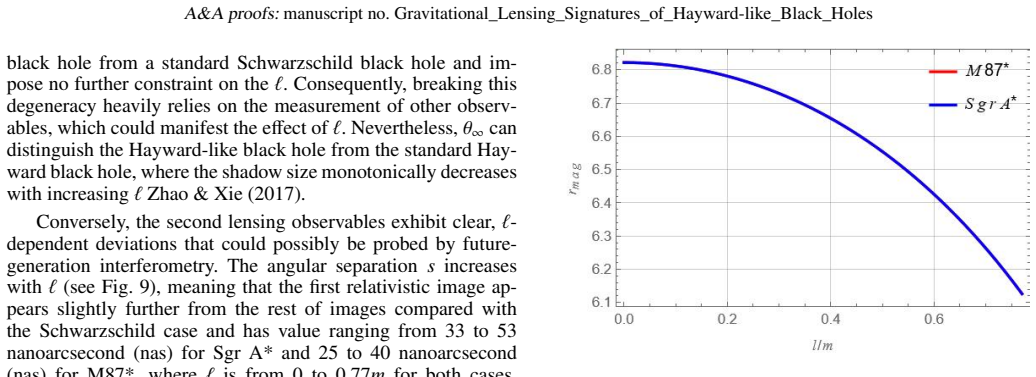
In the strong-deflection limit the asymptotic angular position theta sub infinity of the relativistic images is the same as for Schwarzschild black holes. The strong-lensing coefficients bar a and bar b, however, acquire explicit dependence on the Hayward regularization parameter ell. This dependence shifts the angular separation s between successive images, the relative magnitude r_mag, and the time delay Delta T sub 2 comma 1. The numerical values obtained for Sgr A* and M87* remain consistent with current observational bounds.
What carries the argument
The strong-deflection expansion of the deflection angle, whose coefficients bar a and bar b are computed from the Hayward-like metric function and control the logarithmic divergence near the photon sphere.
If this is right
- Angular separations s between the first and second relativistic images differ from the pure Schwarzschild prediction.
- Relative flux ratios r_mag between successive images are shifted by the value of ell.
- Time delays Delta T sub 2 comma 1 between images acquire an ell-dependent correction.
- Galaxy-scale Einstein-ring data cannot yet place bounds on ell.
- Higher-precision strong-lensing observations of Sgr A* and M87* may eventually distinguish the Hayward-like geometry from Schwarzschild.
Where Pith is reading between the lines
- Strong-field lensing could serve as an indirect probe of whether black-hole interiors are regularized.
- The same coefficient analysis can be repeated for other regular metrics to compare their lensing footprints.
- Time-delay measurements may yield tighter constraints on ell than angular positions alone.
- The approach connects to tests of strong-field gravity that do not require resolving the event horizon.
Load-bearing premise
The Hayward-like metric with finite ell is assumed to be the correct background spacetime and the strong-deflection approximations are taken to remain accurate for impact parameters relevant to Sgr A* and M87*.
What would settle it
A high-precision measurement of the time delay Delta T sub 2 comma 1 or angular separation s for the relativistic images of Sgr A* or M87* lying outside the interval predicted by the ell-dependent coefficients bar a and bar b would falsify the consistency with current data.
Figures




read the original abstract
We examine the gravitational lensing signatures of a Hayward-like regular black hole and its potential observational distinction from a Schwarzschild black hole. In the weak-field limit, the deflection angle includes a small positive correction proportional to $m \ell^2/b^3$, indicating slightly stronger light bending than in Schwarzschild, though the effect remains observationally negligible at large impact parameters. Current galaxy-scale Einstein-ring data, such as from ESO325-G004, cannot yet constrain the regular-core scale $\ell$. In the strong-deflection regime, for Sgr A* and M87*, the asymptotic position $\theta_{\infty}$ is identical to Schwarzschild's. Nevertheless, $\ell$ modifies strong-lensing coefficients $\bar a, \bar b$, influencing angular separations s, relative flux ratio $r_\mathrm{mag}$, and time delays $\Delta T_{2,1}$. Our predicted values for these observables remain consistent with current data, suggesting that future high-precision measurements of strong-field lensing may distinguish Hayward-like from Schwarzschild black holes.
Editorial analysis
A structured set of objections, weighed in public.
Referee Report
Summary. The manuscript examines gravitational lensing by Hayward-like regular black holes versus Schwarzschild, deriving a weak-field deflection correction proportional to m ℓ²/b³ and, in the strong-deflection regime, modifications to the Bozza coefficients ā and b̄ that shift the angular separation s, relative flux ratio r_mag, and time delay ΔT_{2,1} for Sgr A* and M87*. The asymptotic shadow radius θ_∞ remains identical to Schwarzschild, and all predicted observables are stated to lie within current observational bounds, with the suggestion that future precision measurements could distinguish the models.
Significance. If the derivations are correct, the work supplies concrete, falsifiable predictions for how a regular core scale ℓ alters strong-field lensing observables while remaining compatible with existing Sgr A* and M87* data. The application of the standard Bozza formalism to the Hayward-like metric is a direct and reproducible extension; the parametric dependence on ℓ is explicit and the weak-field correction is shown to be parametrically small. These features make the manuscript a useful reference for planning future VLBI or timing observations aimed at testing horizon-scale regularity.
major comments (2)
- [§3] §3 (strong-deflection analysis): the validity of the Bozza logarithmic approximation for the specific impact-parameter range relevant to Sgr A* and M87* is assumed rather than demonstrated; an explicit check that the deflection integral remains in the regime where ā and b̄ are well-defined (i.e., b close to the critical value) is needed to support the claim that the predicted shifts in s, r_mag and ΔT_{2,1} are observationally relevant.
- [Results section] Results section / comparison with data: the statement that the computed values of s, r_mag and ΔT_{2,1} 'remain consistent with current data' is not accompanied by a table or error-budget comparison against the specific observational constraints (e.g., EHT shadow size, VLBI time-delay bounds) used; without these numbers and the precise data-selection criteria, it is impossible to assess whether the consistency is robust or sensitive to post-hoc choices.
minor comments (2)
- [Abstract] The abstract and introduction should explicitly state the numerical range of ℓ explored and the units in which it is expressed (e.g., in units of m) so that readers can immediately judge the scale of the reported corrections.
- [Weak-field section] Equation (weak-field deflection) is given only to leading order in ℓ; the next-order term or an estimate of its magnitude at galactic scales would clarify why the correction is declared 'observationally negligible' for ESO325-G004.
Simulated Author's Rebuttal
We thank the referee for the positive evaluation of the manuscript and for the constructive suggestions that will improve its rigor and clarity. We respond to each major comment below and will revise the manuscript accordingly.
read point-by-point responses
-
Referee: [§3] §3 (strong-deflection analysis): the validity of the Bozza logarithmic approximation for the specific impact-parameter range relevant to Sgr A* and M87* is assumed rather than demonstrated; an explicit check that the deflection integral remains in the regime where ā and b̄ are well-defined (i.e., b close to the critical value) is needed to support the claim that the predicted shifts in s, r_mag and ΔT_{2,1} are observationally relevant.
Authors: We appreciate the referee's emphasis on explicitly verifying the applicability of the Bozza approximation. Although the formalism is standard and has been validated for similar metrics, we agree that a direct check for the Hayward-like case strengthens the analysis. In the revised manuscript we will add a brief numerical verification in §3 showing that, for the critical impact parameters b_c relevant to Sgr A* and M87*, the deflection integral lies sufficiently close to the logarithmic regime (b − b_c small) for the coefficients ā and b̄ to be well-defined and for the predicted shifts in the observables to remain observationally meaningful. revision: yes
-
Referee: [Results section] Results section / comparison with data: the statement that the computed values of s, r_mag and ΔT_{2,1} 'remain consistent with current data' is not accompanied by a table or error-budget comparison against the specific observational constraints (e.g., EHT shadow size, VLBI time-delay bounds) used; without these numbers and the precise data-selection criteria, it is impossible to assess whether the consistency is robust or sensitive to post-hoc choices.
Authors: We concur that a tabulated comparison with explicit observational constraints will make the consistency claim more transparent and reproducible. In the revised Results section we will insert a table listing the predicted values of s, r_mag, and ΔT_{2,1} for representative ℓ, together with the EHT shadow-radius bounds for Sgr A* and M87* and available VLBI time-delay limits. The table will include the data sources, the precise selection criteria, and a short error-budget discussion so that readers can judge the robustness of the agreement. revision: yes
Circularity Check
No significant circularity in derivation chain
full rationale
The paper takes the Hayward-like metric as an external input and applies the standard Bozza strong-deflection formalism (a well-established external method) to compute the coefficients ā and b̄ explicitly as functions of the free parameter ℓ. The lensing observables s, r_mag, and ΔT_{2,1} are then derived directly from those coefficients via standard mappings, without any fitting of ℓ to the target lensing data. Consistency statements with Sgr A* and M87* bounds are post-computation checks, not inputs that force the results. No self-citations, uniqueness theorems, or ansatzes from prior author work are invoked as load-bearing steps; the weak-field expansion is a direct series expansion of the given metric. The entire chain therefore remains independent of the final observables and is self-contained.
Axiom & Free-Parameter Ledger
free parameters (1)
- ell
axioms (2)
- domain assumption The background geometry is the Hayward-like regular black-hole metric
- domain assumption Weak-field and strong-deflection limit expansions are accurate for the relevant impact parameters
Forward citations
Cited by 1 Pith paper
-
Bouncing cosmologies from Born-Infeld-type gravity
A new ghost-free Born-Infeld-type f(R, G) gravity is built that admits a large family of bouncing cosmologies with varied asymptotic behaviors.
Reference graph
Works this paper leans on
-
[1]
Bartelmann, M. & Maturi, M. 2016 [arXiv:1612.06535]
work page Pith review arXiv 2016
-
[2]
Boos, J. & Hu, H. 2026, Phys. Rev. D, 113, 024065
2026
-
[3]
2008, Phys
Bozza, V . 2008, Phys. Rev. D, 78, 103005
2008
-
[4]
2001, Gen
Bozza, V ., Capozziello, S., Iovane, G., & Scarpetta, G. 2001, Gen. Rel. Grav., 33, 1535
2001
-
[5]
& Mancini, L
Bozza, V . & Mancini, L. 2004, Gen. Rel. Grav., 36, 435 Calzá, M., Rinaldi, M., & Zerbini, S. 2025, Phys. Rev. D, 112, 024024
2004
-
[6]
2025, Chinese Physics B
Chang, Z.-X., Wang, S.-M., Yang, C.-Y ., Wang, Y .-B., & He, K.-J. 2025, Chinese Physics B
2025
-
[7]
Eiroa, E. F. & Sendra, C. M. 2011, Class. Quant. Grav., 28, 085008
2011
-
[8]
Gibbons, G. W. & Werner, M. C. 2008, Class. Quant. Grav., 25, 235009
2008
-
[9]
2017, The Astrophysical Journal, 837, 30
Gillessen, S., Plewa, P., Eisenhauer, F., et al. 2017, The Astrophysical Journal, 837, 30
2017
-
[10]
Hayward, S. A. 2006, Phys. Rev. Lett., 96, 031103
2006
-
[11]
2026, https://arxiv.org/abs/2603.20596
Liu, H., Liao, X., & Zhang, Y . 2026 [arXiv:2603.20596]
-
[12]
2016, Eur
Lu, X., Yang, F.-W., & Xie, Y . 2016, Eur. Phys. J. C, 76, 357
2016
-
[13]
2017, Phys
Ono, T., Ishihara, A., & Asada, H. 2017, Phys. Rev. D, 96, 104037
2017
-
[14]
& Israel, W
Poisson, E. & Israel, W. 1990, Phys. Rev. D, 41, 1796
1990
- [15]
-
[16]
& Surdej, J
Refsdal, S. & Surdej, J. 1994, Reports on Progress in Physics, 57 [https://orbi.uliege.be/handle/2268/29076]
1994
-
[17]
J., Blakeslee, J
Smith, R. J., Blakeslee, J. P., Lucey, J. R., & Tonry, J. 2005, Astrophys. J. Lett., 625, L103
2005
-
[18]
Smith, R. J. & Lucey, J. R. 2013, Mon. Not. Roy. Astron. Soc., 434, 1964
2013
-
[19]
2017, Phys
Tsukamoto, N. 2017, Phys. Rev. D, 95, 064035
2017
-
[20]
Virbhadra, K. S. & Ellis, G. F. R. 2000, Phys. Rev. D, 62, 084003
2000
-
[21]
S., Narasimha, D., & Chitre, S
Virbhadra, K. S., Narasimha, D., & Chitre, S. M. 1998, Astron. Astrophys., 337, 1
1998
-
[22]
1998, Living Rev
Wambsganss, J. 1998, Living Rev. Rel., 1, 12
1998
-
[23]
1972, Gravitation and Cosmology: Principles and Applications of the General Theory of Relativity (New York: John Wiley and Sons)
Weinberg, S. 1972, Gravitation and Cosmology: Principles and Applications of the General Theory of Relativity (New York: John Wiley and Sons)
1972
-
[24]
& Cao, Z
Zhang, C. & Cao, Z. 2025, Phys. Rev. Lett., 135, 261401
2025
-
[25]
& Xie, Y
Zhao, S.-S. & Xie, Y . 2017, Eur. Phys. J. C, 77, 272 Article number, page 10
2017
discussion (0)
Sign in with ORCID, Apple, or X to comment. Anyone can read and Pith papers without signing in.