An Investigation in the Kinetic Persistence of TiO₂ Polymorphs using Machine Learning Driven Pathfinding in Crystal Configuration Space
Pith reviewed 2026-05-10 11:36 UTC · model grok-4.3
The pith
The kinetic persistence of metastable TiO2 phases is set by the energy barriers along diffusionless transformation paths found via a new pathfinding algorithm.
A machine-rendered reading of the paper's core claim, the machinery that carries it, and where it could break.
Core claim
The kinetic persistence of a metastable TiO2 polymorph is determined by the topography of the potential energy landscape separating it from lower-energy phases, specifically the barriers along diffusionless transformation pathways that are identified by a machine-learning pathfinding algorithm operating on the graph representation of configuration space given by the Crystal Normal Form.
What carries the argument
A machine-learning pathfinding algorithm that uses the Crystal Normal Form to turn crystal configuration space into a searchable graph and then locates diffusionless transformation pathways together with the energy barriers that separate metastable and ground-state polymorphs.
If this is right
- High calculated barriers imply that a metastable phase can survive long enough to be synthesized and characterized.
- Low barriers imply rapid conversion, so the phase should not be observable under normal conditions.
- The method gives a ranking of kinetic viability that can be used alongside thermodynamic stability to filter predicted structures.
- Direct comparison of the computed barriers with known experimental persistence for the TiO2 family supports the diffusionless-pathway picture.
Where Pith is reading between the lines
- Applying the same pathfinding procedure to other chemistries would let materials-discovery pipelines prioritize candidates that are both thermodynamically and kinetically plausible.
- Adding finite-temperature sampling or diffusive pathways as an optional second stage would make the persistence estimates more realistic for high-temperature synthesis routes.
- The graph representation could be reused to compute minimum-energy paths for other properties such as ionic conductivity or defect migration.
Load-bearing premise
The diffusionless pathways located by the algorithm are the main mechanisms that decide whether a metastable phase can persist under realistic synthesis conditions.
What would settle it
Experimental evidence that a TiO2 polymorph transforms to a lower-energy phase by a route that requires long-range atomic diffusion, or the detection of a phase whose calculated diffusionless barrier is low yet the phase is still observed, would falsify the central claim.
Figures

read the original abstract
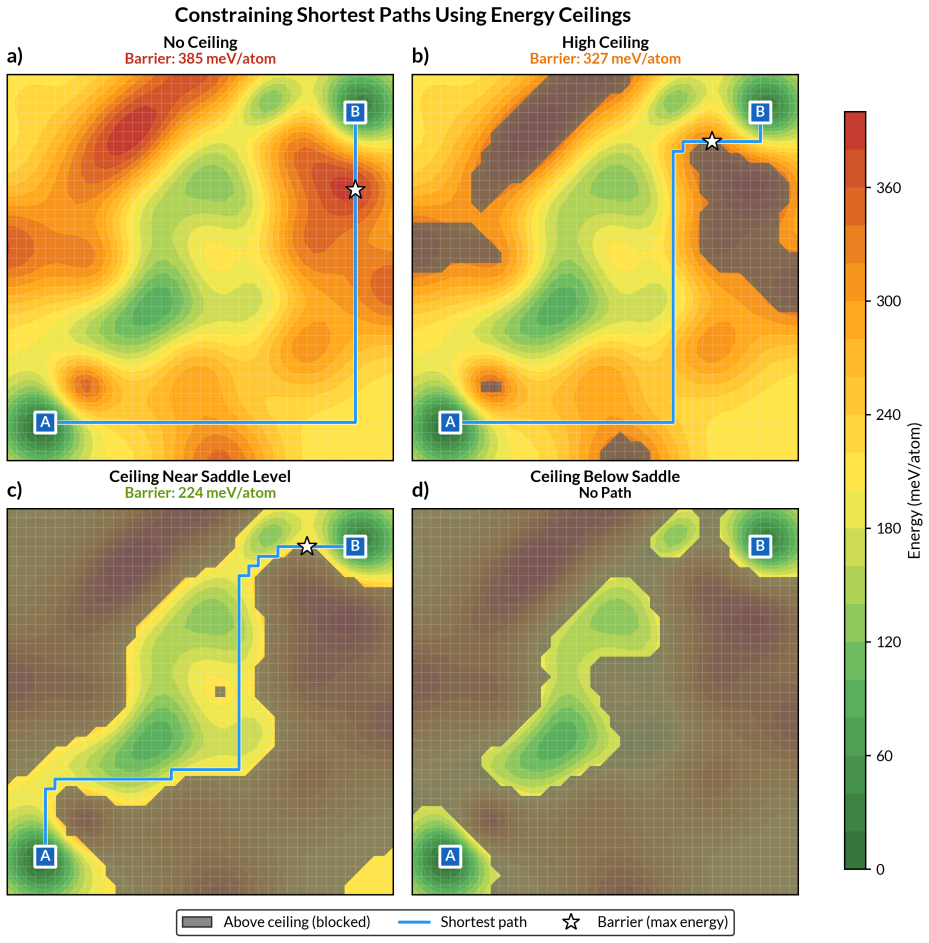
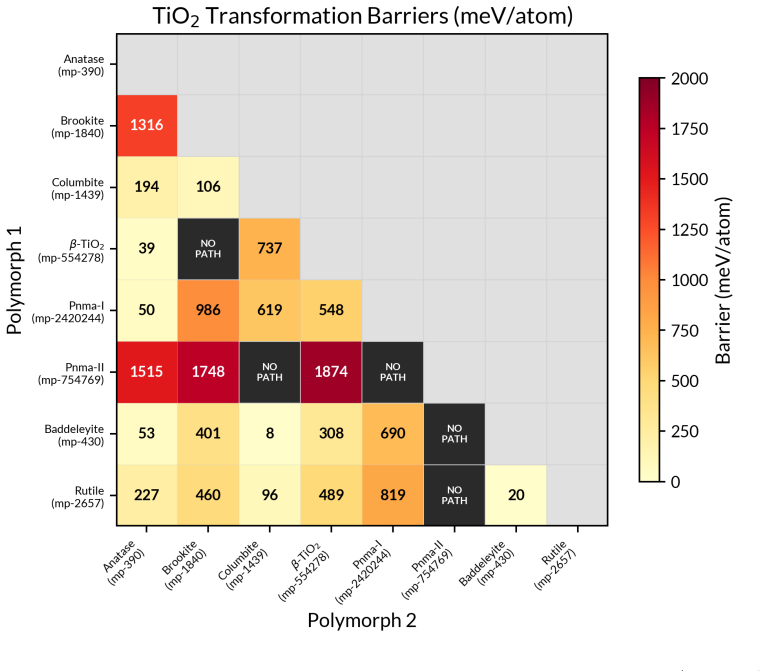
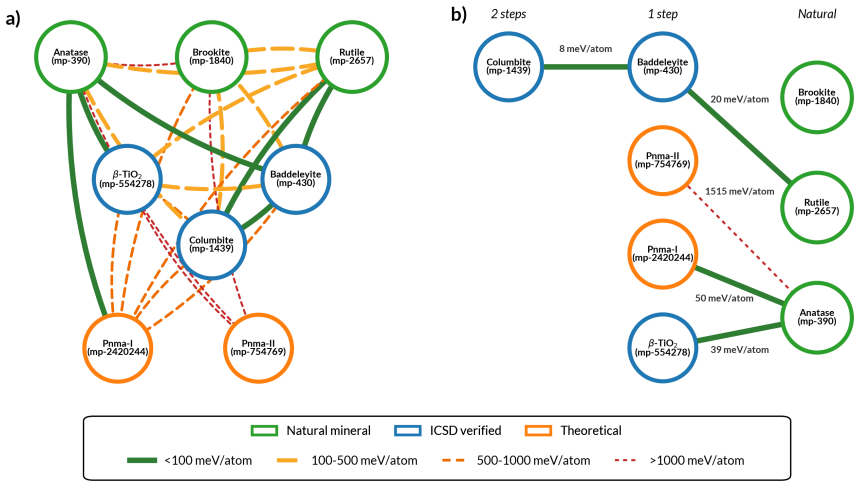
As the number of theoretically predicted materials continues to grow, it becomes increasingly important to assess not only their thermodynamic stability but also their kinetic viability under realistic synthesis conditions. In this study, we investigate the hypothesis that the kinetic persistence of a metastable polymorph is related to the topography of the potential energy landscape separating it from lower energy phases. To accomplish this, we develop a new method for identifying diffusionless transformation pathways between metastable polymorphs and their ground-state counterparts and discuss the energetics of those pathways with respect to the experimental observation of each phase. This algorithm is underpinned by the recently developed Crystal Normal Form, which provides a graph representation of crystal configuration space and supplies the substrate for our pathfinding algorithm. We apply this method to the titanium dioxide system which contains the well-known anatase, rutile, and brookite phases in addition to a number of hypothetical metastable polymorphs.
Editorial analysis
A structured set of objections, weighed in public.
Referee Report
Summary. The paper claims that the kinetic persistence of metastable TiO2 polymorphs (anatase, brookite, and hypothetical phases) relative to the ground-state rutile can be understood from the topography of the potential energy landscape, as probed by diffusionless transformation pathways. These pathways are identified via a new pathfinding algorithm operating on a graph representation of crystal configuration space provided by the Crystal Normal Form; the manuscript discusses the computed energetics of the pathways in relation to experimental observations of which phases persist.
Significance. If the diffusionless pathways are demonstrated to be the operative mechanisms controlling persistence, the approach would offer a systematic, graph-based route to assess kinetic viability of predicted polymorphs without requiring full kinetic Monte Carlo or molecular dynamics simulations. The Crystal Normal Form substrate for pathfinding is a concrete technical contribution that could be reused in other systems where configuration-space connectivity is the limiting factor.
major comments (2)
- [Application to TiO2 polymorphs] The central claim requires that the lowest-barrier diffusionless pathways identified by the algorithm correspond to the rate-limiting steps under realistic synthesis conditions. However, the manuscript does not compare the activation energies of these paths against literature values for the nucleation-and-growth, ionic-diffusion, or solvent-mediated mechanisms known to dominate anatase-rutile and brookite-rutile transformations in TiO2 (see the application section discussing experimental observations).
- [Discussion of pathway energetics] Without explicit validation that the diffusionless routes are accessible and competitive (e.g., via temperature/pressure regimes or comparison to measured activation barriers), the topography-to-persistence correlation remains an assumption rather than a demonstrated result. The abstract states that energetics are discussed relative to observation, but this does not substitute for evidence that the chosen mechanism class controls the observed persistence.
minor comments (1)
- [Abstract] The abstract would benefit from a one-sentence summary of the key numerical findings (e.g., barrier heights or ranking of pathways) rather than only stating that energetics are discussed.
Simulated Author's Rebuttal
We thank the referee for their constructive comments, which help to clarify the scope and limitations of our work. We address the major comments point-by-point below, and have revised the manuscript accordingly to better frame our claims regarding the role of diffusionless pathways in TiO2 polymorph persistence.
read point-by-point responses
-
Referee: [Application to TiO2 polymorphs] The central claim requires that the lowest-barrier diffusionless pathways identified by the algorithm correspond to the rate-limiting steps under realistic synthesis conditions. However, the manuscript does not compare the activation energies of these paths against literature values for the nucleation-and-growth, ionic-diffusion, or solvent-mediated mechanisms known to dominate anatase-rutile and brookite-rutile transformations in TiO2 (see the application section discussing experimental observations).
Authors: We acknowledge that our manuscript does not provide a direct quantitative comparison of our computed diffusionless barriers to all literature values for alternative mechanisms such as nucleation-and-growth or solvent-mediated processes. Our focus is on the development of the Crystal Normal Form-based pathfinding method and its application to identify diffusionless routes. In the revised manuscript, we have expanded the discussion in the application section to include available literature activation energies for solid-state transformations in TiO2 where relevant, and we explicitly note that diffusionless mechanisms may not be rate-limiting under all conditions but can provide insight into kinetic barriers for certain pathways. This revision clarifies that our correlation is within the context of diffusionless transformations. revision: partial
-
Referee: [Discussion of pathway energetics] Without explicit validation that the diffusionless routes are accessible and competitive (e.g., via temperature/pressure regimes or comparison to measured activation barriers), the topography-to-persistence correlation remains an assumption rather than a demonstrated result. The abstract states that energetics are discussed relative to observation, but this does not substitute for evidence that the chosen mechanism class controls the observed persistence.
Authors: We agree that the manuscript would benefit from stronger validation of the relevance of diffusionless pathways. We have revised the abstract and the discussion section to emphasize that our work demonstrates a correlation between the computed diffusionless pathway energetics and the observed persistence of certain phases, while acknowledging that this does not prove these are the operative mechanisms in all experimental settings. We have added qualitative discussion of temperature and pressure regimes where diffusionless transformations might be competitive, based on known TiO2 behavior, and included comparisons to measured barriers from literature for anatase-to-rutile transformations under specific conditions. These changes make the scope of our claims more precise. revision: yes
Circularity Check
No significant circularity; new pathfinding algorithm applied to external TiO2 observations
full rationale
The paper develops a new diffusionless pathfinding algorithm on the Crystal Normal Form graph representation of configuration space and applies it to map pathways among TiO2 polymorphs, then compares the resulting energetics to experimental persistence data. No derivation step reduces by construction to a fitted parameter or self-defined quantity; the central hypothesis is investigated rather than tautologically recovered. The Crystal Normal Form is cited as recently developed (likely prior self-work), but this is not load-bearing for the pathfinding results or the topography-to-persistence discussion, which remain independent against the external benchmark of known anatase/rutile/brookite behavior. No self-definitional, fitted-prediction, or uniqueness-imported patterns appear.
Axiom & Free-Parameter Ledger
Reference graph
Works this paper leans on
-
[1]
(2) Zeni, C. et al.Nature2025,639, 624–632. (3) Luo, X.; Wang, Z.; Wang, Q.; Shao, X.; Lv, J.; Wang, L.; Wang, Y.; Ma, Y.Nature Communications 2025,16,
work page 2025
-
[2]
(4) Kononova, O.; Huo, H.; He, T.; Rong, Z.; Botari, T.; Sun, W.; Tshitoyan, V.; Ceder, G.Scientific Data 2019,6,
work page 2019
-
[3]
J.; Trewartha, A.; Jain, A.; Sutter- Fella, C
(5) Cruse, K.; Baibakova, V.; Abdelsamie, M.; Hong, K.; Bartel, C. J.; Trewartha, A.; Jain, A.; Sutter- Fella, C. M.; Ceder, G.Chemistry of Materials2024,36, 772–785. (6) He, T.; Sun, W.; Huo, H.; Kononova, O.; Rong, Z.; Tshitoyan, V.; Botari, T.; Ceder, G.Chemistry of Materials2020,32, 7861–7873. (7) Zhang, J.; Zhang, L.; Sun, Y.; Li, W.; Quhe, R.Computa...
work page 1957
-
[4]
J.; Wang, Z.; Cruse, K.; Ceder, G.Science Advances2023,9, eadg8180
(16) He, T.; Huo, H.; Bartel, C. J.; Wang, Z.; Cruse, K.; Ceder, G.Science Advances2023,9, eadg8180. (17) Szymanski, N. J. et al.Nature2023,624, 86–91. (18) Chen, J.; Cross, S. R.; Miara, L. J.; Cho, J.-J.; Wang, Y.; Sun, W.Nature Synthesis2024,3, 606–614. 13 (19) Aykol, M.; Montoya, J. H.; Hummelshøj, J.Journal of the American Chemical Society2021,143, 9...
work page 2018
-
[5]
B.; Stevanović, V.Applied Physics Reviews2021,8, 031310
(24) Therrien, F.; Jones, E. B.; Stevanović, V.Applied Physics Reviews2021,8, 031310. (25) Zhu, L.; Cohen, R. E.; Strobel, T. A.The Journal of Physical Chemistry Letters2019,10, 5019–5026. (26) Shang, C.; Liu, Z.-P.Journal of Chemical Theory and Computation2013,9, 1838–1845. (27) Wang, F.-C.; Ye, Q.-J.; Zhu, Y.-C.; Li, X.-Z.Physical Review Letters2024,132...
work page 1998
-
[6]
(42) Luo, Y.; Benali, A.; Shulenburger, L.; Krogel, J. T.; Heinonen, O.; Kent, P. R. C.New Journal of Physics2016,18, 113049. (43) Muscat, J.; Swamy, V.; Harrison, N. M.Physical Review B2002,65, 224112. (44) Zhu, T.; Gao, S.-P.The Journal of Physical Chemistry C2014,118, 11385–11396. (45) Perdew, J. P.; Burke, K.; Ernzerhof, M.Physical Review Letters1996,...
work page 2008
discussion (0)
Sign in with ORCID, Apple, or X to comment. Anyone can read and Pith papers without signing in.