Dual-mode ground-state cooling in quadratic optomechanical systems: from multistability to general dark-mode suppression
Pith reviewed 2026-05-10 11:56 UTC · model grok-4.3
The pith
Simultaneous ground-state cooling of two mechanical resonators occurs on stable branches in a quadratic optomechanical system.
A machine-rendered reading of the paper's core claim, the machinery that carries it, and where it could break.
Core claim
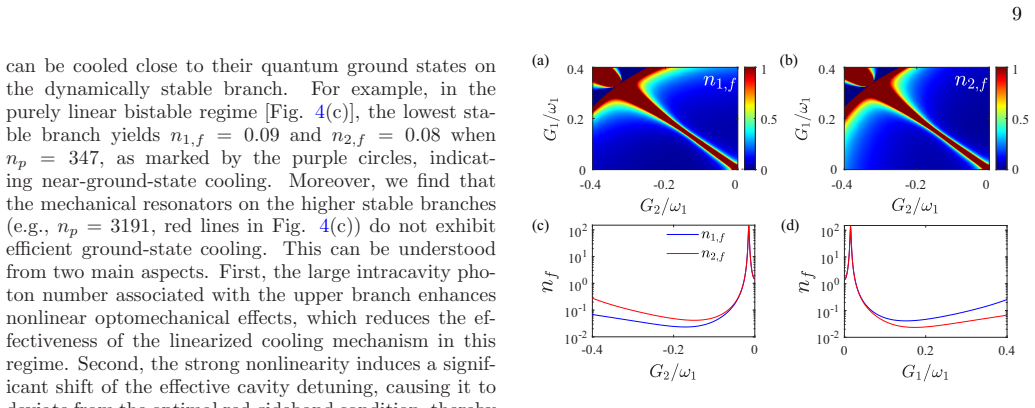
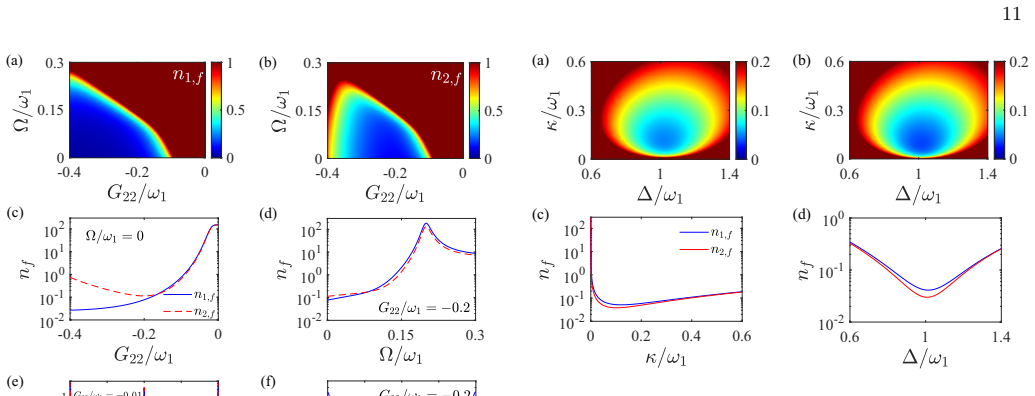
In this quadratic optomechanical system, simultaneous ground-state cooling of both mechanical resonators occurs on the dynamically stable branch of the nonlinear steady-state solutions. Beyond the multistable regime, robust simultaneous cooling is achieved over a broad parameter range, with dark-mode suppression enabled by adjusting second-order frequency shifts when couplings are comparable.
What carries the argument
The central mechanism is the steady-state analysis of the coupled system, where multistability arises from the nonlinear interactions, and dark-mode interference is controlled through optomechanical frequency shifts induced by the quadratic coupling.
Load-bearing premise
The idealized Hamiltonian and steady-state analysis capture the dominant physics without unmodeled losses, thermal noise, or higher-order nonlinearities that would destabilize the cooling branches in a real device.
What would settle it
An experiment that measures both mechanical modes reaching phonon numbers near zero on the predicted stable steady-state branches while varying detuning and couplings would confirm the cooling claim; failure to observe cooling or the presence of instability on those branches would falsify it.
Figures
read the original abstract
We theoretically investigate a quadratic optomechanical system comprising a single-mode optical cavity linearly coupled to one mechanical resonator and quadratically coupled to a second resonator. By tuning the cavity detuning and optomechanical coupling strengths, we demonstrate the transition from optical bistability to multistability with up to seven steady-state solutions. Notably, simultaneous ground-state cooling of both mechanical resonators occurs on the dynamically stable branch of the nonlinear steady-state solutions, offering new opportunities for combined nonlinear optical and quantum cooling functionalities. Beyond the multistable regime, we systematically study dual-mode ground-state cooling and find that robust simultaneous cooling can be achieved over a broad parameter range, except when the linear and quadratic couplings become comparable, where a dark-mode effect arises. In this case, tuning the second-order optomechanical-induced frequency shifts effectively suppresses dark-mode interference, enabling controllable and simultaneous ground-state cooling. Our results provide a versatile framework for engineering multimode quantum states in optomechanical systems and open new avenues for the development of multifunctional quantum devices, including ultra-sensitive sensors, scalable quantum memories, and integrated quantum networks.
Editorial analysis
A structured set of objections, weighed in public.
Referee Report
Summary. The manuscript theoretically investigates a quadratic optomechanical system consisting of a single-mode optical cavity that is linearly coupled to one mechanical resonator and quadratically coupled to a second resonator. By tuning cavity detuning and the linear/quadratic optomechanical coupling strengths, the authors map the transition from optical bistability to multistability (with up to seven steady-state solutions). They then identify dynamically stable branches on which linearized quantum fluctuation analysis yields simultaneous ground-state cooling (phonon numbers n1, n2 < 1) for both resonators, and they derive a tunable second-order frequency-shift term that suppresses dark-mode interference when the couplings become comparable.
Significance. If the results hold, the work supplies a concrete framework for engineering multimode quantum states in hybrid optomechanical systems by combining nonlinear multistability with quantum cooling. The explicit derivation of the dark-mode suppression mechanism from the Hamiltonian and the systematic parameter scans are strengths that could guide designs for multifunctional devices such as sensors or quantum memories. The approach follows standard semiclassical-plus-linearized-fluctuation methods, but the absence of full quantum simulations and explicit stability diagnostics limits immediate experimental translation.
major comments (2)
- [§4] §4 (Steady-state and stability analysis): The central claim that simultaneous ground-state cooling occurs on dynamically stable branches rests on Jacobian eigenvalue checks, yet the manuscript provides no explicit eigenvalue spectra, no tabulated real-part values, and no parameter-range boundaries where all eigenvalues have negative real parts for the cooling solutions. Without these data the stability assertion cannot be independently verified.
- [§5] §5 (Linearized quantum fluctuations): Phonon numbers n1 and n2 are extracted from the covariance matrix obtained via the Lyapunov equation. The manuscript reports no error bars on these numbers, no sensitivity analysis to small deviations in the semiclassical amplitudes, and no comparison against full quantum master-equation simulations, which is especially relevant in the multistable regime where the semiclassical approximation may break down.
minor comments (3)
- [Figures] Figure captions and axis labels in the multistability plots should explicitly mark which branches correspond to the stable cooling solutions discussed in the text.
- [Notation] The notation for the optomechanically induced frequency shifts (linear vs. quadratic contributions) could be made more distinct to avoid confusion when the couplings are comparable.
- [§5] A brief discussion of the validity regime of the linearized fluctuation analysis (e.g., in terms of the smallness of quantum fluctuations relative to the steady-state amplitudes) would improve clarity.
Simulated Author's Rebuttal
We thank the referee for the positive evaluation and constructive comments on our manuscript. We address each major comment below and indicate the revisions we will make.
read point-by-point responses
-
Referee: [§4] §4 (Steady-state and stability analysis): The central claim that simultaneous ground-state cooling occurs on dynamically stable branches rests on Jacobian eigenvalue checks, yet the manuscript provides no explicit eigenvalue spectra, no tabulated real-part values, and no parameter-range boundaries where all eigenvalues have negative real parts for the cooling solutions. Without these data the stability assertion cannot be independently verified.
Authors: We agree that explicit stability diagnostics would enhance independent verification. In the revised manuscript, we will add representative Jacobian eigenvalue spectra (real and imaginary parts) for the stable branches in §4, along with a table or supplementary section specifying the boundaries of the parameter ranges (detuning and coupling strengths) where all eigenvalues have negative real parts for the cooling solutions. This will be presented without changing the underlying analysis or results. revision: yes
-
Referee: [§5] §5 (Linearized quantum fluctuations): Phonon numbers n1 and n2 are extracted from the covariance matrix obtained via the Lyapunov equation. The manuscript reports no error bars on these numbers, no sensitivity analysis to small deviations in the semiclassical amplitudes, and no comparison against full quantum master-equation simulations, which is especially relevant in the multistable regime where the semiclassical approximation may break down.
Authors: We will incorporate error bars on the reported phonon numbers, derived from the elements of the covariance matrix, and add a sensitivity analysis showing how small deviations in the semiclassical amplitudes affect n1 and n2. However, performing full quantum master-equation simulations across the multistable regime is computationally intensive and lies outside the standard semiclassical-plus-linearized-fluctuation framework used throughout the work (valid in the weak-coupling, resolved-sideband limit). We will add a clarifying paragraph on the regime of validity of the approximation rather than including such simulations. revision: partial
Circularity Check
No significant circularity identified
full rationale
The paper's central results follow from direct solution of the semiclassical steady-state equations obtained from the given Hamiltonian, followed by Jacobian-based stability analysis and solution of the Lyapunov equation for the covariance matrix of linearized quantum fluctuations. The dual-mode cooling condition and dark-mode suppression via tunable frequency shifts are explicitly computed from these model equations without any fitted parameters being relabeled as predictions, without load-bearing self-citations, and without any ansatz or uniqueness claim imported from prior author work. The derivation chain is therefore self-contained against the stated Hamiltonian and does not reduce to its inputs by construction.
Axiom & Free-Parameter Ledger
free parameters (2)
- cavity detuning
- linear and quadratic optomechanical coupling strengths
axioms (2)
- domain assumption The system Hamiltonian is well approximated by the standard linear-plus-quadratic optomechanical form under the rotating-wave approximation.
- domain assumption Thermal noise and higher-order nonlinearities can be neglected when identifying the dynamically stable cooling branches.
Reference graph
Works this paper leans on
-
[1]
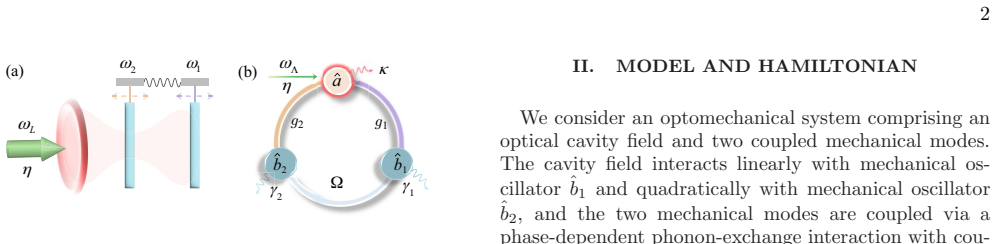
Additionally, an external driving field with frequency ω L and amplitude η is applied to the optical cavity. Under the rotating-wave approximation, the relevant Hamiltonian for the system reads: ˆH/ ℏ = ∆ cˆa†ˆa + ω 1ˆb† 1ˆb1 + ω 2ˆb† 2ˆb2 + g1ˆa†ˆa(ˆb† 1 + ˆb1) +g2ˆa†ˆa(ˆb† 2 + ˆb2)2 + [(Ω eiθˆb† 1ˆb2 + ηˆa) + H. c. ], (1) where ∆ c = ω c − ω L represents...
-
[2]
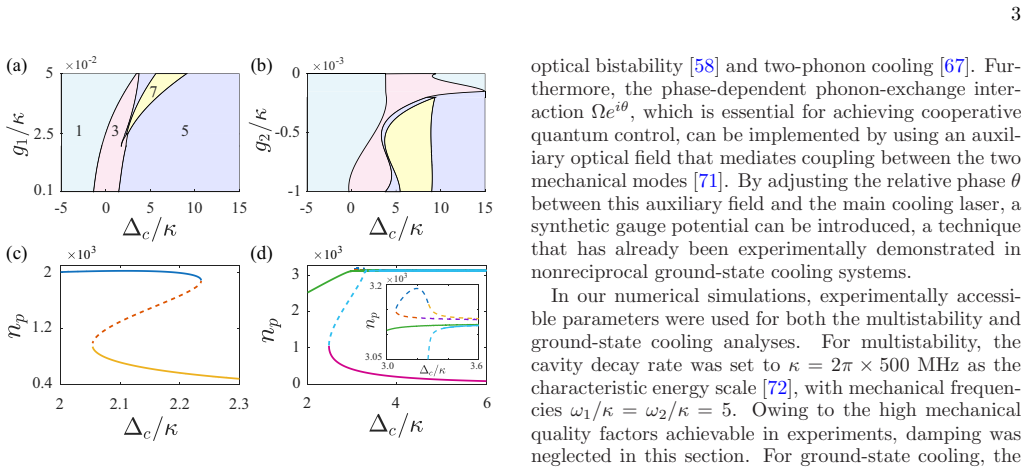
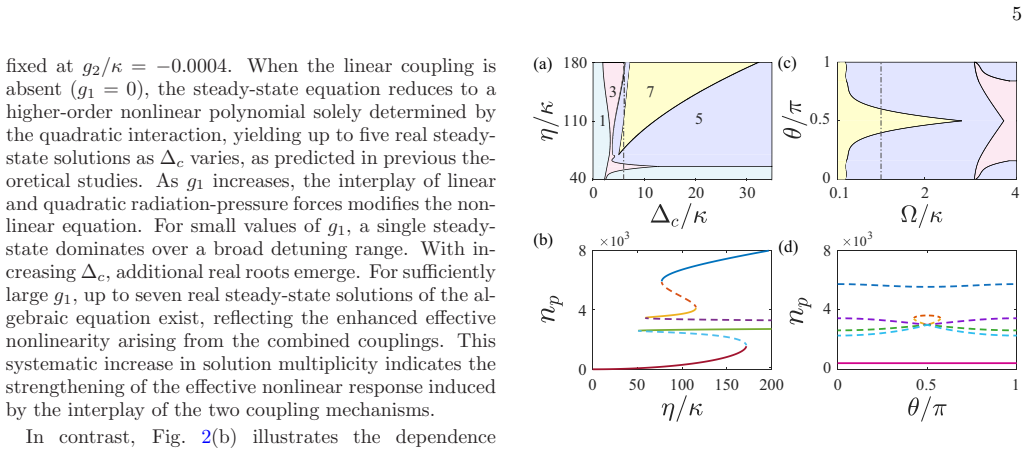
provides a compact representation of the nonlinear steady-state condition, where the coefficients Cm explicitly depend on the linear and quadratic optome- chanical coupling strengths g1 and g2. These coefficients determine the number and stability of the steady-state solutions, enabling a comprehensive understanding of the system’s multistable behavior. In th...
-
[3]
reduces to a linear response with a single steady-state solution. Once optomechanical interactions are introduced ( g1 ̸= 0 and/or g2 ̸= 0), the system’s be- havior changes qualitatively, and multiple steady states, both stable and unstable can emerge. This clearly high- lights the central role of optomechanical nonlinearities in enabling optical bistabil...
-
[4]
reduces to a third-order polynomial, then the sys- tem exhibits three steady-state solutions, corresponding to a conventional optical bistability scenario. Physically, this implies that the inclusion of linear coupling modi- fies the optical response, introducing nonlinear shifts that lead to a hysteresis-like behavior in the cavity field dy- namics. When o...
-
[5]
now takes the form of a fifth-order polynomial, which allows for ad- ditional solutions compared to the linear coupling case. The emergence of five roots suggests that quadratic cou- pling alone can induce higher-order multistability. This is likely due to its ability to introduce asymmetric po- tential modifications and enhance nonlinear feedback ef- fects,...
-
[6]
The com- bined effect of g1 and g2 suggests a highly tunable mech- anism for controlling multistability, where the relative strengths of the two couplings determine the number and stability of solutions. This tunability has significant im- plications for applications in optical switching, quantum memory, and nonlinear photonics, where precise control over m...
-
[7]
(13) here matrix M(t) is defined as M(t) = exp( At)
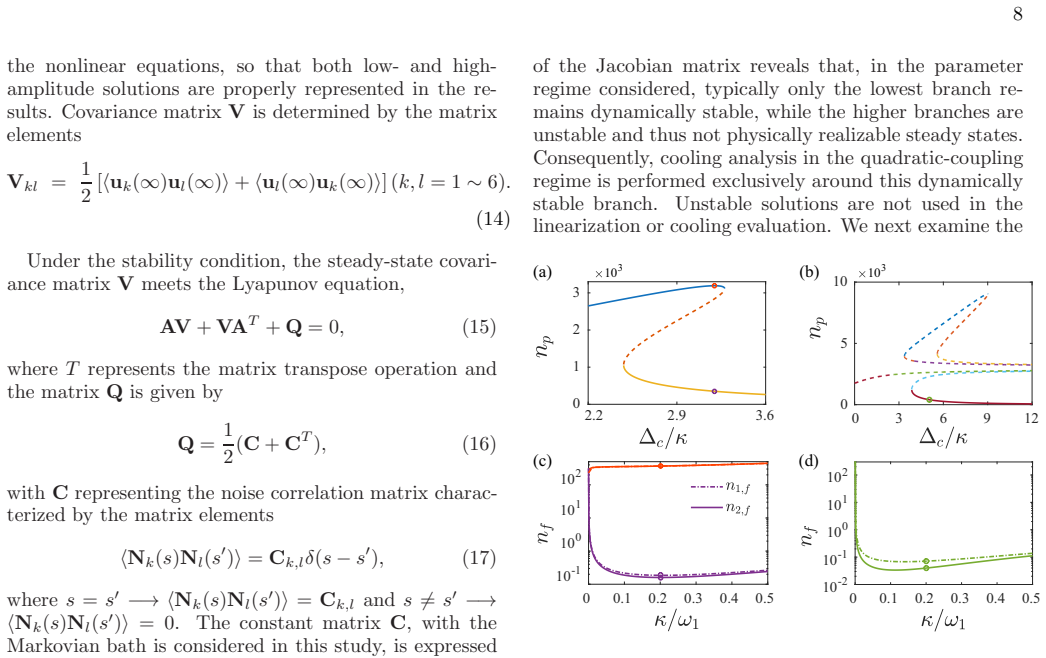
can be written as u(t) = M(t)u(0) + ∫ t 0 M(t − s)N(s)ds. (13) here matrix M(t) is defined as M(t) = exp( At). The steady-state average phonon numbers in two mechanical resonators can be calculated by solving the Lyapunov equation. It is noteworthy that the parameters used in the subsequent calculations satisfy the stability condition derived from the Rout...
-
[8]
Obser- vation of radiation pressure shot noise on a macroscopic object,
T. P. Purdy, R. W. Peterson, and C. A. Regal, “Obser- vation of radiation pressure shot noise on a macroscopic object,” Science 339, 801–804 (2013) ,
work page 2013
-
[9]
Optome- chanical quantum information processing with photons and phonons,
K. Stannigel, P. Komar, S. J. M. Habraken, S. D. Ben- nett, M. D. Lukin, P. Zoller, and P. Rabl, “Optome- chanical quantum information processing with photons and phonons,” Phys. Rev. Lett. 109, 013603 (2012)
work page 2012
-
[10]
Optomechanics for quantum technologies,
Shabir Barzanjeh, Andr´ e Xuereb, Simon Gr¨ oblacher, Mauro Paternostro, Cindy A. Regal, and Eva M. Weig, “Optomechanics for quantum technologies,” Nature Physics 18, 15–24 (2021)
work page 2021
-
[11]
Cavity optomechanical sensing,
Bei-Bei Li, Lingfeng Ou, Yuechen Lei, and Yong-Chun Liu, “Cavity optomechanical sensing,” Nanophotonics 10, 2799–2832 (2021)
work page 2021
-
[12]
Storing optical infor- mation as a mechanical excitation in a silica optomechan- ical resonator,
Victor Fiore, Yong Yang, Mark C. Kuzyk, Russell Bar- bour, Lin Tian, and Hailin Wang, “Storing optical infor- mation as a mechanical excitation in a silica optomechan- ical resonator,” Phys. Rev. Lett. 107, 133601 (2011)
work page 2011
-
[13]
Engi- neering of nonclassical motional states in optomechanical systems,
X.-W. Xu, H. Wang, J. Zhang, and Y.-X. Liu, “Engi- neering of nonclassical motional states in optomechanical systems,” Phys. Rev. A 88, 063819 (2013)
work page 2013
-
[14]
Generation of macroscopic quantum superposi- tions of optomechanical oscillators by dissipation,
H.-T. Tan, F. Bariani, G.-X. Li, and P. Meystre, “Generation of macroscopic quantum superposi- tions of optomechanical oscillators by dissipation,” Phys. Rev. A 88, 023817 (2013)
work page 2013
-
[15]
Macro- scopic optomechanics from displaced single-photon en- tanglement,
P. Sekatski, M. Aspelmeyer, and N. Sangouard, “Macro- scopic optomechanics from displaced single-photon en- tanglement,” Phys. Rev. Lett. 112, 080502 (2014)
work page 2014
-
[16]
Black phosphorus for photonic integrated cir- cuits,
Mingxin Zhang, Lele Yang, Xiaoxuan Wu, and Junjia Wang, “Black phosphorus for photonic integrated cir- cuits,” Research 6, 0206 (2023) ,
work page 2023
-
[17]
Approaching the quantum limit of a nanomechanical resonator,
M. D. LaHaye, O. Buu, B. Camarota, and K. C. Schwab, “Approaching the quantum limit of a nanomechanical resonator,” Science 304, 74–77 (2004) ,
work page 2004
-
[18]
Markus Aspelmeyer, Pierre Meystre, and Keith Schwab, “Quantum optomechanics,” Physics Today 65, 29–35 (2012) , 13
work page 2012
-
[19]
Using interfer- ence for high fidelity quantum state transfer in optome- chanics,
Ying-Dan Wang and Aashish A. Clerk, “Using interfer- ence for high fidelity quantum state transfer in optome- chanics,” Phys. Rev. Lett. 108, 153603 (2012)
work page 2012
-
[20]
Reversible optical-to-microwave quantum in- terface,
Sh. Barzanjeh, M. Abdi, G. J. Milburn, P. Tombesi, and D. Vitali, “Reversible optical-to-microwave quantum in- terface,” Phys. Rev. Lett. 109, 130503 (2012)
work page 2012
-
[21]
A high- resolution microchip optomechanical accelerometer,
Alexander G. Krause, Martin Winger, Tim D. Bla- sius, Qiang Lin, and Oskar Painter, “A high- resolution microchip optomechanical accelerometer,” Nature Photonics 6, 768–772 (2012)
work page 2012
-
[22]
All-optical mass sens- ing with coupled mechanical resonator systems,
Jin-Jin Li and Ka-Di Zhu, “All-optical mass sens- ing with coupled mechanical resonator systems,” Physics Reports 525, 223–254 (2013)
work page 2013
-
[23]
Op- tomechanical superpositions via nested interferometry,
Brian Pepper, Roohollah Ghobadi, Evan Jeffrey, Christoph Simon, and Dirk Bouwmeester, “Op- tomechanical superpositions via nested interferometry,” Phys. Rev. Lett. 109, 023601 (2012)
work page 2012
-
[24]
Quantum ground state and single-phonon control of a mechanical resonator,
A. D. O’Connell, M. Hofheinz, M. Ansmann, Ra- doslaw C. Bialczak, M. Lenander, Erik Lucero, M. Nee- ley, D. Sank, H. Wang, M. Weides, J. Wenner, John M. Martinis, and A. N. Cleland, “Quantum ground state and single-phonon control of a mechanical resonator,” Nature 464, 697–793 (2010)
work page 2010
-
[25]
Op- tomechanical cooling of a macroscopic oscillator by ho- modyne feedback,
Stefano Mancini, David Vitali, and Paolo Tombesi, “Op- tomechanical cooling of a macroscopic oscillator by ho- modyne feedback,” Phys. Rev. Lett. 80, 688–691 (1998)
work page 1998
-
[26]
Quan- tum noise interference and backaction cooling in cavity nanomechanics,
Florian Elste, S. M. Girvin, and A. A. Clerk, “Quan- tum noise interference and backaction cooling in cavity nanomechanics,” Phys. Rev. Lett. 102, 207209 (2009)
work page 2009
-
[27]
Measurement-based quantum control of mechani- cal motion,
Massimiliano Rossi, David Mason, Junxin Chen, Yeghishe Tsaturyan, and Albert Schliesser, “Measurement-based quantum control of mechani- cal motion,” Nature 563, 53–58 (2018)
work page 2018
-
[28]
Sideband cooling of a mi- cromechanical oscillator to the quantum ground state,
J. D. Teufel, T. Donner, D. Li, J. W. Harlow, M. S. All- man, K. Cicak, A. J. Sirois, J. D. Whittaker, K. W. Lehn- ert, and R. W. Simmonds, “Sideband cooling of a mi- cromechanical oscillator to the quantum ground state,” Nature 475, 359–363 (2011)
work page 2011
-
[29]
Radiation pressure cooling of a micromechanical oscillator using dynamical backaction,
A. Schliesser, P. Del’Haye, N. Nooshi, K. J. Vahala, and T. J. Kippenberg, “Radiation pressure cooling of a micromechanical oscillator using dynamical backaction,” Phys. Rev. Lett. 97, 243905 (2006)
work page 2006
-
[30]
Theory of ground state cooling of a mechanical oscillator using dynamical backaction,
I. Wilson-Rae, N. Nooshi, W. Zwerger, and T. J. Kippenberg, “Theory of ground state cooling of a mechanical oscillator using dynamical backaction,” Phys. Rev. Lett. 99, 093901 (2007)
work page 2007
-
[31]
Quantum theory of cavity- assisted sideband cooling of mechanical motion,
Florian Marquardt, Joe P. Chen, A. A. Clerk, and S. M. Girvin, “Quantum theory of cavity- assisted sideband cooling of mechanical motion,” Phys. Rev. Lett. 99, 093902 (2007)
work page 2007
-
[32]
C. Genes, D. Vitali, P. Tombesi, S. Gigan, and M. As- pelmeyer, “Ground-state cooling of a micromechanical oscillator: Comparing cold damping and cavity-assisted cooling schemes,” Phys. Rev. A 77, 033804 (2008)
work page 2008
-
[33]
Resolved- sideband cooling of a micromechanical oscillator,
A. Schliesser, R. Rivi` ere, G. Anetsberger, O. Arcizet, and T. J. Kippenberg, “Resolved- sideband cooling of a micromechanical oscillator,” Nature Physics 4, 415–419 (2008)
work page 2008
-
[34]
Jasper Chan, T. P. Mayer Alegre, Amir H. Safavi- Naeini, Jeff T. Hill, Alex Krause, Simon Gr¨ oblacher, Markus Aspelmeyer, and Oskar Painter, “Ground- state cooling of a micromechanical oscillator: Compar- ing cold damping and cavity-assisted cooling schemes,” Nature 478, 89–92 (2011)
work page 2011
-
[35]
Dynamic dissipative cooling of a me- chanical resonator in strong coupling optomechanics,
Yong-Chun Liu, Yun-Feng Xiao, Xingsheng Luan, and Chee Wei Wong, “Dynamic dissipative cooling of a me- chanical resonator in strong coupling optomechanics,” Phys. Rev. Lett. 110, 153606 (2013)
work page 2013
-
[36]
Laser cooling of a micromechanical membrane to the quantum backaction limit,
R. W. Peterson, T. P. Purdy, N. S. Kampel, R. W. An- drews, P.-L. Yu, K. W. Lehnert, and C. A. Regal, “Laser cooling of a micromechanical membrane to the quantum backaction limit,” Phys. Rev. Lett. 116, 063601 (2016)
work page 2016
-
[37]
Ground-state cooling of a mechanical oscillator by interference in an- dreev reflection,
P. Stadler, W. Belzig, and G. Rastelli, “Ground-state cooling of a mechanical oscillator by interference in an- dreev reflection,” Phys. Rev. Lett. 117, 197202 (2016)
work page 2016
-
[38]
Side- band cooling beyond the quantum backaction limit with squeezed light,
Jeremy B. Clark, Florent Lecocq, Raymond W. Sim- monds, Jos´ e Aumentado, and John D. Teufel, “Side- band cooling beyond the quantum backaction limit with squeezed light,” Nature 541, 191–195 (2017)
work page 2017
-
[39]
High-contrast all optical bistable switching in coupled nonlinear photonic crystal microcavities,
Shaohui Li and Xuhong Cai, “High-contrast all optical bistable switching in coupled nonlinear photonic crystal microcavities,” Applied Physics Letters 96, 131114 (2010) ,
work page 2010
-
[40]
Sublobectomy versus lobectomy for stage i non-small cell lung cancer in the elderly,
Chen Qiu, Guanghui Wang, Jun Xu, Lixuan Cui, Wei Dong, Yang Ni, Xiao Qu, and Ji- ajun Du, “Sublobectomy versus lobectomy for stage i non-small cell lung cancer in the elderly,” International Journal of Surgery 37, 1–7 (2017)
work page 2017
-
[41]
Ob- servation of absorptive bistability with two-level atoms i n a ring cavity,
A. T. Rosenberger, L. A. Orozco, and H. J. Kimble, “Ob- servation of absorptive bistability with two-level atoms i n a ring cavity,” Phys. Rev. A 28, 2569–2572 (1983)
work page 1983
-
[42]
Realization of all-optical multistate switching in an atomic coherent medium,
T. K. Para ¨ ıso, M. Wouters, Y. L´ eger, F. Morier-Genoud, and B. Deveaud-Pl´ edran, “Realization of all-optical multistate switching in an atomic coherent medium,” Nature Materials 9, 655–660 (2010)
work page 2010
-
[43]
Realiza- tion of all-optical multistate switching in an atomic co- herent medium,
Jiteng Sheng, Utsab Khadka, and Min Xiao, “Realiza- tion of all-optical multistate switching in an atomic co- herent medium,” Phys. Rev. Lett. 109, 223906 (2012)
work page 2012
-
[44]
Wavelength-selective 2 × 2 optical switch based on a Ge 2Sb2Te5-assisted microring,
Changping Zhang, Ming Zhang, Yiwei Xie, Yaocheng Shi, Rajesh Kumar, Roberto R. Panepucci, and Daoxin Dai, “Wavelength-selective 2 × 2 optical switch based on a Ge 2Sb2Te5-assisted microring,” Photon. Res. 8, 1171–1176 (2020)
work page 2020
-
[45]
Optical ring- resonator random-access memories,
Rodney S. Tucker and Jennifer L. Riding, “Optical ring- resonator random-access memories,” J. Lightwave Tech- nol. 26, 320–328 (2008)
work page 2008
-
[46]
Radiative bistability and thermal mem- ory,
Viacheslav Kubytskyi, Svend-Age Biehs, and Philippe Ben-Abdallah, “Radiative bistability and thermal mem- ory,” Phys. Rev. Lett. 113, 074301 (2014)
work page 2014
-
[47]
Large-scale integration of wavelength-addressabl e all-optical memories on a photonic crystal chip,
Eiichi Kuramochi, Kengo Nozaki, Akihiko Shinya, Koji Takeda, Tomonari Sato, Shinji Matsuo, Hideaki Taniyama, Hisashi Sumikura, and Masaya No- tomi, “Large-scale integration of wavelength-addressabl e all-optical memories on a photonic crystal chip,” Nature Photonics 8, 474–481 (2014)
work page 2014
-
[48]
Optical bistability under non- resonant excitation in spinor polariton condensates,
L. Pickup, K. Kalinin, A. Askitopoulos, Z. Hat- zopoulos, P. G. Savvidis, N. G. Berloff, and P. G. Lagoudakis, “Optical bistability under non- resonant excitation in spinor polariton condensates,” Phys. Rev. Lett. 120, 225301 (2018)
work page 2018
-
[49]
All-optical polariton transistor,
D. Ballarini, M. De Giorgi, E. Cancellieri, R. Houdr´ e, E. Giacobino, R. Cingolani, A. Bramati, G. Gigli, and D. Sanvitto, “All-optical polariton transistor,” Nature Communications 4, 1778 (2014)
work page 2014
-
[50]
Pengfei Zheng, Xuemeng Xu, Guohua Hu, Ruohu Zhang, Binfeng Yun, and Yiping Cui, “Inte- grated multi-functional optical filter based on a self- coupled microring resonator assisted mzi structure,” 14 J. Lightwave Technol. 39, 1429–1437 (2021)
work page 2021
-
[51]
Silicon-on-insulator micror- ing resonator sensor based on an amplitude comparison sensing function,
Wenjian Yang, Shijie Song, Xiaoke Yi, Suen Xin Chew, Liwei Li, and Linh Nguyen, “Silicon-on-insulator micror- ing resonator sensor based on an amplitude comparison sensing function,” Opt. Lett. 43, 70–73 (2018)
work page 2018
-
[52]
Con- trollable optical bistability based on photons and phonons in a two-mode optomechanical system,
Cheng Jiang, Hongxiang Liu, Yuanshun Cui, Xi- aowei Li, Guibin Chen, and Xuemin Shuai, “Con- trollable optical bistability based on photons and phonons in a two-mode optomechanical system,” Phys. Rev. A 88, 055801 (2013)
work page 2013
-
[53]
Optomechanically induced non- reciprocity in a three-mode optomechanical system,
Xun-Wei Xu, L. N. Song, Qiang Zheng, Z. H. Wang, and Yong Li, “Optomechanically induced non- reciprocity in a three-mode optomechanical system,” Phys. Rev. A 98, 063845 (2018)
work page 2018
-
[54]
Suzhen Zhang, Jiahua Li, Rong Yu, Wei Wang, and Ying Wu, “Optical multistability and fano line- shape control via mode coupling in whispering- gallery-mode microresonator optomechanics,” Scientific Reports 7, 39781 (2017)
work page 2017
-
[55]
Bistability of cavity magnon polaritons,
Yi-Pu Wang, Guo-Qiang Zhang, Dengke Zhang, Tie-Fu Li, C.-M. Hu, and J. Q. You, “Bistability of cavity magnon polaritons,” Phys. Rev. Lett. 120, 057202 (2018)
work page 2018
-
[56]
Long-time memory and ternary logic gate using a multistable cavity magnonic system,
Rui-Chang Shen, Yi-Pu Wang, Jie Li, Shi-Yao Zhu, G. S. Agarwal, and J. Q. You, “Long-time memory and ternary logic gate using a multistable cavity magnonic system,” Phys. Rev. Lett. 127, 183202 (2021)
work page 2021
-
[57]
Optical multistabil- ity in three-level atoms inside an optical ring cavity,
Amitabh Joshi and Min Xiao, “Optical multistabil- ity in three-level atoms inside an optical ring cavity,” Phys. Rev. Lett. 91, 143904 (2003)
work page 2003
-
[58]
Cavity-mediated strong mat- ter wave bistability in a spin-1 condensate,
Lu Zhou, Han Pu, Hong Y. Ling, and Weiping Zhang, “Cavity-mediated strong mat- ter wave bistability in a spin-1 condensate,” Phys. Rev. Lett. 103, 160403 (2009)
work page 2009
-
[59]
Prob- ing a dissipative phase transition via dynamical optical hysteresis,
S. R. K. Rodriguez, W. Casteels, F. Storme, N. Car- lon Zambon, I. Sagnes, L. Le Gratiet, E. Galopin, A. Lema ˆ ıtre, A. Amo, C. Ciuti, and J. Bloch, “Prob- ing a dissipative phase transition via dynamical optical hysteresis,” Phys. Rev. Lett. 118, 247402 (2017)
work page 2017
-
[60]
Signatures of a dis- sipative phase transition in photon correlation measure- ments,
Thomas Fink, Anne Schade, Sven H¨ ofling, Christian Schneider, and Ata¸ c Imamo˘ glu, “Signatures of a dis- sipative phase transition in photon correlation measure- ments,” Nature Physics 14, 365–369 (2018)
work page 2018
-
[61]
Optical bistability in nonlinear surface-plasmon polaritonic cry s- tals,
G. A. Wurtz, R. Pollard, and A. V. Zayats, “Optical bistability in nonlinear surface-plasmon polaritonic cry s- tals,” Phys. Rev. Lett. 97, 057402 (2006)
work page 2006
-
[62]
Low threshold optical bistability in one-dimensional gratings based on graphene plasmonics,
Jun Guo, Leyong Jiang, Yue Jia, Xiaoyu Dai, Yuan- jiang Xiang, and Dianyuan Fan, “Low threshold optical bistability in one-dimensional gratings based on graphene plasmonics,” Opt. Express 25, 5972–5981 (2017)
work page 2017
-
[63]
Strong dispersive coupling of a high-finesse cavity to a microme- chanical membrane,
J. D. Thompson, B. M. Zwickl, A. M. Jayich, Florian Marquardt, S. M. Girvin, and J. G. E. Harris, “Strong dispersive coupling of a high-finesse cavity to a microme- chanical membrane,” Nature 452, 72–75 (2008)
work page 2008
-
[64]
Dispersive op- tomechanics: a membrane inside a cavity,
A M Jayich, J C Sankey, B M Zwickl, C Yang, J D Thompson, S M Girvin, A A Clerk, F Mar- quardt, and J G E Harris, “Dispersive op- tomechanics: a membrane inside a cavity,” New Journal of Physics 10, 095008 (2008)
work page 2008
-
[65]
Sonam Mahajan, Neha Aggarwal, Madhav Kumar Singh, and Aranya B. Bhattacherjee, “Nonlinear ef- fects of quadratic coupling in optical multistability and controllable transparency of a hybrid optome- chanical system consisting of quantum dot molecules,” Optical and Quantum Electronics 55, 207 (2023)
work page 2023
-
[66]
Optomechanically induced transparency in a membrane-in-the-middle setup at room temperature,
M. Karuza, C. Biancofiore, M. Bawaj, C. Molinelli, M. Galassi, R. Natali, P. Tombesi, G. Di Giuseppe, and D. Vitali, “Optomechanically induced transparency in a membrane-in-the-middle setup at room temperature,” Phys. Rev. A 88, 013804 (2013)
work page 2013
-
[67]
C. Bai, B. P. Hou, D. G. Lai, and D. Wu, “Tunable op- tomechanically induced transparency in double quadrat- ically coupled optomechanical cavities within a common reservoir,” Phys. Rev. A 93, 043804 (2016)
work page 2016
-
[68]
Photon blockade in quadratically coupled optomechanical systems,
Jie-Qiao Liao and Franco Nori, “Photon blockade in quadratically coupled optomechanical systems,” Phys. Rev. A 88, 023853 (2013)
work page 2013
-
[69]
Quantum- limited directional amplifiers with optomechanics,
Daniel Malz, L´ aszl´ o D. T´ oth, Nathan R. Bernier, Alexey K. Feofanov, Tobias J. Kippen- berg, and Andreas Nunnenkamp, “Quantum- limited directional amplifiers with optomechanics,” Phys. Rev. Lett. 120, 023601 (2018)
work page 2018
-
[70]
Liu-Gang Si, Hao Xiong, M. Suhail Zubairy, and Ying Wu, “Optomechanically induced opacity and amplifica- tion in a quadratically coupled optomechanical system,” Phys. Rev. A 95, 033803 (2017)
work page 2017
-
[71]
Amit Rai and G. S. Agarwal, “Quantum optical spring,” Phys. Rev. A 78, 013831 (2008)
work page 2008
-
[72]
Sumei Huang and G. S. Agarwal, “Electromag- netically induced transparency from two-phonon processes in quadratically coupled membranes,” Phys. Rev. A 83, 023823 (2011)
work page 2011
-
[73]
Trapping and cool- ing a mirror to its quantum mechanical ground state,
M. Bhattacharya and P. Meystre, “Trapping and cool- ing a mirror to its quantum mechanical ground state,” Phys. Rev. Lett. 99, 073601 (2007)
work page 2007
-
[74]
Cooling and squeezing via quadratic optome- chanical coupling,
A. Nunnenkamp, K. Børkje, J. G. E. Harris, and S. M. Girvin, “Cooling and squeezing via quadratic optome- chanical coupling,” Phys. Rev. A 82, 021806 (2010)
work page 2010
-
[75]
Entanglement-enhanced optomechanical sensing,
Yi Xia, Aman R Agrawal, Christian M Pluchar, An- thony J Brady, Zhen Liu, Quntao Zhuang, Dalziel J Wilson, and Zheshen Zhang, “Entanglement-enhanced optomechanical sensing,” Nature Photonics 17, 470–477 (2023)
work page 2023
-
[76]
Simulation of an optomechan- ical quantum memory in the nonlinear regime,
R. Y. Teh, S. Kiesewetter, M. D. Reid, and P. D. Drummond, “Simulation of an optomechan- ical quantum memory in the nonlinear regime,” Phys. Rev. A 96, 013854 (2017)
work page 2017
-
[77]
Hybrid quantum systems with circuit quantum electrodynamics,
A. A. Clerk, K. W. Lehnert, P. Bertet, J. R. Petta, and Y. Nakamura, “Hybrid quantum systems with circuit quantum electrodynamics,” Nat. Phys. 16, 257–267 (2020)
work page 2020
-
[78]
Nonreciprocal ground- state cooling of multiple mechanical resonators,
Deng-Gao Lai, Jin-Feng Huang, Xian-Li Yin, Bang-Pin Hou, Wenlin Li, David Vitali, Franco Nori, and Jie-Qiao Liao, “Nonreciprocal ground- state cooling of multiple mechanical resonators,” Phys. Rev. A 102, 011502 (2020)
work page 2020
-
[79]
Laser cooling of a nanomechanical oscillator into its quantum ground state,
Jasper Chan, T. P. Mayer Alegre, Amir H. Safavi- Naeini, Jeff T. Hill, Alex Krause, Simon Gr¨ oblacher, Markus Aspelmeyer, and Oskar Painter, “Laser cooling of a nanomechanical oscillator into its quantum ground state,” Nature 478, 89–92 (2011)
work page 2011
discussion (0)
Sign in with ORCID, Apple, or X to comment. Anyone can read and Pith papers without signing in.