Absence of solid phase in dense amorphous active granular matter
Pith reviewed 2026-05-10 10:17 UTC · model grok-4.3
The pith
Active granular matter with varied particle sizes stays fluid at densities where passive systems jam into solids.
A machine-rendered reading of the paper's core claim, the machinery that carries it, and where it could break.
Core claim
In experiments with active Brownian granular matter using polydisperse particles to suppress crystallization, the system maintains a fluid phase at packing fractions higher than those that trigger jamming or solidification in passive or monodisperse cases, suggesting that activity influences the global dynamical properties by preventing the transition to a solid state.
What carries the argument
The combination of persistent activity in Brownian-like particle motion and polydispersity from mixed particle sizes, which together suppress both crystallization and jamming to sustain fluid dynamics at high densities.
If this is right
- Jamming transitions can be avoided in dense granular systems when activity is present and crystallization is blocked by polydispersity.
- The material exhibits fluid-like global dynamics, such as ongoing particle motion, even at packing fractions above the crystallization point.
- Activity modifies the overall response of granular matter to compression or crowding beyond what local particle interactions would predict.
- Dense amorphous states remain accessible in active granular systems without inevitable solidification.
Where Pith is reading between the lines
- Varying the degree of size difference or activity strength could map out boundaries where fluidity gives way to other states.
- Similar suppression of solidification might appear in other active systems like swarms or self-propelled colloids at high densities.
- Engineering applications could use activity and controlled polydispersity to keep granular flows moving in confined or crowded environments.
- The result raises questions about whether passive granular matter under external driving could mimic this fluid retention.
Load-bearing premise
The fluid phase persists specifically because activity and size mixing block jamming, rather than because the highest packing fractions were not fully achieved or because mixing was incomplete.
What would settle it
Running the same setup without activity (passive particles) at the reported high packing fractions and observing either crystallization or a jammed solid phase would contradict the claim that activity is required to maintain fluidity.
Figures


read the original abstract
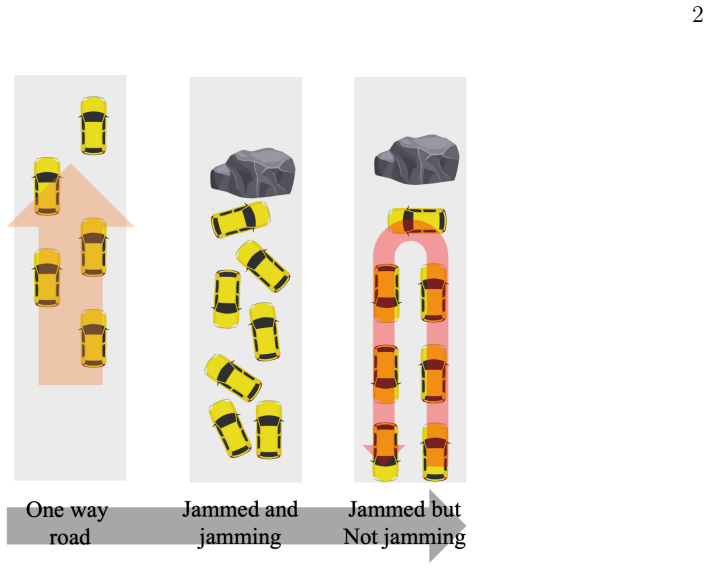
Solid phase of dense granular matter is inevitable because of jamming transition when the packing fraction or the pressure suffered is high enough. The experiment suggests that active Brownian granular matter will keep fluid phase even under the highest packing fraction (higher than the packing fraction of crystallization) if crystallization is prevented by mixing granular particles of different sizes. The findings encourage us to reconsider the role of activity in affecting the global dynamical properties of matter.
Editorial analysis
A structured set of objections, weighed in public.
Referee Report
Summary. The manuscript claims that dense amorphous active Brownian granular matter remains fluid even at packing fractions exceeding the crystallization threshold when polydispersity (mixing particles of different sizes) prevents crystallization, in contrast to the jamming-induced solid phase expected in passive granular systems. The abstract frames this as an experimental observation that encourages reconsidering the role of activity in global dynamical properties.
Significance. If the central claim were substantiated with quantitative data, it would challenge standard pictures of jamming transitions in active granular matter by suggesting that activity combined with polydispersity can suppress solidification at high densities. This could inform models of active matter and non-equilibrium phase behavior. However, the current manuscript provides no supporting evidence, rendering the significance unevaluable at present.
major comments (2)
- Abstract: The central claim is presented as an experimental suggestion, yet the text contains no methods description, no measured packing-fraction values, no structural metrics (pair-correlation function, bond-orientational order parameter), no dynamical measures of fluidity (e.g., particle trajectories, mean-squared displacement, or absence of yield stress), and no passive control comparison at matched density. Without these, it is impossible to verify that densities above the crystallization point were reached while remaining fully amorphous and fluid due to activity rather than experimental artifacts.
- Abstract: The assertion that the system 'will keep fluid phase even under the highest packing fraction' is load-bearing for the title and conclusion, but rests on an unevaluated assumption that polydispersity and activity are the causal factors; no quantitative thresholds, error bars, or controls are supplied to test this against alternatives such as incomplete mixing or undetected local order.
Simulated Author's Rebuttal
We thank the referee for the thorough review and constructive criticism. We agree that the submitted manuscript is too brief and lacks the quantitative details needed to fully substantiate the claims. We will prepare a substantially revised version that incorporates all requested elements while preserving the core experimental observation.
read point-by-point responses
-
Referee: Abstract: The central claim is presented as an experimental suggestion, yet the text contains no methods description, no measured packing-fraction values, no structural metrics (pair-correlation function, bond-orientational order parameter), no dynamical measures of fluidity (e.g., particle trajectories, mean-squared displacement, or absence of yield stress), and no passive control comparison at matched density. Without these, it is impossible to verify that densities above the crystallization point were reached while remaining fully amorphous and fluid due to activity rather than experimental artifacts.
Authors: We fully agree that the current version omits these essential elements. In the revised manuscript we will add a dedicated Methods section describing the experimental apparatus, particle preparation, and imaging protocol. We will report specific packing-fraction values (with uncertainties) reached in the experiments, include pair-correlation functions and bond-orientational order parameters to confirm the amorphous state above the crystallization threshold, present mean-squared displacements and representative trajectories demonstrating persistent fluidity, and add direct comparisons with passive (non-active) granular mixtures at identical densities to isolate the role of activity. revision: yes
-
Referee: Abstract: The assertion that the system 'will keep fluid phase even under the highest packing fraction' is load-bearing for the title and conclusion, but rests on an unevaluated assumption that polydispersity and activity are the causal factors; no quantitative thresholds, error bars, or controls are supplied to test this against alternatives such as incomplete mixing or undetected local order.
Authors: We acknowledge that the present text does not supply the quantitative thresholds, error bars, or explicit controls needed to rule out alternatives. The revised manuscript will state the maximum packing fractions achieved together with their uncertainties, include quantitative checks on mixing homogeneity (e.g., local composition maps), and provide additional order-parameter analysis to exclude undetected local crystallinity. We will also discuss why incomplete mixing or other artifacts are inconsistent with the observed long-time dynamics. revision: yes
Circularity Check
No circularity: pure experimental observation with no derivation chain
full rationale
The paper reports an experimental result claiming that active polydisperse granular matter remains fluid at packing fractions above the crystallization threshold. No equations, fitted parameters, ansatzes, uniqueness theorems, or self-citations appear in the abstract or description. The claim is framed as a direct observation rather than a derived prediction, so no load-bearing step reduces to its own inputs by construction. This is the expected non-finding for an experimental report without theoretical modeling.
Axiom & Free-Parameter Ledger
Reference graph
Works this paper leans on
-
[1]
Y. Deng, D. Pan, and Y. Jin, Nature Communications15, 7072 (2024), ISSN 2041-1723, URL https://doi.org/10.1038/s41467-024-51319-4
-
[2]
A. J. Liu and S. R. Nagel, Annual Review of Condensed Matter Physics1, 347 (2010), ISSN 1947-5462, URLhttps://www.annualreviews.org/content/journals/10. 1146/annurev-conmatphys-070909-104045
work page 2010
-
[3]
H. A. Makse, D. L. Johnson, and L. M. Schwartz, Phys. Rev. Lett.84, 4160 (2000), URL https://link.aps.org/doi/10.1103/PhysRevLett.84.4160
-
[4]
D. Pan, Y. Wang, H. Yoshino, J. Zhang, and Y. Jin, Physics Reports1038, 1 (2023), ISSN 0370-1573, a review on shear jamming, URLhttps://www.sciencedirect.com/science/ article/pii/S0370157323003149
work page 2023
-
[5]
M. R. Shaebani, A. Wysocki, R. G. Winkler, G. Gompper, and H. Rieger, Na- ture Reviews Physics2, 181 (2020), ISSN 2522-5820, URLhttps://doi.org/10.1038/ s42254-020-0152-1
work page 2020
-
[6]
S. Shankar, A. Souslov, M. J. Bowick, M. C. Marchetti, and V. Vitelli, Nature Reviews Physics 4, 380 (2022), ISSN 2522-5820, URLhttps://doi.org/10.1038/s42254-022-00445-3
-
[7]
C. Bechinger, R. Di Leonardo, H. L¨ owen, C. Reichhardt, G. Volpe, and G. Volpe, Rev. Mod. Phys.88, 045006 (2016), URLhttps://link.aps.org/doi/10.1103/RevModPhys.88. 045006
-
[8]
H. Chat´ e, Annual Review of Condensed Matter Physics11, 189 (2020), ISSN 1947-5462, URLhttps://www.annualreviews.org/content/journals/10.1146/ annurev-conmatphys-031119-050752
work page 2020
-
[9]
Y. Chen and J. Zhang, Nature Communications15, 6032 (2024), ISSN 2041-1723, URL https://doi.org/10.1038/s41467-024-50479-7
-
[10]
F. Gu, B. Guiselin, N. Bain, I. Zuriguel, and D. Bartolo, Nature638, 112 (2025), ISSN 1476-4687, URLhttps://doi.org/10.1038/s41586-024-08514-6
-
[11]
P. Romanczuk, M. B¨ ar, W. Ebeling, B. Lindner, and L. Schimansky-Geier, The European Physical Journal Special Topics202, 1 (2012), ISSN 1951-6401, URLhttps://doi.org/10. 1140/epjst/e2012-01529-y. 10
work page 2012
-
[12]
Y. Chen and J. Zhang, Phys. Rev. E106, L052903 (2022), URLhttps://link.aps.org/ doi/10.1103/PhysRevE.106.L052903
-
[13]
C. Jiang, Z. Zheng, Y. Chen, M. Baggioli, and J. Zhang, Phys. Rev. Lett.133, 188302 (2024), URLhttps://link.aps.org/doi/10.1103/PhysRevLett.133.188302
-
[14]
C. Jiang, Z. Zheng, Y. Chen, M. Baggioli, and J. Zhang, Communications Physics8, 82 (2025), ISSN 2399-3650, URLhttps://doi.org/10.1038/s42005-025-02008-1
-
[15]
K. Chen, W. G. Ellenbroek, Z. Zhang, D. T. N. Chen, P. J. Yunker, S. Henkes, C. Brito, O. Dauchot, W. van Saarloos, A. J. Liu, et al., Phys. Rev. Lett.105, 025501 (2010), URL https://link.aps.org/doi/10.1103/PhysRevLett.105.025501
- [16]
-
[17]
G. Parisi,The physical meaning of replica symmetry breaking(2002), cond-mat/0205387, URL https://arxiv.org/abs/cond-mat/0205387
work page internal anchor Pith review arXiv 2002
discussion (0)
Sign in with ORCID, Apple, or X to comment. Anyone can read and Pith papers without signing in.