M2-PALE: A Framework for Explaining Multi-Agent MCTS--Minimax Hybrids via Process Mining and LLMs
Pith reviewed 2026-05-10 11:39 UTC · model grok-4.3
The pith
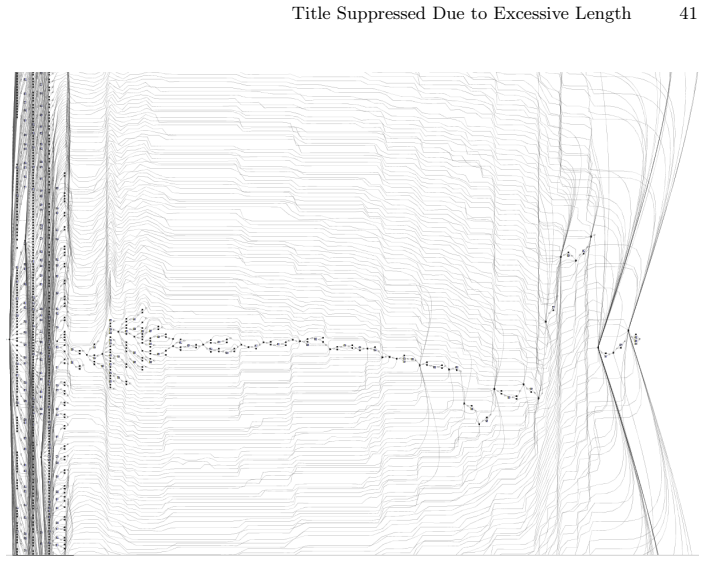
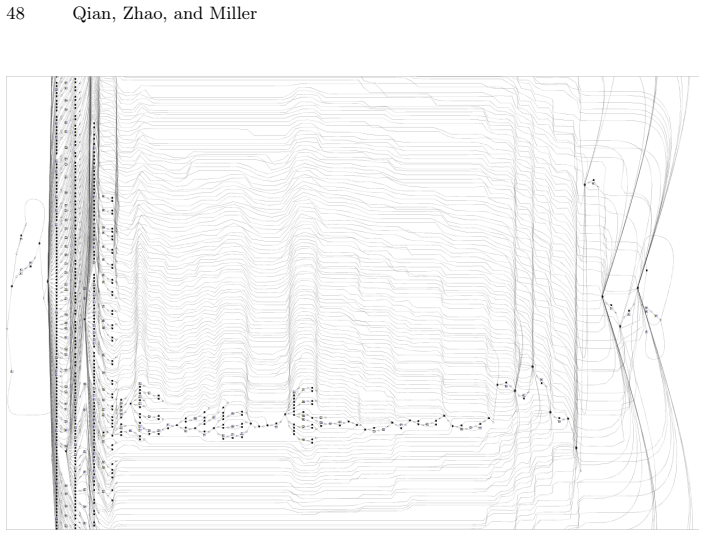
M2-PALE extracts process models from MCTS-Minimax hybrid traces and uses LLMs to generate causal explanations of their decisions.
A machine-rendered reading of the paper's core claim, the machinery that carries it, and where it could break.
Core claim
The authors establish that process models discovered by Alpha Miner, iDHM, and Inductive Miner from hybrid agent traces can be synthesized by LLMs into accurate, human-readable explanations that capture both the immediate causes and longer-term strategic intent behind the agent's choices.
What carries the argument
M2-PALE framework, which applies Alpha Miner, iDHM, and Inductive Miner to agent execution traces and then uses LLMs to synthesize the resulting process models into causal and distal explanations.
If this is right
- Developers can identify tactical weaknesses such as omitted critical moves that standard MCTS would miss.
- The hybrid agents become more interpretable in domains where strategic depth matters.
- Explanations scale with domain complexity because the mining and synthesis steps operate on traces rather than on the full search tree.
- Users receive concrete causal reasons for agent behavior instead of opaque tree statistics.
Where Pith is reading between the lines
- The same pipeline could be tested on larger checkers boards or other perfect-information games to measure how explanation quality changes with state-space size.
- If the explanations prove reliable, they could be fed back into agent design to automatically adjust Minimax depth or MCTS selection policies.
- Real-time versions of the framework might support human-AI team play by surfacing explanations during ongoing games.
Load-bearing premise
The mined process models, once interpreted by LLMs, faithfully describe the agent's actual decision logic rather than producing plausible but inaccurate summaries.
What would settle it
A direct comparison on held-out game positions in which the LLM-generated explanations predict moves that contradict the actual choices made by the hybrid agent when the process model is consulted.
Figures








read the original abstract
Monte-Carlo Tree Search (MCTS) is a fundamental sampling-based search algorithm widely used for online planning in sequential decision-making domains. Despite its success in driving recent advances in artificial intelligence, understanding the behavior of MCTS agents remains a challenge for both developers and users. This difficulty stems from the complex search trees produced through the simulation of numerous future states and their intricate relationships. A known weakness of standard MCTS is its reliance on highly selective tree construction, which may lead to the omission of crucial moves and a vulnerability to tactical traps. To resolve this, we incorporate shallow, full-width Minimax search into the rollout phase of multi-agent MCTS to enhance strategic depth. Furthermore, to demystify the resulting decision-making logic, we introduce \textsf{M2-PALE} (MCTS--Minimax Process-Aided Linguistic Explanations). This framework employs process mining techniques, specifically the Alpha Miner, iDHM, and Inductive Miner algorithms, to extract underlying behavioral workflows from agent execution traces. These process models are then synthesized by LLMs to generate human-readable causal and distal explanations. We demonstrate the efficacy of our approach in a small-scale checkers environment, establishing a scalable foundation for interpreting hybrid agents in increasingly complex strategic domains.
Editorial analysis
A structured set of objections, weighed in public.
Referee Report
Summary. The manuscript proposes M2-PALE, a framework for explaining the behavior of multi-agent MCTS-Minimax hybrid agents. It extracts process models from agent execution traces using the Alpha Miner, iDHM, and Inductive Miner algorithms, then synthesizes these models with LLMs to produce human-readable causal and distal explanations. The approach is demonstrated via a small-scale checkers environment to address limitations in standard MCTS such as selective tree construction and vulnerability to tactical traps.
Significance. If the generated explanations prove faithful to the underlying agent's search biases and value estimates, the framework could provide a useful bridge between process mining and LLM-based interpretability for complex strategic agents. The hybrid MCTS-Minimax design itself is a straightforward engineering response to known MCTS weaknesses, but the paper's contribution rests on an unverified demonstration rather than quantitative validation or theoretical guarantees.
major comments (2)
- [Abstract] Abstract and demonstration section: the claim that M2-PALE 'demonstrate[s] the efficacy of our approach' in checkers supplies no quantitative metrics for explanation fidelity, no comparison against ground-truth minimax/MCTS value estimates or move preferences, no human or automated faithfulness evaluation, and no error analysis. This leaves the central claim that the LLM-synthesized process models yield accurate causal and distal explanations unsupported by evidence.
- [Framework description] The weakest assumption—that Alpha Miner/iDHM/Inductive Miner models, when fed to an LLM, recover the agent's true decision logic rather than plausible but unfaithful summaries—is stated but never tested against the hybrid agent's internal state (e.g., rollout values or tree statistics). Without such a test the framework cannot be distinguished from post-hoc rationalization.
minor comments (2)
- [§3] The expansion of the acronym M2-PALE is given clearly, but the manuscript would benefit from an explicit statement of the input/output format of the process-mining step (event logs, activity labels, etc.) to allow replication.
- [§2] Notation for the hybrid agent (MCTS rollout phase augmented by shallow Minimax) is introduced without a diagram or pseudocode; a small figure would clarify the integration point.
Simulated Author's Rebuttal
We thank the referee for the constructive and detailed feedback on our manuscript. We address each major comment below and describe the revisions we will undertake to strengthen the work.
read point-by-point responses
-
Referee: [Abstract] Abstract and demonstration section: the claim that M2-PALE 'demonstrate[s] the efficacy of our approach' in checkers supplies no quantitative metrics for explanation fidelity, no comparison against ground-truth minimax/MCTS value estimates or move preferences, no human or automated faithfulness evaluation, and no error analysis. This leaves the central claim that the LLM-synthesized process models yield accurate causal and distal explanations unsupported by evidence.
Authors: We agree that the current demonstration is illustrative rather than supported by quantitative evidence. The manuscript shows example explanations generated by M2-PALE in the small-scale checkers setting but does not report fidelity metrics, comparisons to ground-truth agent values, or formal evaluations. In the revised manuscript we will add a dedicated evaluation subsection that includes (i) quantitative alignment scores between LLM-generated causal explanations and the hybrid agent's rollout values and move preferences, (ii) a basic error analysis of cases where explanations diverge from internal search statistics, and (iii) a small-scale automated faithfulness check. We will also moderate the abstract claim from 'demonstrate the efficacy' to 'illustrate the framework and provide initial evidence of its utility' pending these additions. revision: yes
-
Referee: [Framework description] The weakest assumption—that Alpha Miner/iDHM/Inductive Miner models, when fed to an LLM, recover the agent's true decision logic rather than plausible but unfaithful summaries—is stated but never tested against the hybrid agent's internal state (e.g., rollout values or tree statistics). Without such a test the framework cannot be distinguished from post-hoc rationalization.
Authors: We accept this critique. The manuscript presents the process-mining-plus-LLM pipeline as recovering decision logic but does not validate the resulting models or explanations against the agent's internal MCTS tree statistics or Minimax value estimates. In revision we will insert an explicit validation step within the checkers case study: we will extract the process models, generate LLM explanations, and then measure their consistency with logged rollout values, visit counts, and final move selections produced by the hybrid agent. This comparison will be reported quantitatively and will help differentiate the approach from post-hoc rationalization. revision: yes
Circularity Check
No circularity: methodological proposal without derivations or self-referential predictions
full rationale
The paper introduces M2-PALE as a framework combining process mining (Alpha Miner, iDHM, Inductive Miner) with LLMs to generate explanations from agent traces in a hybrid MCTS-Minimax setting. No equations, fitted parameters, or predictive claims appear in the provided text. The demonstration is limited to a small-scale checkers environment with no internal reduction of results to inputs by construction. No self-citations are invoked as load-bearing uniqueness theorems or ansatzes. The central claim rests on external validation of explanation fidelity rather than any self-definitional or fitted-input structure.
Axiom & Free-Parameter Ledger
axioms (2)
- domain assumption Process mining algorithms (Alpha Miner, iDHM, Inductive Miner) can extract meaningful behavioral workflows from MCTS-Minimax execution traces
- domain assumption LLMs can synthesize the extracted process models into accurate causal and distal explanations
Reference graph
Works this paper leans on
-
[1]
WileyInterdisciplinary Reviews: Data Mining and Knowledge Discovery2(2), 182–192 (2012)
Van der Aalst, W., Adriansyah, A., van Dongen, B.: Replaying history on process modelsforconformancecheckingand performanceanalysis. WileyInterdisciplinary Reviews: Data Mining and Knowledge Discovery2(2), 182–192 (2012)
work page 2012
-
[2]
In: IEEE 7th International Conference on Research Challenges in Information Science (RCIS)
van der Aalst, W.M.: Mediating between modeled and observed behavior: The quest for the “right” process: keynote. In: IEEE 7th International Conference on Research Challenges in Information Science (RCIS). pp. 1–12. IEEE (2013)
work page 2013
-
[3]
arXiv preprint arXiv:2407.10820 (2024)
An, Z., Baier, H., Dubey, A., Mukhopadhyay, A., Ma, M.: Enabling mcts ex- plainability for sequential planning through computation tree logic. arXiv preprint arXiv:2407.10820 (2024)
-
[4]
Information fusion58, 82–115 (2020)
Arrieta, A.B., Díaz-Rodríguez, N., Del Ser, J., Bennetot, A., Tabik, S., Barbado, A., García, S., Gil-López, S., Molina, D., Benjamins, R., et al.: Explainable artifi- cial intelligence (xai): Concepts, taxonomies, opportunities and challenges toward responsible ai. Information fusion58, 82–115 (2020)
work page 2020
-
[5]
IEEE Transactions on Compu- tational Intelligence and AI in Games7(2), 167–179 (2014)
Baier, H., Winands, M.H.: Mcts-minimax hybrids. IEEE Transactions on Compu- tational Intelligence and AI in Games7(2), 167–179 (2014)
work page 2014
-
[6]
Beazley, D.: Understanding the python gil. In: PyCON Python Conference. At- lanta, Georgia (2010)
work page 2010
-
[7]
In: Proceedings of the 2020 conference on fairness, accountability, and transparency
Bhatt, U., Xiang, A., Sharma, S., Weller, A., Taly, A., Jia, Y., Ghosh, J., Puri, R., Moura, J.M., Eckersley, P.: Explainable machine learning in deployment. In: Proceedings of the 2020 conference on fairness, accountability, and transparency. pp. 648–657 (2020)
work page 2020
-
[8]
Llms for explainable ai: A comprehensive survey.arXiv preprint arXiv:2504.00125, 2025
Bilal, A., Ebert, D., Lin, B.: Llms for explainable ai: A comprehensive survey. arXiv preprint arXiv:2504.00125 (2025)
-
[9]
Browne,C.B.,Powley,E.,Whitehouse,D.,Lucas,S.M.,Cowling,P.I.,Rohlfshagen, P., Tavener, S., Perez, D., Samothrakis, S., Colton, S.: A survey of monte carlo tree searchmethods.IEEETransactionsonComputationalIntelligenceandAIingames 4(1), 1–43 (2012)
work page 2012
-
[10]
International Journal of Cooperative Information Systems23(01), 1440001 (2014)
Buijs, J.C., van Dongen, B.F., van der Aalst, W.M.: Quality dimensions in pro- cess discovery: The importance of fitness, precision, generalization and simplicity. International Journal of Cooperative Information Systems23(01), 1440001 (2014)
work page 2014
-
[11]
arXiv preprint arXiv:2408.05488 (2024)
Bustin, R., Goldman, C.V.: Structure and reduction of mcts for explainable-ai. arXiv preprint arXiv:2408.05488 (2024)
-
[12]
Chaslot, G., Bakkes, S., Szita, I., Spronck, P.: Monte-carlo tree search: A new framework for game ai. In: Proceedings of the AAAI Conference on Artificial In- telligence and Interactive Digital Entertainment. vol. 4, pp. 216–217 (2008)
work page 2008
-
[13]
A survey on explainable deep reinforcement learning.CoRR, abs/2502.06869, 2025
Cheng, Z., Yu, J., Xing, X.: A survey on explainable deep reinforcement learning. arXiv preprint arXiv:2502.06869 (2025)
-
[14]
Interpretable contrastive monte carlo tree search reasoning.arXiv preprint arXiv:2410.01707,
Gao, Z., Niu, B., He, X., Xu, H., Liu, H., Liu, A., Hu, X., Wen, L.: Inter- pretable contrastive monte carlo tree search reasoning, 2024b. URL https://arxiv. org/abs/2410.01707
-
[15]
In: International Conference on Advanced Information Systems Engineering
Gerlach, Y., Seeliger, A., Nolle, T., Mühlhäuser, M.: Inferring a multi-perspective likelihood graph from black-box next event predictors. In: International Conference on Advanced Information Systems Engineering. pp. 19–35. Springer (2022)
work page 2022
-
[16]
arXiv preprint arXiv:1610.07989 (2016)
Ghawi, R.: Process discovery using inductive miner and decomposition. arXiv preprint arXiv:1610.07989 (2016)
-
[17]
Khan,N.,Shahid,M.A.,Rasool,S.:Leveragingaiinaccountingandfinance:Trans- forming business operations and enhancing healthcare decision-making through brain-inspired analytics. International Journal of Advanced Engineering Technolo- gies and Innovations10(2), 603931 (2024) 18 Qian, Zhao, and Miller
work page 2024
-
[18]
Kocsis, L., Szepesvári, C.: Bandit based monte-carlo planning. In: Machine Learn- ing: ECML 2006: 17th European Conference on Machine Learning Berlin, Ger- many, September 18-22, 2006 Proceedings 17. pp. 282–293. Springer (2006)
work page 2006
-
[19]
arXiv preprint arXiv:2001.10284 (2020)
Madumal, P., Miller, T., Sonenberg, L., Vetere, F.: Distal explanations for model- free explainable reinforcement learning. arXiv preprint arXiv:2001.10284 (2020)
-
[20]
Artificial intelligence267, 1–38 (2019)
Miller, T.: Explanation in artificial intelligence: Insights from the social sciences. Artificial intelligence267, 1–38 (2019)
work page 2019
-
[21]
The Knowledge Engineering Review36(2021)
Miller, T.: Contrastive explanation: A structural-model approach. The Knowledge Engineering Review36(2021)
work page 2021
-
[22]
IBM Journal of research and development3(3), 210–229 (1959)
Samuel, A.L.: Some studies in machine learning using the game of checkers. IBM Journal of research and development3(3), 210–229 (1959)
work page 1959
-
[23]
Strong, G.: The minimax algorithm. Trinity College Dublin (2011)
work page 2011
-
[24]
In: Inter- national conference on application and theory of petri nets
Van Dongen, B.F., de Medeiros, A.K.A., Verbeek, H., Weijters, A., van Der Aalst, W.M.: The prom framework: A new era in process mining tool support. In: Inter- national conference on application and theory of petri nets. pp. 444–454. Springer (2005)
work page 2005
-
[25]
Journal of Software: Evolution and Process31(6), e2170 (2019)
Verenich, I., Dumas, M., La Rosa, M., Nguyen, H.: Predicting process performance: A white-box approach based on process models. Journal of Software: Evolution and Process31(6), e2170 (2019)
work page 2019
-
[26]
ACM Sig- plan Oops Messenger1(1), 7–87 (1990)
Wegner, P.: Concepts and paradigms of object-oriented programming. ACM Sig- plan Oops Messenger1(1), 7–87 (1990)
work page 1990
-
[27]
Ziyan, A., Wang, X., Baier, H., Chen, Z., Dubey, A., Johnson, T.T., Sprinkle, J., Mukhopadhyay, A., Ma, M.: Combining llms with a logic-based framework to explain mcts (2025) Title Suppressed Due to Excessive Length 19 A Evaluate Process Models Based on Trial 1, Trial 2, Trial 3 Trial 1: Variable Iteration Times – Iteration Times = 1000: •Red Agent:Figure...
work page 2025
-
[28]
Red Agent Strategic Analysis (Ref: Figure 6) The following insights are derived from the hierarchical transition layers of the Red agent’s Petri-net: Causal Selection (Q1) The recommendation to selectPiece 1 (left, up)or Piece 2 (left, up)in the second layer is driven by im- mediate reward optimization. These transitions yield7 reward points, correlating ...
-
[29]
White Agent Strategic Analysis (Ref: Figure 7) The interpretation of the White agent’s procedural patterns is summarized as follows: Causal Selection (Q1) Upon the Red agent moving Piece 3 (left, down), the sys- tem recommendsWhite Piece 2 (right, up). This se- lection is justified by its potential to trigger a capture or crowning event, identified as a 7...
work page 2000
discussion (0)
Sign in with ORCID, Apple, or X to comment. Anyone can read and Pith papers without signing in.