ISAC with Backscattering RFID Tags: Beamforming and Codebook Design
Pith reviewed 2026-05-10 11:00 UTC · model grok-4.3
The pith
Joint beamforming designs in ISAC systems with backscattering RFID tags mitigate interference between sensing and communication to extend tag interrogation range under total power limits.
A machine-rendered reading of the paper's core claim, the machinery that carries it, and where it could break.
Core claim
Under a total transmit power constraint, joint sensing and communication beamforming vectors can be designed so that the sensing beam interrogates RFID tags while the communication beams serve users; a zero-forcing closed-form solution exists under the dominant sensitivity condition, and a power-minimization formulation further reduces total power. For multiple tags a sector-based codebook obtained via semidefinite relaxation and generalized Benders decomposition per sector achieves high interrogation success rates by scanning the region of interest.
What carries the argument
The joint sensing-communication beamforming vector (and its sector-based codebook extension), which allocates power and shapes beams to satisfy tag interrogation and user communication constraints simultaneously.
If this is right
- The closed-form zero-forcing solution with optimized power allocation directly yields the minimum power needed for a given interrogation requirement when one link dominates sensitivity.
- The power-minimization formulation produces beamforming vectors that trade off sensing and communication performance without exceeding the total power budget.
- Dividing the region into sectors and solving per-sector optimizations produces a codebook that can be scanned sequentially to cover multiple tags.
- The resulting designs demonstrably lower interference, thereby increasing achievable interrogation range at fixed power and raising multi-tag success rates.
Where Pith is reading between the lines
- The same joint-optimization structure could be tested in other backscattering scenarios such as ambient backscatter or passive IoT sensors.
- Replacing the static sector codebook with adaptive selection based on real-time channel estimates might further reduce scanning time.
- Hardware imperfections such as phase noise or tag nonlinearity would need explicit modeling before the closed-form solution can be applied in practice.
Load-bearing premise
The dominant sensitivity condition must hold for the closed-form zero-forcing solution, and sector divisions plus the chosen solvers must accurately reflect real multi-tag channel conditions and tag responses.
What would settle it
An experiment or simulation in which the measured interrogation range or success rate fails to increase (or decreases) when the proposed joint beamforming or sector codebook is applied compared with separate sensing and communication beams under the same total power.
Figures
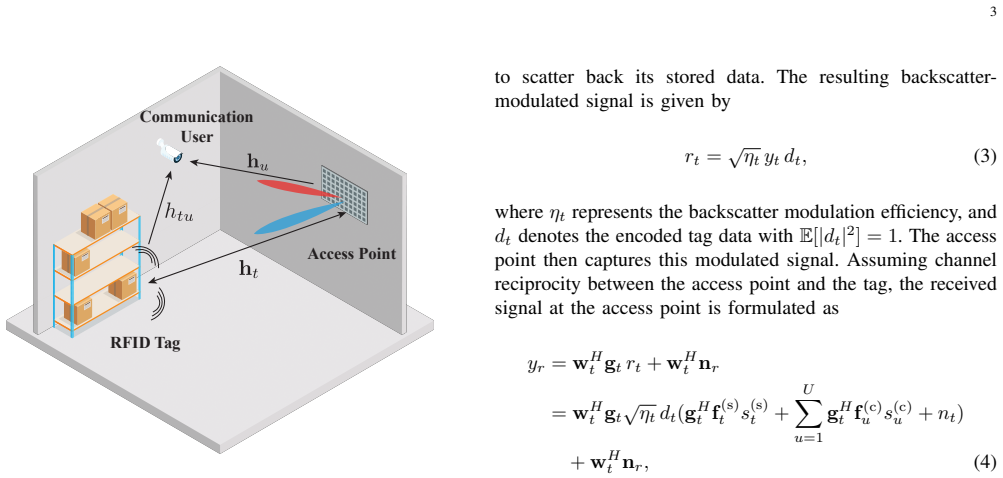


read the original abstract
This paper explores an integrated sensing and communication (ISAC) system with backscattering RFID tags. In this setup, an access point employs communication beams to serve communication users while leveraging a sensing beam to interrogate RFID tags. Under the total transmit power constraint of the system, our objective is to design a joint sensing and communication beamforming codebook by considering the tag interrogation and communication requirements. To lay a foundation for the codebook design problem, we first study the beamforming design problem in a single-tag scenario and investigate two approaches: (i) a zero-forcing approach with optimized sensing/communication power allocation, for which a closed-form solution is derived under a dominant sensitivity condition, and (ii) a joint sensing and communication beamforming design obtained by transmit power minimization. Then, we investigate the codebook design problem in a multi-tag scenario. To resolve this, we propose a sector-based joint sensing and communication beamforming codebook that scans the region of interest. For each sector, semidefinite relaxation and generalized Benders decomposition are employed to handle the resulting optimization. The simulation results show that the proposed joint beamforming designs can effectively mitigate the mutual interference between sensing and communication functionalities, thus enhancing the interrogation range of the tags with minimized transmit power. Also, the efficacy of the proposed sector-based codebook design has been demonstrated in terms of interrogation success rate, offering a promising approach for the ISAC-backscattering systems.
Editorial analysis
A structured set of objections, weighed in public.
Referee Report
Summary. The paper proposes joint sensing-communication beamforming designs for an ISAC system using backscattering RFID tags. In the single-tag case it derives a closed-form zero-forcing solution under a dominant sensitivity condition together with a power-minimization formulation; in the multi-tag case it introduces a sector-based codebook solved by semidefinite relaxation and generalized Benders decomposition. Simulations are used to show that the designs reduce mutual interference, extend interrogation range at minimum transmit power, and achieve high interrogation success rates.
Significance. If the designs prove robust, the work would provide a concrete beamforming and codebook framework for integrating RFID sensing into ISAC systems under total power constraints, with potential practical value for scalable multi-tag deployments. The sector-based approach and the closed-form shortcut (when valid) are constructive contributions, but the current evidence rests entirely on simulations whose generality is limited by unvalidated modeling assumptions.
major comments (3)
- [single-tag beamforming analysis] Single-tag zero-forcing derivation: the closed-form solution is obtained only after imposing the dominant sensitivity condition that decouples sensing and communication power allocation. No analysis, bounds, or additional simulations are provided to characterize the regimes in which this condition holds or to quantify performance degradation when it is violated, yet the headline claims of interference mitigation and range extension rely on this shortcut.
- [multi-tag codebook design] Multi-tag codebook: the switch to SDR plus generalized Benders decomposition for the sector-based design indicates that the dominant sensitivity condition does not extend, but the reported performance gains (interrogation range, success rate) are demonstrated only in simulations that presumably satisfy the single-tag condition. This creates a gap between the analytic claims and the multi-tag results.
- [simulation results] Simulation evidence: the abstract and results sections provide no error bars, no explicit channel model parameters, and no verification that the reported gains persist outside the dominant sensitivity regime or under realistic multi-tag interference and tag response variations.
minor comments (2)
- [single-tag section] Notation for the power allocation variables and the sensitivity condition should be introduced with explicit definitions before the closed-form derivation is presented.
- [multi-tag section] The description of the sector division and the choice of optimization solvers would benefit from a brief justification of why these particular methods are expected to capture real multi-tag channel conditions.
Simulated Author's Rebuttal
We thank the referee for the constructive comments on our manuscript. We address each major point below, clarifying the distinctions in our designs and outlining planned revisions to strengthen the analysis and simulation reporting.
read point-by-point responses
-
Referee: Single-tag zero-forcing derivation: the closed-form solution is obtained only after imposing the dominant sensitivity condition that decouples sensing and communication power allocation. No analysis, bounds, or additional simulations are provided to characterize the regimes in which this condition holds or to quantify performance degradation when it is violated, yet the headline claims of interference mitigation and range extension rely on this shortcut.
Authors: We agree that the dominant sensitivity condition enables the closed-form ZF solution but requires further characterization. In the revised manuscript we will add a dedicated subsection deriving bounds on the condition's validity in terms of tag sensitivity and power allocation ratios, along with supplementary simulations that quantify degradation when the condition is mildly violated. These additions will directly support the interference mitigation and range extension claims. revision: yes
-
Referee: Multi-tag codebook: the switch to SDR plus generalized Benders decomposition for the sector-based design indicates that the dominant sensitivity condition does not extend, but the reported performance gains (interrogation range, success rate) are demonstrated only in simulations that presumably satisfy the single-tag condition. This creates a gap between the analytic claims and the multi-tag results.
Authors: The multi-tag sector-based codebook is formulated and solved independently of the dominant sensitivity condition, using SDR and generalized Benders decomposition directly on the general optimization problem under the total power constraint. The multi-tag simulations employ the complete system model with inter-tag interference and do not invoke the single-tag condition. We will revise the text to explicitly distinguish the two cases and detail the simulation setups to eliminate any ambiguity. revision: yes
-
Referee: Simulation evidence: the abstract and results sections provide no error bars, no explicit channel model parameters, and no verification that the reported gains persist outside the dominant sensitivity regime or under realistic multi-tag interference and tag response variations.
Authors: We concur that enhanced simulation transparency is needed. The revised manuscript will include error bars on all performance curves, a table listing all channel and tag parameters (path-loss exponents, Rician factors, sensitivity thresholds, etc.), and new simulation sets evaluating the designs outside the dominant sensitivity regime as well as under increased multi-tag interference and varied tag response statistics. revision: yes
Circularity Check
No significant circularity; derivations use standard optimization under explicit assumptions
full rationale
The paper derives a closed-form ZF solution only after stating an explicit 'dominant sensitivity condition' as an assumption that decouples power allocation; this is not a self-definition or reduction to inputs. Multi-tag codebook design applies SDR and generalized Benders decomposition to the optimization problem. No fitted parameters are relabeled as predictions, no load-bearing self-citations, no imported uniqueness theorems, and no ansatz smuggling or renaming of known results. The chain remains self-contained against external convex optimization benchmarks.
Axiom & Free-Parameter Ledger
free parameters (1)
- sensing/communication power allocation
axioms (2)
- domain assumption Total transmit power constraint of the system
- ad hoc to paper Dominant sensitivity condition for closed-form solution
Reference graph
Works this paper leans on
-
[1]
ISAC with Backscattering RFID Tags: Joint Beamforming Design,
H. Luo, U. Demirhan, and A. Alkhateeb, “ISAC with Backscattering RFID Tags: Joint Beamforming Design,” inProc. IEEE ICC, 2024, pp. 921–925
work page 2024
-
[2]
Integrated Sensing and Communications: Toward Dual- Functional Wireless Networks for 6G and Beyond,
F. Liuet al., “Integrated Sensing and Communications: Toward Dual- Functional Wireless Networks for 6G and Beyond,”IEEE J. Sel. Areas Commun., vol. 40, no. 6, pp. 1728–1767, 2022
work page 2022
-
[3]
Integrated Sensing and Communication for 6G: Ten Key Machine Learning Roles,
U. Demirhan and A. Alkhateeb, “Integrated Sensing and Communication for 6G: Ten Key Machine Learning Roles,”IEEE Commun. Mag., vol. 61, no. 5, pp. 113–119, 2023
work page 2023
-
[4]
Robust Low-Cost Passive UHF RFID Based Smart Shopping Trolley,
T. Athaudaet al., “Robust Low-Cost Passive UHF RFID Based Smart Shopping Trolley,”IEEE J. Radio Freq. Identif., vol. 2, no. 3, pp. 134– 143, 2018
work page 2018
-
[5]
Radio Frequency Identifica- tion: Decades at a Time,
C. Saetia, D. M. Dobkin, and G. Durgin, “Radio Frequency Identifica- tion: Decades at a Time,”arXiv preprint arXiv:2508.17051, 2025
-
[6]
Joint Transmit Beamforming for Multiuser MIMO Communications and MIMO Radar,
X. Liuet al., “Joint Transmit Beamforming for Multiuser MIMO Communications and MIMO Radar,”IEEE Trans. Signal Process., vol. 68, pp. 3929–3944, 2020
work page 2020
-
[7]
Cram ´er-Rao Bound Optimization for Joint Radar- Communication Beamforming,
F. Liuet al., “Cram ´er-Rao Bound Optimization for Joint Radar- Communication Beamforming,”IEEE Trans. Signal Process., vol. 70, pp. 240–253, 2022
work page 2022
-
[8]
Beamformer Design and Optimization for Joint Communication and Full-Duplex Sensing at mm-Waves,
C. B. Barnetoet al., “Beamformer Design and Optimization for Joint Communication and Full-Duplex Sensing at mm-Waves,”IEEE Trans. Commun., vol. 70, no. 12, pp. 8298–8312, 2022
work page 2022
-
[9]
Optimal Transmit Beamforming for Integrated Sensing and Communication,
H. Hua, J. Xu, and T. X. Han, “Optimal Transmit Beamforming for Integrated Sensing and Communication,”IEEE Trans. V eh. Technol., vol. 72, no. 8, pp. 10 588–10 603, 2023
work page 2023
-
[10]
Joint Transmit and Receive Beamforming Design for Integrated Sensing and Communication,
N. Zhaoet al., “Joint Transmit and Receive Beamforming Design for Integrated Sensing and Communication,”IEEE Commun. Lett., vol. 26, no. 3, pp. 662–666, 2022
work page 2022
-
[11]
Joint Transceiver Beamforming for Multi-Target Single-User Joint Radar and Communication,
Y . Ni, Z. Wang, and Q. Huang, “Joint Transceiver Beamforming for Multi-Target Single-User Joint Radar and Communication,”IEEE Wireless Commun. Lett., vol. 11, no. 11, pp. 2360–2364, 2022
work page 2022
-
[12]
M. Bayraktaret al., “Self-Interference Aware Codebook Design for Full- Duplex Joint Sensing and Communication Systems at Mmwave,” in Proc. IEEE CAMSAP, 2023, pp. 231–235
work page 2023
-
[13]
R. Hernang ´omezet al., “CISSIR: Beam Codebooks With Self- Interference Reduction Guarantees for Integrated Sensing and Commu- nication Beyond 5G,”IEEE Trans. Wirel. Commun., vol. 25, pp. 6523– 6537, 2026
work page 2026
-
[14]
A Multiantenna RFID Reader With Blind Adaptive Beamforming,
S. Chenet al., “A Multiantenna RFID Reader With Blind Adaptive Beamforming,”IEEE Internet Things J., vol. 3, no. 6, pp. 986–996, 2016
work page 2016
-
[15]
Pushing the Range Limits of Commercial Passive RFIDs,
J. Wanget al., “Pushing the Range Limits of Commercial Passive RFIDs,” inProc. USENIX NSDI, 2019, pp. 301–316
work page 2019
-
[16]
Concurrent Rate-Adaptive Reading With Passive RFIDs,
G. Wanget al., “Concurrent Rate-Adaptive Reading With Passive RFIDs,”IEEE Internet Things J., vol. 10, no. 1, pp. 499–511, 2023
work page 2023
-
[17]
mReader: Concurrent UHF RFID Tag Reading,
H. Pirayesh, S. Zhang, and H. Zeng, “mReader: Concurrent UHF RFID Tag Reading,” inProc. of the Twenty-fourth International Symposium on Theory, Algorithmic F oundations, and Protocol Design for Mobile Networks and Mobile Computing, 2023, pp. 280–289
work page 2023
-
[18]
Integrated Sens- ing and Backscatter Communication,
D. Galappaththige, C. Tellambura, and A. Maaref, “Integrated Sens- ing and Backscatter Communication,”IEEE Wireless Commun. Lett., vol. 12, no. 12, pp. 2043–2047, 2023
work page 2043
-
[19]
Joint Beamforming for Backscatter Integrated Sensing and Communication,
Z. Zhaoet al., “Joint Beamforming for Backscatter Integrated Sensing and Communication,” inProc. IEEE GLOBECOM, 2024, pp. 5399– 5404
work page 2024
-
[20]
Optimized Resource Allocation in NOMA-Enabled ISAC Systems With RFID Backscatterers,
R. Ket al., “Optimized Resource Allocation in NOMA-Enabled ISAC Systems With RFID Backscatterers,”IEEE Wireless Commun. Lett., vol. 14, no. 7, pp. 1934–1938, 2025
work page 1934
-
[21]
Sum-Rate Maximization for ISAC Systems With Backscatter RFID Tags,
——, “Sum-Rate Maximization for ISAC Systems With Backscatter RFID Tags,” inProc. IEEE ICC, 2025, pp. 2755–2760
work page 2025
-
[22]
Transmit Power- Efficient Beamforming Design for Integrated Sensing and Backscatter Communication,
S. Zargari, D. Galappaththige, and C. Tellambura, “Transmit Power- Efficient Beamforming Design for Integrated Sensing and Backscatter Communication,”IEEE Open J. Commun. Soc., vol. 6, pp. 775–792, 2025
work page 2025
- [23]
-
[24]
The Principle, Methods and Recent Progress in RFID Positioning Techniques: A Review,
J. Xuet al., “The Principle, Methods and Recent Progress in RFID Positioning Techniques: A Review,”IEEE J. Radio Freq. Identif., vol. 7, pp. 50–63, 2023
work page 2023
-
[25]
Perfect Isolation: Dealing with Self-Jamming in Passive RFID Systems,
A. Boaventuraet al., “Perfect Isolation: Dealing with Self-Jamming in Passive RFID Systems,”IEEE Microw. Mag., vol. 17, no. 11, pp. 20–39, 2016
work page 2016
-
[26]
E. Bj ¨ornson, M. Bengtsson, and B. Ottersten, “Optimal Multiuser Transmit Beamforming: A Difficult Problem with a Simple Solution Structure [Lecture Notes],”IEEE Signal Process. Mag., vol. 31, no. 4, pp. 142–148, 2014
work page 2014
-
[27]
Cell-Free ISAC MIMO Systems: Joint Sensing and Communication Beamforming,
U. Demirhan and A. Alkhateeb, “Cell-Free ISAC MIMO Systems: Joint Sensing and Communication Beamforming,”IEEE Trans. Commun., vol. 73, no. 6, pp. 4454–4468, 2025
work page 2025
-
[28]
C. A. Floudas,Nonlinear and Mixed-Integer Optimization: Fundamen- tals and Applications. Oxford University Press, 1995
work page 1995
-
[29]
Semidefinite Relaxation of Quadratic Optimization Problems,
Z.-Q. Luoet al., “Semidefinite Relaxation of Quadratic Optimization Problems,”IEEE Signal Process. Mag., vol. 27, no. 3, pp. 20–34, 2010
work page 2010
-
[30]
Generalized Benders Decomposition,
A. M. Geoffrion, “Generalized Benders Decomposition,”Journal of Optimization Theory and Applications, vol. 10, pp. 237–260, 1972
work page 1972
- [31]
- [32]
-
[33]
Antennas and Propagation in UHF RFID Systems,
P. V . Nikitin and K. V . S. Rao, “Antennas and Propagation in UHF RFID Systems,” inProc. IEEE International Conference on RFID, 2008, pp. 277–288
work page 2008
-
[34]
ApS,The MOSEK Optimization Toolbox for MATLAB Manual
M. ApS,The MOSEK Optimization Toolbox for MATLAB Manual. V ersion 10.0., 2022. [Online]. Available: http://docs.mosek.com/10.0/ toolbox/index.html
work page 2022
-
[35]
CVX: Matlab Software for Disciplined Convex Programming, version 2.1,
M. Grant and S. Boyd, “CVX: Matlab Software for Disciplined Convex Programming, version 2.1,” http://cvxr.com/cvx, Mar. 2014
work page 2014
discussion (0)
Sign in with ORCID, Apple, or X to comment. Anyone can read and Pith papers without signing in.