Morphological Transition: From Meanders to Mound Structures
Pith reviewed 2026-05-10 11:28 UTC · model grok-4.3
The pith
Competition between the Ehrlich-Schwoebel barrier and adatom mobility on terraces controls a reversible switch from mound structures to regular meandered step patterns on vicinal crystal surfaces.
A machine-rendered reading of the paper's core claim, the machinery that carries it, and where it could break.
Core claim
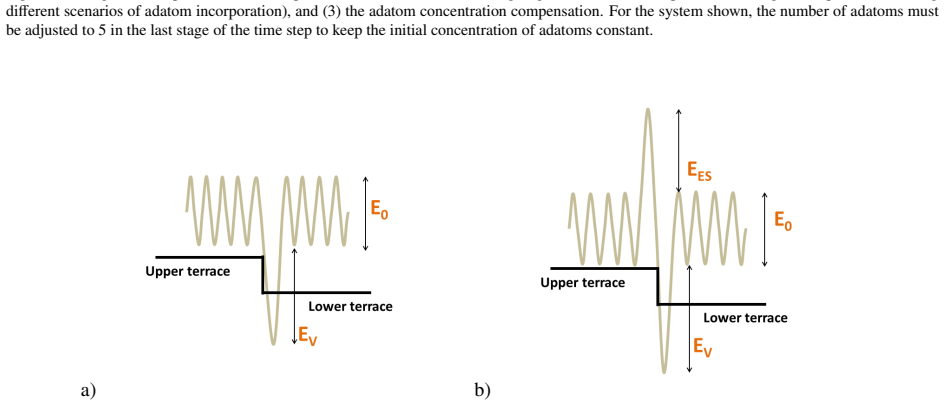
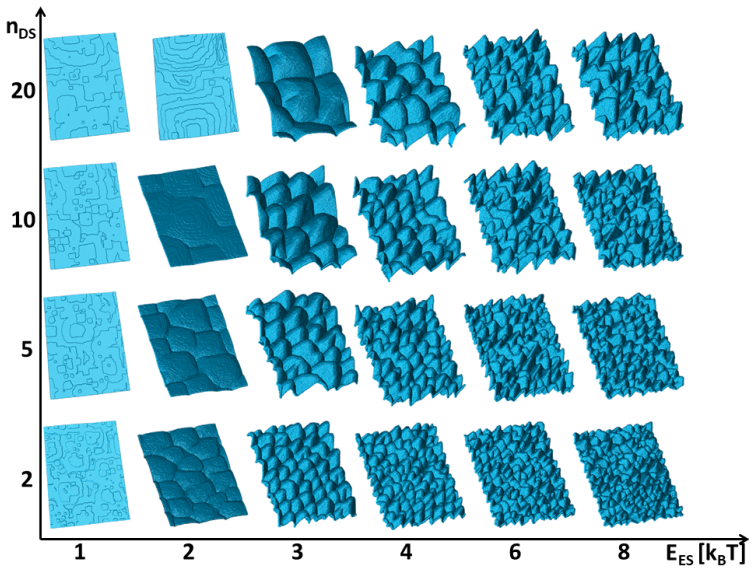
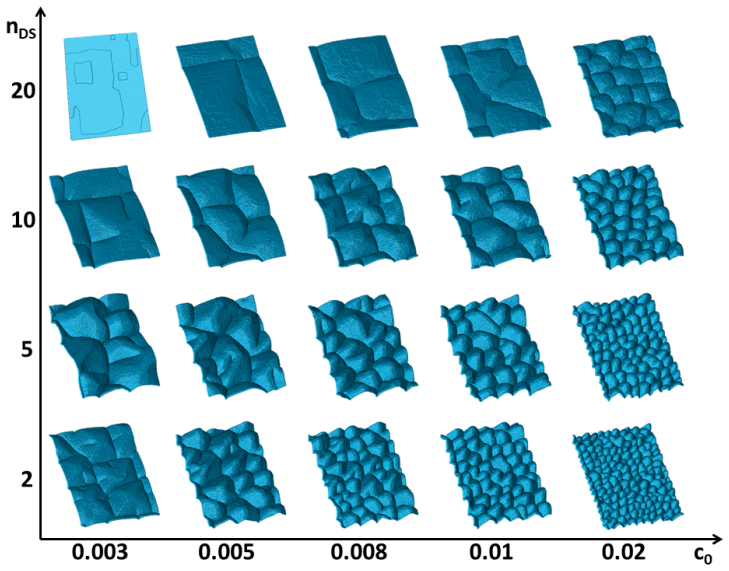
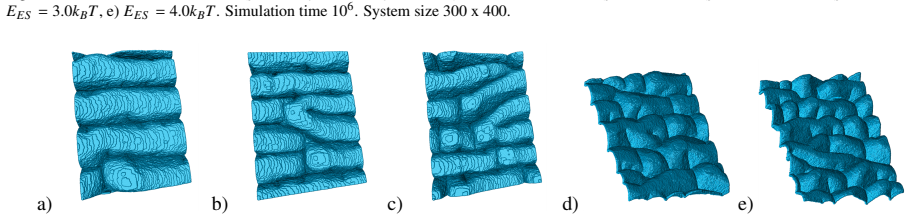
In the vicinal cellular automata model the transition from meandered step patterns to faceted pyramidal mounds is governed by the competition between the Ehrlich-Schwoebel barrier and adatom mobility on terraces; moderate barrier strengths together with high terrace diffusivity produce a reversible shift from mounded configurations back to regular meandered patterns across a range of deposition fluxes, diffusion rates, temperatures, and miscut angles.
What carries the argument
Vicinal cellular automata framework that encodes attachment, diffusion, and the Ehrlich-Schwoebel barrier to simulate the kinetic competition that selects between meandered and mounded morphologies.
If this is right
- Surface morphology can be switched by varying deposition flux, surface diffusion rates, temperature, or miscut angle.
- Height-height correlation functions yield correlation lengths along and across steps whose scaling distinguishes the two pattern classes.
- Distinct surface structures are connected by continuous changes in the same kinetic parameters.
- A single set of rules describes pattern evolution across flat and miscut growth regimes.
Where Pith is reading between the lines
- If real surfaces obey the same barrier-mobility competition, experiments could induce reversible morphology changes by modest temperature adjustments.
- The model suggests that similar transitions may appear in other epitaxial systems once strain and impurity effects are controlled.
- Continuum descriptions of mound and meander formation could be derived directly from the discrete kinetic rules used here.
Load-bearing premise
The model's attachment, diffusion, and barrier rules are sufficient to represent actual surface kinetics without dominant effects from strain, impurities, or long-range forces.
What would settle it
An experiment on a real vicinal surface that shows no reversible switch from mounds to meanders when the Ehrlich-Schwoebel barrier strength is tuned to moderate values and terrace diffusivity is made high.
Figures




read the original abstract
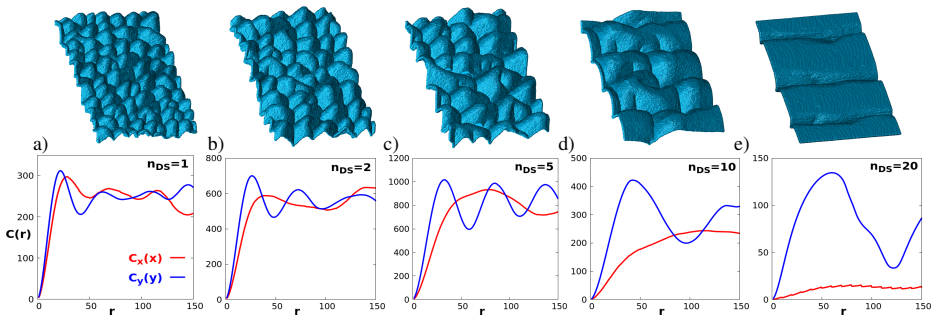
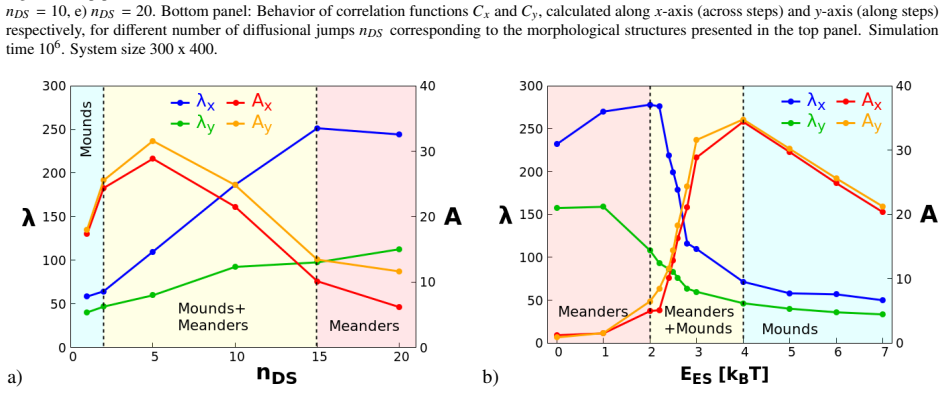
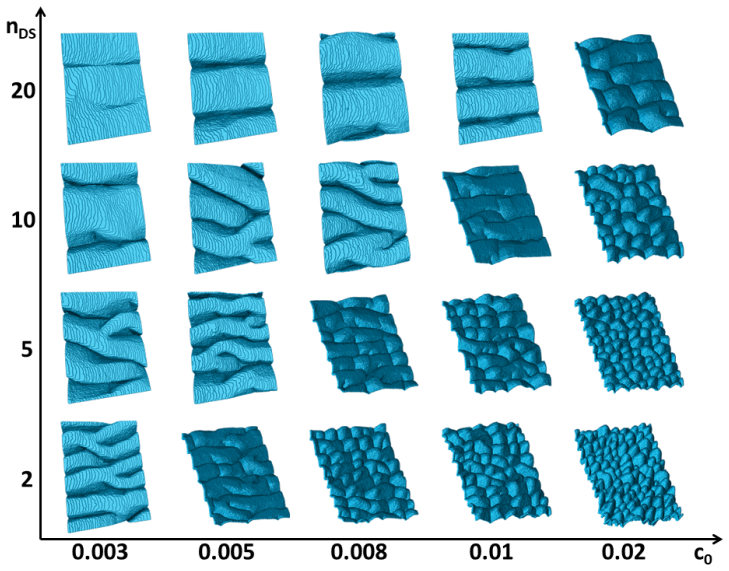
Mound formation on flat and miscut crystal surfaces exhibits distinct growth behaviors. While mound structures are the predominant feature on flat surfaces, miscut surfaces display a smooth transition from meandered patterns to three-dimensional mounds, depending on both internal and external conditions. We investigate this morphological evolution-from meander-like surface patterns to faceted pyramidal structures-using a vicinal Cellular Automata modeling framework. The transition is shown to be governed by the competition between the Ehrlich-Schwoebel barrier and adatom mobility on terraces. Under moderate barrier strengths and sufficiently high terrace diffusivity, the system demonstrates a reversible transition from mounded configurations to regular step meandered patterns. This reveals a complex interplay between kinetic barriers and mass transport. Our simulations cover a wide range of growth conditions, including variations in deposition flux, surface diffusion rates, temperature, and miscut angle. By applying the height-height correlation function, we calculate the correlation lengths along and across the steps and analyze their scaling behavior. These results offer insight into the continuum pathways that connect distinct classes of surface structures and provide a unified framework for describing pattern evolution across different crystal growth regimes.
Editorial analysis
A structured set of objections, weighed in public.
Referee Report
Summary. The manuscript presents simulations of morphological evolution on miscut crystal surfaces using a vicinal Cellular Automata model. It claims that the transition from regular step meanders to three-dimensional mound structures is controlled by the competition between the Ehrlich-Schwoebel barrier and terrace adatom mobility, with a reversible transition occurring under moderate barrier strengths and high diffusivity. The work scans parameters including deposition flux, diffusion rates, temperature, and miscut angle, and analyzes the resulting patterns via height-height correlation functions to extract correlation lengths and scaling behavior, proposing a unified view of continuum pathways between surface structure classes.
Significance. If the discrete rules faithfully isolate the claimed kinetic competition without lattice artifacts, the parameter exploration and correlation analysis could help connect discrete simulations to continuum step models and clarify how meander and mound regimes interconvert. The broad coverage of growth conditions is a positive feature. However, the purely qualitative nature of the reported outcomes limits the strength of any claims about scaling or mechanism attribution.
major comments (3)
- [Abstract] Abstract: the central claim of a 'reversible transition' from mounded to meandered patterns is stated without any indication of whether reversibility was tested by dynamically changing parameters (e.g., barrier strength or diffusivity) within a single ongoing simulation or only by comparing independent runs at fixed parameter sets; only the former would substantiate true reversibility.
- [Model description section] Model description section: the specific CA update rules for attachment, terrace diffusion, and the Ehrlich-Schwoebel barrier (reduced crossing probability at steps) are presented without a master-equation derivation, continuum limit, or calibration to known physical rates, so it remains unclear whether the observed meander-mound transition is produced by the intended competition or by discrete-lattice or finite-range artifacts.
- [Results section on correlation analysis] Results section on correlation analysis: the height-height correlation function is used to compute correlation lengths along and across steps, yet no numerical values, error bars, statistical uncertainties, or explicit scaling exponents are supplied; the abstract's reference to 'scaling behavior' therefore rests on qualitative inspection alone.
minor comments (2)
- [Abstract] Abstract: the phrase 'internal and external conditions' is used without immediately listing the corresponding model parameters (barrier strength, diffusivity, flux, miscut angle).
- [Discussion] Discussion: a direct comparison of the simulated correlation lengths or transition thresholds to existing Burton-Cabrera-Frank or continuum step models would clarify the claimed 'unified framework'.
Simulated Author's Rebuttal
We thank the referee for the careful reading and constructive comments on our manuscript. We address each major comment point by point below. Revisions have been made to clarify the reversibility claim, strengthen the model foundation, and provide quantitative details on the correlation analysis.
read point-by-point responses
-
Referee: [Abstract] Abstract: the central claim of a 'reversible transition' from mounded to meandered patterns is stated without any indication of whether reversibility was tested by dynamically changing parameters (e.g., barrier strength or diffusivity) within a single ongoing simulation or only by comparing independent runs at fixed parameter sets; only the former would substantiate true reversibility.
Authors: We agree that the original presentation left the nature of the reversibility ambiguous. The transition was demonstrated by comparing separate simulations initialized at different fixed parameter sets (moderate ES barrier strength combined with high terrace diffusivity). To address the referee's concern directly, we have performed new simulations in which the barrier strength or diffusivity is varied dynamically within a single ongoing run, confirming that the morphology reverts from mounds to meanders. A new subsection and accompanying figure have been added to the Results section to document this dynamic reversibility. revision: yes
-
Referee: [Model description section] Model description section: the specific CA update rules for attachment, terrace diffusion, and the Ehrlich-Schwoebel barrier (reduced crossing probability at steps) are presented without a master-equation derivation, continuum limit, or calibration to known physical rates, so it remains unclear whether the observed meander-mound transition is produced by the intended competition or by discrete-lattice or finite-range artifacts.
Authors: The referee correctly notes the absence of an explicit derivation. Although the update rules follow standard kinetic Monte Carlo-style implementations for vicinal surfaces, we have added an appendix that derives the master equation for the attachment, terrace diffusion, and reduced step-crossing probabilities, then takes the appropriate continuum limit to recover the expected step-flow equations. We have also calibrated the reduced crossing probability to literature values of the Ehrlich-Schwoebel barrier height for comparable systems. These additions confirm that the meander-to-mound transition arises from the intended kinetic competition rather than lattice artifacts. revision: yes
-
Referee: [Results section on correlation analysis] Results section on correlation analysis: the height-height correlation function is used to compute correlation lengths along and across steps, yet no numerical values, error bars, statistical uncertainties, or explicit scaling exponents are supplied; the abstract's reference to 'scaling behavior' therefore rests on qualitative inspection alone.
Authors: We accept that the lack of quantitative metrics weakened the scaling claims. The revised manuscript now reports explicit numerical values for the correlation lengths (both parallel and perpendicular to the steps), together with error bars obtained from ensemble averages over multiple independent runs. We also include fitted scaling exponents with their statistical uncertainties and compare them to theoretical expectations from continuum models. These quantitative results are presented in updated figures and a new table in the Results section. revision: yes
Circularity Check
No significant circularity in simulation-based parameter study
full rationale
The paper uses a vicinal Cellular Automata model to explore morphological transitions by explicitly varying parameters for the Ehrlich-Schwoebel barrier, terrace diffusivity, deposition flux, temperature, and miscut angle, then observing outcomes such as meander-to-mound shifts and correlation lengths via the height-height correlation function. No mathematical derivation chain exists that reduces a claimed result to its inputs by construction; the reported behaviors are direct consequences of the defined discrete rules and scanned inputs rather than fitted predictions or self-referential steps. The work contains no load-bearing self-citations, uniqueness theorems, or ansatzes imported from prior author work, making the study self-contained computational exploration of the model's phase space.
Axiom & Free-Parameter Ledger
free parameters (5)
- Ehrlich-Schwoebel barrier strength
- terrace adatom diffusivity / mobility
- deposition flux
- temperature
- miscut angle
axioms (2)
- domain assumption Cellular automata rules accurately capture adatom attachment, diffusion, and Ehrlich-Schwoebel barrier effects
- ad hoc to paper No significant influence from unmodeled effects such as elastic strain or impurities
Reference graph
Works this paper leans on
-
[1]
Damilano B., Aristégui R., Teisseyre H., Vézian S., Guigoz V ., Courville A., Florea I., Vennéguès P., Bockowski M., Guillet T., Vladimirova M., Molecular beam epitaxy of GaN/AlGaN quantum wells on bulk GaN substrate in the step-flow or step meandering regime: Influence on indirect ex- citon diffusion, J. Appl. Phys. 135 (2024) 095702
work page 2024
-
[2]
Chou T.-S., Akhtar A., Bin Anooz S., Rehm J., Ernst O., Seyidov P., Fiedler A., Miller W., Galazka Z., Remmele T., Albrecht M., Popp A., Influencing the morphological stability of MOVPE-grownβ-Ga 2O3 films by O 2/Ga ratio, Appl. Surf. Sci. 660 (2024) 159966
work page 2024
-
[3]
Wu Y .-Z., Liu B., Li Z.-H., Tao T., Xie Z.-L., Xiu X.-Q., Chen P., Chen D.-J., Lu H., Shi Y ., Zhang R., Zheng Y .-D., Homo-epitaxial growth of high crystal quality GaN thin films by plasma assisted - molecular beam epitaxy, J Cryst. Growth 506 (2019) 30 - 35
work page 2019
-
[4]
Gocalinska A., Rubini S., Pelucchi E., Native ox- ides formation and surface wettability of epitaxial III-V materials: The case of InP and GaAs, Appl. Surf. Sci. 383 (2016) 19-27
work page 2016
-
[5]
Pandey A., Singh V . K., Dalal S., Bag R. K., Narang K., Kaur D., Raman R., Tyagi R., Effect of two step GaN buffer on the structural and electri- cal characteristics in AlGaN/GaN heterostructure, Vacuum 178 (2020) 109442
work page 2020
-
[6]
Uesugi K., Kuboya S., Shojiki K., Xiao S., Nakamura T., Kubo M., Miyake H., 263 nm wavelength UV-C LED on face-to-face annealed 13 sputter-deposited AlN with low screw- and mixed- type dislocation densities, Appl. Phys. Express 15 (2022) 055501. https://doi.org/10.35848/1882- 0786/ac66c2
-
[7]
Michely T., Krug J., Islands, mounds and atoms, Springer, Berlin, 2004
work page 2004
-
[8]
Siegert M., Plischke M., Slope Selection and Coarsening in Molecular Beam Epitaxy, Phys. Rev. Lett. 73 (1994) 1517
work page 1994
-
[9]
Chakrabarti B., Dasgupta Ch., Mound formation and coarsening from a nonlinear instability in sur- face growth, Phys. Rev. E 69 (2004) 011601
work page 2004
-
[10]
Rost M., ˘Smilauer P., Krug J., Unstable epitaxy on vicinal surfaces, Surf. Sci. 369 (1996) 393
work page 1996
-
[11]
Bryan I., Bryan Z., Mita S., Rice A., Tweedie J., Collazo R., Sitar Z., Surface kinetics in AlN growth: A universal model for the control of sur- face morphology in III-nitrides, J. Cryst. Growth 438 (2016) 81-89
work page 2016
-
[12]
Evans J. W., Thiel P. A., Bartelt M. C., Morpho- logical evolution during epitaxial thin film growth: Formation of 2D islands and 3D mounds, Surface Science Reports 61 (2006) 1-128
work page 2006
-
[13]
Bartelt M. C., Evans J. W., Transition to Mul- tilayer Kinetic Roughening for Metal (100) Ho- moepitaxy, Phys. Rev. Lett. 75 (1995) 4250
work page 1995
-
[14]
A., Surface-morphology evolution during unstable homoepitaxial growth of GaAs(110), Phys
Tejedor P., ˘Smilauer P., Roberts C., Joyce B. A., Surface-morphology evolution during unstable homoepitaxial growth of GaAs(110), Phys. Rev. B 59 (1999) 2341
work page 1999
-
[15]
Leal F. F., Ferreira S. C., Ferreira S. O., Mod- elling of epitaxial film growth with an Ehrlich- Schwoebel barrier dependent on the step height, J. Phys.: Condens. Matter 23 (2011) 292201
work page 2011
-
[16]
Schneider J. P., Margetis D., Gibou F., Ratsch Ch., An examination of scaling behavior in unstable epitaxial mound growth via kinetic Monte Carlo simulations, J. Phys.: Condens. Matter 31 (2019) 365301
work page 2019
-
[17]
I., Step barrier ef- fects during early stages of the kinetic roughening of fcc(111) surfaces, J
Wollschläger J., Larsson M. I., Step barrier ef- fects during early stages of the kinetic roughening of fcc(111) surfaces, J. Vac. Sci. Technol. A 40 (2022) 013210
work page 2022
-
[18]
Punyindu Chatraphorn P., Toroczkai Z., Das Sarma S., Epitaxial mounding in limited-mobility models of surface growth, Phys. Rev. B 64 (2001) 205407
work page 2001
-
[19]
Munko F., Cruz Luukkonen C., Carrasco I. S. S., Aarão Reis F. D. A., Oettel M., Island formation in heteroepitaxial growth, Phys. Rev. E 111 (2025) 035501
work page 2025
-
[20]
A., Popova H., Załuska-Kotur M
Chabowska M. A., Popova H., Załuska-Kotur M. A., Step meandering: Balance between the potential well and the Ehrlich – Schwoebel barrier, Phys. Rev. B 111 (2025) 155401. https://doi.org/10.1103/PhysRevB.111.155401
-
[21]
Załuska-Kotur M., Popova H., Tonchev V ., Step Bunches, Nanowires and Other Vicinal "Creatures" – Ehrlich – Schwoebel Effect by Cellular Automata, Crystals 11 (2021) 1135. https://doi.org/10.3390/cryst11091135
-
[22]
Chabowska M. A., Załuska-Kotur M. A., Diffusion-Dependent Pattern Formation on Crys- tal Surfaces, ACS Omega 8 (2023) 45779-45786. https://doi.org/10.1021/acsomega.3c06377
-
[23]
Chabowska M. A., Załuska-Kotur M. A., Surface Patterns Shaped by Additives in Crystals, Vacuum 240 (2025) 114431
work page 2025
-
[24]
Chabowska M. A., Załuska-Kotur M. A., En- gineering 2D surface patterns with the VicCa model, J. Cryst. Growth 667 (2025) 128245. https://doi.org/10.1016/j.jcrysgro.2025.128245
-
[25]
Ohka T., Akiyama T., Muizz Pradipto A., Naka- mura K., Ito T., Effect of Step Edges on Ad- sorption Behavior for GaN(0001) Surfaces during Metalorganic Vapor Phase Epitaxy: An Ab Initio Study, Cryst. Growth Des. 20 (2020) 4358
work page 2020
-
[26]
Akiyama T., Ohka T., Nakamura K., Ito T., Ab ini- tio study for adsorption and desorption behavior at step edges of GaN (0001) surface, J. Cryst. Growth 532 (2020) 125410
work page 2020
-
[27]
Akiyama T., Ohka T., Nagai K., Ito T., Effect of step edges on the adsorption behavior on vici- nal AlN(0001) surface during metal-organic vapor phase epitaxy: An ab initio study, J. Cryst. Growth 571 (2021) 126244
work page 2021
-
[28]
Akiyama T., Kawamura T., Ab initio study for ad- sorption behavior on AlN(0001) surface with steps 14 and kinks during metal-organic vapor-phase epi- taxy, Jpn. J. Appl. Phys. 63 (2024) 02SP71
work page 2024
-
[29]
Golubovi ´c L., Levandovsky A., Moldovan D., Interface Dynamics and Far-From-Equilibrium Phase Transitions in Multilayer Epitaxial Growth and Erosion on Crystal Surfaces: Continuum The- ory Insights, East Asian J. Appl. Math. 1 (2011) 297
work page 2011
-
[30]
Supplementary Material In this supplement we provide the additional figures. FigureS1presents a diagram of patterns grown on flat surface as a function of number of diffusional jumps nDS with a more detailed examination of the morpho- logical transition controlled by the height of the Ehrlich- Schwoebel (ES) barrier fromE ES =2k BTtoward EES =3k BT. Figur...
discussion (0)
Sign in with ORCID, Apple, or X to comment. Anyone can read and Pith papers without signing in.