Coherence dynamics in quantum algorithm for linear systems of equations
Pith reviewed 2026-05-10 11:11 UTC · model grok-4.3
The pith
In the HHL quantum algorithm, the coherence of the inverse phase estimation operator decreases with rising success probability for Tsallis parameter alpha between 1 and 2.
A machine-rendered reading of the paper's core claim, the machinery that carries it, and where it could break.
Core claim
The operator coherence of the phase estimation P relies on the coefficients beta_i from decomposing the input state |b> in the eigenbasis of A. The operator coherence of the inverse phase estimation ~P relies on beta_i, the eigenvalues of A, and the success probability P_s; it decreases with increasing P_s when alpha is in (1,2]. The variations of coherence decrease with increasing success probability and also depend on the eigenvalues of A and P_s.
What carries the argument
Tsallis relative alpha-entropy of coherence and l_{1,p} norm of coherence applied to the phase estimation operator P and its inverse ~P within the standard HHL quantum circuit.
If this is right
- The coherence in phase estimation depends solely on the beta_i coefficients of the input vector.
- Coherence in inverse phase estimation decreases monotonically with success probability for alpha in (1,2].
- Coherence variations become smaller as success probability increases, with dependence on matrix eigenvalues.
- These relations hold under the assumption of the standard HHL structure and clean eigenbasis decomposition.
Where Pith is reading between the lines
- Optimizing the success probability in HHL could serve as a way to reduce unwanted coherence effects in quantum computations.
- Similar coherence analysis might be extended to other quantum algorithms that rely on phase estimation.
- These findings could guide the choice of coherence measures or circuit parameters in designing more stable quantum linear solvers.
- If the success probability can be tuned independently, it provides a control knob for coherence management.
Load-bearing premise
The analysis assumes the standard HHL circuit with phase estimation and its inverse, where the input state has a clean decomposition into the eigenbasis of A and the success probability is well-defined and independent.
What would settle it
An experiment or simulation showing that the coherence of the inverse phase estimation does not decrease with increasing success probability for alpha=1.5, or that it depends on factors other than beta_i, eigenvalues, and P_s, would falsify the claim.
Figures

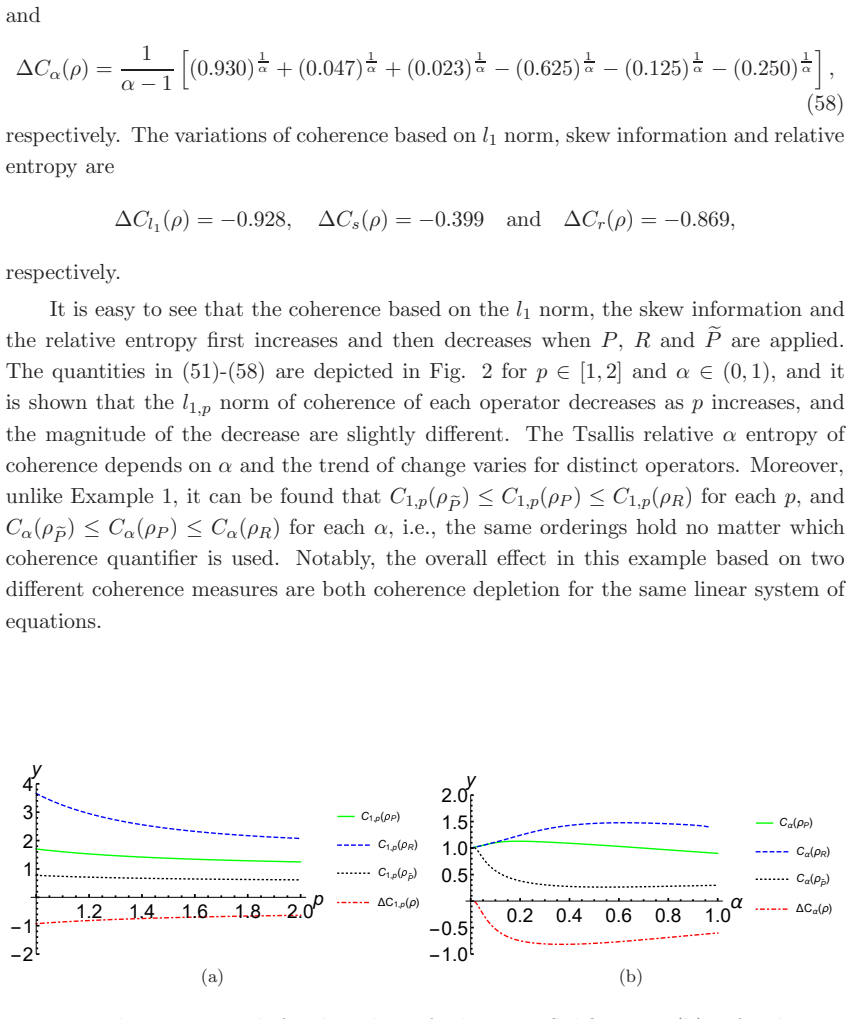
read the original abstract
Quantum coherence is a fundamental issue in quantum mechanics and quantum information processing. We explore the coherence dynamics of the evolved states in HHL quantum algorithm for solving the linear system of equation $A\overrightarrow{x}=\overrightarrow{b}$. By using the Tsallis relative $\alpha$ entropy of coherence and the $l_{1,p}$ norm of coherence, we show that the operator coherence of the phase estimation $P$ relies on the coefficients $\beta_{i}$ obtained by decomposing $|b\rangle$ in the eigenbasis of $A$. We prove that the operator coherence of the inverse phase estimation $\widetilde{P}$ relies on the coefficients $\beta_{i}$, eigenvalues of $A$ and the success probability $P_{s}$, and it decreases with the increase of the probability when $\alpha\in(1,2]$. Moreover, the variations of coherence deplete with the increase of the success probability and rely on the eigenvalues of $A$ as well as the success probability.
Editorial analysis
A structured set of objections, weighed in public.
Referee Report
Summary. The paper explores coherence dynamics in the HHL quantum algorithm for solving linear systems Ax=b. Using the Tsallis relative α-entropy of coherence and the l_{1,p} norm of coherence, it claims that the operator coherence of the phase estimation operator P depends only on the coefficients β_i from the decomposition of |b⟩ in the eigenbasis of A. For the inverse operator ~P, coherence depends on β_i, the eigenvalues of A, and the success probability P_s; the authors prove that this coherence decreases with increasing P_s when α ∈ (1,2], and that coherence variations diminish with P_s while depending on the eigenvalues and P_s.
Significance. If the claimed monotonicity and dependences are established with rigorous, circuit-consistent derivations, the work could illuminate how quantum coherence evolves through the steps of a canonical quantum linear solver. This might inform resource accounting or coherence management in near-term implementations of HHL and related algorithms. The choice of Tsallis and l_{1,p} measures provides a concrete, quantifiable link between coherence and algorithmic success probability.
major comments (2)
- [Abstract (proof of monotonicity for ~P)] Abstract and the proof that operator coherence of ~P decreases with P_s (for α ∈ (1,2]): the coherence is expressed as a function of β_i, eigenvalues of A, and P_s treated as an independent variable. In the standard HHL circuit, however, P_s is fixed by the controlled-rotation angles, which are chosen as functions of the estimated eigenvalues (typically sin(θ/2) = C/λ_i). Varying P_s therefore simultaneously modifies the unitary ~P and the post-selected state, so the partial dependence on P_s alone does not describe a physically realizable variation along the algorithm's execution path.
- [Derivations and circuit analysis] The manuscript states that proofs are given for the stated dependences on β_i, eigenvalues, and P_s, yet no explicit derivations, error bounds, or circuit diagrams for the phase estimation P and its inverse ~P are supplied. Without these, it is impossible to verify whether the claimed relations hold under the standard HHL assumptions or whether post-hoc choices were made in the coherence calculations.
minor comments (1)
- [Notation] The notation ~P for the inverse phase estimation should be introduced with an explicit definition or reference to the standard HHL circuit decomposition to avoid ambiguity with other inverse operations.
Simulated Author's Rebuttal
We are grateful to the referee for their insightful comments on our manuscript. We respond to each major comment below, providing clarifications and indicating the revisions we will make.
read point-by-point responses
-
Referee: Abstract and the proof that operator coherence of ~P decreases with P_s (for α ∈ (1,2]): the coherence is expressed as a function of β_i, eigenvalues of A, and P_s treated as an independent variable. In the standard HHL circuit, P_s is fixed by the controlled-rotation angles chosen as functions of the estimated eigenvalues. Varying P_s modifies the unitary ~P and the post-selected state, so the partial dependence does not describe a physically realizable variation.
Authors: We appreciate this observation. Our derivation shows the mathematical dependence of the coherence on P_s for the inverse operator ~P, which is valid regardless of how P_s is realized in the circuit. In practice, selecting different values for the constant C in the rotation angles (sin(θ/2) = C/λ_i) results in different P_s, and our result demonstrates that higher success probability corresponds to lower coherence in ~P for α in (1,2]. We will update the abstract and discussion to emphasize that this functional dependence guides the choice of algorithm parameters rather than describing intra-circuit dynamics. The proof itself remains unchanged as it correctly follows from the coherence definitions. revision: partial
-
Referee: The manuscript states that proofs are given for the stated dependences on β_i, eigenvalues, and P_s, yet no explicit derivations, error bounds, or circuit diagrams for the phase estimation P and its inverse ~P are supplied. Without these, it is impossible to verify whether the claimed relations hold under the standard HHL assumptions.
Authors: We regret that the derivations were not presented with sufficient explicitness in the submitted version. The dependences follow from substituting the matrix elements of P and ~P into the formulas for Tsallis relative α-entropy of coherence and l_{1,p} norm of coherence. We will include detailed derivations in the main text or as an appendix, along with circuit diagrams illustrating the phase estimation and its inverse. Where approximations are used in phase estimation, we will add error bounds. This will ensure the claims are verifiable under standard HHL assumptions. revision: yes
Circularity Check
No significant circularity; derivations apply standard coherence measures to HHL circuit states
full rationale
The paper computes operator coherence of P and ~P via the Tsallis relative α-entropy and l_{1,p} norm applied to the standard HHL decomposition |b⟩ = ∑ β_i |u_i⟩ and the controlled rotations that define P_s. These are direct algebraic consequences of the definitions and the known eigenbasis expansion; no parameters are fitted then relabeled as predictions, no self-citations bear the central claim, and no ansatz is smuggled. The monotonicity statements for α ∈ (1,2] are obtained by differentiating the explicit coherence expressions with respect to P_s while holding β_i and λ_i fixed, which is a valid (if idealized) mathematical step rather than a definitional reduction. The analysis remains self-contained against external benchmarks.
Axiom & Free-Parameter Ledger
axioms (3)
- standard math Tsallis relative alpha entropy of coherence satisfies the required properties for an operator coherence measure
- standard math l1,p norm of coherence is a valid coherence monotone
- domain assumption The HHL algorithm proceeds via phase estimation P followed by inverse phase estimation ~P with well-defined success probability P_s
Reference graph
Works this paper leans on
-
[1]
Scully M O and Zubairy M S 1997 Quantum Optics (Cambridge: Cambridge University Press)
work page 1997
-
[2]
Glauber R J 1963 Coherent and incoherent states of the radiatio n feld Phys. Rev. 131 2766
work page 1963
-
[3]
Sudarshan E C G 1963 Equivalence of semiclassical and quantum me chanical descriptions of statistical light beams Phys. Rev. Lett. 10 277
work page 1963
-
[4]
Rebentrost P, Mohseni M and Aspuru-Guzik A 2009 Role of quant um coherence and envi- ronmental fuctuations in chromophoric energy transport J. Phys. Chem. B 113 9942
work page 2009
-
[5]
Witt B and Mintert F 2013 Stationary quantum coherence and tra nsport in disordered networks New J. Phys. 15 093020
work page 2013
-
[6]
Plenio M B and Huelga S F 2008 Dephasing-assisted transport: qua ntum networks and biomolecules New J. Phys. 10 113019
work page 2008
-
[7]
Huelga S F and Plenio M B 2013 Vibrations, quanta and biology Contemp. Phys. 54 181
work page 2013
-
[8]
Lloyd S 2011 Quantum coherence in biological systems J. Phys. Conf. Ser 302 012037 20
work page 2011
-
[9]
Karlstr¨ om O, Linke H, Karlstr¨ om G and Wacker A 2011 Increasin g thermoelectric perfor- mance using coherent transport Phys. Rev. B 84 113415
work page 2011
-
[10]
Baumgratz T, Cramer M and Plenio M B 2014 Quantifying coherenc e Phys. Rev. Lett. 113 140401
work page 2014
-
[11]
Yu X, Zhang D, Xu G and Tong D 2016 Alternative framework for q uantifying coherence Phys. Rev. A 94 060302
work page 2016
-
[12]
Xu J 2016 Quantifying coherence of Gaussian states Phys. Rev. A 93 032111
work page 2016
-
[13]
Zhang Y, Shao L, Li Y and Fan H 2016 Quantifying coherence in infi nite-dimensional systems Phys. Rev. A 93 012334
work page 2016
-
[14]
Lostaglio M, Jennings D and Rudolph T 2015 Description of quantu m coherence in thermo- dynamic processes requires constraints beyond free energy Nat. Commun. 6 6383
work page 2015
-
[15]
Lostaglio M, Korzekwa K, Jennings D and Rudolph T 2015 Quantum coherence, time- translation symmetry, and thermodynamics Phys. Rev. X 5 021001
work page 2015
-
[16]
Narasimhachar V and Gour G 2015 Low-temperature thermody namics with quantum co- herence Nat. Commun. 6 7689
work page 2015
-
[17]
Horodecki M and Oppenheim J 2013 Fundamental limitations for q uantum and nanoscale thermodynamics Nat. Commun. 4 2059
work page 2013
-
[18]
Chitambar E and Hsieh M-H 2016 Relating the resource theories o f entanglement and quan- tum coherence Phys. Rev. Lett. 117 020402
work page 2016
-
[19]
Ma J, Yadin B, Girolami D, Vedral V and Gu M 2016 Converting cohe rence to quantum correlations Phys. Rev. Lett. 116 160407
work page 2016
-
[20]
Xi Z, Li Y and Fan H 2015 Quantum coherence and correlations in quantum system Sci. Rep. 5 10922
work page 2015
-
[21]
Yao Y, Xiao X, Ge L and Sun C 2015 Quantum coherence in multipart ite systems Phys. Rev. A 92 022112
work page 2015
-
[22]
Du S, Bai Z and Guo Y 2016 Conditions for coherence transform ations under incoherent operations Phys. Rev. A 93 022324
work page 2016
-
[23]
Bromley T R, Cianciaruso M and Adesso G 2015 Frozen quantum co herence Phys. Rev. Lett. 114 210401
work page 2015
-
[24]
Wang J, Tian Z, Jing J and Fan H 2016 Irreversible degradation of quantum coherence under relativistic motion Phys. Rev. A 93 062105
work page 2016
-
[25]
Peng Y, Jiang Y and Fan H 2016 Maximally coherent states and coh erence-preserving op- erations Phys. Rev. A 93 032326
work page 2016
-
[26]
Wu Z, Huang H, Fei S-M and Li-Jost X 2020 Geometry of skew info rmation-based quantum coherence Commun. Theor. phys. 72 105102
work page 2020
-
[27]
Radhakrishnan C, Parthasarathy M, Jambulingam S and Byrnes T 2016 Distribution of quantum coherence in multipartite systems Phys. Rev. Lett. 116 150504 21
work page 2016
-
[28]
Wu Z, Zhang L, Fei S-M and Wang J 2022 Skew information-based coherence generating power of quantum channels Quantum Inf. Process. 21 236
work page 2022
-
[29]
Wu Z, Zhang L, Fei S-M and Li-Jost X 2020 Average skew informa tion-based coherence and its typicality for random quantum states J. Phys. A Math. Theor. 54 015302
work page 2020
-
[30]
Tsallis C 1988 Possible generalization of Boltzmann-Gibbs statistic s J. Stat. Phys. 52 479
work page 1988
-
[31]
Furuichi S, Yanagi K and Kuriyama K 2004 Fundamental proper ties of Tsallis relative en- tropy J. Math. Phys. 45 4868
work page 2004
-
[32]
Abe S 2003 Monotonic decrease of the quantum nonadditive dive rgence by projective mea- surements Phys. Rev. A 312 336
work page 2003
-
[33]
Rastegin A E 2016 Quantum-coherence quantifiers based on th e Tsallis relative α entropies Phys. Rev. A 93 032136
work page 2016
-
[34]
Zhao H and Yu C 2018 Coherence measure in terms of the Tsallis re lative α entropy Sci. Rep. 8 299
work page 2018
-
[35]
Klaus A L and Li C K 1995 Isometries for the vector ( p,q ) norm and the induced ( p,q ) norm Linear Multilinear A 38 315
work page 1995
-
[36]
Jing Y, Li C, Poon E and Zhang C 2021 Coherence measures induc ed by norm functions J. Math. Phys. 62 042202
work page 2021
-
[37]
Nielsen M A and Chuang I L 2000 Quantum Computation and Quantum Information (Cam- bridge: Cambridge University Press)
work page 2000
-
[38]
Zhou N-R, Zhang T-F, Xie X-W and Wu J-Y 2023 Hybrid quantum-c lassical generative adversarial networks for image generation via learning discrete dis tribution Sig. Process.- Image 110 116891
work page 2023
-
[39]
Shor P W 1997 Polynomial-time algorithms for prime factorization a nd discrete logarithms on a quantum computer SIAM J. Comput. 26 1484
work page 1997
-
[40]
Lloyd S 1996 Universal quantum simulators Science 273 1073
work page 1996
-
[41]
Abrams D S and Lloyd S 1999 Quantum algorithm providing exponen tial speed increase for finding eigenvalues and eigenvectors Phys. Rev. Lett. 83 5162
work page 1999
-
[42]
Grover L K 1997 Quantum mechanics helps in searching for a need le in a haystack Phys. Rev. Lett. 79 325
work page 1997
-
[43]
Collins D, Kim K W and Holton W C 1998 Deutsch-Jozsa algorithm as a t est of quantum computation Phys. Rev. A 58 R1633
work page 1998
-
[44]
Knill E and Laflamme R 1998 Power of one bit of quantum informatio n Phys. Rev. Lett. 81 5672
work page 1998
-
[45]
Du J, Shi M, Zhou X, Fan Y, Ye B, Han R and Wu J 2001 Implementat ion of a quan- tum algorithm to solve the Bernstein-Vazirani parity problem withou t entanglement on an ensemble quantum computer Phys. Rev. A 64 042306
work page 2001
-
[46]
Harrow A W, Hassidim A and Lloyd S 2009 Quantum algorithm for linea r systems of equa- tions Phys. Rev. Lett. 103 150502 22
work page 2009
-
[47]
Deutsch D 1985 Quantum theory, the Church-Turing principle a nd the universal quantum computer Proc. R. Soc. London, Ser. A 400 97
work page 1985
-
[48]
Cao Y, Daskin A, Frankel S and Kais S 2012 Quantum circuit design for solving linear systems of equations Mol. Phys. 110 1675
work page 2012
-
[49]
Wen J, Kong X, Wei S, Wang B, Xin T and Long G 2019 Experimental realization of quantum algorithms for a linear system inspired by adiabatic quantum computing Phys. Rev. A 99 012320
work page 2019
-
[50]
Zheng Y et al 2017 Solving systems of linear equations with a superconducting qua ntum processor Phys. Rev. Lett. 118 210504
work page 2017
-
[51]
Pan J, Cao Y, Yao X, Li Z, Ju C, Chen H, Peng X, Kais S and Du J 201 4 Experimental realization of quantum algorithm for solving linear systems of equatio ns Phys. Rev. A 89 022313
-
[52]
Cai X D et al 2013 Experimental quantum computing to solve systems of linear eq uations Phys. Rev. Lett. 110 230501
work page 2013
-
[53]
Clader B D, Jacobs B C and Sprouse C R 2013 Preconditioned quan tum linear system algorithm Phys. Rev. Lett. 110 250504
work page 2013
-
[54]
Wossnig L, Zhao Z and Prakash A 2018 Quantum linear system algo rithm for dense matrices Phys. Rev. Lett. 120 050502
work page 2018
-
[55]
Subasi Y, Somma R D and Orsucci D 2019 Quantum algorithms for systems of linear equa- tions inspired by adiabatic quantum computing Phys. Rev. Lett. 122 060504
work page 2019
-
[56]
An D and Lin L 2022 Quantum linear system solver based on time-op timal adiabatic quan- tum computing and quantum approximate optimization algorithm ACM Trans. Quantum Comput. 3 3
work page 2022
-
[57]
Montanaro A and Pallister S 2016 Quantum algorithms and the finit e element method Phys. Rev. A 93 032324
work page 2016
-
[58]
Rebentrost P, Mohseni M and Lloyd S 2014 Quantum support ve ctor machine for big data classification Phys. Rev. Lett. 113 130503
work page 2014
-
[59]
Schuld M, Sinayskiy I and Petruccione F 2016 Prediction by linear r egression on a quantum computer Phys. Rev. A 94 022342
work page 2016
-
[60]
Wiebe N, Braun D and Lloyd S 2012 Quantum algorithm for data fitt ing Phys. Rev. Lett. 109 050505
work page 2012
-
[61]
Pan M, Qiu D, Zheng S 2017 Global multipartite entanglement dyna mics in Grover’s search algorithm Quantum Inf. Process. 16 211
work page 2017
-
[62]
Pan M, Qiu D, Mateus P, Gruska J 2019 Entangling and disentanglin g in Grover’s search algorithm Theor. Comput. Sci. 773 138-152
work page 2019
-
[63]
Shi H, Liu S, Wang X, Yang W-L, Yang Z-Y and Fan H 2017 Coheren ce depletion in the Grover quantum search algorithm Phys. Rev. A 95 032307
work page 2017
-
[64]
Hillery M 2016 Coherence as a resource in decision problems: The D eutsch-Jozsa algorithm and a variation Phys. Rev. A 93 012111 23
work page 2016
-
[65]
Liu Y, Shang J and Zhang X 2019 Coherence depletion in quantum a lgorithms Entropy 21 260
work page 2019
-
[66]
Naseri M, Kondra T V, Goswami S, Fellous-Asiani M and Streltso v A 2022 Entanglement and coherence in the Bernstein-Vazirani algorithm Phys. Rev. A 106 062429
work page 2022
-
[67]
Ahnefeld F, Theurer T, Egloff D, Matera J M and Plenio M B 2022 Coh erence as a resource for shor’s algorithm Phys. Rev. Lett. 129 120501
work page 2022
-
[68]
Pan M and Qiu D 2019 Operator coherence dynamics in Grover’s qu antum search algorithm Phys. Rev. A 100 012349
work page 2019
-
[69]
Pan M, Situ H and Zheng S 2022 Complementarity between succes s probability and coher- ence in Grover search algorithm Europhys. Lett. 138 48002
work page 2022
-
[70]
Ye L, Wu Z and Fei S M 2023 Tsallis relative α entropy of coherence dynamics in Grover’s search algorithm Commun. Theor. Phys. 75 085101
work page 2023
-
[71]
Feng C, Chen L and Zhao L J 2023 Coherence and entanglement in Grover and Harrow- Hassidim-Lloyd algorithm Physica A 626 129048
work page 2023
-
[72]
Matera J M, Egloff D, Killoran N and Plenio M B 2016 Coherent contro l of quantum systems as a resource theory Quantum Sci. Technol. 1 01LT01
work page 2016
-
[73]
Fu S, He J, Li X and Luo S 2023 Uncertainties and coherence in DQ C1 Phys. Scr. 98 045114
work page 2023
-
[74]
Wang W, Han J, Yadin B, Ma Y, Ma J, Cai W, Xu Y, Hu L, Wang H, Song Y, Gu M and Sun L 2019 Witnessing quantum resource conversion within deterministic quantum computation using one pure superconducting qubit Phys. Rev. Lett. 123 220501
work page 2019
-
[75]
Goettems E I, Maciel T O, Soares-Pinto D O and Duzzioni E I 2021 Promoting quantum correlations in deterministic quantum computation with a one-qubit m odel via postselection Phys. Rev. A 103 042416
work page 2021
-
[76]
Berry D W, Ahokas G, Cleve R and Sanders B C 2007 Efficient quant um algorithms for simulating sparse Hamiltonians Comm. Math. Phys. 270 359
work page 2007
-
[77]
Luis A and Peˇ rina J 1996 Optimum phase-shift estimation and the quantum description of the phase difference Phys. Rev. A 54 4564
work page 1996
-
[78]
Buˇ zek V, Derka R and Massar S 1999 Optimal quantum clocks Phys. Rev. Lett. 82 2207
work page 1999
-
[79]
Abe S 2003 Nonadditive generalization of the quantum Kullback-L eibler divergence for mea- suring the degree of purification Phys. Rev. A 68 032302
work page 2003
-
[80]
White A G, James D F, Eberhard P H and Kwiat P G 1999 Nonmaximally e ntangled states: production, characterization, and utilization Phys. Rev. Lett. 83 3103
work page 1999
discussion (0)
Sign in with ORCID, Apple, or X to comment. Anyone can read and Pith papers without signing in.