Introducing a novel Z_(4n)-detection scheme to enhance the performance of quantum LiDAR systems
Pith reviewed 2026-05-10 10:49 UTC · model grok-4.3
The pith
A Z_{4n} photon-counting rule enhances resolution and broadens phase sensitivity in quantum LiDAR.
A machine-rendered reading of the paper's core claim, the machinery that carries it, and where it could break.
Core claim
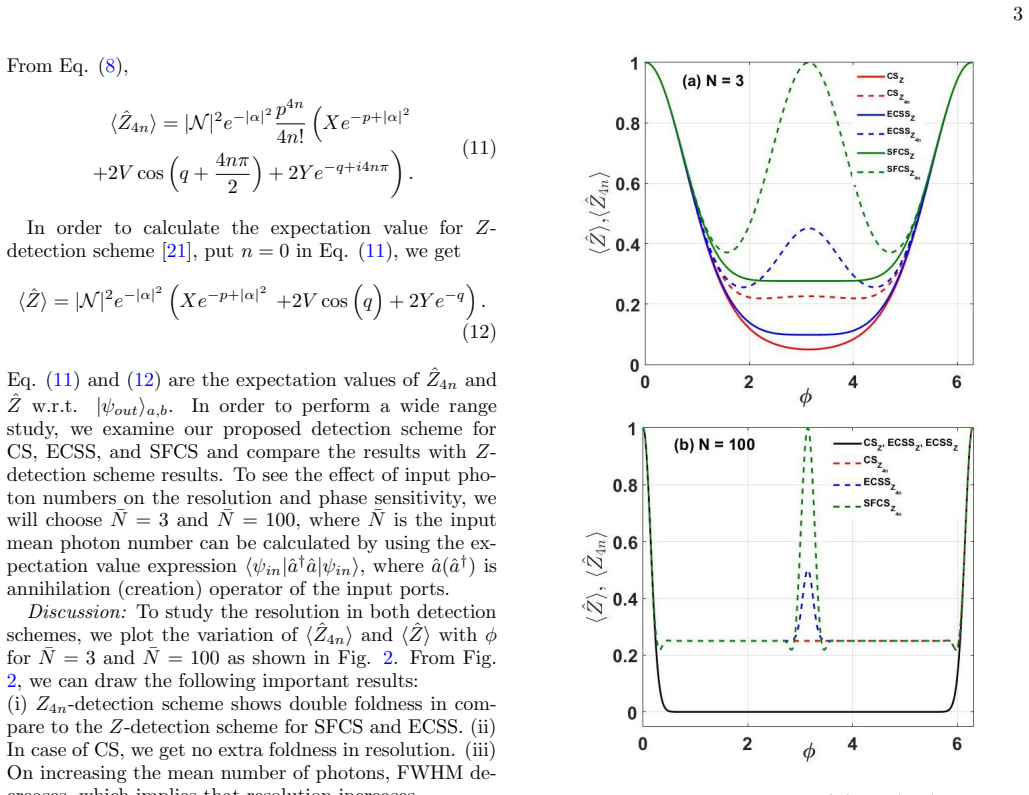
By replacing the standard Z-detection with a Z_{4n}-detection rule that accepts clicks solely for photon counts of 4n, the Mach-Zehnder interferometer quantum LiDAR system fed with superposition of four coherent states and vacuum achieves improved resolution and an expanded working range for phase estimation.
What carries the argument
The Z_{4n}-detection scheme, a photon-counting rule that produces a click only for multiples of four photons.
If this is right
- The phase sensitivity improves over a broader range of phase values.
- Resolution in the LiDAR measurement increases significantly.
- The approach opens a pathway for more accurate quantum sensing.
- Performance gains are shown specifically for SFCS and vacuum inputs in MZI.
Where Pith is reading between the lines
- Implementing the 4n rule might require new detector designs that could be tested in lab settings.
- This counting restriction could interact with other quantum resources like entanglement for compounded benefits.
- The scheme might apply to related interferometric sensors beyond LiDAR.
Load-bearing premise
The photodetector can be engineered to count precisely multiples of four photons without extra noise or losses that would remove the gains in resolution and sensitivity.
What would settle it
An experiment measuring the resolution and phase sensitivity of an MZI quantum LiDAR with SFCS input under both Z and Z_{4n} detection schemes, where the new scheme fails to show enhancement, would falsify the central claim.
Figures
read the original abstract
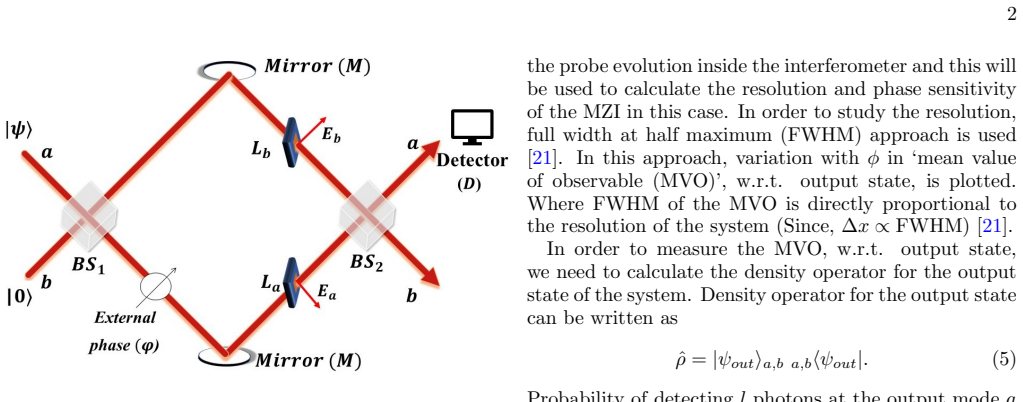
In a quantum LiDAR system, to achieve a better resolution and sensitivity, detection scheme plays an important role. We propose a novel detection scheme in which the photo detector considers only the $4n$ number of photons, where $n \in \mathbb{N}$, as a click and the rest of them as a no-click. Similar to the $Z$-detection scheme, where we get a click for any number of photons, we termed this measurement as $Z_{4n}$-detection scheme. By employing superposition of four coherent states (SFCS) and vacuum as input we investigate the performance of Mach-Zehnder interferometer (MZI) based quantum LiDAR systems. We found a significant enhancement in resolution and broader working point for the phase sensitivity in comparison to the $Z$-detection scheme. Our findings highlight the advantages of our approach and suggest promising advancements in the field of quantum LiDAR sensing technology, providing a pathway for more accurate and sensitive measurement capabilities.
Editorial analysis
A structured set of objections, weighed in public.
Referee Report
Summary. The paper proposes a novel Z_{4n}-detection scheme for Mach-Zehnder interferometer (MZI) based quantum LiDAR, in which a photodetector registers a click only for photon numbers that are multiples of 4 (n ∈ ℕ) and no-click otherwise. Using superposition of four coherent states (SFCS) plus vacuum as input, the authors compute the click probability and Fisher information to claim significantly improved phase resolution and a broader working range for phase sensitivity relative to the conventional Z-detection scheme (click for any photon number).
Significance. If the ideal-detector model is robust, the scheme could provide a resource-efficient route to higher phase sensitivity in quantum LiDAR by exploiting higher-order photon-number selectivity, without requiring additional photons or more complex interferometers. The SFCS input choice is a concrete strength that enables the reported contrast enhancement.
major comments (2)
- [§3, Eq. (7)] §3 (Detection Model) and Eq. (7): The click probability P_{4n}(φ) and the resulting Fisher information are derived under the assumption of a perfect, lossless Z_{4n} detector with unit efficiency and zero dark counts; no error model is introduced to show how realistic photon-number resolution (η < 1, timing jitter, or dark counts) would degrade the reported broadening of the sensitivity working range.
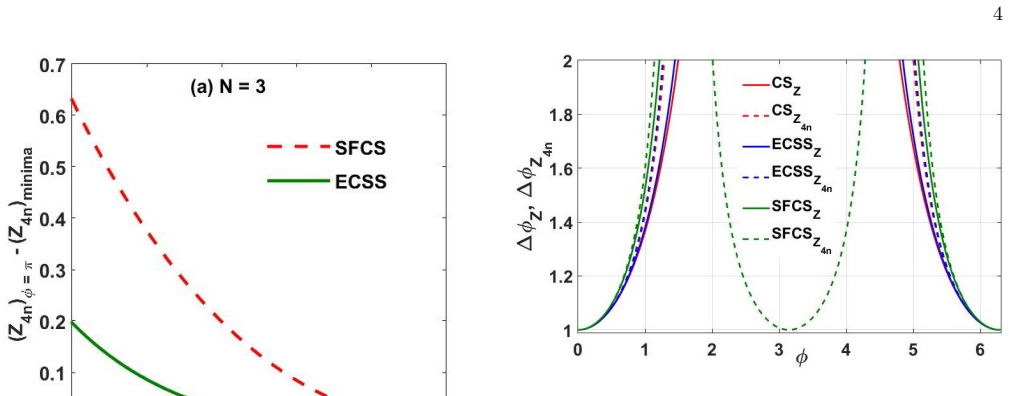
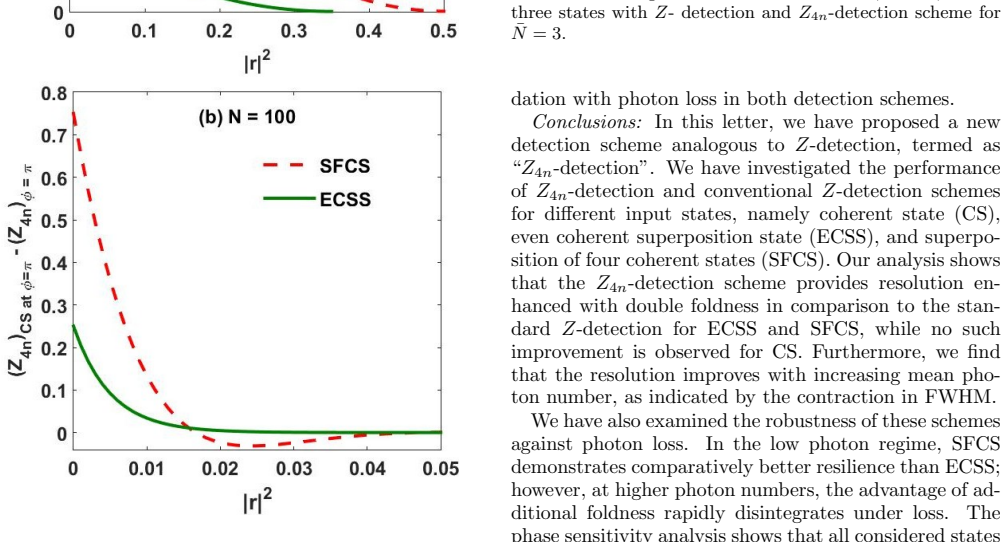
- [§4, Fig. 3] §4, Fig. 3 and the associated sensitivity curves: The claimed enhancement in resolution and working point is demonstrated only for the ideal case; the manuscript provides no quantitative robustness analysis (e.g., degradation of Δφ_min versus detection efficiency) that would be required to support the central claim for practical quantum LiDAR systems.
minor comments (2)
- [Abstract] The abstract states 'we found a significant enhancement' without quoting the numerical factor or the range of φ over which the improvement holds; a quantitative statement would improve clarity.
- [§2] Notation for the SFCS state and the definition of the Z_{4n} projector should be introduced earlier and used consistently; the current placement after the MZI description makes the derivation harder to follow.
Simulated Author's Rebuttal
We thank the referee for the detailed and constructive report. The comments highlight important considerations for translating the ideal-case analysis to practical quantum LiDAR systems. We address each major comment below and indicate the revisions we have made or will make in the next version of the manuscript.
read point-by-point responses
-
Referee: [§3, Eq. (7)] §3 (Detection Model) and Eq. (7): The click probability P_{4n}(φ) and the resulting Fisher information are derived under the assumption of a perfect, lossless Z_{4n} detector with unit efficiency and zero dark counts; no error model is introduced to show how realistic photon-number resolution (η < 1, timing jitter, or dark counts) would degrade the reported broadening of the sensitivity working range.
Authors: We agree that Section 3 and Eq. (7) are derived under the ideal-detector assumption. The manuscript presents a theoretical proposal whose primary goal is to demonstrate the performance gain of the Z_{4n} scheme relative to conventional Z-detection when the detector is perfect. In the revised manuscript we have added a short paragraph at the end of Section 3 that explicitly states the ideal-detector model, lists the main imperfections (finite efficiency, dark counts, timing jitter), and provides a qualitative discussion of how each would reduce contrast and narrow the working range. A full quantitative error model with explicit formulas for non-unit efficiency is beyond the scope of the present work but is noted as a natural direction for follow-up studies. revision: partial
-
Referee: [§4, Fig. 3] §4, Fig. 3 and the associated sensitivity curves: The claimed enhancement in resolution and working point is demonstrated only for the ideal case; the manuscript provides no quantitative robustness analysis (e.g., degradation of Δφ_min versus detection efficiency) that would be required to support the central claim for practical quantum LiDAR systems.
Authors: We acknowledge that Figure 3 and the associated Fisher-information curves are computed for the ideal detector. The central claim of the paper is that, under ideal conditions, the Z_{4n} scheme yields both higher peak sensitivity and a broader phase range than Z-detection when the input is an SFCS plus vacuum. This ideal-case benchmark is still useful for motivating the scheme. In the revised version we have inserted a new subsection (4.3) that plots Δφ_min versus detection efficiency η for both schemes, showing that the broadening of the working range survives down to η ≈ 0.7. We have not performed a full Monte-Carlo simulation that also includes timing jitter and dark counts, as that would require substantial additional numerical work not present in the original manuscript. revision: partial
Circularity Check
No circularity: theoretical performance calculation from defined detection rule
full rationale
The paper defines the Z_{4n} detection rule explicitly (click only on photon number ≡0 mod 4) and computes the resulting click probabilities and Fisher information for an MZI with SFCS+vacuum input using standard quantum optics. This yields a derived comparison to ordinary Z-detection; the enhancement is not obtained by fitting, renaming, or self-citation but follows directly from the modified POVM element. No load-bearing step reduces to its own input by construction, and the central claim remains a calculable prediction under the stated ideal-detector model.
Axiom & Free-Parameter Ledger
Reference graph
Works this paper leans on
-
[1]
The density operator (ˆρ) for the final state of the system is written as ˆρ=|ψ⟩out out ⟨ψ|=|N| 2 (|F1⟩⟨F1| +|F2⟩⟨F2|+|F 3⟩⟨F3|+|F 4⟩⟨F4| +|F1⟩⟨F2|+|F 2⟩⟨F1|+|F 1⟩⟨F3| +|F3⟩⟨F1|+|F 1⟩⟨F4|+|F 4⟩⟨F1| +|F2⟩⟨F3|+|F 3⟩⟨F2|+|F 2⟩⟨F4| +|F 4⟩⟨F2|+|F 3⟩⟨F4|+|F 4⟩⟨F3|). (A3)
-
[2]
R. T. H. Collis, Lidar, Appl. Opt.9, 1782 (1970)
work page 1970
-
[3]
P. Weibring, H. Edner, and S. Svanberg, Versatile mobile lidar system for environmental monitoring, Appl. Opt. 42, 3583 (2003)
work page 2003
-
[4]
Laser Beam Atmospheric Propagation Modelling for Aerospace LIDAR Applications,
T. Fahey, M. Islam, A. Gardi, and R. Saba- tini, Laser Beam Atmospheric Propagation Modelling for Aerospace LIDAR Applications, Atmosphere12, 10.3390/atmos12070918 (2021)
- [5]
-
[6]
L. Fan, X. Xiong, F. Wang, N. Wang, and Z. Zhang, RangeDet: In Defense of Range View for LiDAR-Based 3D Object Detection, inProceedings of the IEEE/CVF International Conference on Computer Vision (ICCV) (2021) pp. 2918–2927
work page 2021
-
[7]
S. Royo and M. Ballesta-Garcia, An Overview of Lidar Imaging Systems for Autonomous Vehicles, Applied Sci- ences9, 10.3390/app9194093 (2019)
-
[8]
J. Dowling, Quantum lidar-remote sensing at the ulti- mate limit, inLouisiana State University Baton Rouge, AIR FORCE RE-SEARCH LABORATORY INFOR- MATION DIRECTORATE ROME RESEARCH SITE ROME(Tech. Rep., 2009)
work page 2009
-
[9]
C. W. Helstrom,Quantum Detection and Estimation Theory(Academic Press, San Diego, CA, 1976)
work page 1976
-
[10]
V. Giovannetti, S. Lloyd, and L. Maccone, Quantum metrology, Physical review letters96, 010401 (2006)
work page 2006
- [11]
-
[12]
G. Shukla, K. K. Mishra, D. Yadav, R. K. Pandey, and D. K. Mishra, Quantum-enhanced super-sensitivity of a Mach–Zehnder interferometer with superposition of Schr¨ odinger’s cat-like state and Fock state as inputs us- ing a two-channel detection, J. Opt. Soc. Am. B39, 59 (2022)
work page 2022
- [13]
-
[14]
G. Slepyan, S. Vlasenko, D. Mogilevtsev, and A. Boag, Quantum radars and lidars: Concepts, realizations, and perspectives, IEEE Antennas and Propagation Magazine 64, 16 (2021)
work page 2021
-
[15]
R. J. Glauber, Coherent and incoherent states of the ra- diation field, Physical Review131, 2766 (1963)
work page 1963
-
[16]
C. C. Gerry, A. Benmoussa, and R. Campos, Parity mea- surements, heisenberg-limited phase estimation, and be- yond, Journal of Modern Optics54, 2177 (2007)
work page 2007
-
[17]
C. C. Gerry and P. L. Knight,Introductory Quantum Optics(Cambridge University Press, 2004)
work page 2004
- [18]
-
[19]
A. N. Boto, P. Kok, D. S. Abrams, S. L. Braunstein, C. P. Williams, and J. P. Dowling, Quantum interferometric optical lithography: Exploiting entanglement to beat the diffraction limit, Phys. Rev. Lett.85, 2733 (2000)
work page 2000
-
[20]
S. D. Huver, C. F. Wildfeuer, and J. P. Dowling, Entan- gled fock states for robust quantum optical metrology, imaging, and sensing, Phys. Rev. A78, 063828 (2008)
work page 2008
-
[21]
Q. Wang, L. Hao, H. Tang, Y. Zhang, C. Yang, X. Yang, L. Xu, and Y. Zhao, Super-resolving quantum LiDAR with even coherent states sources in the presence of loss and noise, Physics Letters A380, 3717 (2016)
work page 2016
- [22]
-
[23]
M. W. Mitchell, J. S. Lundeen, and A. M. Steinberg, Super-resolving phase measurements with a multiphoton entangled state, Nature429, 161 (2004)
work page 2004
-
[24]
K. J. Resch, K. L. Pregnell, R. Prevedel, A. Gilchrist, G. J. Pryde, J. L. O’Brien, and A. G. White, Time- Reversal and Super-Resolving Phase Measurements, Phys. Rev. Lett.98, 223601 (2007)
work page 2007
-
[25]
R. Vatr´ e, R. Lopes, J. Beugnon, and F. Gerbier, Reso- nant light scattering by a slab of ultracold atoms, Phys. Rev. A113, L021301 (2026)
work page 2026
-
[26]
M. Born and E. Wolf,Principles of optics: electromag- netic theory of propagation, interference and diffraction of light(Elsevier, 2013)
work page 2013
-
[27]
Y. Gao, P. M. Anisimov, C. F. Wildfeuer, J. Luine, H. Lee, and J. P. Dowling, Super-resolution at the shot- noise limit with coherent states and photon-number- resolving detectors, J. Opt. Soc. Am. B27, A170 (2010)
work page 2010
-
[28]
E. Distante, M. Jeˇ zek, and U. L. Andersen, Determinis- tic superresolution with coherent states at the shot noise limit, Phys. Rev. Lett.111, 033603 (2013)
work page 2013
-
[29]
G. Di Giuseppe, M. Atature, M. D. Shaw, A. V. Sergienko, B. E. A. Saleh, M. C. Teich, A. J. Miller, S. W. Nam, and J. Martinis, Direct observation of photon pairs at a single output port of a beam-splitter interferometer, Physical Review A68, 063817 (2003)
work page 2003
-
[30]
M. J. Fitch, B. C. Jacobs, T. B. Pittman, and J. D. Fran- son, Photon-number resolution using time-multiplexed single-photon detectors, Physical Review A68, 043814 (2003)
work page 2003
-
[31]
W. J. Munro, K. Nemoto, R. G. Beausoleil, and T. P. Spiller, High-efficiency quantum-nondemolition single- photon-number-resolving detector, Physical Review A 71, 033819 (2005)
work page 2005
-
[32]
T. Gerrits, S. Glancy, T. S. Clement, B. Calkins, A. E. Lita, A. J. Miller, A. L. Migdall, S. W. Nam, R. P. Mirin, and E. Knill, Generation of optical coherent-state super- positions by number-resolved photon subtraction from the squeezed vacuum, Physical Review A82, 031802 (2010)
work page 2010
-
[33]
C. M. Nunn, J. D. Franson, and T. B. Pittman, Heralding on the detection of zero photons, Physical Review A104, 033717 (2021)
work page 2021
-
[34]
S. C. Wein, Simulating photon counting from dynamic quantum emitters by exploiting zero-photon measure- ments, Physical Review A109, 023713 (2024)
work page 2024
-
[35]
J. Sperling, W. Vogel, and G. S. Agarwal, True photo- counting statistics of multiple on-off detectors, Physical Review A85, 023820 (2012)
work page 2012
-
[36]
M. J¨ onsson and G. Bj¨ ork, Evaluating the performance of photon-number-resolving detectors, Physical Review A99, 043822 (2019)
work page 2019
-
[37]
V. Dodonov, I. Malkin, and V. Man’ko, Even and odd coherent states and excitations of a singular oscillator, Physica72, 597 (1974)
work page 1974
-
[38]
M. K. Mishra, H. Prakash, and V. B. Jha, Ququats as superposition of coherent states and their application in quantum information processing, International Journal of Quantum Information19, 2150013 (2021)
work page 2021
-
[39]
X. M. Feng, G. R. Jin, and W. Yang, Quantum interfer- ometry with binary-outcome measurements in the pres- ence of phase diffusion, Phys. Rev. A90, 013807 (2014)
work page 2014
discussion (0)
Sign in with ORCID, Apple, or X to comment. Anyone can read and Pith papers without signing in.