AI-Enabled Covert Channel Detection in RF Receiver Architectures
Pith reviewed 2026-05-10 10:49 UTC · model grok-4.3
The pith
A compacted CNN detects covert channels in RF receivers by monitoring raw I/Q samples with over 97% accuracy in practical conditions.
A machine-rendered reading of the paper's core claim, the machinery that carries it, and where it could break.
Core claim
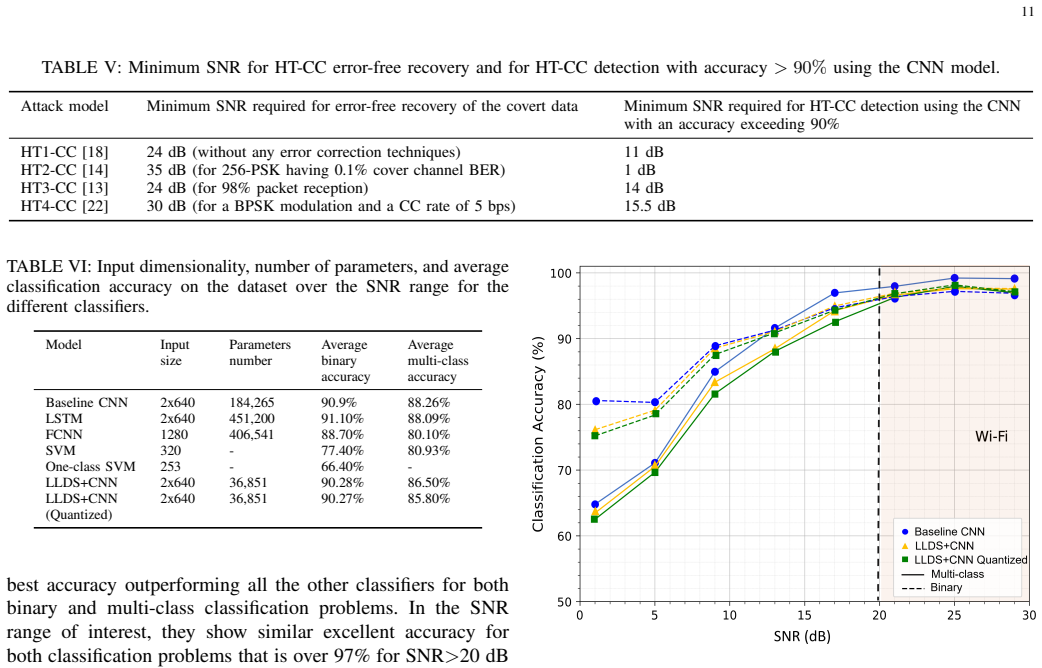
A state-of-the-art CNN can be compacted to one-fifth its original size, trained on raw I/Q samples to detect hardware-Trojan-based covert channels, and implemented as an FPGA accelerator that delivers over 97 percent accuracy for both channel detection and Trojan identification at SNR above 20 dB while using minimal resources and achieving 107 GOPs/W efficiency.
What carries the argument
The compacted convolutional neural network that ingests raw I/Q samples to classify whether a covert channel is present and, if so, which hardware Trojan is responsible.
If this is right
- Real-time covert-channel monitoring becomes practical on edge RF receivers because the model fits in small hardware and maintains high accuracy at typical operating SNRs.
- The FPGA accelerator can be added to existing wireless receiver chips without large area or power overhead.
- The approach shows a favorable accuracy-versus-size trade-off compared with other classifiers when the task is RF signal classification for security.
- Detection and Trojan identification can run simultaneously in the same lightweight model.
Where Pith is reading between the lines
- The same compacted architecture could be retrained to flag other signal anomalies such as jamming or spoofing in wireless links.
- Pairing the detector with conventional correlation-based checks might raise reliability further without increasing model size.
- Field tests on live over-the-air links would reveal how well the model holds up when the channel statistics differ from the training dataset.
Load-bearing premise
The open-source hardware-Trojan covert-channel dataset used for all accuracy numbers accurately reflects how real covert channels would appear inside deployed RF receiver hardware.
What would settle it
Evaluating the same compacted model on a fresh dataset of I/Q recordings taken from physical RF hardware that contains deliberately inserted covert channels under uncontrolled channel conditions and measuring whether accuracy falls below 90 percent.
Figures




read the original abstract
Covert channels (CCs) in wireless chips pose a serious security threat, as they enable the exfiltration of sensitive information from the chip to an external attacker. In this work, we propose an AI-based defense mechanism deployed at the RF receiver, where the model directly monitors raw I/Q samples to detect, in real time, the presence of a CC embedded within an otherwise nominal signal. We first compact a state-of-the-art convolutional neural network (CNN), achieving an 80% reduction in parameters, which is an essential requirement for efficient edge deployment. When evaluated on the open-source hardware Trojan (HT)-based CC dataset, the compacted CNN attains an average accuracy of 90.28% for CC detection and 86.50% for identifying the underlying HT, with results averaged across SNR values above 1 dB. For practical communication scenarios where SNR > 20 dB, the model achieves over 97% accuracy for both tasks. These results correspond to a minimal performance degradation of less than 2% compared to the baseline model. The compacted CNN is further benchmarked against alternative classifiers, demonstrating an excellent accuracy-model size trade-off. Finally, we design a lightweight CNN hardware accelerator and demonstrate it on an FPGA, achieving very low resource utilization and an efficiency of 107 GOPs/W. Being the first AI hardware accelerator proposed specifically for CC detection, we compare it against state-of-the-art AI accelerators for RF signal classification tasks such as modulation recognition, showing superior performance.
Editorial analysis
A structured set of objections, weighed in public.
Referee Report
Summary. The manuscript presents an AI-based approach for detecting covert channels (CCs) in wireless RF chips using a compacted convolutional neural network (CNN) that processes raw I/Q samples at the receiver. The key contributions include an 80% reduction in CNN parameters, empirical results on an open-source hardware Trojan (HT)-based CC dataset showing 90.28% average accuracy for CC detection and 86.50% for HT identification (SNR > 1 dB), over 97% accuracy at SNR > 20 dB with <2% degradation from baseline, benchmarking against other classifiers, and an FPGA implementation of a lightweight CNN accelerator achieving 107 GOPs/W efficiency, claimed to be the first such for CC detection.
Significance. Should the results prove robust and the dataset representative of real-world conditions, this work would be significant for advancing hardware security in RF systems by enabling real-time, edge-deployable detection of covert channels. The parameter compaction and high-efficiency hardware accelerator represent practical advancements, and the comparison to state-of-the-art accelerators for similar tasks strengthens the contribution. However, the empirical nature without mathematical derivations means significance hinges on the quality of the experimental validation.
major comments (2)
- [Abstract] The headline accuracy figures (90.28% for CC detection, 86.50% for HT identification, <2% degradation) and the claim of practical scenarios (SNR >20 dB yielding >97%) are presented without any description of the training/validation splits, hyperparameter selection, or controls for overfitting. This information is essential to evaluate whether the results are reliable and not due to data leakage or poor generalization.
- [Abstract] All reported performance metrics depend on the open-source HT-based CC dataset faithfully representing real-world covert channel behavior in deployed RF receiver hardware, including I/Q distortions and hardware impairments. The manuscript provides no details on dataset generation, physical-layer validation, or comparisons to other CC implementations, leaving the generalization to practical deployment unsupported.
minor comments (1)
- [Abstract] The compaction procedure is mentioned as achieving 80% reduction but not briefly described, which would aid reader understanding in the summary.
Simulated Author's Rebuttal
We thank the referee for the detailed and constructive feedback. We have addressed each major comment point-by-point below, providing clarifications and making targeted revisions to strengthen the manuscript's transparency and completeness.
read point-by-point responses
-
Referee: [Abstract] The headline accuracy figures (90.28% for CC detection, 86.50% for HT identification, <2% degradation) and the claim of practical scenarios (SNR >20 dB yielding >97%) are presented without any description of the training/validation splits, hyperparameter selection, or controls for overfitting. This information is essential to evaluate whether the results are reliable and not due to data leakage or poor generalization.
Authors: We agree that the abstract would benefit from explicit mention of the experimental protocol to support evaluation of result reliability. The full manuscript (Section IV) specifies an 80/20 train/test split with 5-fold cross-validation for hyperparameter selection (learning rate, batch size, and epochs tuned via grid search), along with dropout (rate 0.5) and early stopping to control overfitting. No data leakage was present as splits were performed at the sample level with no overlap between train and test sets. To directly address this concern, we have revised the abstract to include a brief clause noting the use of standard cross-validated splits and regularization techniques. revision: yes
-
Referee: [Abstract] All reported performance metrics depend on the open-source HT-based CC dataset faithfully representing real-world covert channel behavior in deployed RF receiver hardware, including I/Q distortions and hardware impairments. The manuscript provides no details on dataset generation, physical-layer validation, or comparisons to other CC implementations, leaving the generalization to practical deployment unsupported.
Authors: The open-source HT-based CC dataset (cited as [reference] in the manuscript) was generated using a hardware Trojan implementation on an RF transceiver platform, with I/Q samples collected under controlled SNR conditions (including additive noise and phase offsets to emulate impairments). We have added a concise summary of the dataset generation process and physical-layer validation steps (drawn from the source) to the experimental setup section. While exhaustive comparisons against every alternative CC implementation exceed the scope of this work, the dataset incorporates realistic distortions and multiple SNR regimes; the >97% accuracy at SNR >20 dB directly supports applicability to practical high-SNR receiver scenarios. We acknowledge that broader generalization claims would require additional datasets and have tempered the abstract language accordingly. revision: partial
Circularity Check
No circularity: empirical ML results on external dataset
full rationale
The paper reports direct empirical measurements of a compacted CNN's detection accuracy (90.28% CC detection, 86.50% HT identification, >97% at SNR>20 dB) on the open-source HT-based CC dataset, with FPGA benchmarking for efficiency. No equations, derivations, or fitted parameters exist that could reduce to inputs by construction. No self-citations support load-bearing uniqueness claims or ansatzes. All central claims are performance numbers measured on an external dataset, making the work self-contained without circular reduction.
Axiom & Free-Parameter Ledger
axioms (1)
- domain assumption The open-source HT-based CC dataset is representative of real covert channel threats in RF receivers.
Reference graph
Works this paper leans on
-
[1]
Stealing AI model weights through covert commu- nication channels,
V . Barbaza, A. R. Diaz-Rizo, H. Aboushady, S. Raptis, and H.-G. Stratigopoulos, “Stealing AI model weights through covert commu- nication channels,”arXiv:2510.00151, 2025
-
[2]
A survey of hardware trojan taxonomy and detection,
M. Tehranipoor and F. Koushanfar, “A survey of hardware trojan taxonomy and detection,”IEEE Des. Test Comput., vol. 27, no. 1, pp. 10–25, Jan./Feb. 2010
work page 2010
-
[3]
Trustworthy hardware: Identifying and classifying hardware trojans,
R. Karri, J. Rajendran, K. Rosenfeld, and M. Tehranipoor, “Trustworthy hardware: Identifying and classifying hardware trojans,”Computer, vol. 43, no. 10, pp. 39–46, Oct. 2010
work page 2010
-
[4]
Hardware trojan attacks: Threat analysis and countermeasures,
S. Bhunia, M. S. Hsiao, M. Banga, and S. Narasimhan, “Hardware trojan attacks: Threat analysis and countermeasures,”Proc. IEEE, vol. 102, no. 8, pp. 1229–1247, Jul. 2014
work page 2014
-
[5]
Hardware Trojans: lessons learned after one decade of research,
K. Xiao, D. Forte, Y . Jin, R. Karri, S. Bhunia, and M. Tehranipoor, “Hardware Trojans: lessons learned after one decade of research,”ACM Trans. Des. Autom. Electron. Syst., vol. 22, no. 1, pp. 6:1–6:23, Dec. 2016
work page 2016
-
[6]
S. Bhunia and M. M. Tehranipoor (Eds.),The Hardware Trojan War: Attacks, Myths, and Defenses, Springer International Publishing, 2018
work page 2018
-
[7]
A survey on machine learn- ing against hardware trojan attacks: Recent advances and challenges,
Z. Huang, Q. Wang, Y . Chen, and X. Jiang, “A survey on machine learn- ing against hardware trojan attacks: Recent advances and challenges,” IEEE Access, vol. 8, pp. 10796–10826, Jan 2020
work page 2020
-
[8]
Survey of recent developments for hardware trojan detection,
A. Jain, Z. Zhou, and U. Guin, “Survey of recent developments for hardware trojan detection,” inProc. IEEE Int. Symp. Circuits Syst. (ISCAS), May 2021
work page 2021
-
[9]
Digital-to-analog hardware Trojan attacks,
M. Elshamyet al., “Digital-to-analog hardware Trojan attacks,”IEEE Trans. Circuits Syst. I, Reg. Papers, vol. 69, no. 2, pp. 573–586, Feb. 2022
work page 2022
-
[10]
Circuit-to-circuit attacks in SoCs via trojan-infected IEEE 1687 test infrastructure,
M. Portolan, A. Pavlidis, G. Di Natale, E. Faehn, and H.-G. Stratigopou- los, “Circuit-to-circuit attacks in SoCs via trojan-infected IEEE 1687 test infrastructure,” inProc. IEEE Int. Test Conf. (ITC), 2022, pp. 539–543
work page 2022
-
[11]
Run-time hardware trojan detection in analog and mixed-signal ICs,
A. Pavlidis, E. Faehn, M.-M. M. Lou ¨erat, and H.-G. Stratigopoulos, “Run-time hardware trojan detection in analog and mixed-signal ICs,” inProc. IEEE VLSI Test Symp. (VTS), Apr. 2022
work page 2022
-
[12]
A timing channel spyware for the CSMA/CA protocol,
N. Kiyavash, F. Koushanfar, T. P. Coleman, and M. Rodrigues, “A timing channel spyware for the CSMA/CA protocol,”IEEE Trans. Inf. Forensics Security, vol. 8, no. 3, pp. 477–487, Mar. 2013
work page 2013
-
[13]
Secret agent radio: Covert communication through dirty constellations,
A. Dutta, D. Saha, D. Grunwald, and D. Sicker, “Secret agent radio: Covert communication through dirty constellations,” inInformation Hiding, M. Kirchner and D. Ghosal, Eds., Berlin, Heidelberg, 2013, pp. 160–175, Springer Berlin Heidelberg
work page 2013
-
[14]
Practical covert channels for WiFi systems,
J. Classen, M. Schulz, and M. Hollick, “Practical covert channels for WiFi systems,” inProc. IEEE Conf. Commun. Netw. Secur. (CNS), Sep. 2015, pp. 209–217
work page 2015
-
[15]
Exploiting OFDM systems for covert communication,
Z. Hijaz and V . S. Frost, “Exploiting OFDM systems for covert communication,” inProc. IEEE Mil. Commun. Conf. (MILCOM), Oct./Nov. 2010, pp. 2149–2155. 14
work page 2010
-
[16]
Steganography in OFDM symbols of fast IEEE 802.11n networks,
S. Grabski and K. Szczypiorski, “Steganography in OFDM symbols of fast IEEE 802.11n networks,” inProc. IEEE Secur. Priv. Workshops, May 2013, pp. 158–164
work page 2013
-
[17]
Demonstrating and mitigating the risk of an FEC-based hardware trojan in wireless networks,
K. S. Subraman, A. Antonopoulos, A. A. Abotabl, A. Nosratinia, and Y . Makris, “Demonstrating and mitigating the risk of an FEC-based hardware trojan in wireless networks,”IEEE Trans. Inf. Forensics Security, vol. 14, no. 10, pp. 2720–2734, Feb. 2019
work page 2019
-
[18]
Leaking wireless ICs via hardware trojan-infected synchronization,
A. R. D ´ıaz-Rizo, H. Aboushady, and H.-G. Stratigopoulos, “Leaking wireless ICs via hardware trojan-infected synchronization,”IEEE Trans. Dependable Secure Comput., vol. 20, no. 5, pp. 3845–3859, Sept. 2023
work page 2023
-
[19]
A wireless covert channel based on dirty constellation with phase drift,
K. Grzesiak, Z. Piotrowski, and J. Kelner, “A wireless covert channel based on dirty constellation with phase drift,”Electronics, vol. 10, no. 6, 2021
work page 2021
-
[20]
Hardware trojans in wireless cryptographic ICs,
Y . Jin and Y . Makris, “Hardware trojans in wireless cryptographic ICs,” IEEE Design Test Comput., vol. 27, no. 1, pp. 26–35, Jan./Feb. 2010
work page 2010
-
[21]
Silicon demonstration of hardware trojan design and detection in wireless cryptographic ICs,
Y . Liu, Y . Jin, A. Nosratinia, and Y . Makris, “Silicon demonstration of hardware trojan design and detection in wireless cryptographic ICs,” IEEE Trans. Very Large Scale Integr. (VLSI) Syst., vol. 25, no. 4, pp. 1506–1519, Apr. 2017
work page 2017
-
[22]
Amplitude-modulating analog/RF hardware trojans in wireless networks: Risks and remedies,
K. S. Subramani, N. Helal, A. Antonopoulos, A. Nosratinia, and Y . Makris, “Amplitude-modulating analog/RF hardware trojans in wireless networks: Risks and remedies,”IEEE Trans. Inf. Forensics Security, vol. 15, pp. 3497–3510, Apr. 2020
work page 2020
-
[23]
Detection mechanisms for unauthorized wireless transmissions,
S. Chang, G. Bhat, U. Ogras, B. Bakkaloglu, and S. Ozev, “Detection mechanisms for unauthorized wireless transmissions,”ACM Trans. Des. Autom. Electron. Syst., vol. 23, no. 6, pp. 70:1–70:21, Nov. 2018
work page 2018
-
[24]
Impairment shift keying: Covert signaling by deep learning of controlled radio imperfections,
K. Sankheet al., “Impairment shift keying: Covert signaling by deep learning of controlled radio imperfections,” inProc. IEEE Mil. Commun. Conf. (MILCOM), Nov. 2019, pp. 598–603
work page 2019
-
[25]
Chaos- based hardware trojan covert channel for synchronized chaotic cryp- tosystems,
R. U. Almada-Prieto, J. C. N ´u˜nez-P´erez, and A. R. D ´ıaz-Rizo, “Chaos- based hardware trojan covert channel for synchronized chaotic cryp- tosystems,” inProc. IEEE Lat. Am. Symp. Circuits Syst. (LASCAS), 2026, pp. 1–5
work page 2026
-
[26]
A. R. D ´ıaz-Rizo, A. Abdelazim, H. Aboushady, and H.-G. Stratigopou- los, “Covert communication channels based on hardware trojans: Open- source dataset and AI-based detection,” inProc. IEEE Int. Symp. Hardw.-Oriented Secur. Trust (HOST), May 2024, pp. 101–106
work page 2024
-
[27]
Hardware dithering: A run-time method for trojan neutralization in wireless cryptographic ICs,
C. Kapatsori, Y . Liu, A. Antonopoulos, and Y . Makris, “Hardware dithering: A run-time method for trojan neutralization in wireless cryptographic ICs,” inProc. IEEE Int. Test Conf. (ITC), Oct./Nov. 2018
work page 2018
-
[28]
Concurrent hardware trojan detection in wireless cryptographic ICs,
Y . Liu, G. V olanis, K. Huang, and Y . Makris, “Concurrent hardware trojan detection in wireless cryptographic ICs,” inProc. IEEE Int. Test Conf. (ITC), Oct. 2015
work page 2015
-
[29]
L. Lin, T. G ¨uneysu M. Kasper, C. Paar, and W. Burleson,Trojan Side-Channels: Lightweight Hardware Trojans through Side-Channel Engineering, Berlin, Germany: Springer, 2009
work page 2009
-
[30]
Physical gate based preamble obfuscation for securing wireless communication,
J. Chackoet al., “Physical gate based preamble obfuscation for securing wireless communication,” inProc. Int. Conf. Comput. Netw. Commun. (ICNC), Jan. 2017, pp. 293–297
work page 2017
-
[31]
RF transceiver security against piracy attacks,
A. R. D ´ıaz-Rizo, J. Leonhard, H. Aboushady, and H. Stratigopoulos, “RF transceiver security against piracy attacks,”IEEE Trans. Circuits Syst., II, Exp. Briefs, vol. 69, no. 7, pp. 3169–3173, Jul. 2022
work page 2022
-
[32]
Anti-piracy design of RF transceivers,
A. R. D ´ıaz-Rizo, H. Aboushady, and H.-G. Stratigopoulos, “Anti-piracy design of RF transceivers,”IEEE Trans. Circuits Syst. I, Reg. Papers, vol. 70, no. 1, pp. 492–505, Jan. 2023
work page 2023
-
[33]
Anti-counterfeiting design of bluetooth transceivers through logic locking,
G. Montoya-Z ´u˜niga, A. R. D ´ıaz-Rizo, H. Aboushady, R. Parra-Michel, A. Veloz-Guerrero, and H.-G. Stratigopoulos, “Anti-counterfeiting design of bluetooth transceivers through logic locking,” inProc. IEEE Global Communications Conference (GLOBECOM), Dec. 2025
work page 2025
-
[34]
Analog and mixed-signal IC security via sizing camou- flaging,
J. Leonhard, A. Sayed, M.-M. Lou ¨erat, H. Aboushady, and H.-G. Stratigopoulos, “Analog and mixed-signal IC security via sizing camou- flaging,”IEEE Trans. Comput.-Aided Design Integr. Circuits Syst., vol. 40, no. 5, pp. 822–835, Jul. 2021
work page 2021
-
[35]
Case study: Detecting hardware trojans in third-party digital IP cores,
X. Zhang and M. Tehranipoor, “Case study: Detecting hardware trojans in third-party digital IP cores,” inIEEE Int. Symp. Hardw.-Oriented Secur. Trust (HOST), Jan. 2011, pp. 67–70
work page 2011
-
[36]
Advancing the state-of-the-art in hardware trojans detection,
S. K. Haider, C. Jin, M. Ahmad, D. M. Shila, O. Khan, and M. van Dijk, “Advancing the state-of-the-art in hardware trojans detection,” IEEE Trans. Dependable Secure Comput., vol. 16, no. 1, pp. 18–32, Jan./Feb. 2019
work page 2019
-
[37]
Exposing hardware trojans in embedded platforms via short-term aging,
V . R. Surabhi, P. Krishnamurthy, H. Amrouch, J. Henkel, R. Karri, and F. Khorrami, “Exposing hardware trojans in embedded platforms via short-term aging,”IEEE Trans. Comput.-Aided Design Integr. Circuits Syst., vol. 39, no. 11, pp. 3519–3530, Nov. 2020
work page 2020
-
[38]
Y . Jin, X. Guo, R. G. Dutta, M.-M. Bidmeshki, and Y . Makris, “Data secrecy protection through information flow tracking in proof-carrying hardware IP—part I: Framework fundamentals,”IEEE Trans. Inf. Forensics Security, vol. 12, no. 10, pp. 2416–2429, Oct. 2017
work page 2017
-
[39]
Pre-silicon security verification and validation: A formal perspective,
X. Guo, R. G. Dutta, Y . Jin, F. Farahmandi, and P. Mishra, “Pre-silicon security verification and validation: A formal perspective,” inProc. 52nd Design Autom. Conf. (DAC), Jun. 2015
work page 2015
-
[40]
Hardware trojans classification for gate-level netlists using multi-layer neural networks,
K. Hasegawa, M. Yanagisawa, and N. Togawa, “Hardware trojans classification for gate-level netlists using multi-layer neural networks,” inProc. IEEE Int. Symp. On-Line Test. Robust Syst. Des. (IOLTS), 2017, pp. 227–232
work page 2017
-
[41]
Hard- ware IP assurance against trojan attacks with machine learning and post- processing,
P. Gaikwad, J. Cruz, P. Chakraborty, S. Bhunia, and T. Hoque, “Hard- ware IP assurance against trojan attacks with machine learning and post- processing,”ACM J. Emerg. Technol. Comput. Syst., vol. 19, no. 3, Jun. 2023
work page 2023
-
[42]
Reversing stealthy dopant-level circuits,
T. Sugawaraet al., “Reversing stealthy dopant-level circuits,”J. Cryptograph. Eng., vol. 5, no. 2, pp. 85–94, Jun. 2015
work page 2015
-
[43]
Trojan detection using IC fingerprinting,
D. Agrawal, S. Baktir, D. Karakoyunlu, P. Rohatgi, and B. Sunar, “Trojan detection using IC fingerprinting,” inProc. IEEE Symp. Secur. Privacy (SP), May 2007, pp. 296–310
work page 2007
-
[44]
Improving IC security against trojan attacks through integration of security monitors,
S. Narasimhan, W. Yueh, X. Wang, S. Mukhopadhyay, and S. Bhunia, “Improving IC security against trojan attacks through integration of security monitors,”IEEE Design Test Comput., vol. 29, no. 5, pp. 37–46, Sep./Oct. 2012
work page 2012
-
[45]
Temperature tracking: Toward robust run-time detection of hardware trojans,
C. Bao, D. Forte, and A. Srivastava, “Temperature tracking: Toward robust run-time detection of hardware trojans,”IEEE Trans. Comput.- Aided Design Integr. Circuits Syst., vol. 34, no. 10, pp. 1577–1585, Apr. 2015
work page 2015
-
[46]
Hardware trojan detection through chip-free electromagnetic side-channel statistical analysis,
J. He, Y . Zhao, X. Guo, and Y . Jin, “Hardware trojan detection through chip-free electromagnetic side-channel statistical analysis,”IEEE Trans. Very Large Scale Integr. (VLSI) Syst., vol. 25, no. 10, pp. 2939–2948, Oct. 2017
work page 2017
-
[47]
SPARTA-COTS: A laser probing approach for sequential trojan detection in COTS integrated circuits,
A. Stern, D. Mehta, S. Tajik, U. Guin, F. Farahmandi, and M. Tehra- nipoor, “SPARTA-COTS: A laser probing approach for sequential trojan detection in COTS integrated circuits,” inIEEE Phys. Assur. Insp. Electron. (PAINE), Dec. 2020
work page 2020
-
[48]
IEEE, “IEEE standard for information technology—telecommunications and information exchange between systems local and metropolitan area networks—specific requirements - part 11: Wireless LAN medium access control (MAC) and physical layer (PHY) specifications,”IEEE Std 802.11-2016 (Revision of IEEE Std 802.11-2012), pp. 1–3534, 2016
work page 2016
-
[49]
Nuand, “SDR bladeRF 2.0 micro xA9,” https://bit.ly/3z2QV1N, Online
-
[50]
Edge-first language model inference: Models, metrics, and tradeoffs,
S. Jang and R. Morabito, “Edge-first language model inference: Models, metrics, and tradeoffs,”arXiv.2505.16508, 2025
-
[51]
Latency comparison of cloud datacenters and edge servers,
B. Charyyev, E. Arslan, and M. H. Gunes, “Latency comparison of cloud datacenters and edge servers,” inProc. IEEE Global Communications Conference (GLOBECOM), Dec. 2020
work page 2020
-
[52]
A comprehensive study of security of internet-of-things,
A. Mosenia and N. K. Jha, “A comprehensive study of security of internet-of-things,”IEEE Trans. Emerg. Top. Comput., vol. 5, no. 4, pp. 586–602, Oct.-Dec. 2017
work page 2017
-
[53]
Going deeper with convolutions,
C. Szegedy et al., “Going deeper with convolutions,” inProc. IEEE Conf. Comput. Vis. Pattern Recognit. (CVPR), Jun. 2015
work page 2015
-
[54]
Deep learning modulation recognition for RF spectrum monitoring,
A. Emadet al., “Deep learning modulation recognition for RF spectrum monitoring,” inProc. IEEE Int. Symp. Circuits Syst. (ISCAS), May 2021
work page 2021
-
[55]
Real-time and embedded deep learning on FPGA for RF signal classification,
S. Soltani, Y . E. Sagduyu, R. Hasan, K. Davaslioglu, H. Deng, and T. Erpek, “Real-time and embedded deep learning on FPGA for RF signal classification,” inProc. IEEE Mil. Commun. Conf. (MILCOM), Mar 2019
work page 2019
-
[56]
A power-efficient attention-infused CNN hardware accelerator for RF spectrum monitoring,
Z. Song, A. E. Abdelazim, P. Bazargan Sabet, F. Wajsb ¨urt, H.-G. Stratigopoulos, and H. Aboushady, “A power-efficient attention-infused CNN hardware accelerator for RF spectrum monitoring,” inProc. IEEE Int. Symp. Circuits Syst. (ISCAS), May 2025
work page 2025
-
[57]
Efficient hardware design of DNN for RF signal modulation recognition employing ternary weights,
J. Woo, K. Jung, and S. Mukhopadhyay, “Efficient hardware design of DNN for RF signal modulation recognition employing ternary weights,” IEEE Access, vol. 12, pp. 80165–80175, Jun 2024
work page 2024
-
[58]
Real-time automatic modulation recognition based on FPGA,
K. Zhang et al., “Real-time automatic modulation recognition based on FPGA,” inProc. IEEE Int. Conf. Comput. Commun. (ICCC), Dec. 2023
work page 2023
-
[59]
W. Guo, K. Yang, H.-G. Stratigopoulos, H. Aboushady, and K. N. Salama, “An end-to-end neuromorphic radio classification system with an efficient sigma-delta-based spike encoding scheme,”IEEE Trans. Artif. Intell., vol. 5, no. 4, pp. 1869–1881, Aug. 2024
work page 2024
-
[60]
J. Gan et al., “A Zynq-based platform with conditional- reconfigurable complex-valued neural network for specific emitter identification,”IEEE Trans. Instrum. Meas., vol. 73, pp. 1–11, Apr. 2024
work page 2024
discussion (0)
Sign in with ORCID, Apple, or X to comment. Anyone can read and Pith papers without signing in.