ConGISATA: A Framework for Continuous Gamified Information Security Awareness Training and Assessment
Pith reviewed 2026-05-10 10:58 UTC · model grok-4.3
The pith
ConGISATA uses continuous gamified training and mobile sensors to improve information security awareness.
A machine-rendered reading of the paper's core claim, the machinery that carries it, and where it could break.
Core claim
The central discovery is that the ConGISATA framework, built around continuous and gradual gamified training with embedded mobile sensors, enables users to learn from real-life mistakes and adapt their behavior. It specifically transforms passive risk situations, where people fail to act, into active risk situations that users are more likely to address. The authors' evaluation demonstrates that this approach improves individuals' information security awareness both according to the sensor measurements and in simulations of common attack vectors.
What carries the argument
ConGISATA: a continuous gamified ISA training and assessment framework using mobile sensors designed from a taxonomy of security awareness to turn passive risks into active ones.
If this is right
- Users show measurable improvement in information security awareness through the sensor-based assessments.
- Participants exhibit better performance when encountering simulated social engineering attacks.
- The continuous nature allows adaptation based on actual daily behaviors rather than hypothetical scenarios.
- Passive risks are reframed as active concerns, countering the tendency to underestimate them.
Where Pith is reading between the lines
- Longer-term studies could test if the observed improvements persist and translate to fewer real-world incidents.
- Organizations might combine this with other security measures for broader protection against human-targeted attacks.
- The sensor taxonomy could inspire similar continuous assessment tools in related fields such as data privacy awareness.
Load-bearing premise
The mobile sensors designed from the taxonomy accurately reflect true security awareness, and the improvements seen in training lead to lasting changes that lower actual attack success rates.
What would settle it
Tracking whether individuals who undergo the ConGISATA training experience fewer successful social engineering attacks in their daily use compared to a control group over several months.
Figures
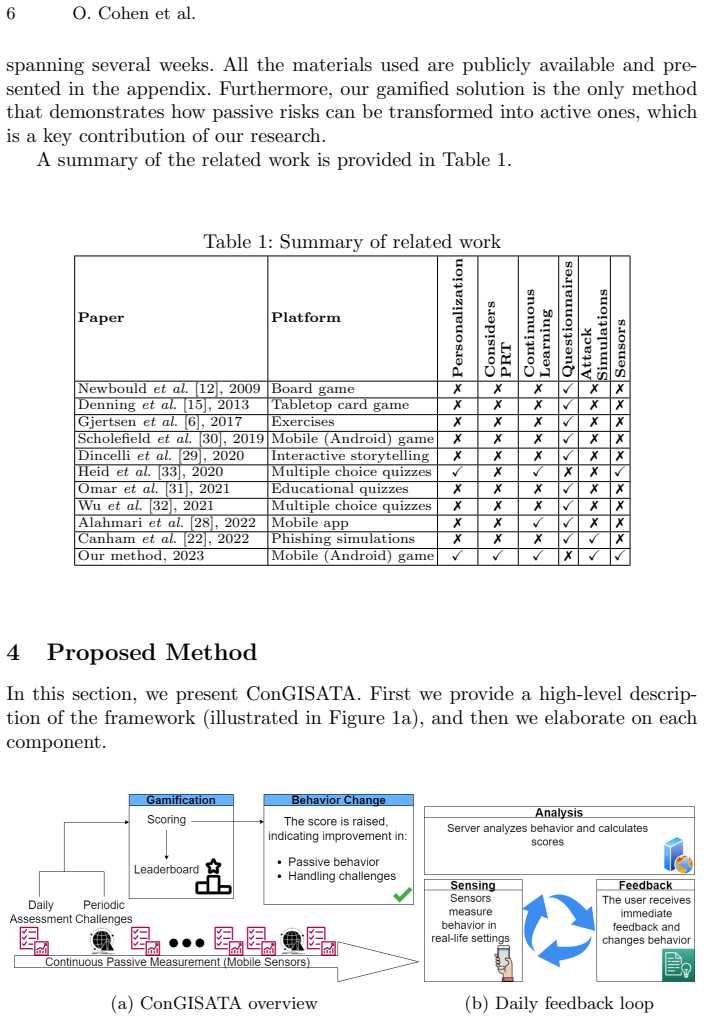


read the original abstract
The incidence of cybersecurity attacks utilizing social engineering techniques has increased. Such attacks exploit the fact that in every secure system, there is at least one individual with the means to access sensitive information. Since it is easier to deceive a person than it is to bypass the defense mechanisms in place, these types of attacks have gained popularity. This situation is exacerbated by the fact that people are more likely to take risks in their passive form, i.e., risks that arise due to the failure to perform an action. Passive risk has been identified as a significant threat to cybersecurity. To address these threats, there is a need to strengthen individuals' information security awareness (ISA). Therefore, we developed ConGISATA - a continuous gamified ISA training and assessment framework based on embedded mobile sensors; a taxonomy for evaluating mobile users' security awareness served as the basis for the sensors' design. ConGISATA's continuous and gradual training process enables users to learn from their real-life mistakes and adapt their behavior accordingly. ConGISATA aims to transform passive risk situations (as perceived by an individual) into active risk situations, as people tend to underestimate the potential impact of passive risks. Our evaluation of the proposed framework demonstrates its ability to improve individuals' ISA, as assessed by the sensors and in simulations of common attack vectors.
Editorial analysis
A structured set of objections, weighed in public.
Referee Report
Summary. The manuscript proposes ConGISATA, a continuous gamified framework for information security awareness (ISA) training and assessment built on a taxonomy of mobile users' security awareness to design embedded mobile sensors. It emphasizes gradual, real-life mistake-based learning to convert perceived passive risks into active risks, with the central claim that evaluation demonstrates improvement in individuals' ISA as assessed by the sensors and in simulations of common attack vectors.
Significance. If the evaluation holds, the framework could provide a practical method for ongoing ISA training that uses mobile sensors for passive monitoring and gamification to target passive risks in cybersecurity. This has potential to improve user behavior and reduce social-engineering attack success rates, offering a contribution to continuous awareness programs beyond one-time training.
major comments (2)
- Abstract and Evaluation section: The claim that evaluation demonstrates improvement in ISA supplies no information on participant numbers, control conditions, statistical tests, sensor validation against real behaviors, or post-hoc analysis handling, rendering the central claim unverifiable from the provided details.
- Evaluation and Framework sections: The assessment relies exclusively on internal sensor scores and framework-internal simulations without external ground-truth data (e.g., logged phishing clicks, permission grants, or incident reports) linking sensor deltas to reduced real-world attack success; this leaves unaddressed whether improvements persist outside the gamified setting or translate to actual behavior change.
Simulated Author's Rebuttal
We thank the referee for their constructive and detailed feedback on our manuscript. The comments have highlighted important areas where additional clarity and transparency are needed. We address each major comment below and describe the revisions we will make to strengthen the paper.
read point-by-point responses
-
Referee: Abstract and Evaluation section: The claim that evaluation demonstrates improvement in ISA supplies no information on participant numbers, control conditions, statistical tests, sensor validation against real behaviors, or post-hoc analysis handling, rendering the central claim unverifiable from the provided details.
Authors: We agree that the evaluation details require expansion for verifiability. In the revised manuscript, we will update both the abstract and the Evaluation section to explicitly report the number of participants, describe any control conditions employed, specify the statistical tests used (such as pre-post paired comparisons), explain the validation process of sensor metrics against observed user behaviors during the study, and outline the post-hoc analysis procedures. These additions will directly support and make verifiable the claim of ISA improvement. revision: yes
-
Referee: Evaluation and Framework sections: The assessment relies exclusively on internal sensor scores and framework-internal simulations without external ground-truth data (e.g., logged phishing clicks, permission grants, or incident reports) linking sensor deltas to reduced real-world attack success; this leaves unaddressed whether improvements persist outside the gamified setting or translate to actual behavior change.
Authors: We acknowledge this as a valid limitation of the current evaluation design. The study prioritizes demonstrating the framework's internal mechanisms and initial effectiveness via sensor scores and controlled attack simulations. In the revision, we will add a new subsection in the Evaluation or Discussion section that explicitly discusses this gap, including the absence of external ground-truth linkages and the open question of persistence and real-world translation. We will also outline planned future work involving longitudinal studies with real-world metrics. This will clarify the scope of the present claims without overstating them. revision: partial
Circularity Check
No circularity: framework and evaluation are independently described with no self-referential derivations or fitted predictions
full rationale
The paper presents ConGISATA as a framework whose sensors are designed from an external taxonomy and whose evaluation uses those sensors plus separate simulations of attack vectors. No equations, parameter fitting, or 'predictions' appear that reduce by construction to the inputs. The central claim of improved ISA is assessed via the framework's own metrics, but this is a standard internal evaluation rather than a load-bearing self-definition or renamed result. The derivation chain is self-contained and does not invoke self-citations for uniqueness or smuggle ansatzes. This matches the default expectation of no significant circularity.
Axiom & Free-Parameter Ledger
axioms (2)
- domain assumption Gamification combined with continuous real-world feedback improves security awareness and reduces passive risk behavior
- domain assumption Mobile sensors can be designed from a taxonomy to reliably assess information security awareness
invented entities (1)
-
ConGISATA framework
no independent evidence
Reference graph
Works this paper leans on
-
[1]
Kumar, A., Chaudhary, M. & Kumar, N. Social engineering threats and awareness: a survey.European Journal Of Advances In Engineering And Technology. 2, 15-19 (2015)
work page 2015
-
[2]
Almost 90% of cyber attacks are caused by human error or behavior
Kelly, R. Almost 90% of cyber attacks are caused by human error or behavior. ChiefExecutive. Net. (2017)
work page 2017
-
[3]
Bada, M., Sasse, A. & Nurse, J. Cyber security awareness campaigns: Why do they fail to change behaviour?.ArXiv Preprint ArXiv:1901.02672. (2019)
-
[4]
Deterding, S., Dixon, D., Khaled, R. & Nacke, L. From game design elements to gamefulness: defining” gamification”.Proceedings Of The 15th International Academic MindTrek Conference: Envisioning Future Media Environments. pp. 9- 15 (2011)
work page 2011
-
[5]
Hamari, J., Koivisto, J. & Sarsa, H. Does gamification work?–a literature review of empirical studies on gamification.2014 47th Hawaii International Conference On System Sciences. pp. 3025-3034 (2014)
work page 2014
-
[6]
Gjertsen, E., Gjære, E., Bartnes, M. & Flores, W. Gamification of Information Security Awareness and Training..ICISSP. pp. 59-70 (2017)
work page 2017
- [7]
-
[8]
Bitton, R., Finkelshtein, A., Sidi, L., Puzis, R., Rokach, L. & Shabtai, A. Taxonomy of mobile users’ security awareness.Computers & Security. 73 pp. 266-293 (2018)
work page 2018
-
[9]
Keinan, R. & Bereby-Meyer, Y. ” Leaving it to chance”–Passive risk taking in everyday life..Judgment & Decision Making. 7 (2012)
work page 2012
-
[10]
Keinan, R. & Bereby-Meyer, Y. Perceptions of active versus passive risks, and the effect of personal responsibility.Personality And Social Psychology Bulletin. 43, 999-1007 (2017)
work page 2017
-
[11]
Bitton, R., Boymgold, K., Puzis, R. & Shabtai, A. Evaluating the Information Security Awareness of Smartphone Users.Proceedings Of The 2020 CHI Conference On Human Factors In Computing Systems. pp. 1-13 (2020)
work page 2020
-
[12]
Newbould, M. & Furnell, S. Playing Safe: A prototype game for raising awareness of social engineering.Australian Information Security Management Conference. pp. 4 (2009)
work page 2009
-
[13]
Hart, S., Margheri, A., Paci, F. & Sassone, V. Riskio: A Serious Game for Cyber Security Awareness and Education.Computers & Security. pp. 101827 (2020)
work page 2020
-
[14]
Chapman, P., Burket, J. & Brumley, D. PicoCTF: A game-based computer security competition for high school students.2014 USENIX Summit On Gaming, Games, And Gamification In Security Education (3GSE 14). (2014)
work page 2014
-
[15]
Denning, T., Lerner, A., Shostack, A. & Kohno, T. Control-Alt-Hack: the design and evaluation of a card game for computer security awareness and education.Pro- ceedings Of The 2013 ACM SIGSAC Conference On Computer & Communications Security. pp. 915-928 (2013)
work page 2013
-
[16]
Alqahtani, H. & Kavakli-Thorne, M. Design and Evaluation of an Augmented Reality Game for Cybersecurity Awareness (CybAR).Information. 11, 121 (2020)
work page 2020
-
[17]
Luh, R., Temper, M., Tjoa, S., Schrittwieser, S. & Janicke, H. PenQuest: a gamified attacker/defender meta model for cyber security assessment and education.Journal Of Computer Virology And Hacking Techniques. 16, 19-61 (2020)
work page 2020
-
[18]
Yasin, A., Liu, L., Li, T., Fatima, R. & Jianmin, W. Improving software security awareness using a serious game.IET Software. 13, 159-169 (2018) ConGISATA: A Framework for Continuous Gamified ISA 21
work page 2018
-
[19]
Arend, I., Shabtai, A., Idan, T., Keinan, R. & Bereby-Meyer, Y. Passive-and Not Active-Risk Tendencies Predict Cyber Security Behavior.Computers & Security. pp. 101929 (2020)
work page 2020
-
[20]
Human Error in IT Security.ArXiv Preprint ArXiv:2005.04163
Selvam, V. Human Error in IT Security.ArXiv Preprint ArXiv:2005.04163. (2020)
-
[21]
Dunlosky, J., Rawson, K., Marsh, E., Nathan, M. & Willingham, D. Improving students’ learning with effective learning techniques: Promising directions from cognitive and educational psychology.Psychological Science In The Public Interest. 14, 4-58 (2013)
work page 2013
-
[22]
Canham, M., Posey, C. & Constantino, M. Phish Derby: Shoring the Human Shield Through Gamified Phishing Attacks.Frontiers In Education. 6 pp. 536 (2022)
work page 2022
-
[23]
Jaffray, A., Finn, C. & Nurse, J. SherLOCKED: A Detective-Themed Serious Game for Cyber Security Education.International Symposium On Human Aspects Of Information Security And Assurance. pp. 35-45 (2021)
work page 2021
-
[24]
Sophos Sophos 2023 Threat Report. (2022), https://assets.sophos.com/X24WTUEQ/at/b5n9ntjqmbkb8fg5rn25g4fc/sophos- 2023-threat-report.pdf
work page 2023
-
[25]
Redmiles, E., Zhu, Z., Kross, S., Kuchhal, D., Dumitras, T. & Mazurek, M. Asking for a friend: Evaluating response biases in security user studies.Proceedings Of The 2018 Acm Sigsac Conference On Computer And Communications Security. pp. 1238-1255 (2018)
work page 2018
-
[26]
Solomon, A., Michaelshvili, M., Bitton, R., Shapira, B., Rokach, L., Puzis, R. & Shabtai, A. Contextual security awareness: A context-based approach for assessing the security awareness of users.Knowledge-Based Systems. 246 pp. 108709 (2022)
work page 2022
- [27]
-
[28]
Alahmari, S., Renaud, K. & Omoronyia, I. Moving beyond cyber security awareness and training to engendering security knowledge sharing.Information Systems And E-Business Management. pp. 1-36 (2022)
work page 2022
-
[29]
Dincelli, E. & Chengalur-Smith, I. Choose your own training adventure: designing a gamified SETA artefact for improving information security and privacy through interactive storytelling.European Journal Of Information Systems. 29, 669-687 (2020)
work page 2020
-
[30]
Scholefield, S. & Shepherd, L. Gamification techniques for raising cyber security awareness.HCI For Cybersecurity, Privacy And Trust: First International Confer- ence, HCI-CPT 2019, Held As Part Of The 21st HCI International Conference, HCII 2019, Orlando, FL, USA, July 26–31, 2019, Proceedings 21. pp. 191-203 (2019)
work page 2019
-
[31]
Omar, N., Foozy, C., Hamid, I., Hafit, H., Arbain, A. & Shamala, P. Malware aware- ness tool for internet safety using gamification techniques.Journal Of Physics: Conference Series. 1874 pp. 012023 (2021)
work page 2021
- [32]
-
[33]
Heid, K., Heider, J. & Qasempour, K. Raising Security Awareness on Mobile Sys- tems through Gamification.Proceedings Of The European Interdisciplinary Cyber- security Conference. pp. 1-6 (2020)
work page 2020
discussion (0)
Sign in with ORCID, Apple, or X to comment. Anyone can read and Pith papers without signing in.