Coherent control of optomechanical entanglement and steering via dual parametric amplification
Pith reviewed 2026-05-10 10:45 UTC · model grok-4.3
The pith
Dual parametric amplification with coherent feedback strengthens optomechanical entanglement and steering against thermal noise.
A machine-rendered reading of the paper's core claim, the machinery that carries it, and where it could break.
Core claim
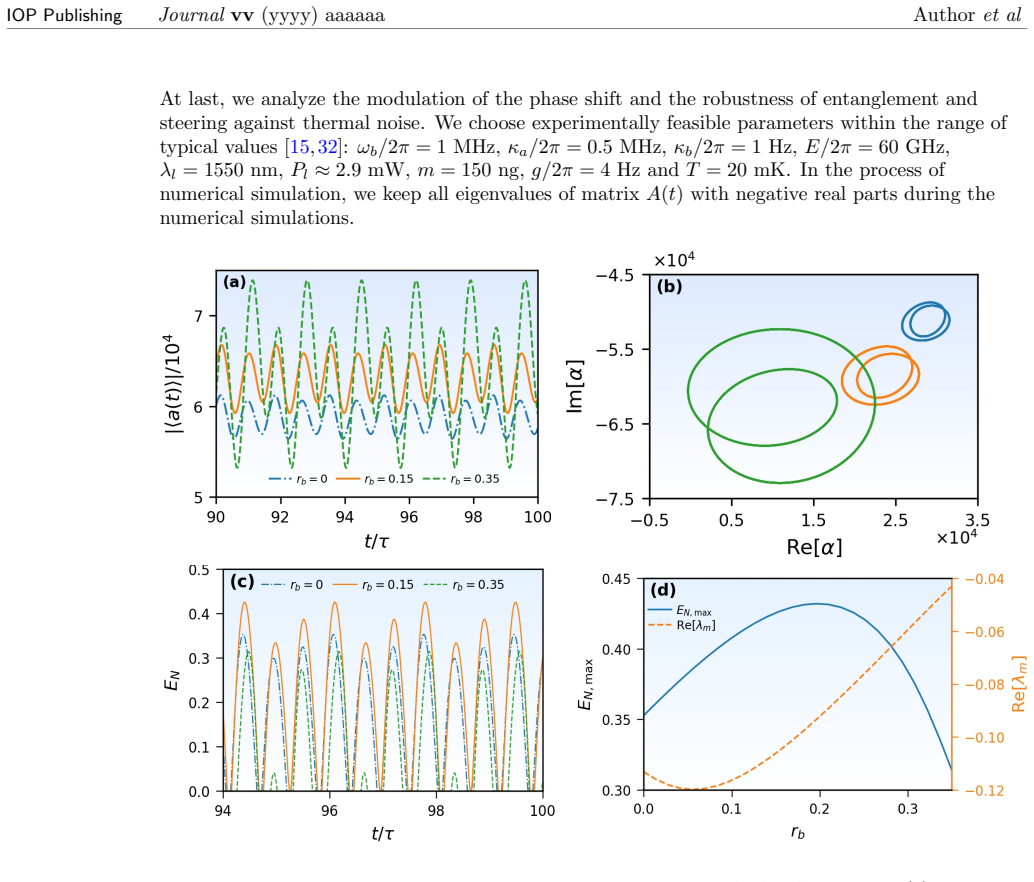
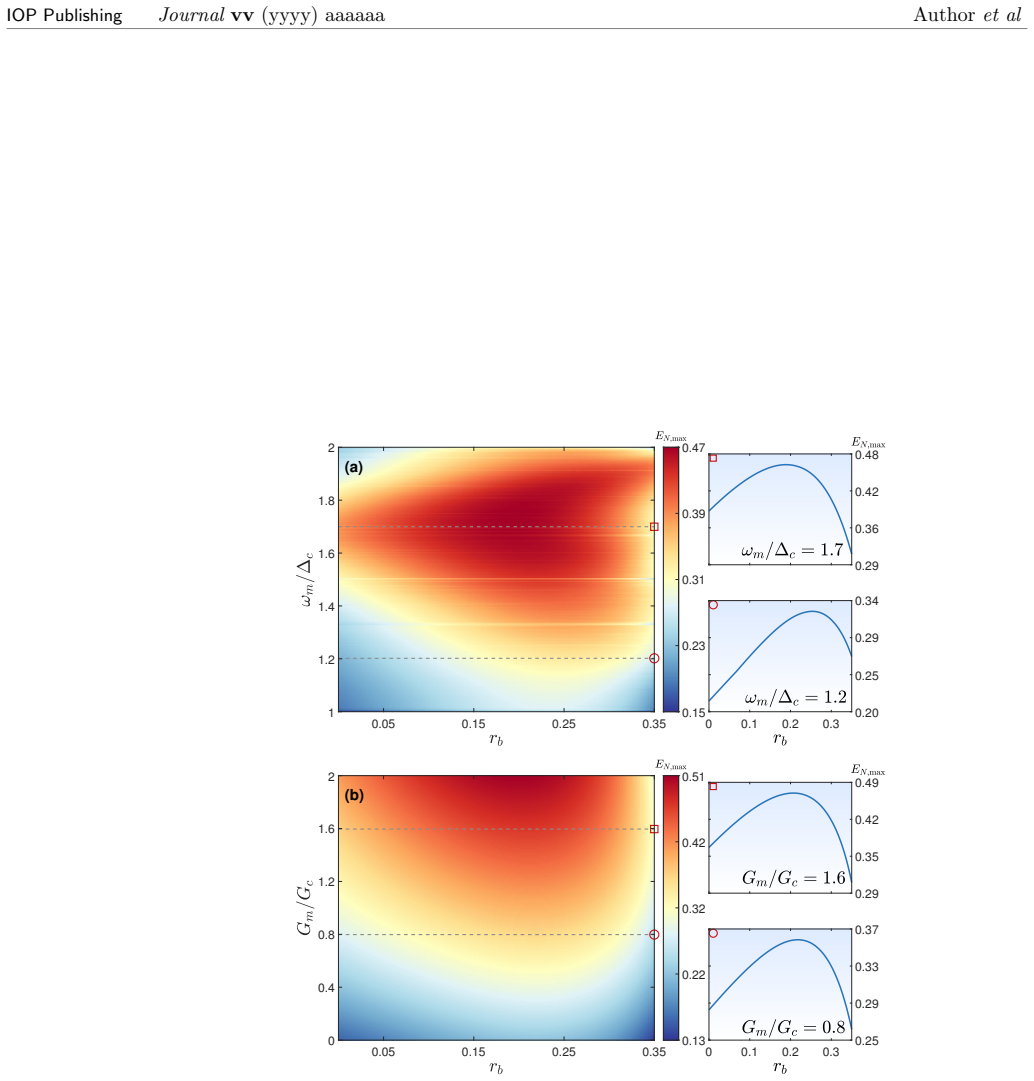
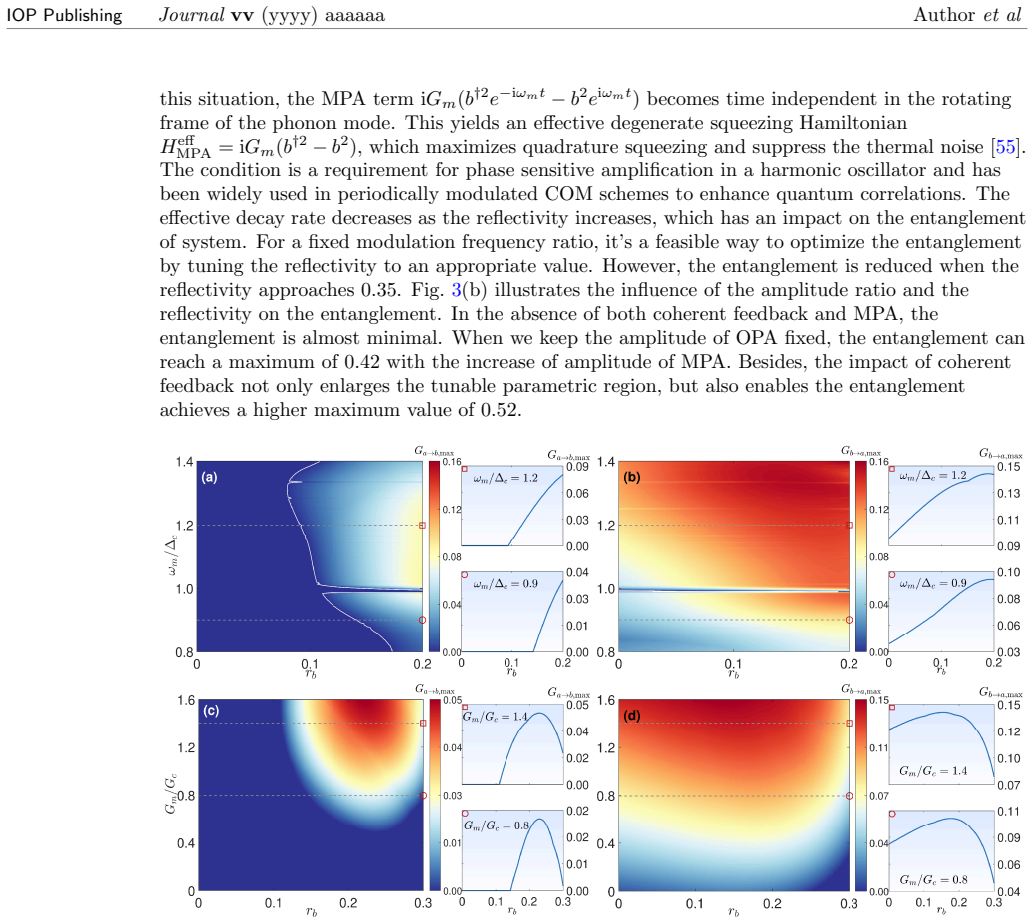
Through the combined modulation of the two parametric amplifications and the coherent feedback loop, the effective cavity decay rate is engineered and the distribution of quantum fluctuations is controlled, thereby strengthening quantum correlations and improving their robustness against thermal noise in the optomechanical system.
What carries the argument
Dual parametric amplification (optical and mechanical) assisted by a coherent feedback loop that engineers the effective cavity decay rate and quantum fluctuation distribution.
If this is right
- The scheme yields highly tunable, strong quantum correlations in cavity optomechanical systems.
- Quantum entanglement and steering become more robust to thermal noise from the environment.
- The approach offers an efficient route to protecting fragile quantum resources in optomechanics.
- Correlations remain useful at higher temperatures than in conventional setups.
Where Pith is reading between the lines
- The tunability might allow dynamic switching between entangled and separable states in real time.
- Similar modulation techniques could suppress noise in other hybrid quantum platforms such as electromechanical or magnomechanical systems.
- Room-temperature operation of certain quantum optomechanical tasks may become feasible if the noise suppression scales as predicted.
Load-bearing premise
Independent pumping of the nonlinear medium and membrane with controllable modulation frequencies and amplitudes can be realized experimentally without introducing significant additional decoherence, losses, or technical noise beyond the modeled thermal bath.
What would settle it
Experimental measurement showing higher values of logarithmic negativity for entanglement or the steering parameter when both parametric pumps and the feedback loop are active, compared to the case without them, at the same elevated bath temperature.
Figures
read the original abstract
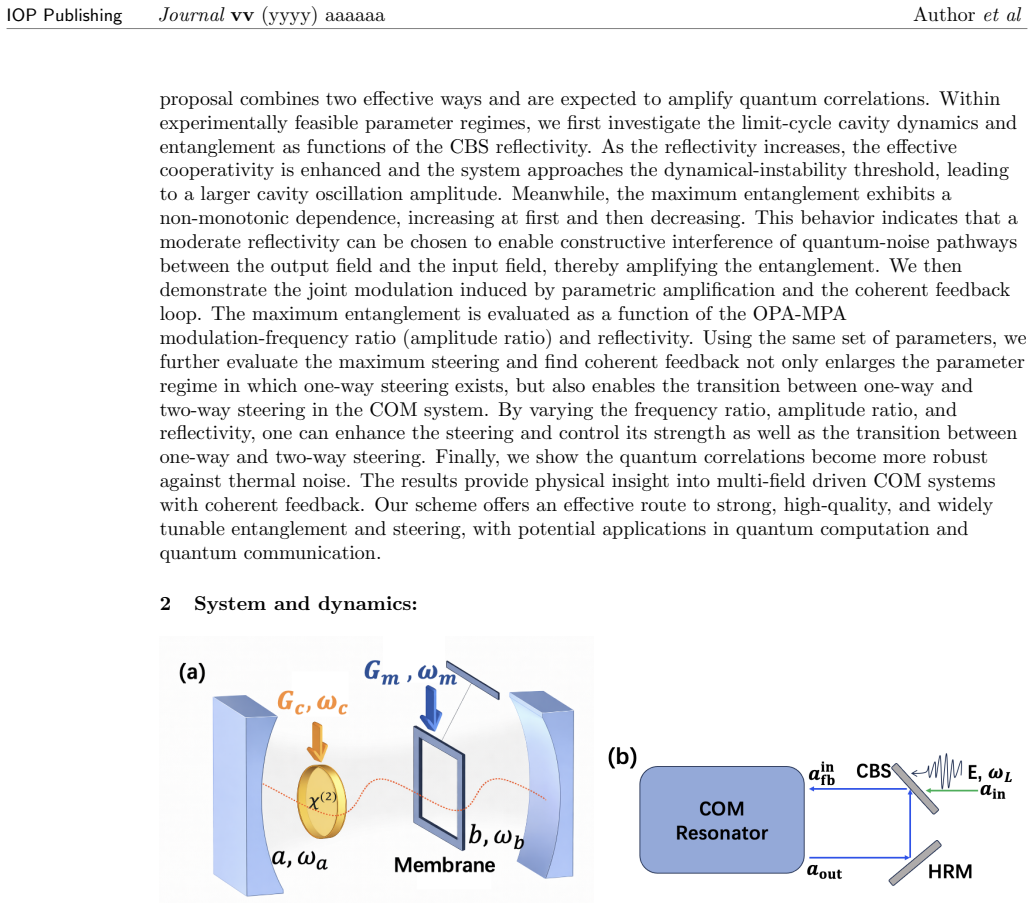
We propose a coherent-control scheme for engineering quantum correlations in a cavity optomechanical (COM) system consisting of a driven optical cavity with an embedded nonlinear medium and a membrane, assisted by a coherent feedback loop. The nonlinear medium and the membrane are pumped to implement optical and mechanical parametric amplifications with controllable modulation frequencies and pump amplitudes. Through the combined modulation of the two parametric amplifications and the coherent feedback loop, we engineer the effective cavity decay rate and the distribution of quantum fluctuations, thereby strengthening quantum correlations and improving their robustness against thermal noise. Our scheme provides an efficient route to realizing highly tunable, strong, thermally robust quantum correlations in COM systems, which is promising for the protection of fragile quantum resources.
Editorial analysis
A structured set of objections, weighed in public.
Referee Report
Summary. The manuscript proposes a coherent-control scheme in a cavity optomechanical system consisting of a driven optical cavity containing a nonlinear medium and a membrane, augmented by a coherent feedback loop. Optical and mechanical parametric amplifications are realized by pumping the nonlinear medium and membrane with controllable modulation frequencies and amplitudes. The combined action of these modulations and the feedback loop is claimed to engineer the effective cavity decay rate and redistribute quantum fluctuations, thereby strengthening entanglement and steering while improving robustness to thermal noise.
Significance. If the modeling assumptions hold, the scheme provides a tunable, all-optical route to protecting quantum correlations in optomechanical platforms against thermal decoherence. This could be relevant for quantum sensing and information tasks that rely on robust continuous-variable entanglement and steering, extending standard optomechanical control techniques with dual parametric drives and feedback.
major comments (2)
- [System Hamiltonian and master equation] The central claim that dual parametric amplification plus feedback engineers the effective cavity decay rate and improves thermal robustness rests on the unstated assumption that the two pumps can be applied independently without introducing additional loss or decoherence channels beyond the single thermal bath. No explicit terms accounting for pump-induced absorption, cross-talk, or extra noise appear in the system Hamiltonian or master equation, making this assumption load-bearing for the robustness results.
- [Numerical results on entanglement and steering] The reported strengthening of entanglement and steering is obtained by varying the modulation frequencies and pump amplitudes (the free parameters listed in the model). However, the manuscript does not provide a sensitivity analysis showing how these improvements degrade when realistic pump-induced losses (e.g., 1–5 % additional cavity or mechanical damping) are included, which directly tests the practical utility of the engineering step.
minor comments (1)
- [Abstract] The abstract summarizes the scheme at a high level but does not reference the specific equations or parameter regimes used to obtain the effective decay-rate tuning.
Simulated Author's Rebuttal
We thank the referee for the careful reading of our manuscript and the constructive comments. We address each major comment below and will revise the manuscript accordingly to improve its clarity and completeness.
read point-by-point responses
-
Referee: [System Hamiltonian and master equation] The central claim that dual parametric amplification plus feedback engineers the effective cavity decay rate and improves thermal robustness rests on the unstated assumption that the two pumps can be applied independently without introducing additional loss or decoherence channels beyond the single thermal bath. No explicit terms accounting for pump-induced absorption, cross-talk, or extra noise appear in the system Hamiltonian or master equation, making this assumption load-bearing for the robustness results.
Authors: We acknowledge that the model treats the parametric pumps as ideal coherent drives without explicit additional loss or noise terms from the pumps themselves. This is a standard theoretical approximation in studies of driven parametric amplification in optomechanics, where the focus is on the coherent control effects under the assumption that pump-induced decoherence is minimized or absorbed into the existing bath parameters. To address the referee's valid point, we will revise the manuscript to explicitly state this assumption in the model section and add a short discussion of its regime of validity. revision: yes
-
Referee: [Numerical results on entanglement and steering] The reported strengthening of entanglement and steering is obtained by varying the modulation frequencies and pump amplitudes (the free parameters listed in the model). However, the manuscript does not provide a sensitivity analysis showing how these improvements degrade when realistic pump-induced losses (e.g., 1–5 % additional cavity or mechanical damping) are included, which directly tests the practical utility of the engineering step.
Authors: We agree that including a sensitivity analysis to realistic additional losses would strengthen the practical implications of the results. In the revised manuscript we will add numerical plots and discussion showing the degradation of entanglement and steering when extra cavity and mechanical damping rates of 1–5% are introduced on top of the nominal values. revision: yes
Circularity Check
No circularity; proposal uses explicit modulation parameters on standard COM models
full rationale
The manuscript presents a theoretical proposal for engineering optomechanical correlations via dual parametric amplification and coherent feedback. All load-bearing steps involve introducing controllable pump amplitudes and frequencies as free parameters into the standard linearized quantum Langevin equations for the cavity-membrane system, then solving for the resulting covariance matrix or logarithmic negativity. No result is obtained by fitting to the target entanglement/steering metric and then relabeling the fit as a prediction; no self-citation supplies a uniqueness theorem or ansatz that is itself unverified; the effective decay-rate tuning is derived from the explicit time-dependent Hamiltonian terms rather than being defined circularly. The derivation chain therefore remains self-contained against external benchmarks.
Axiom & Free-Parameter Ledger
free parameters (2)
- modulation frequencies of the two pumps
- pump amplitudes
axioms (2)
- standard math Validity of the standard quantum Langevin or master-equation description for the driven cavity with embedded nonlinear medium and membrane
- domain assumption Coherent feedback loop can be implemented ideally without adding extra noise or loss channels
Reference graph
Works this paper leans on
-
[1]
de L´ epinay L M, Ockeloen-Korppi C F, Woolley M J and Sillanp¨ a¨ a M A 2021Science372 625–629
-
[2]
Kotler S, Peterson G A, Shojaee E, Lecocq F, Cicak K, Kwiatkowski A, Geller S, Glancy S, Knill E, Simmonds R W, Aumentado J and Teufel J D 2021Science372622–625
- [3]
-
[4]
L¨ u X Y, Zhu G L, Zheng L L and Wu Y 2018Phys. Rev. A97033807
-
[5]
Horodecki R, Horodecki P, Horodecki M and Horodecki K 2009Rev. Mod. Phys.81865–942
-
[6]
Pezz` e L, Smerzi A, Oberthaler M K, Schmied R and Treutlein P 2018Rev. Mod. Phys.90 035005
-
[7]
Zhang Z, Mouradian S, Wong F N C and Shapiro J H 2015Phys. Rev. Lett.114110506
-
[8]
Graham T M, Song Y, Scott J, Poole C, Phuttitarn L, Jooya K, Eichler P, Jiang X, Marra A, Grinkemeyer B, Kwon M, Ebert M, Cherek J, Lichtman M T, Gillette M, Gilbert J, Bowman D, Ballance T, Campbell C, Dahl E D, Crawford O, Blunt N S, Rogers B, Noel T and Saffman M 2022Nature604457–462
-
[9]
Bartolucci S, Birchall P, Bomb´ ın H, Cable H, Dawson C, Gimeno-Segovia M, Johnston E, Kieling K, Nickerson N, Pant M, Pastawski F, Rudolph T and Sparrow C 2023Nat. Commun. 14912
-
[10]
Ursin R, Tiefenbacher F, Schmitt-Manderbach T, Weier H, Scheidl T, Lindenthal M, Blauensteiner B, Jennewein T, Perdigues J, Trojek P, ¨Omer B, F¨ urst M, Meyenburg M, Rarity J, Sodnik Z, Barbieri C, Weinfurter H and Zeilinger A 2007Nat. Phys.3481–486
-
[11]
Piveteau A, Pauwels J, H˚ akansson E, Muhammad S, Bourennane M and Tavakoli A 2022Nat. Commun.137878
-
[12]
Ritter S, N¨ olleke C, Hahn C, Reiserer A, Neuzner A, Uphoff M, M¨ ucke M, Figueroa E, Bochmann J and Rempe G 2012Nature484195–200
-
[13]
Jost J D, Home J P, Amini J M, Hanneke D, Ozeri R, Langer C, Bollinger J J, Leibfried D and Wineland D J 2009Nature459683–685
-
[14]
Farace A and Giovannetti V 2012Phys. Rev. A86013820
-
[15]
Yang J, Lu T X, Peng M, Liu J, Jiao Y F and Jing H 2024Opt. Express32785–794
-
[16]
Peng R, Zhao C, Yang Z, Yang J and Zhou L 2023Phys. Rev. A107013507
-
[17]
Li J, Li G, Zippilli S, Vitali D and Zhang T 2017Phys. Rev. A95043819
-
[18]
Shang C and Li H C 2024Phys. Rev. Applied21044048
-
[19]
Genes C, Mari A, Tombesi P and Vitali D 2008Phys. Rev. A78032316
-
[20]
Aspelmeyer M, Kippenberg T J and Marquardt F 2014Rev. Mod. Phys.861391–1452 13 IOP PublishingJournalvv(yyyy) aaaaaa Authoret al
-
[21]
Szorkovszky A, Doherty A C, Harris G I and Bowen W P 2011Phys. Rev. Lett.107213603
-
[22]
L¨ u X Y, Liao J Q, Tian L and Nori F 2015Phys. Rev. A91013834
-
[23]
Yan X B 2020Phys. Rev. A101043820
-
[24]
Lai D G, Wang X, Qin W, Hou B P, Nori F and Liao J Q 2020Phys. Rev. A102023707
-
[25]
Zoepfl D, Juan M L, Diaz-Naufal N, Schneider C M F, Deeg L F, Sharafiev A, Metelmann A and Kirchmair G 2023Phys. Rev. Lett.130033601
- [26]
-
[27]
Reid M D, Drummond P D, Bowen W P, Cavalcanti E G, Lam P K, Bachor H A, Andersen U L and Leuchs G 2009Rev. Mod. Phys.811727–1751
-
[28]
Cavalcanti D and Skrzypczyk P 2017Rep. Prog. Phys.80024001
-
[29]
Tan H, Deng W, Wu Q and Li G 2017Phys. Rev. A95053842
-
[30]
Li J and Zhu S Y 2017Phys. Rev. A96062115
-
[31]
Zhu Y J, Han X, Wang H F and Zhang S 2025Adv. Quantum Technol.8e2500148
- [32]
-
[33]
Wu X J, Cheng H H, Wu Q, Bai C H and Wu S X 2024Opt. Express3235663–35677
-
[34]
Hu C S, Liu Z Q, Liu Y, Shen L T, Wu H and Zheng S B 2020Phys. Rev. A101033810
-
[35]
Wei J N, Wang T, Zhang S and Wang H F 2024Adv. Quantum Technol.72300374
-
[36]
Liu Y H, Yu Y, Han X, Wang H F and Zhang S 2025Adv. Quantum Technol.e00709
-
[37]
Peng J X, Djorwe P, Cui H T, Akhtar N, Haq I U, Zhao C and Li D 2025Phys. Rev. A111 012607
- [38]
-
[39]
Harwood A, Brunelli M and Serafini A 2021Phys. Rev. A103023509
- [40]
-
[41]
Wei Y, Wang X, Xiong B, Zhao C, Liu J and Shan C 2021Opt. Express2935299–35313
-
[42]
Rossi M, Kralj N, Zippilli S, Natali R, Borrielli A, Pandraud G, Serra E, Di Giuseppe G and Vitali D 2017Phys. Rev. Lett.119123603
-
[43]
Qiu L, Huang G, Shomroni I, Pan J, Seidler P and Kippenberg T J 2022PRX Quantum3 020309
-
[44]
Lloyd S 2000Phys. Rev. A62022108
-
[45]
Schmid G L, Ngai C T, Ernzer M, Aguilera M B, Karg T M and Treutlein P 2022Phys. Rev. X12011020
-
[46]
Frimmer M, Gieseler J and Novotny L 2016Phys. Rev. Lett.117163601
-
[47]
Hirose M and Cappellaro P 2016Nature53277–80
-
[48]
Si L G, Xiong H, Zubairy M S and Wu Y 2017Phys. Rev. A95033803
-
[49]
Agarwal G S 2013Quantum Optics(Cambridge, UK: Cambridge University Press)
-
[50]
Adesso G, Serafini A and Illuminati F 2004Phys. Rev. A70022318
-
[51]
Li J, Zhu S Y and Agarwal G S 2019Phys. Rev. A99021801
-
[52]
Paris M G A, Illuminati F, Serafini A and De Siena S 2003Phys. Rev. A68012314
-
[53]
Mari A and Eisert J 2009Phys. Rev. Lett.103213603 14 IOP PublishingJournalvv(yyyy) aaaaaa Authoret al
-
[54]
Hu C S, Shen L T, Yang Z B, Wu H, Li Y and Zheng S B 2019Phys. Rev. A100043824
-
[56]
Xiang Y, Cheng S, Gong Q, Ficek Z and He Q 2022PRX Quantum3030102
-
[57]
Dania L, Kremer O S, Piotrowski J, Candoli D, Vijayan J, Romero-Isart O, Gonzalez-Ballestero C, Novotny L and Frimmer M 2025Nat. Phys.211603–1608
- [58]
-
[59]
Marti S, von L”upke U, Joshi O, Yang Y, Bild M, Omahen A, Chu Y and Fadel M 2024Nat. Phys.201448–1453
-
[60]
Agarwal G and Huang S 2016Phys. Rev. A93043844
-
[61]
Huang S and Agarwal G 2017Phys. Rev. A95023844
-
[62]
He Q, Badshah F, Song Y, Wang L, Liang E and Su S L 2022Phys. Rev. A105013503
-
[63]
Singh S K, Mazaheri M, Peng J X, Sohail A, Khalid M and Asjad M 2023Front. Phys.11 1142452
-
[64]
Marhic M E, Andrekson P A, Petropoulos P, Radic S, Peucheret C and Jazayerifar M 2015 Laser Photonics Rev.950–74
work page 2015
-
[65]
Pan X, Chen H, Wei T, Zhang J, Marino A M, Treps N, Glasser R T and Jing J 2018Phys. Rev. B97161115
-
[66]
Zhang J, Sun H, Guo H, Blair C, Bossilkov V, Page M, Chen X, Gao J, Ju L and Zhao C 2023 Appl. Phys. Lett.122261106
work page 2023
-
[67]
Vahlbruch H, Mehmet M, Chelkowski S, Hage B, Franzen A, Lastzka N, Gossler S, Danzmann K and Schnabel R 2008Phys. Rev. Lett.100033602
-
[68]
Vahlbruch H, Mehmet M, Danzmann K and Schnabel R 2016Phys. Rev. Lett.117110801
- [69]
-
[70]
Mashaal A, Stefan L, Ranfagni A, Catalini L, Chernobrovkin I, Capelle T, Langman E C and Schliesser A 2025Phys. Rev. Res.7L012071
-
[71]
Bothner D, Yanai S, Iniguez-Rabago A, Yuan M, Blanter Y M and Steele G A 2020Nat. Commun.111589
-
[72]
Li J, Zhu S Y and Agarwal G 2018Phys. Rev. Lett.121203601
-
[73]
Palomaki T A, Teufel J D, Simmonds R W and Lehnert K W 2013Science342710–713
-
[74]
Barzanjeh S, Redchenko E S, Peruzzo M, Wulf M, Lewis D P, Arnold G and Fink J M 2019 Nature570480–483
work page 2019
- [75]
-
[76]
Jiao Y F, Zhang S D, Zhang Y L, Miranowicz A, Kuang L M and Jing H 2020Phys. Rev. Lett. 125143605
-
[77]
Ockeloen-Korppi C F, Damsk¨ agg E, Pirkkalainen J M, Asjad M, Clerk A A, Massel F, Woolley M J and Sillanp¨ a¨ a M A 2018Nature556478–482 15
discussion (0)
Sign in with ORCID, Apple, or X to comment. Anyone can read and Pith papers without signing in.