IQP circuits for 2-Forrelation
Pith reviewed 2026-05-10 11:41 UTC · model grok-4.3
The pith
IQP circuits solve 2-Forrelation using two queries and classical post-processing.
A machine-rendered reading of the paper's core claim, the machinery that carries it, and where it could break.
Core claim
2-Forrelation can be solved using IQP circuits, with two IQP circuits and two quantum queries plus classical post-processing sufficing for the standard problem and a single IQP circuit and query sufficing for the signed variant. The construction rests on an algebraic identity of the quadratic function Q(x) = sum_{i < j} x_i x_j that extracts inner-product phases inside an IQP circuit. The same identity also yields Fourier growth bounds for IQP circuits measured by the size of the accepting set.
What carries the argument
The algebraic identity of the quadratic function Q(x) = sum_{i < j} x_i x_j that extracts inner-product phases inside an IQP circuit.
If this is right
- IQP circuits suffice for a problem with optimal classical-quantum query separation.
- An oracle separation (BPP^IQP)^O notsubseteq PH^O follows directly.
- IQP circuits become a tool for classically hard decision problems rather than only sampling tasks.
- Fourier growth of IQP circuits is bounded by the size of their accepting sets.
Where Pith is reading between the lines
- Similar algebraic identities may reduce other query-complexity separations to the IQP model.
- Decision-problem formulations could lower the experimental bar for demonstrating commuting-gate advantage compared with sampling.
- The single-query signed case suggests even tighter resource bounds may exist for related correlation problems.
Load-bearing premise
The quadratic function Q(x) admits an algebraic identity that extracts inner-product phases inside an IQP circuit.
What would settle it
Explicit 2-Forrelation instances on which the output distribution of the proposed two-IQP-circuit procedure fails to match the correct correlation value with high probability would falsify the claim.
Figures


read the original abstract
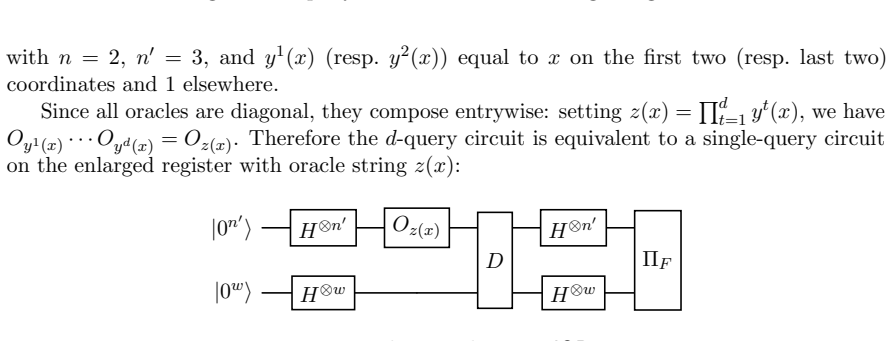
The 2-Forrelation problem provides an optimal separation between classical and quantum query complexity and is also the problem used for separating $\mathsf{BQP}$ and $\mathsf{PH}$ relative to an oracle. A natural question is therefore to ask what are the minimal quantum resources needed to solve this problem. We show that 2-Forrelation can be solved using Instantaneous Quantum Polynomial-time ($\mathsf{IQP}$) circuits, a restricted model of quantum computation in which all gates commute. Concretely, two $\mathsf{IQP}$ circuits with two quantum queries and efficient classical processing suffice. For the signed variant of 2-Forrelation, even a single $\mathsf{IQP}$ circuit and query suffices. This answers a recent open question of Girish (arXiv:2510.06385) on the power of commuting quantum computations. We use this to show that $(\mathsf{BPP}^{\mathsf{IQP}})^O \not\subseteq \mathsf{PH}^O$ relative to an oracle $O$, strengthening the result of Raz and Tal (STOC 2019). Our results show that $\mathsf{IQP}$ circuits can be used for classically hard decision problems, thus providing a new route for showing quantum advantage with $\mathsf{IQP}$ circuits, avoiding the verification difficulties associated with sampling tasks. We also prove Fourier growth bounds for $\mathsf{IQP}$ circuits in terms of the size of their accepting set. The key ingredient is an algebraic identity of the quadratic function $Q(x) = \sum_{i < j} x_ix_j$ that allows extracting inner-product phases within an $\mathsf{IQP}$ circuit.
Editorial analysis