Generation of Schr\"odinger cat-like states via degenerate dual pump spontaneous four-wave mixing in a chi⁽³⁾ microring resonator
Pith reviewed 2026-05-10 11:17 UTC · model grok-4.3
The pith
Dual-pump four-wave mixing in a microring resonator produces Schrödinger cat-like states that remain robust to moderate dissipation.
A machine-rendered reading of the paper's core claim, the machinery that carries it, and where it could break.
Core claim
By applying a unitary transformation that exactly decouples the self-phase modulation and cross-phase modulation terms, the nonlinear Hamiltonian reduces to an effective three-mode interaction. The resulting Lindblad dynamics produce a signal mode whose Wigner function is structured and whose photon-number distribution is even-dominated in the non-dissipative case, features characteristic of an even coherent state. When moderate dissipation is included the interference fringes weaken and odd photon numbers appear, yet the fidelity with the ideal cat-like state remains above 0.9; the pump mode stays Gaussian while both modes exhibit super-Poissonian statistics and entanglement greater than 2.
What carries the argument
The unitary transformation that exactly decouples self-phase and cross-phase modulation, reducing the Hamiltonian to an effective three-mode interaction whose Lindblad evolution generates the cat-like features.
If this is right
- The signal mode develops a structured Wigner function and even-dominated photon statistics characteristic of an even coherent state.
- Fidelity to the ideal cat-like state remains above 0.9 when moderate cavity losses are present.
- The pump mode remains Gaussian while both modes show super-Poissonian statistics and entanglement.
- Full quantum treatment including pump depletion allows non-Gaussian features to appear that semiclassical approximations miss.
Where Pith is reading between the lines
- The decoupling technique could simplify analysis of other multi-mode χ³ processes in resonators.
- High loss tolerance suggests these states could survive in integrated photonic circuits for quantum error correction or sensing.
- Direct measurement of the Fano factor or Schmidt number in experiment would provide independent confirmation of the generated state's non-Gaussian character.
Load-bearing premise
The unitary transformation exactly decouples the self- and cross-phase modulation terms without residual effects on the three-mode dynamics, and the chosen loss rates are representative of accessible experimental conditions.
What would settle it
An experimental reconstruction of the signal-mode Wigner function that lacks clear interference fringes or yields fidelity below 0.5 with the target even coherent state under the modeled dissipation parameters would falsify the central claim.
Figures



read the original abstract
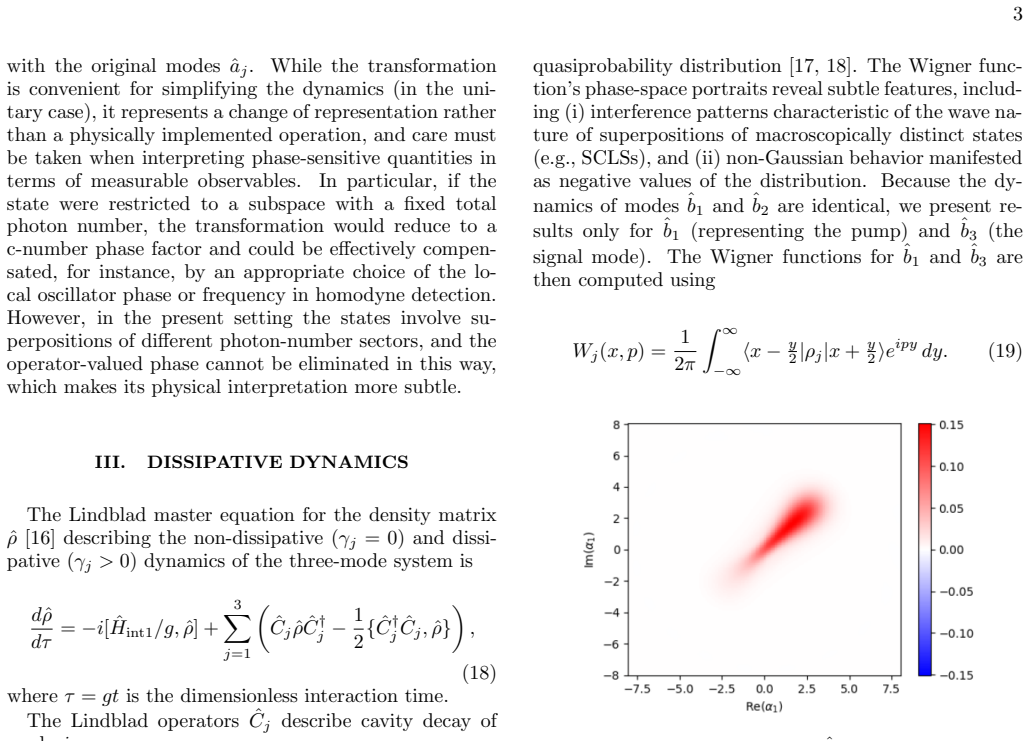
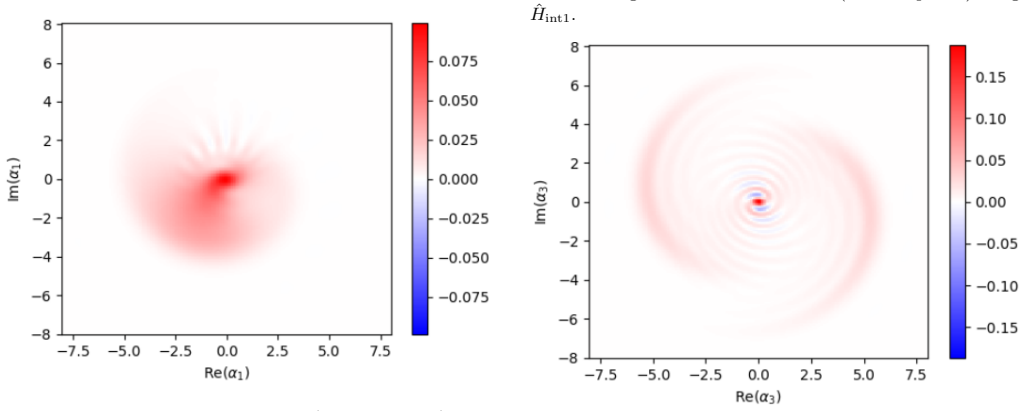
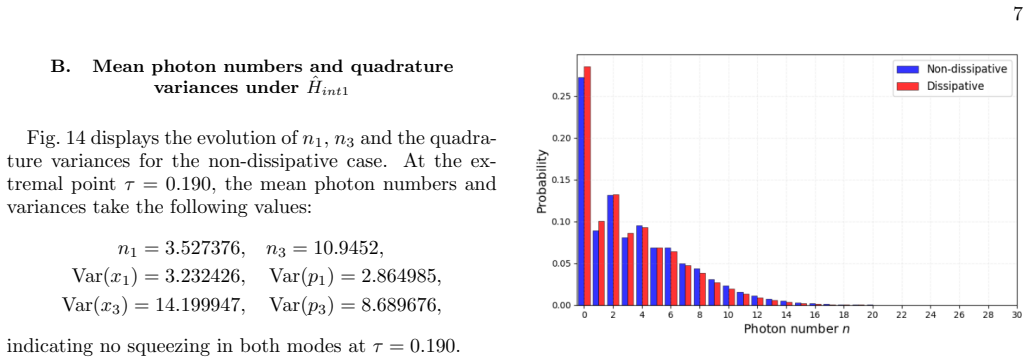
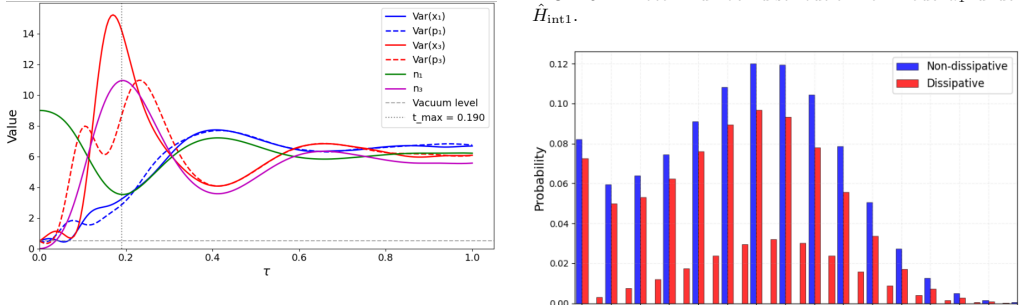
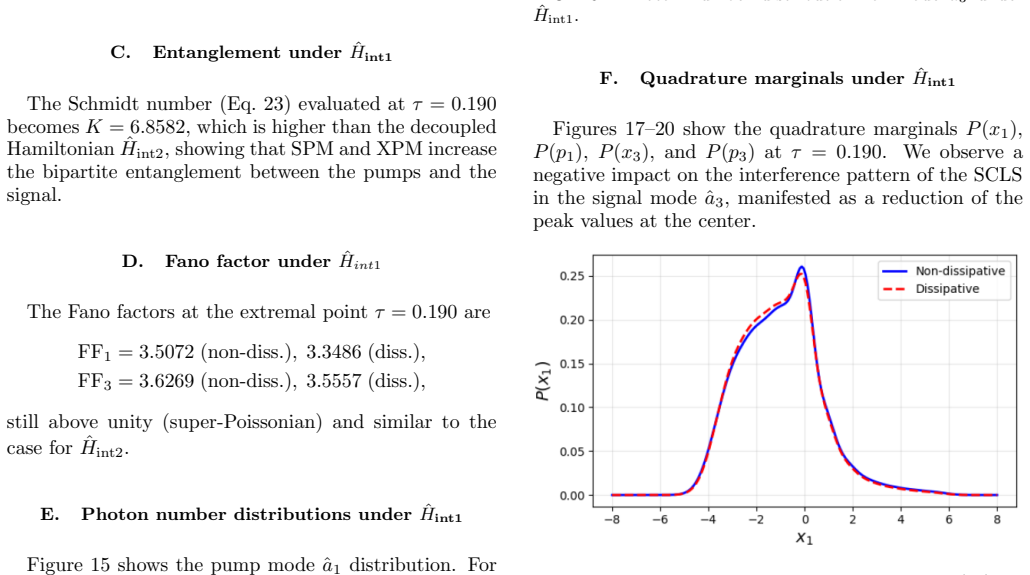
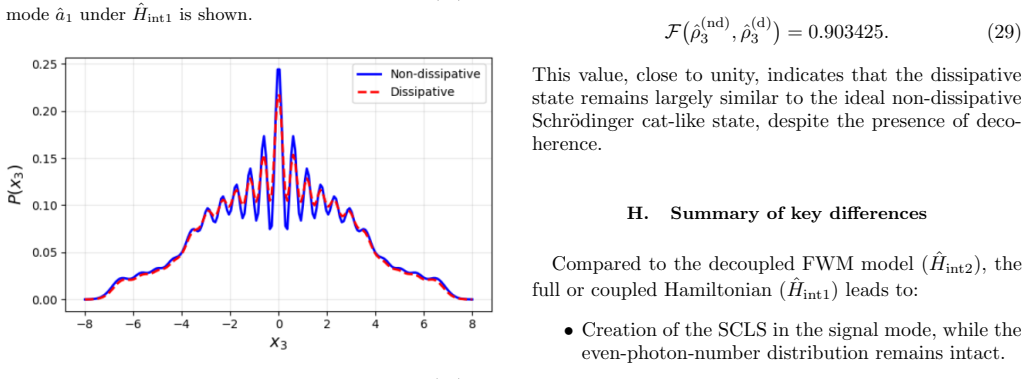
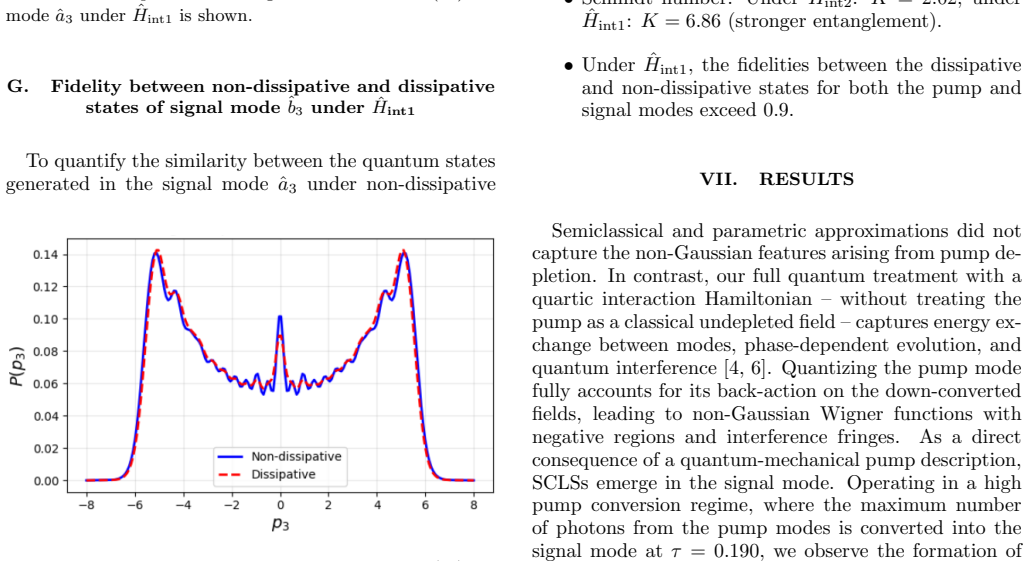
We theoretically investigate the generation of non-Gaussian quantum states, specifically Schr\"odinger cat-like states (SCLSs), via degenerate dual-pump spontaneous four-wave mixing in a $\chi^{(3)}$-based microring resonator. By introducing a unitary transformation that exactly decouples the self-phase modulation (SPM) and cross-phase modulation (XPM) terms, we reduce the full nonlinear Hamiltonian to an effective three-mode interaction. The resulting dynamics (decoupled and full Hamiltonians) are studied using the Lindblad master equation, accounting for cavity losses. Unlike semiclassical or parametric approximations, our full quantum mechanical approach explicitly includes quantum pump depletion, which enables the emergence and observation of non-Gaussian features. We compute the Wigner function, photon number distributions, quadrature variances, Fano factor, Schmidt number, and fidelity to characterize the generated states. For the non-dissipative case, we find that the signal mode $\hat{b}_3$ or $\hat{a}_3$ exhibits clear non-Gaussian features with a structured Wigner function and even-dominated photon number distribution, characteristic of an even coherent state. In the presence of dissipation ($\gamma_j = 0.2$), the interference fringes become faint, odd photon numbers appear, and the fidelity with the ideal state remains high ($>0.9$), indicating robustness. The pump mode $\hat{b}_1$ or $\hat{a}_1$ remains Gaussian, while both modes display super-Poissonian statistics and entanglement ($>2$). Our results demonstrate that degenerate dual-pump spontaneous four-wave mixing in microring resonators is a promising platform for generating and controlling cat-like states under dissipative conditions.
Editorial analysis
A structured set of objections, weighed in public.
Referee Report
Summary. The manuscript investigates the generation of Schrödinger cat-like states via degenerate dual-pump spontaneous four-wave mixing in a χ³ microring resonator. A unitary transformation is applied to the full nonlinear Hamiltonian to exactly decouple self-phase modulation (SPM) and cross-phase modulation (XPM) terms, yielding an effective three-mode interaction. Dynamics are solved via the Lindblad master equation, incorporating cavity losses and quantum pump depletion (no parametric or semiclassical approximations). For the closed system, the signal mode exhibits non-Gaussian features including a structured Wigner function and even-photon dominance. With dissipation (γ_j = 0.2), fidelity to the ideal cat state remains >0.9 despite faint fringes and some odd-photon population. The pump mode stays Gaussian; both modes show super-Poissonian statistics and entanglement (Schmidt number >2). Multiple diagnostics (Wigner functions, photon distributions, quadrature variances, Fano factor, fidelity) are used to characterize the states.
Significance. If the decoupling holds exactly and numerics are converged, the work advances integrated quantum optics by delivering a full quantum treatment of cat-state generation that retains pump depletion. This goes beyond standard parametric approximations and demonstrates robustness to realistic dissipation levels, with concrete metrics showing preserved non-Gaussianity. The approach could inform experimental designs in microring platforms for non-Gaussian resource states.
major comments (2)
- [Unitary Transformation] The unitary transformation (abstract and the section deriving the effective Hamiltonian) is asserted to exactly decouple SPM/XPM without residuals on the three-mode interaction. Because the central non-Gaussian signatures (even-photon dominance, structured Wigner function) and the fidelity claim rest on this reduction, the transformed Hamiltonian must be written out explicitly with all quantum pump operators retained, confirming that no cross terms survive and couple back into the signal-mode dynamics.
- [Numerical Methods and Results] In the numerical section solving the Lindblad master equation, the Hilbert-space truncation (photon-number cutoffs per mode) and convergence tests are not specified. Truncation artifacts could alter the reported Wigner-function structure, even/odd photon populations, and fidelity values (>0.9 at γ_j = 0.2), which are load-bearing for the robustness claim.
minor comments (3)
- [Figures] Figure captions for Wigner plots should include explicit axis labels, color-bar scales, and contour values to allow readers to assess fringe visibility quantitatively.
- [Notation] Notation for the signal and pump modes (b3/a3 and b1/a1) should be unified or explicitly related once the transformation is introduced, to avoid confusion between original and transformed bases.
- [Discussion] A brief comparison table or paragraph placing the achieved fidelity and entanglement values against prior cat-state proposals in χ³ resonators would strengthen context.
Simulated Author's Rebuttal
We thank the referee for their careful reading of the manuscript and for the constructive comments, which help improve the clarity and rigor of our presentation. We address each major comment point by point below.
read point-by-point responses
-
Referee: [Unitary Transformation] The unitary transformation (abstract and the section deriving the effective Hamiltonian) is asserted to exactly decouple SPM/XPM without residuals on the three-mode interaction. Because the central non-Gaussian signatures (even-photon dominance, structured Wigner function) and the fidelity claim rest on this reduction, the transformed Hamiltonian must be written out explicitly with all quantum pump operators retained, confirming that no cross terms survive and couple back into the signal-mode dynamics.
Authors: We thank the referee for highlighting the need for explicit verification of the decoupling. The unitary transformation is introduced and applied in Section II, where it is shown to exactly remove the SPM and XPM contributions from the original four-mode Hamiltonian while preserving the quantum operators of the pump modes in the resulting effective interaction. In the revised manuscript we will write out the full transformed Hamiltonian explicitly (retaining all pump creation and annihilation operators), followed by a term-by-term confirmation that no residual cross terms re-couple into the signal-mode dynamics. This will make the exactness of the reduction transparent and directly support the subsequent non-Gaussian signatures and fidelity results. revision: yes
-
Referee: [Numerical Methods and Results] In the numerical section solving the Lindblad master equation, the Hilbert-space truncation (photon-number cutoffs per mode) and convergence tests are not specified. Truncation artifacts could alter the reported Wigner-function structure, even/odd photon populations, and fidelity values (>0.9 at γ_j = 0.2), which are load-bearing for the robustness claim.
Authors: We agree that the truncation parameters and convergence checks should have been stated explicitly. In the revised manuscript we will specify the photon-number cutoffs employed for each mode when solving the Lindblad master equation and will add convergence tests (comparing results obtained with the chosen cutoffs against those with substantially higher cutoffs). These tests will confirm that the Wigner-function structure, even/odd photon populations, and fidelity values above 0.9 at γ_j = 0.2 remain stable and are not affected by truncation artifacts. revision: yes
Circularity Check
No significant circularity; derivation is self-contained from standard Hamiltonian
full rationale
The paper begins with the standard χ³ nonlinear Hamiltonian for the microring resonator modes. It introduces a unitary transformation to decouple SPM/XPM terms, yielding an effective three-mode interaction Hamiltonian. Dynamics are obtained by solving the Lindblad master equation (with and without dissipation) and computing observables such as the Wigner function, photon-number distribution, and fidelity. These quantities are direct numerical outcomes of the time evolution under the transformed Hamiltonian; they are not fitted parameters, self-defined quantities, or results imported via self-citation. No load-bearing step reduces by construction to an input defined in terms of the target non-Gaussian features. The approach is first-principles and externally falsifiable against the underlying master equation.
Axiom & Free-Parameter Ledger
free parameters (1)
- gamma_j = 0.2
axioms (1)
- domain assumption The system is well-described by the standard chi-3 nonlinear Hamiltonian plus Markovian loss
Reference graph
Works this paper leans on
-
[1]
P. T. Cochrane, G. J. Milburn, and W. J. Munro, Phys. Rev. A59, 2631 (1999)
work page 1999
-
[2]
A. Ourjoumtsev, R. Tualle-Brouri, J. Laurat, and P. Grangier, Science312, 83 (2006)
work page 2006
-
[3]
D. V. Sychev, A. E. Ulanov, A. A. Pushkina, M. W. Richards, I. A. Fedorov, and A. I. Lvovsky, Nat. Photon- ics11, 379 (2017)
work page 2017
- [4]
- [5]
- [6]
-
[7]
V. Delaubert, N. Treps, C. Fabre, H. A. Bachor, and P. K. Lam, Opt. Lett.31, 1537 (2006)
work page 2006
-
[8]
A. K. Vorobyev, N. A. Kapridov, T. R. Yunusov, D. V. Morozov, A. N. Danilin, A. D. Ivanov, A. E. Shitikov, V. E. Lobanov, I. A. Bilenko, and D. A. Chermoshentsev, Phys. Rev. Applied24, 054054 (2025)
work page 2025
-
[9]
A. E. Ulanov, B. Ruhnke, T. Wildi, and T. Herr, Nat. Commun.16, 10791 (2025)
work page 2025
- [10]
-
[11]
C. Wu, Y. Liu, Y. Wang, J. Ding, P. Zhu, S. Xue, X. Qiang, et al., Opt. Express30, 9992 (2022)
work page 2022
- [12]
-
[13]
J. R. Johansson, P. D. Nation, and F. Nori, Comput. Phys. Commun.183, 1760 (2012)
work page 2012
-
[14]
J. R. Johansson, P. D. Nation, and F. Nori, Comput. Phys. Commun.184, 1234 (2013)
work page 2013
-
[15]
V. D. Vaidya, B. Morrison, L. G. Helt, R. Shahrokhshahi, D. H. Mahler, M. J. Collins, K. Tan, J. Lavoie, A. Re- pingon, M. Menotti, N. Quesada, R. C. Pooser, A. E. Lita, T. Gerrits, S. W. Nam, and Z. Vernon, Sci. Adv.6, eaba9186 (2020)
work page 2020
-
[16]
H.-P. Breuer and F. Petruccione, The Theory of Open Quantum Systems (Oxford Uni- versity Press, Oxford, 2002)
work page 2002
-
[17]
D. Walls and G. Milburn, Quantum Optics, 2nd ed. (Springer, Berlin, Heidelberg, 2008)
work page 2008
-
[18]
G. S. Agarwal, Quantum Optics (Cambridge University Press, Cambridge, 2013)
work page 2013
-
[19]
C. K. Law and J. H. Eberly, Phys. Rev. Lett.92, 127903 (2004)
work page 2004
-
[20]
V. V. Dodonov, I. A. Malkin, and V. I. Man’ko, Physica 72, 597 (1974)
work page 1974
-
[21]
Jozsa, Journal of Modern Optics41, 2315 (1994)
R. Jozsa, Journal of Modern Optics41, 2315 (1994)
work page 1994
- [22]
-
[23]
A. S. Holevo, Quantum Systems, Channels, Information (De Gruyter, Berlin, Boston, 2019)
work page 2019
- [24]
- [25]
discussion (0)
Sign in with ORCID, Apple, or X to comment. Anyone can read and Pith papers without signing in.