Recognition: unknown
Quantum Search without Global Diffusion
Pith reviewed 2026-05-10 10:47 UTC · model grok-4.3
The pith
Quantum search preserves its quadratic speedup when the diffusion operator is replaced by local reflections on register partitions.
A machine-rendered reading of the paper's core claim, the machinery that carries it, and where it could break.
Core claim
The central discovery is a recursive construction for amplitude amplification in which the oracle remains the sole global operator and all other reflections are local to chosen partitions of the search register. For cases where both the initial state and the target state factorize as tensor products over these partitions, the dynamics admit an exact closed-form solution. The solution is made possible by a degeneracy in which the principal angles between successive reflections collapse to two values governed by one recursively defined angle. When applied to unstructured search this construction delivers the same O(sqrt(N)) oracle complexity as Grover's algorithm once each partition contains a
What carries the argument
A recursive construction of local reflection operators whose principal angles degenerate to two distinct values controlled by a single recursively defined angle, enabling closed-form dynamics.
If this is right
- Maintains O(sqrt(N)) oracle complexity for unstructured search when partitions have at least log2(log2 N) qubits each.
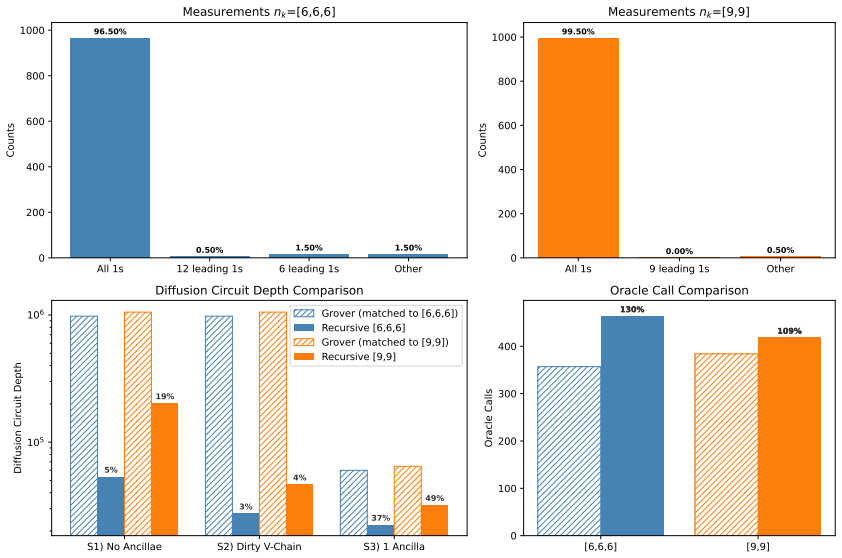
- On an 18-qubit problem, partitioning into two stages cuts non-oracle circuit depth by 51 to 96 percent compared with standard Grover search.
- The extra oracle calls needed drop quickly as the problem size grows.
- Depth reductions remain useful even when the oracle circuit is much deeper than the original diffusion operator.
- Global diffusion is not required to obtain the quadratic speedup in quantum search.
Where Pith is reading between the lines
- Implementations on hardware without all-to-all connectivity may become feasible for search tasks by confining most operations to local subsets.
- The angle-degeneracy method could be adapted to simplify analysis or implementation of other reflection-based quantum algorithms.
- Choosing partitions to match hardware topology might further optimize circuit depth beyond the paper's examples.
- Hybrid approaches combining this method with error mitigation techniques could extend its utility to noisy intermediate-scale quantum devices.
Load-bearing premise
Both the initial state and the target state must decompose as tensor products over the partitions chosen for the local operations.
What would settle it
Execute the recursive local algorithm on a small unstructured search instance with known target and verify whether the measured success probability after the calculated number of iterations agrees with the exact closed-form prediction to within sampling error.
Figures




read the original abstract
Quantum search is among the most important algorithms in quantum computing. At its core is quantum amplitude amplification, a technique that achieves a quadratic speedup over classical search by combining two global reflections: the oracle, which marks the target, and the diffusion operator, which reflects about the initial state. We show that this speedup can be preserved when the oracle is the only global operator, with all other operations acting locally on non-overlapping partitions of the search register. We present a recursive construction that, when the initial and target states both decompose as tensor products over these chosen partitions, admits an exact closed-form solution for the algorithm's dynamics. This is enabled by an intriguing degeneracy in the principal angles between successive reflections, which collapse to just two distinct values governed by a single recursively defined angle. Applied to unstructured search, a problem that naturally satisfies the tensor decomposition, the approach retains the $O(\sqrt{N})$ oracle complexity of Grover search when each partition contains at least $\log_2(\log_2 N)$ qubits. On an 18-qubit search problem, partitioning into two stages reduces the non-oracle circuit depth by as much as 51%-96% relative to Grover, requiring up to 9% additional oracle calls. For larger problem sizes this oracle overhead rapidly diminishes, and valuable depth reductions persist when the oracle circuit is substantially deeper than the diffusion operator. More broadly, these results show that a global diffusion operator is not necessary to achieve the quadratic speedup in quantum search, offering a new perspective on this foundational algorithm. Moreover, the scalar reduction at the heart of our analysis inspires and motivates new directions and innovations in quantum algorithm design and evaluation.
Editorial analysis
A structured set of objections, weighed in public.
Referee Report
Summary. The manuscript presents a recursive construction for quantum amplitude amplification in which only the oracle reflection is global while all other operations act locally on non-overlapping partitions of the search register. When the initial uniform superposition and target basis state both factorize as tensor products over the chosen partitions, the dynamics admit an exact closed-form solution because the principal angles between successive reflections collapse to exactly two distinct values controlled by a single recursively defined angle. Applied to unstructured search, the construction retains the O(sqrt(N)) oracle complexity of Grover search provided each partition contains at least log2(log2 N) qubits; an 18-qubit numerical demonstration reports non-oracle depth reductions of 51-96% at the cost of at most 9% additional oracle calls, with the overhead vanishing asymptotically for larger N.
Significance. If the central derivation holds, the result is significant: it establishes that a global diffusion operator is not required to achieve the quadratic speedup in quantum search, supplying a new perspective on amplitude amplification. The exact closed-form solution enabled by the angle degeneracy, together with the parameter-free recursive construction, constitutes a technical strength that could motivate further innovations in quantum algorithm design. The concrete depth reductions on 18 qubits, combined with the asymptotic vanishing of oracle overhead when the oracle is deeper than the diffusion operator, add practical relevance for near-term hardware where circuit depth is the limiting resource.
major comments (1)
- [recursive construction] Recursive construction section: the exact closed-form solution and the preservation of O(sqrt(N)) complexity rest on the claimed degeneracy that reduces all principal angles to two values governed by one recursive angle. The manuscript should state the base case, the explicit recurrence, and the inductive argument that establishes the collapse, ideally as a numbered theorem or proposition with a short proof sketch.
minor comments (2)
- [numerical results] 18-qubit results: the reported depth reductions (51%-96%) and oracle overhead (up to 9%) should be accompanied by a table listing the exact non-oracle gate counts and total oracle calls for both the partitioned algorithm and standard Grover, together with the precise partition sizes chosen for the 18-qubit instance.
- [abstract and introduction] Notation: the recursive angle is introduced without an explicit symbol or equation number in the abstract; assigning a symbol (e.g., theta_k) and referencing its defining recurrence early in the main text would improve readability.
Simulated Author's Rebuttal
We thank the referee for the positive assessment of our manuscript and for the constructive suggestion regarding the recursive construction. We address the comment below and will revise the manuscript accordingly.
read point-by-point responses
-
Referee: Recursive construction section: the exact closed-form solution and the preservation of O(sqrt(N)) complexity rest on the claimed degeneracy that reduces all principal angles to two values governed by one recursive angle. The manuscript should state the base case, the explicit recurrence, and the inductive argument that establishes the collapse, ideally as a numbered theorem or proposition with a short proof sketch.
Authors: We agree that explicitly presenting the base case, recurrence, and inductive argument will improve clarity. In the revised manuscript we will insert a numbered proposition in the Recursive Construction section. The proposition will (i) state the base case for the smallest admissible partition size, (ii) give the explicit recurrence for the governing angle, and (iii) supply a concise inductive proof that all principal angles collapse to the two values controlled by this single angle. This addition will make the origin of the exact closed-form solution and the retention of O(sqrt(N)) oracle complexity fully transparent without altering any results. revision: yes
Circularity Check
No significant circularity; derivation is self-contained
full rationale
The paper derives a recursive construction for local quantum search from the tensor-product structure of initial and target states over chosen partitions, which holds exactly for unstructured search. The degeneracy of principal angles to two values governed by a single recursive angle, and the resulting closed-form dynamics, emerge directly from this construction and the partition-size bound rather than being presupposed or fitted. No load-bearing steps reduce to self-definitions, renamed known results, or self-citation chains; the 18-qubit numerics serve as consistency checks on the independent analytic scaling. The central claim that global diffusion is unnecessary therefore rests on explicit construction and exact solution rather than circular reduction.
Axiom & Free-Parameter Ledger
axioms (1)
- domain assumption Initial and target states decompose as tensor products over the chosen partitions
Reference graph
Works this paper leans on
-
[1]
Gilles Brassard et al. “Quantum amplitude amplification and estimation”. In:Quantum Com- putation and Information(2002), pp. 53–74.issn: 0271-4132.doi: 10.1090/conm/305/05215. url:http://dx.doi.org/10.1090/conm/305/05215
-
[2]
A fast quantum mechanical algorithm for database search,
Lov K. Grover. “A fast quantum mechanical algorithm for database search”. In:Proceedings of the Twenty-Eighth Annual ACM Symposium on Theory of Computing.STOC’96.Philadel- phia, Pennsylvania, USA: Association for Computing Machinery, 1996, pp. 212–219.isbn: 0897917855.doi: 10.1145/237814.237866.url:https://doi.org/10.1145/237814.237866. 22
work page doi:10.1145/237814.237866.url:https://doi.org/10.1145/237814.237866 1996
-
[3]
and Bernstein, Ethan and Brassard, Gilles and Vazirani, Umesh , title =
Charles H. Bennett et al. “Strengths and Weaknesses of Quantum Computing”. In:SIAM Journal on Computing26.5 (1997), pp. 1510–1523.doi: 10.1137/S0097539796300933. eprint: https : / / doi . org / 10 . 1137 / S0097539796300933.url:https : / / doi . org / 10 . 1137 / S0097539796300933
-
[4]
Nested quantum search and structured problems
Nicolas J. Cerf et al. “Nested quantum search and structured problems”. In:Physical Review A61.3 (Feb. 2000).issn: 1094-1622.doi: 10.1103/physreva.61.032303.url:http : / / dx . doi.org/10.1103/PhysRevA.61.032303
-
[5]
Grover search revisited: Application to image pattern matching
Hiroyuki Tezuka et al. “Grover search revisited: Application to image pattern matching”. In: Physical Review A105.3 (Mar. 2022).issn: 2469-9934.doi: 10.1103/physreva.105.032440. url:http://dx.doi.org/10.1103/PhysRevA.105.032440
-
[6]
O’Connor, and Kevin McGuinness
Somayeh Bakhtiari Ramezani et al. “Machine Learning Algorithms in Quantum Computing: A Survey”. In:2020 International Joint Conference on Neural Networks (IJCNN). 2020, pp. 1–8.doi: 10.1109/IJCNN48605.2020.9207714.url:http : / / dx . doi . org / 10 . 1109 / IJCNN48605.2020.9207714
-
[7]
Lov K. Grover. “Fixed-Point Quantum Search”. In:Phys. Rev. Lett.95 (15 Oct. 2005), p. 150501.doi: 10.1103/PhysRevLett.95.150501.url:https://link.aps.org/doi/10. 1103/PhysRevLett.95.150501
work page doi:10.1103/physrevlett.95.150501.url:https://link.aps.org/doi/10 2005
-
[8]
Fixed-Point Quantum Search with an Optimal Number of Queries
Theodore J. Yoder et al. “Fixed-Point Quantum Search with an Optimal Number of Queries”. In:Phys. Rev. Lett.113 (21 Nov. 2014), p. 210501.doi: 10.1103/PhysRevLett.113.210501. url:https://link.aps.org/doi/10.1103/PhysRevLett.113.210501
-
[9]
Deciding First-Order Properties of Nowhere Dense Graphs , booktitle =
Dominic W. Berry et al. “Exponential improvement in precision for simulating sparse Hamil- tonians”. In:Proceedings of the Forty-Sixth Annual ACM Symposium on Theory of Comput- ing. STOC ’14. New York, New York: Association for Computing Machinery, 2014, pp. 283– 292.isbn: 9781450327107.doi: 10.1145/2591796.2591854.url:https://doi.org/10.1145/ 2591796.2591854
work page doi:10.1145/2591796.2591854.url:https://doi.org/10.1145/ 2014
-
[10]
Arbitrary phases in quantum amplitude amplification
Peter Høyer. “Arbitrary phases in quantum amplitude amplification”. In:Phys. Rev. A62 (5 Oct. 2000), p. 052304.doi: 10.1103/PhysRevA.62.052304.url:https://link.aps.org/ doi/10.1103/PhysRevA.62.052304
work page doi:10.1103/physreva.62.052304.url:https://link.aps.org/ 2000
-
[11]
Grover algorithm with zero theoretical failure rate
G. L. Long. “Grover algorithm with zero theoretical failure rate”. In:Phys. Rev. A64 (2 July 2001), p. 022307.doi: 10.1103/PhysRevA.64.022307.url:https://link.aps.org/ doi/10.1103/PhysRevA.64.022307
work page doi:10.1103/physreva.64.022307.url:https://link.aps.org/ 2001
-
[12]
Deterministic Grover search with a restricted oracle
Tanay Roy et al. “Deterministic Grover search with a restricted oracle”. In:Phys. Rev. Res.4 (2 Apr. 2022), p. L022013.doi: 10.1103/PhysRevResearch.4.L022013.url:https: //link.aps.org/doi/10.1103/PhysRevResearch.4.L022013
work page doi:10.1103/physrevresearch.4.l022013.url:https: 2022
-
[13]
Deterministic quantum search with adjustable parameters: Implementa- tions and applications
Guanzhong Li et al. “Deterministic quantum search with adjustable parameters: Implementa- tions and applications”. In:Information and Computation292 (2023), p. 105042.issn: 0890- 5401.doi: https://doi.org/10.1016/j.ic.2023.105042.url:https : / / www . sciencedirect . com/science/article/pii/S0890540123000457
-
[14]
Trade-offs in the quantum search algorithm
Lov K. Grover. “Trade-offs in the quantum search algorithm”. en. In:Physical Review A66.5 (Nov. 2002), p. 052314.issn: 1050-2947, 1094-1622.doi: 10.1103/PhysRevA.66.052314.url: https://link.aps.org/doi/10.1103/PhysRevA.66.052314(visited on 02/24/2026)
-
[15]
Kun Zhang et al. “Depth optimization of quantum search algorithms beyond Grover’s al- gorithm”. In:Physical Review A101.3 (Mar. 2020).issn: 2469-9934.doi: 10.1103/phys- reva.101.032346.url:http://dx.doi.org/10.1103/PhysRevA.101.032346
-
[16]
Ji Liu et al.Hardware Efficient Quantum Search Algorithm. arXiv:2103.14196. Mar. 2021. doi: 10.48550/arXiv.2103.14196.url:http : / / arxiv . org / abs / 2103 . 14196(visited on 02/24/2026)
-
[17]
Optimizing the Number of Gates in Quantum Search
Srinivasan Arunachalam et al. “Optimizing the Number of Gates in Quantum Search”. In: Quantum Information and Computation17.3–4 (2017), pp. 251–261. arXiv:1512 . 07550 [quant-ph].url:https://arxiv.org/abs/1512.07550. 23
-
[18]
Introducing structure to expedite quantum searching
Marcin Briański et al. “Introducing structure to expedite quantum searching”. In:Physical Review A103.6 (June 2021).issn: 2469-9934.doi: 10.1103/physreva.103.062425.url:http: //dx.doi.org/10.1103/PhysRevA.103.062425
-
[19]
Simple Algorithm for Partial Quantum Search
Vladimir E. Korepin et al. “Simple Algorithm for Partial Quantum Search”. In:Quantum Information Processing5.1 (Feb. 2006), pp. 5–10.issn: 1573-1332.doi: 10.1007/s11128-005- 0004-z.url:http://dx.doi.org/10.1007/s11128-005-0004-z
-
[20]
Quest for Fast Partial Search Algorithm
Vladimir E. Korepin et al. “Quest for Fast Partial Search Algorithm”. In:Quantum Infor- mation Processing5.3 (May 2006), pp. 209–226.issn: 1573-1332.doi: 10.1007/s11128-006- 0024-3.url:http://dx.doi.org/10.1007/s11128-006-0024-3
-
[21]
Group Theoretical Formulation of a Quantum Partial Search Algorithm*)
Vladimir E. Korepin et al. “Group Theoretical Formulation of a Quantum Partial Search Algorithm*)”. In:Progress of Theoretical Physics116.5 (Nov. 2006), pp. 783–793.issn: 0033- 068X.doi: 10.1143/PTP.116.783. eprint:https : / / academic . oup . com / ptp / article - pdf/116/5/783/5426456/116-5-783.pdf.url:https://doi.org/10.1143/PTP.116.783
-
[22]
Dmitri Maslov. “Advantages of using relative-phase Toffoli gates with an application to multiple control Toffoli optimization”. In:Phys. Rev. A93 (2 Feb. 2016), p. 022311.doi: 10.1103/PhysRevA.93.022311.url:https://link.aps.org/doi/10.1103/PhysRevA.93. 022311
work page doi:10.1103/physreva.93.022311.url:https://link.aps.org/doi/10.1103/physreva.93 2016
-
[23]
Quantum circuits for isometries
Raban Iten et al. “Quantum circuits for isometries”. In:Phys. Rev. A93 (3 Mar. 2016), p. 032318.doi: 10.1103/PhysRevA.93.032318.url:https://link.aps.org/doi/10.1103/ PhysRevA.93.032318
work page doi:10.1103/physreva.93.032318.url:https://link.aps.org/doi/10.1103/ 2016
-
[24]
Rafaella Vale et al.Decomposition of Multi-controlled Special Unitary Single-Qubit Gates
- [25]
-
[26]
Viamontes et al.Is Quantum Search Practical?2004
George F. Viamontes et al.Is Quantum Search Practical?2004. arXiv:quant-ph/0405001 [quant-ph].url:https://arxiv.org/abs/quant-ph/0405001
-
[27]
Implementation of efficient quantum search algorithms on NISQ com- puters
Kun Zhang et al. “Implementation of efficient quantum search algorithms on NISQ com- puters”. en. In:Quantum Information Processing20.7 (July 2021), p. 233.issn: 1573-1332. doi: 10.1007/s11128-021-03165-2.url:https://doi.org/10.1007/s11128-021-03165-2 (visited on 02/24/2026)
work page doi:10.1007/s11128-021-03165-2.url:https://doi.org/10.1007/s11128-021-03165-2 2021
- [28]
-
[29]
Quantum search of spatial regions
S. Aaronson et al. “Quantum search of spatial regions”. In:44th Annual IEEE Symposium on Foundations of Computer Science, 2003. Proceedings.2003,pp.200–209.doi:10.1109/SFCS.2003.1238194
-
[30]
Quantum Procedures for Nested Search Problems: with Appli- cations in Cryptanalysis
André Schrottenloher et al. “Quantum Procedures for Nested Search Problems: with Appli- cations in Cryptanalysis”. In:IACR Communications in Cryptology1.3 (Oct. 7, 2024).issn: 3006-5496.doi: 10.62056/aee0fhbmo
-
[31]
QuantumSearchonBounded-ErrorInputs
PeterHøyeretal.“QuantumSearchonBounded-ErrorInputs”.In:Automata, Languages and Programming. Ed. by Jos C. M. Baeten et al. Berlin, Heidelberg: Springer Berlin Heidelberg, 2003, pp. 291–299.isbn: 978-3-540-45061-0
2003
-
[32]
Validating quantum computers using randomized model circuits
Andrew W. Cross et al. “Validating quantum computers using randomized model circuits”. In:Phys. Rev. A100 (3 Sept. 2019), p. 032328.doi: 10.1103/PhysRevA.100.032328.url: https://link.aps.org/doi/10.1103/PhysRevA.100.032328
-
[33]
Gushu Li et al. “Tackling the Qubit Mapping Problem for NISQ-Era Quantum Devices”. en. In:Proceedings of the Twenty-Fourth International Conference on Architectural Support for Programming Languages and Operating Systems. Providence RI USA: ACM, Apr. 2019, pp. 1001–1014.isbn: 9781450362405.doi: 10.1145/3297858.3304023.url:https://dl.acm. org/doi/10.1145/3...
work page doi:10.1145/3297858.3304023.url:https://dl.acm 2019
-
[34]
Distributed quantum computing across an optical network link
D. Main et al. “Distributed quantum computing across an optical network link”. In:Nature 638.8050 (Feb. 2025), pp. 383–388.issn: 1476-4687.doi: 10.1038/s41586-024-08404-x.url: https://www.nature.com/articles/s41586-024-08404-x(visited on 03/10/2026)
-
[35]
Measuring error rates of mid-circuit measurements,
Daniel Hothem et al. “Measuring error rates of mid-circuit measurements”. In:Nature Com- munications16.1 (July 1, 2025), p. 5761.issn: 2041-1723.doi: 10.1038/s41467-025-60923-x. url:https://www.nature.com/articles/s41467-025-60923-x(visited on 03/25/2026). 24
-
[36]
Suppression of midcircuit measurement crosstalk errors with micromo- tion
J. P. Gaebler et al. “Suppression of midcircuit measurement crosstalk errors with micromo- tion”.In:Physical Review A104.6(Dec.27,2021),p.062440.issn:2469-9926,2469-9934.doi: 10.1103/PhysRevA.104.062440.url:https://link.aps.org/doi/10.1103/PhysRevA. 104.062440(visited on 03/25/2026)
work page doi:10.1103/physreva.104.062440.url:https://link.aps.org/doi/10.1103/physreva 2021
-
[37]
Quantum Tensor-Product Decomposition from Choi-State Tomog- raphy
Refik Mansuroglu et al. “Quantum Tensor-Product Decomposition from Choi-State Tomog- raphy”. In:PRX Quantum5 (3 July 2024), p. 030306.doi: 10.1103/PRXQuantum.5.030306. url:https://link.aps.org/doi/10.1103/PRXQuantum.5.030306
-
[38]
GitHub repository
John Burke.Quantum Search Without Global Diffusion: Implementation Code.https://gi thub.com/JohnBurke4/Quantum_Search_Without_Global_Diffusion. GitHub repository. 2026. 25
2026
discussion (0)
Sign in with ORCID, Apple, or X to comment. Anyone can read and Pith papers without signing in.