Recognition: unknown
Detectability of Gravitationally Lensed Kilonovae in the Rubin LSST
Pith reviewed 2026-05-10 09:52 UTC · model grok-4.3
The pith
Longer minimum delay times in compact binary mergers increase the rate of detectable lensed kilonovae in LSST.
A machine-rendered reading of the paper's core claim, the machinery that carries it, and where it could break.
Core claim
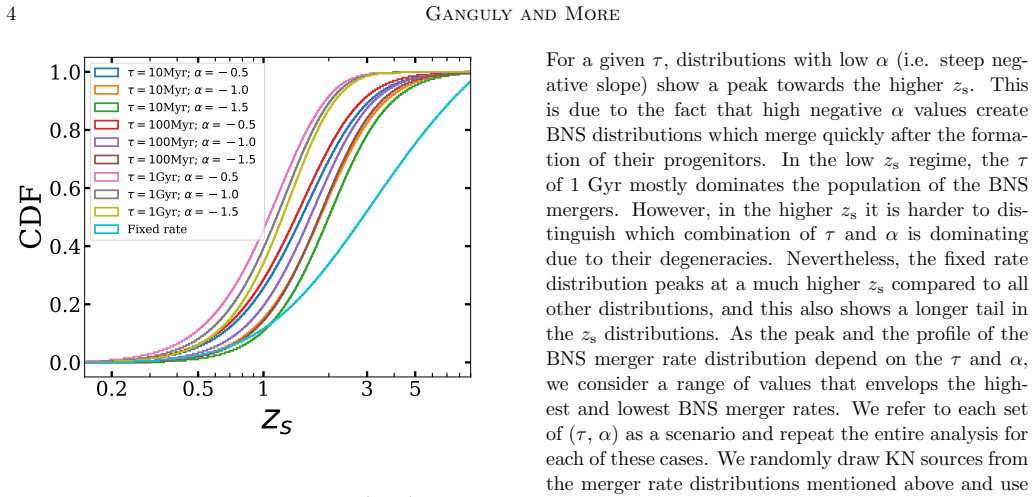
The authors generate the first statistically realistic lensed kilonova population for different delay time distributions and find that the rate of detectable lensed kilonovae increases for distributions with longer minimum delay time τ for a fixed slope. They further note that an AT2017gfo-like event at redshift 0.5 (1.0) needs magnification of at least 5 (44) to be detectable in LSST.
What carries the argument
Simulations of unlensed and lensed kilonova populations in six LSST bands that incorporate varying delay time distributions (parameterized by minimum delay τ and power-law slope) and use color evolution at two epochs to distinguish from Type Ia supernovae.
If this is right
- Kilonovae can be separated from Type Ia supernovae by comparing their colors at two observation epochs because their color evolution is faster.
- The rate of detectable kilonovae in LSST rises for longer minimum delay times and shallower power-law slopes in the delay time distribution.
- An AT2017gfo-like kilonova at redshift 0.5 requires at least 5 times magnification to be detectable in LSST, while the same event at redshift 1.0 requires at least 44 times magnification.
Where Pith is reading between the lines
- Real-time color-based filters could be developed for LSST transient alerts to prioritize lensed kilonova candidates.
- Better observational constraints on merger delay times from other surveys would tighten the predicted lensed kilonova rates.
- Lensed kilonovae could serve as an independent probe of high-redshift binary merger rates once LSST data accumulates.
Load-bearing premise
The simulations rely on chosen kilonova light-curve models, lensing statistics, and specific delay time distribution parameters that may not match real populations.
What would settle it
The actual count of lensed kilonovae detected by LSST over several years, compared against the predicted rates for different values of τ, would test whether longer minimum delays truly produce more events.
Figures


read the original abstract
Identification and characterisation of Kilonovae (KNe) can be instrumental in improving our understanding of cosmology and astrophysics. However, their detection poses unique challenges due to rarity and faintness. Upcoming telescopes, with their deep imaging capabilities and wide field-of-views, will provide a unique opportunity to observe these rare and faint transients. The Rubin Legacy Survey of Space and Time (LSST) will generate a deluge of data, making it essential to deploy fast, efficient methods for identifying genuine KNe, especially when they are gravitationally lensed. To address this, we simulate realistic populations of both unlensed and lensed KNe in the six LSST bands. Comparing with the Type Ia Supernovae, we find that the KNe color evolution is more rapid and the two separate out when their colors are compared at two epochs. Since the mergers of compact binaries are probable progenitors of KNe, the KNe properties may be affected by the delay time distribution (DTD) of the mergers, which is dictated by the minimum delay time ($\tau$) and power-law slope. For longer $\tau$ and shallower slopes, we find an increased rate of detectable KNe in LSST. We generate the first statistically realistic lensed KNe population for different DTDs and find that the rate of detectable lensed KNe increases for DTDs with longer $\tau$ for a fixed slope. We further note that an AT2017gfo-like event at a redshift of 0.5~(1.0) needs magnification of at least 5~(44) to be detectable in LSST.
Editorial analysis
A structured set of objections, weighed in public.
Referee Report
Summary. The paper simulates realistic populations of unlensed and gravitationally lensed kilonovae (KNe) in the six LSST bands, compares their rapid color evolution to Type Ia supernovae for separation at two epochs, and examines the dependence of detectable rates on compact binary delay time distributions (DTDs) parameterized by minimum delay time τ and power-law slope. It generates the first statistically realistic lensed KNe population across DTD variants, reports that detectable lensed KNe rates increase with longer τ at fixed slope, and states that an AT2017gfo-like event requires minimum magnifications of 5 at z=0.5 and 44 at z=1.0 for LSST detectability.
Significance. If the central results hold, the work supplies the first forward-simulated lensed KNe populations tailored to LSST, offering concrete guidance on color-based selection and DTD-dependent rates that could inform follow-up strategies and constraints on merger progenitors. The explicit magnification thresholds and DTD trends are potentially useful for survey planning, though their robustness hinges on the adopted light-curve assumptions.
major comments (3)
- [Abstract] Abstract and simulation description: the quoted minimum magnifications (μ ≥ 5 at z = 0.5; μ ≥ 44 at z = 1.0) and the DTD-rate trend are computed from a single fixed AT2017gfo-like light-curve template. No Monte-Carlo variation over ejecta mass, velocity, lanthanide fraction, or viewing angle is reported, despite known >1 mag shifts in peak luminosity and color evolution that would directly rescale the detection efficiency p(detect | z, μ) and therefore the quoted thresholds and DTD dependence.
- [Results (lensed KNe population)] Results on lensed population and DTD dependence: the claim that 'the rate of detectable lensed KNe increases for DTDs with longer τ for a fixed slope' rests on a fixed detection probability derived from the single template. Without sensitivity tests using alternative grids (e.g., Kasen or Hotokezaka models) or parameter sampling, it is unclear whether the reported trend is robust or an artifact of the chosen SED and luminosity.
- [Color evolution comparison] Comparison with Type Ia SNe: the statement that KNe 'separate out when their colors are compared at two epochs' is presented without quantitative metrics (e.g., overlap fractions, ROC curves, or contamination rates) or details on the exact epochs and bands used, making it difficult to assess the practical utility of the proposed color cut for LSST transient classification.
minor comments (2)
- [Abstract] The abstract uses the notation '0.5~(1.0)' which is non-standard; replace with '0.5 (1.0)' or 'approximately 0.5 and 1.0'.
- [Abstract] The repeated phrasing of the DTD-rate result in the abstract could be consolidated for conciseness.
Simulated Author's Rebuttal
We thank the referee for their insightful and constructive comments on our manuscript. We address each major comment below with clarifications and indicate the revisions we will make to strengthen the presentation and acknowledge limitations.
read point-by-point responses
-
Referee: [Abstract] Abstract and simulation description: the quoted minimum magnifications (μ ≥ 5 at z = 0.5; μ ≥ 44 at z = 1.0) and the DTD-rate trend are computed from a single fixed AT2017gfo-like light-curve template. No Monte-Carlo variation over ejecta mass, velocity, lanthanide fraction, or viewing angle is reported, despite known >1 mag shifts in peak luminosity and color evolution that would directly rescale the detection efficiency p(detect | z, μ) and therefore the quoted thresholds and DTD dependence.
Authors: We acknowledge that the reported magnification thresholds and DTD trends are derived using a single AT2017gfo-like template. This choice provides a concrete baseline anchored to the best-observed event while allowing us to isolate the effects of the delay-time distribution. We agree that variations in ejecta parameters can alter peak luminosities and colors by more than 1 mag, which would rescale the exact thresholds. In the revised manuscript we will add explicit language stating that the quoted values apply specifically to this template, include a brief discussion of how parameter variations affect detectability (with references to the relevant literature), and note that a full Monte Carlo exploration lies beyond the present scope. revision: partial
-
Referee: [Results (lensed KNe population)] Results on lensed population and DTD dependence: the claim that 'the rate of detectable lensed KNe increases for DTDs with longer τ for a fixed slope' rests on a fixed detection probability derived from the single template. Without sensitivity tests using alternative grids (e.g., Kasen or Hotokezaka models) or parameter sampling, it is unclear whether the reported trend is robust or an artifact of the chosen SED and luminosity.
Authors: The increase in detectable lensed KNe rates with longer minimum delay time τ arises because longer τ shifts the redshift distribution of mergers toward lower redshifts, where the (fixed) detection efficiency yields higher rates for a given magnification distribution. The relative trend is therefore driven by the population demographics rather than the absolute normalization of the light curve. Nevertheless, we accept that demonstrating invariance under alternative light-curve models would increase confidence. We will revise the relevant section to clarify the origin of the trend, state the assumption of the adopted template, and indicate that the directional dependence on τ is expected to persist for comparable models. revision: partial
-
Referee: [Color evolution comparison] Comparison with Type Ia SNe: the statement that KNe 'separate out when their colors are compared at two epochs' is presented without quantitative metrics (e.g., overlap fractions, ROC curves, or contamination rates) or details on the exact epochs and bands used, making it difficult to assess the practical utility of the proposed color cut for LSST transient classification.
Authors: We agree that quantitative metrics would make the separation claim more actionable for LSST classification. The current text describes the qualitative difference in color evolution but does not supply overlap statistics or specify the exact epochs and bands. In the revised manuscript we will add the precise epochs (e.g., observations at +1 day and +5 days) and filter combinations used, together with overlap fractions between the KNe and Type Ia color distributions at those epochs. This will allow readers to evaluate the practical utility of the proposed two-epoch color cut. revision: yes
- A full Monte Carlo sampling over ejecta parameters and alternative light-curve models for the statistically realistic lensed population would require a new suite of computationally intensive simulations that exceeds the scope of the current study.
Circularity Check
No circularity: forward population simulations produce independent outputs
full rationale
The paper's central results (lensed KNe detection rates vs. DTD parameters τ and slope, plus minimum magnification thresholds for an AT2017gfo-like event) are obtained by generating synthetic populations from assumed light-curve templates, lensing statistics, and DTD functional forms, then applying LSST detection criteria. These quantities are direct numerical outputs of the simulation pipeline rather than quantities that are fitted to the same observables and re-labeled as predictions. No equations or steps reduce by construction to the inputs, and the provided text contains no load-bearing self-citations that would require external verification of uniqueness theorems or ansatzes.
Axiom & Free-Parameter Ledger
free parameters (2)
- minimum delay time τ
- power-law slope of DTD
axioms (1)
- domain assumption KNe properties are affected by the delay time distribution of compact binary mergers
Reference graph
Works this paper leans on
-
[1]
Aihara, H., AlSayyad, Y., Ando, M., et al. 2022, PASJ, 74, 247, doi: 10.1093/pasj/psab122 16Ganguly and More 0.2 0.4 vej1 (in c) 0.4 0.8 ej1 (cm2/g) 0 2500 5000 Tfloor1 (in K) 0.02 0.04 0.06 Mej2 (M ) 0.0 0.2 0.4 vej2 (in c) 1.5 3.0 4.5 ej2 (cm2/g) 0 2000 4000 Tfloor2 (in K) 0.015 0.030 Mej3 (M ) 0.3 0.6 0.9 vej3 (in c) 8 12 ej3 (cm2/g) 0.015 0.030 Mej1 (...
-
[2]
2020, JCAP, 2020, 047, doi: 10.1088/1475-7516/2020/12/047
Aiola, S., Calabrese, E., Maurin, L., et al. 2020, JCAP, 2020, 047, doi: 10.1088/1475-7516/2020/12/047
-
[3]
Andrade, C., Alserkal, R., Salazar Manzano, L., et al. 2025, Publications of the Astronomical Society of the Pacific, 137, 034102, doi: 10.1088/1538-3873/adbfbc
-
[4]
Andreoni, I., Anand, S., Bianco, F. B., et al. 2019, Publications of the Astronomical Society of the Pacific, 131, 068004, doi: 10.1088/1538-3873/ab1531
-
[5]
Andreoni, I., Coughlin, M. W., Kool, E. C., et al. 2021a, The Astrophysical Journal, 918, 63, doi: 10.3847/1538-4357/ac0bc7 —. 2021b, The Astrophysical Journal, 918, 63, doi: 10.3847/1538-4357/ac0bc7
-
[6]
Andreoni, I., Margutti, R., Salafia, O. S., et al. 2022, The Astrophysical Journal Supplement Series, 260, 18, doi: 10.3847/1538-4365/ac617c Lensed Kilonovae in LSST17 0.50.5 1 2 3 5 8 0.1 1 10 50 200 Doubles 0.50.5 1 2 3 5 8 Quads = 10 Myr = -1.5 = 1 Gyr = -1.5 zs Figure 12.Distribution ofµof double and quad lensed images withz s for two differentτvalues...
-
[7]
Arcavi, I., Hosseinzadeh, G., Howell, D. A., et al. 2017, Nature, 551, 64, doi: 10.1038/nature24291
-
[8]
2024, MNRAS, 531, 3509, doi: 10.1093/mnras/stae1356
Arendse, N., Dhawan, S., Sagu´ es Carracedo, A., et al. 2024, MNRAS, 531, 3509, doi: 10.1093/mnras/stae1356 Astropy Collaboration, Robitaille, T. P., Tollerud, E. J., et al. 2013, A&A, 558, A33, doi: 10.1051/0004-6361/201322068 Astropy Collaboration, Price-Whelan, A. M., Sip˝ ocz, B. M., et al. 2018, AJ, 156, 123, doi: 10.3847/1538-3881/aabc4f
-
[9]
Balkenhol, L., Dutcher, D., Ade, P. A. R., et al. 2021, PhRvD, 104, 083509, doi: 10.1103/PhysRevD.104.083509
-
[10]
Barnes, J., & Kasen, D. 2013, ApJ, 775, 18, doi: 10.1088/0004-637X/775/1/18
-
[11]
Bulla, M. 2019, MNRAS, 489, 5037, doi: 10.1093/mnras/stz2495
-
[12]
Chen, W., Kelly, P. L., Oguri, M., et al. 2022, Nature, 611, 256, doi: 10.1038/s41586-022-05252-5
-
[13]
2020, JCAP, 2020, 001, doi: 10.1088/1475-7516/2020/06/001
Colas, T., d’Amico, G., Senatore, L., Zhang, P., & Beutler, F. 2020, JCAP, 2020, 001, doi: 10.1088/1475-7516/2020/06/001
-
[14]
Science358, 1556 (2017) https://doi.org/10.1126/science.aap9811 arXiv:1710.05452 [astro- ph.HE]
Coulter, D. A., Foley, R. J., Kilpatrick, C. D., et al. 2017, Science, 358, 1556, doi: 10.1126/science.aap9811
-
[15]
Cowperthwaite, P. S., Berger, E., Villar, V. A., et al. 2017, ApJL, 848, L17, doi: 10.3847/2041-8213/aa8fc7 d’Amico, G., Gleyzes, J., Kokron, N., et al. 2020, JCAP, 2020, 005, doi: 10.1088/1475-7516/2020/05/005
-
[16]
Dhawan, S., Jha, S. W., & Leibundgut, B. 2018, A&A, 609, A72, doi: 10.1051/0004-6361/201731501
-
[17]
Dobler, G., & Keeton, C. R. 2006, The Astrophysical Journal, 653, 1391
2006
-
[18]
Dutcher, D., Balkenhol, L., Ade, P. A. R., et al. 2021, PhRvD, 104, 022003, doi: 10.1103/PhysRevD.104.022003
-
[19]
Freedman, W. L., Madore, B. F., Scowcroft, V., et al. 2012, The Astrophysical Journal, 758, 24, doi: 10.1088/0004-637X/758/1/24
-
[20]
2023, Transient Name Server AstroNote, 96, 1
Frye, B., Pascale, M., Cohen, S., et al. 2023, Transient Name Server AstroNote, 96, 1
2023
-
[21]
Goldstein, D. A., & Nugent, P. E. 2016, The Astrophysical Journal Letters, 834, L5, doi: 10.3847/2041-8213/834/1/L5
-
[22]
A., Nugent, P
Goldstein, D. A., Nugent, P. E., Kasen, D. N., & Collett, T. E. 2018, The Astrophysical Journal, 855, 22
2018
-
[23]
Goobar, A., Amanullah, R., Kulkarni, S. R., et al. 2017, Science, 356, 291, doi: 10.1126/science.aal2729
-
[24]
2023, Nature Astronomy, 7, 1098, doi: 10.1038/s41550-023-01981-3 DISCOVERY OFSN 2025MKN11
Goobar, A., Johansson, J., Schulze, S., et al. 2023, Nature Astronomy, 7, 1098, doi: 10.1038/s41550-023-01981-3
-
[25]
2021, Astronomy & Astrophysics, 646, A110 18Ganguly and More
Huber, S., Suyu, S., Noebauer, U., et al. 2021, Astronomy & Astrophysics, 646, A110 18Ganguly and More
2021
-
[26]
and Simonovi\'c, Marko and Zaldarriaga, Matias
Ivanov, M. M., Simonovi´ c, M., & Zaldarriaga, M. 2020, JCAP, 2020, 042, doi: 10.1088/1475-7516/2020/05/042 Ivezi´ c, v., Kahn, S. M., Tyson, J. A., et al. 2019, The Astrophysical Journal, 873, 111, doi: 10.3847/1538-4357/ab042c
-
[27]
Kasen, D., Badnell, N. R., & Barnes, J. 2013, ApJ, 774, 25, doi: 10.1088/0004-637X/774/1/25
-
[28]
2017, Nature, 551, 80, doi: 10.1038/nature24453
Ramirez-Ruiz, E. 2017, Nature, 551, 80, doi: 10.1038/nature24453
-
[29]
2022, Transient Name Server AstroNote, 169, 1
Kelly, P., Zitrin, A., Oguri, M., et al. 2022, Transient Name Server AstroNote, 169, 1
2022
-
[30]
Kelly, P. L., Rodney, S. A., Treu, T., et al. 2015, Science, 347, 1123, doi: 10.1126/science.aaa3350
-
[31]
Koopmans, L. V. E., Bolton, A., Treu, T., et al. 2009, The Astrophysical Journal, 703, L51, doi: 10.1088/0004-637X/703/1/L51
-
[32]
1994, A&A, 284, 285
Kormann, R., Schneider, P., & Bartelmann, M. 1994, A&A, 284, 285
1994
-
[33]
2022, Chinese Physics Letters, 39, 119801, doi: 10.1088/0256-307X/39/11/119801
Liao, K., Biesiada, M., & Zhu, Z.-H. 2022, Chinese Physics Letters, 39, 119801, doi: 10.1088/0256-307X/39/11/119801
-
[34]
M., Gorbovskoy, E., Kornilov, V
Lipunov, V. M., Gorbovskoy, E., Kornilov, V. G., et al. 2017, ApJL, 850, L1, doi: 10.3847/2041-8213/aa92c0
-
[35]
2023, MNRAS, 518, 6183, doi: 10.1093/mnras/stac3418
Ma, H., Lu, Y., Guo, X., Zhang, S., & Chu, Q. 2023, MNRAS, 518, 6183, doi: 10.1093/mnras/stac3418
-
[36]
Madau, P., & Dickinson, M. 2014, Annual Review of Astronomy and Astrophysics, 52, 415, doi: https: //doi.org/10.1146/annurev-astro-081811-125615
work page internal anchor Pith review doi:10.1146/annurev-astro-081811-125615 2014
-
[37]
2024, arXiv e-prints, arXiv:2411.09412, doi: 10.48550/arXiv.2411.09412 —
Mane, P., More, A., & More, S. 2024, arXiv e-prints, arXiv:2411.09412, doi: 10.48550/arXiv.2411.09412 —. 2025, The Open Journal of Astrophysics, 8, 80, doi: 10.33232/001c.141393
-
[38]
Metzger, B. D. 2017, Living Reviews in Relativity, 20, 3, doi: 10.1007/s41114-017-0006-z
-
[39]
2022, MNRAS, 515, 1044, doi: 10.1093/mnras/stac1704
More, A., & More, S. 2022, MNRAS, 515, 1044, doi: 10.1093/mnras/stac1704
-
[40]
H., Oguri, M., More, S., & Lee, C.-H
More, A., Suyu, S. H., Oguri, M., More, S., & Lee, C.-H. 2017, ApJL, 835, L25, doi: 10.3847/2041-8213/835/2/L25
-
[41]
More, A., Verma, A., Marshall, P. J., et al. 2016, MNRAS, 455, 1191, doi: 10.1093/mnras/stv1965
-
[42]
2017, ApJL, 848, L18, doi: 10.3847/2041-8213/aa9029
Nicholl, M., Berger, E., Kasen, D., et al. 2017, ApJL, 848, L18, doi: 10.3847/2041-8213/aa9029
-
[43]
Nicholl, M., Wevers, T., Oates, S. R., et al. 2020, MNRAS, 499, 482, doi: 10.1093/mnras/staa2824
-
[44]
2019, Reports on Progress in Physics, 82, 126901, doi: 10.1088/1361-6633/ab4fc5
Oguri, M. 2019, Reports on Progress in Physics, 82, 126901, doi: 10.1088/1361-6633/ab4fc5
-
[45]
Oguri, M., & Marshall, P. J. 2010, Monthly Notices of the Royal Astronomical Society, 405, 2579, doi: 10.1111/j.1365-2966.2010.16639.x
-
[46]
Parker, L. C., Hoekstra, H., Hudson, M. J., van Waerbeke, L., & Mellier, Y. 2007, ApJ, 669, 21, doi: 10.1086/521541
-
[47]
2023, Lensed Supernova Encore atz= 2! The First Galaxy to Host Two Multiply-Imaged
Pierel, J., et al. 2023, Lensed Supernova Encore atz= 2! The First Galaxy to Host Two Multiply-Imaged
2023
-
[48]
Pierel, J. D. R., Rodney, S., Vernardos, G., et al. 2021, The Astrophysical Journal, 908, 190, doi: 10.3847/1538-4357/abd8d3 Pietrzy´ nski, G., Graczyk, D., Gallenne, A., et al. 2019, Nature, 567, 200, doi: 10.1038/s41586-019-0999-4 Planck Collaboration, Ade, P. A. R., Aghanim, N., et al. 2014, A&A, 571, A16, doi: 10.1051/0004-6361/201321591 Planck Collab...
-
[49]
and Casertano, Stefano and Yuan, Wenlong and Bowers, J
Riess, A. G., Casertano, S., Yuan, W., et al. 2021, The Astrophysical Journal Letters, 908, L6, doi: 10.3847/2041-8213/abdbaf
-
[50]
Scolnic, D. 2019, ApJ, 876, 85, doi: 10.3847/1538-4357/ab1422
-
[51]
Riess, A. G., Macri, L. M., Hoffmann, S. L., et al. 2016, ApJ, 826, 56, doi: 10.3847/0004-637X/826/1/56
-
[52]
Riess, A. G., Casertano, S., Yuan, W., et al. 2018, ApJ, 855, 136, doi: 10.3847/1538-4357/aaadb7
-
[53]
Rodney, S. A., Brammer, G. B., Pierel, J. D. R., et al. 2021, Nature Astronomy, 5, 1118, doi: 10.1038/s41550-021-01450-9
-
[54]
Safarzadeh, M., Berger, E., Ng, K. K. Y., et al. 2019, ApJL, 878, L13, doi: 10.3847/2041-8213/ab22be
-
[55]
Sandage, A., Tammann, G. A., Saha, A., et al. 2006, The Astrophysical Journal, 653, 843, doi: 10.1086/508853
-
[56]
2013, A&A, 559, A37, doi: 10.1051/0004-6361/201321882
Schneider, P., & Sluse, D. 2013, A&A, 559, A37, doi: 10.1051/0004-6361/201321882
-
[57]
Scolnic, D., Kessler, R., Brout, D., et al. 2018, ApJL, 852, L3, doi: 10.3847/2041-8213/aa9d82
-
[58]
Siebert, M. R., Foley, R. J., Drout, M. R., et al. 2017, ApJL, 848, L26, doi: 10.3847/2041-8213/aa905e
-
[59]
P., Robertson, A., Mahler, G., et al
Smith, G. P., Robertson, A., Mahler, G., et al. 2023, MNRAS, 520, 702, doi: 10.1093/mnras/stad140
-
[60]
Soares-Santos, M., Holz, D. E., Annis, J., et al. 2017, ApJL, 848, L16, doi: 10.3847/2041-8213/aa9059
-
[61]
2013, ApJ, 775, 113, doi: 10.1088/0004-637X/775/2/113
Tanaka, M., & Hotokezaka, K. 2013, ApJ, 775, 113, doi: 10.1088/0004-637X/775/2/113
-
[62]
2018, ApJ, 852, 109, doi: 10.3847/1538-4357/aaa0cb
Tanaka, M., Kato, D., Gaigalas, G., et al. 2018, ApJ, 852, 109, doi: 10.3847/1538-4357/aaa0cb
-
[63]
Tanvir, N. R., Levan, A. J., Gonz´ alez-Fern´ andez, C., et al. 2017, The Astrophysical Journal Letters, 848, L27, doi: 10.3847/2041-8213/aa90b6 Lensed Kilonovae in LSST19
-
[64]
Treu, T., & Marshall, P. J. 2016, A&A Rv, 24, 11, doi: 10.1007/s00159-016-0096-8
-
[65]
2017, The Astrophysical Journal Letters, 848, L24, doi: 10.3847/2041-8213/aa8edf
Valenti, S., Sand, D. J., Yang, S., et al. 2017, ApJL, 848, L24, doi: 10.3847/2041-8213/aa8edf Van Rossum, G., & Drake, F. L. 2009, Python 3 Reference Manual (Scotts Valley, CA: CreateSpace)
-
[66]
2016, Python Data Science Handbook: Essential Tools for Working with Data, 1st edn
VanderPlas, J. 2016, Python Data Science Handbook: Essential Tools for Working with Data, 1st edn. (O’Reilly
2016
-
[67]
Villar, V. A., Berger, E., Metzger, B. D., & Guillochon, J. 2017, The Astrophysical Journal, 849, 70, doi: 10.3847/1538-4357/aa8fcb
-
[68]
A., Guillochon, J., Berger, E., et al
Villar, V. A., Guillochon, J., Berger, E., et al. 2017, ApJL, 851, L21, doi: 10.3847/2041-8213/aa9c84
-
[69]
2019, Monthly Notices of the Royal Astronomical Society, 487, 3342, doi: 10.1093/mnras/stz1516
Wojtak, R., Hjorth, J., & Gall, C. 2019, Monthly Notices of the Royal Astronomical Society, 487, 3342, doi: 10.1093/mnras/stz1516
-
[70]
Wong, K. C., Keeton, C. R., Williams, K. A., Momcheva, I. G., & Zabludoff, A. I. 2010, The Astrophysical Journal, 726, 84, doi: 10.1088/0004-637X/726/2/84
discussion (0)
Sign in with ORCID, Apple, or X to comment. Anyone can read and Pith papers without signing in.