Recognition: unknown
Enhancing Model Based Derivative Free Optimization using Direct Search
Pith reviewed 2026-05-10 10:21 UTC · model grok-4.3
The pith
A switching framework inserts direct search steps into any model-based optimizer to improve performance on simulation-based problems while preserving asymptotic convergence in the single-objective case.
A machine-rendered reading of the paper's core claim, the machinery that carries it, and where it could break.
Core claim
Inserting direct search steps via a switching rule enhances any model-based derivative-free optimizer without destroying its convergence properties, as established by the asymptotic analysis, and yields stronger numerical results on both standard test sets and machine-learning hyperparameter problems.
What carries the argument
The switching framework that decides when to apply direct search steps inside an otherwise model-based optimization loop.
Load-bearing premise
Direct search steps can be inserted into model-based methods without breaking their convergence guarantees or harming practical performance.
What would settle it
A simple test problem on which the switched algorithm diverges or returns worse final values than the unmodified model-based solver would disprove the central enhancement claim.
Figures



read the original abstract
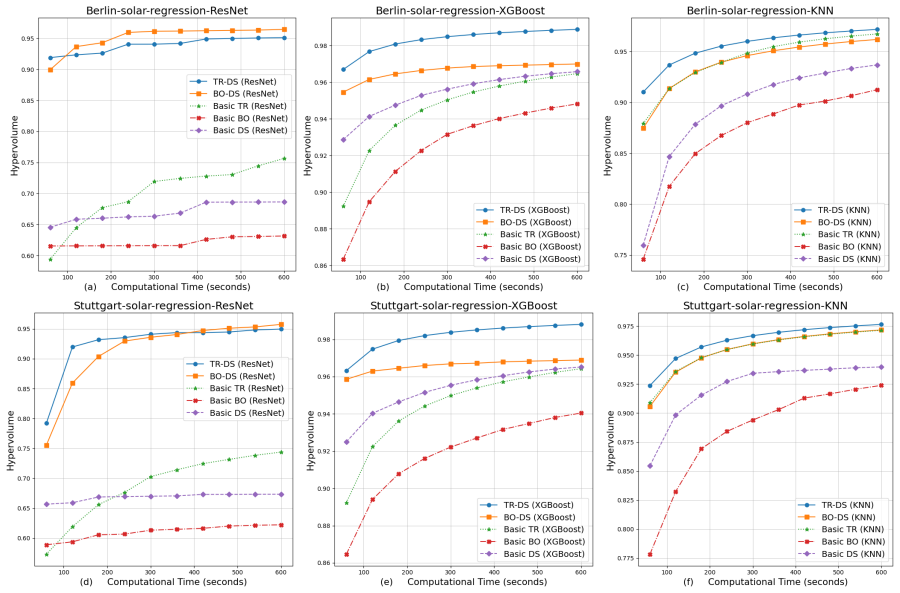
We consider single and multiobjective simulation-based optimization problems. Simulation-based optimization has traditionally used both model-based and search-based methods, often in isolation. Model-based methods include trust region approaches and Bayesian optimization, while search methods include genetic algorithms and Direct Search-type techniques. In this work, we propose a switching framework that leverages Direct Search methods to enhance the performance of any model-based optimizer. Our contributions are twofold. First, in the single-objective setting, we analyze and prove the asymptotic convergence of the proposed switching approach. Second, motivated by applications in machine learning, we consider both classification and regression problems, where the objectives span accuracy, computational time, algorithmic bias, and sparsity. The models range from complex neural networks and decision trees to simpler KNN-type baselines. For machine learning in particular, we also introduce a warm-starting mechanism using weights from previous hyperparameter or architectural configurations to exploit problem structure and accelerate training. Finally, beyond ML tasks, we evaluate the method on the standard CUTEr test problems and compare its performance against classical Bayesian and trust region solvers. We observe consistently strong numerical performance, suggesting promise for the proposed switching-based approach.
Editorial analysis
A structured set of objections, weighed in public.
Referee Report
Summary. The manuscript proposes a switching framework that integrates Direct Search methods into arbitrary model-based derivative-free optimizers (trust-region, Bayesian optimization) for single- and multi-objective simulation-based problems. It claims an asymptotic convergence proof in the single-objective setting, introduces warm-starting for ML hyperparameter/architecture search across neural nets, decision trees, and KNN baselines, and reports strong numerical results on ML tasks (accuracy, time, bias, sparsity) plus CUTEr test problems against classical solvers.
Significance. A rigorously proven, general switching rule that preserves convergence while improving practical performance would be a useful contribution to derivative-free optimization, particularly for expensive black-box problems in ML. The warm-starting mechanism and multi-criteria ML formulation address real application needs; if the numerical gains are robust and the proof avoids hidden assumptions on the base method, the work could influence hybrid DFO design.
major comments (1)
- [Convergence Analysis] The central convergence claim (abstract and single-objective analysis section) asserts asymptotic convergence for the switching approach applied to any model-based optimizer. However, model-based methods rely on specific hypotheses (model accuracy within a trust region, sufficient decrease, or exploration guarantees). The manuscript must explicitly state the switching rule, post-switch model update, and conditions under which these hypotheses remain satisfied; otherwise the generality to arbitrary base methods is not established.
minor comments (3)
- [Numerical Results] In the numerical experiments on CUTEr problems, report the number of function evaluations, wall-clock time, and statistical tests (e.g., Wilcoxon) for the observed improvements over Bayesian and trust-region baselines.
- [Machine Learning Applications] For the ML warm-starting mechanism, clarify how weights or configurations are transferred across different model classes (e.g., neural nets to decision trees) and whether this transfer preserves any convergence-related properties of the underlying optimizer.
- [Algorithm Description] Notation for the switching indicator and the model-update step after a Direct Search iteration should be defined once and used consistently; currently it appears only informally in the algorithm description.
Simulated Author's Rebuttal
We thank the referee for the constructive feedback on our manuscript. We address the single major comment below and will revise the convergence analysis section accordingly to improve clarity and rigor.
read point-by-point responses
-
Referee: The central convergence claim (abstract and single-objective analysis section) asserts asymptotic convergence for the switching approach applied to any model-based optimizer. However, model-based methods rely on specific hypotheses (model accuracy within a trust region, sufficient decrease, or exploration guarantees). The manuscript must explicitly state the switching rule, post-switch model update, and conditions under which these hypotheses remain satisfied; otherwise the generality to arbitrary base methods is not established.
Authors: We agree that the convergence analysis would benefit from greater explicitness on these points to fully substantiate the claimed generality. In the revised manuscript, we will add a new subsection in the single-objective analysis that: (1) precisely defines the switching rule as a trigger based on failure of the model-based step to satisfy a sufficient decrease condition relative to the current model prediction; (2) specifies the post-switch model update, which re-centers the trust region (or updates the surrogate) at the accepted Direct Search point and reuses the existing model structure with the new function evaluation; and (3) states the preservation conditions, namely that the switch occurs only after the model-based step has already satisfied the base method's internal accuracy and decrease requirements up to that iteration, ensuring the overall sequence continues to meet the hypotheses (e.g., model accuracy within the trust region and sufficient decrease) required by standard convergence theorems for trust-region or Bayesian methods. This will be supported by a short lemma showing that the combined iteration still produces a sequence satisfying the necessary liminf conditions for asymptotic convergence. We view this as a clarification rather than a change to the underlying result. revision: yes
Circularity Check
No circularity: convergence analysis presented as independent proof without self-referential reduction
full rationale
The abstract states that the authors 'analyze and prove the asymptotic convergence of the proposed switching approach' in the single-objective setting. No equations, definitions, or derivation steps are exhibited that reduce this claim to a fitted parameter, self-citation chain, or input by construction. The switching framework is introduced as a proposal that inserts Direct Search steps, with convergence asserted via analysis rather than tautological redefinition. Absent any quoted reduction (e.g., a 'prediction' that is the fit itself), the derivation chain remains self-contained against external benchmarks.
Axiom & Free-Parameter Ledger
Reference graph
Works this paper leans on
-
[1]
Aithal and Stefan M
Shashi M. Aithal and Stefan M. Wild. Development of a reduced-order design/optimization tool for automotive engines using massively parallel computing. InProceedings of the SAE 12th International Conference on Engines & Vehicles, 2015
2015
-
[2]
Nonsmooth optimization through mesh adaptive direct search and variable neighborhood search.Journal of Global Optimization, 41(2):299–318, 2008
Charles Audet, Vincent B´ echard, and S´ ebastien Le Digabel. Nonsmooth optimization through mesh adaptive direct search and variable neighborhood search.Journal of Global Optimization, 41(2):299–318, 2008
2008
-
[3]
Analysis of generalized pattern searches.SIAM Journal on optimization, 13(3):889–903, 2002
Charles Audet and John E Dennis Jr. Analysis of generalized pattern searches.SIAM Journal on optimization, 13(3):889–903, 2002
2002
-
[4]
Mesh adaptive direct search algorithms for constrained optimization.SIAM Journal on optimization, 17(1):188–217, 2006
Charles Audet and John E Dennis Jr. Mesh adaptive direct search algorithms for constrained optimization.SIAM Journal on optimization, 17(1):188–217, 2006
2006
-
[5]
Uncertainty-aware search framework for multi-objective bayesian optimization
Syrine Belakaria, Aryan Deshwal, Nitthilan Kannappan Jayakodi, and Janardhan Rao Doppa. Uncertainty-aware search framework for multi-objective bayesian optimization. InProceedings of the AAAI Conference on Artificial Intelligence, volume 34, pages 10044–10052, 2020
2020
-
[6]
Dmulti-mads: Mesh adaptive di- rect multisearch for bound-constrained blackbox multiobjective optimization.Computational Optimization and Applications, 79(2):301–338, 2021
Jean Bigeon, S´ ebastien Le Digabel, and Ludovic Salomon. Dmulti-mads: Mesh adaptive di- rect multisearch for bound-constrained blackbox multiobjective optimization.Computational Optimization and Applications, 79(2):301–338, 2021
2021
-
[7]
Improving the flexibil- ity and robustness of model-based derivative-free optimization solvers.ACM Transactions on Mathematical Software (TOMS), 45(3):1–41, 2019
Coralia Cartis, Jan Fiala, Benjamin Marteau, and Lindon Roberts. Improving the flexibil- ity and robustness of model-based derivative-free optimization solvers.ACM Transactions on Mathematical Software (TOMS), 45(3):1–41, 2019
2019
-
[8]
A derivative-free gauss–newton method.Mathematical Programming Computation, 11:631–674, 2019
Coralia Cartis and Lindon Roberts. A derivative-free gauss–newton method.Mathematical Programming Computation, 11:631–674, 2019
2019
-
[9]
Escaping local minima with local derivative-free methods: a numerical investigation.Optimization, 71(8):2343–2373, 2022
Coralia Cartis, Lindon Roberts, and Oliver Sheridan-Methven. Escaping local minima with local derivative-free methods: a numerical investigation.Optimization, 71(8):2343–2373, 2022
2022
-
[10]
MPS/SIAM Series on Optimization
Andrew R Conn, Nicholas IM Gould, and Philippe L Toint.Trust-Region Methods. MPS/SIAM Series on Optimization. SIAM, Philadelphia, 2000
2000
-
[11]
SIAM, 2009
Andrew R Conn, Katya Scheinberg, and Luis N Vicente.Introduction to derivative-free opti- mization. SIAM, 2009
2009
-
[12]
An augmented weighted tchebycheff method with adaptively chosen parameters for discrete bicriteria optimization problems.Com- puters & Operations Research, 39(12):2929–2943, 2012
Kerstin D¨ achert, Jochen Gorski, and Kathrin Klamroth. An augmented weighted tchebycheff method with adaptively chosen parameters for discrete bicriteria optimization problems.Com- puters & Operations Research, 39(12):2929–2943, 2012
2012
-
[13]
A fast and elitist multiobjective genetic algorithm: Nsga-ii.IEEE transactions on evolutionary computation, 6(2):182–197, 2002
Kalyanmoy Deb, Amrit Pratap, Sameer Agarwal, and TAMT Meyarivan. A fast and elitist multiobjective genetic algorithm: Nsga-ii.IEEE transactions on evolutionary computation, 6(2):182–197, 2002
2002
-
[14]
Multi-objective optimization
Kalyanmoy Deb, Karthik Sindhya, and Jussi Hakanen. Multi-objective optimization. InDecision sciences, pages 161–200. CRC Press, 2016
2016
-
[15]
Benchmarking optimization software with performance profiles.Mathematical programming, 91:201–213, 2002
Elizabeth D Dolan and Jorge J Mor´ e. Benchmarking optimization software with performance profiles.Mathematical programming, 91:201–213, 2002
2002
-
[16]
Multiobjective combinatorial optimization—theory, methodology, and applications
Matthias Ehrgott and Xavier Gandibleux. Multiobjective combinatorial optimization—theory, methodology, and applications. InMultiple criteria optimization: State of the art annotated bibliographic surveys, pages 369–444. Springer, 2002
2002
-
[17]
A Tutorial on Bayesian Optimization
Peter I Frazier. A tutorial on bayesian optimization.arXiv preprint arXiv:1807.02811, 2018
work page internal anchor Pith review arXiv 2018
-
[18]
Performance analysis of trust region subproblem solvers for limited-memory distributed bfgs optimization method.Frontiers in Applied Mathematics and Statistics, 7:673412, 2021
Guohua Gao, Horacio Florez, Jeroen C Vink, Terence J Wells, Fredrik Saaf, and Carl PA Blom. Performance analysis of trust region subproblem solvers for limited-memory distributed bfgs optimization method.Frontiers in Applied Mathematics and Statistics, 7:673412, 2021
2021
-
[19]
Google vizier: A service for black-box optimization
Daniel Golovin, Benjamin Solnik, Subhodeep Moitra, Greg Kochanski, John Karro, and David Sculley. Google vizier: A service for black-box optimization. InProceedings of the 23rd ACM SIGKDD international conference on knowledge discovery and data mining, pages 1487–1495, 2017
2017
-
[20]
Efficient global optimization of expensive black-box functions.Journal of Global optimization, 13:455–492, 1998
Donald R Jones, Matthias Schonlau, and William J Welch. Efficient global optimization of expensive black-box functions.Journal of Global optimization, 13:455–492, 1998
1998
-
[21]
Hyperaspo: Fusion of model and hyper parameter opti- mization for multi-objective machine learning
Aswin Kannan, Anamitra Roy Choudhury, Vaibhav Saxena, Saurabh Raje, Parikshit Ram, Ashish Verma, and Yogish Sabharwal. Hyperaspo: Fusion of model and hyper parameter opti- mization for multi-objective machine learning. In2021 IEEE International Conference on Big Data (Big Data), pages 790–800. IEEE, 2021
2021
-
[22]
Aswin Kannan and Stefan M. Wild. Obtaining quadratic models of noisy functions. ANL/MCS- P1975-1111 P1975-1111, Argonne National Laboratory, September 2011. Published October 24, 2012 on Optimization Online
2011
-
[23]
Survey of trust-region derivative free optimization methods.Journal of Industrial and Management Optimization, 3(2):321, 2007
B ¨ULENT Karasozen. Survey of trust-region derivative free optimization methods.Journal of Industrial and Management Optimization, 3(2):321, 2007. 24
2007
-
[24]
Adaptive weighted sum method for multiobjective optimiza- tion: a new method for pareto front generation.Structural and multidisciplinary optimization, 31(2):105–116, 2006
Il Yong Kim and Olivier L de Weck. Adaptive weighted sum method for multiobjective optimiza- tion: a new method for pareto front generation.Structural and multidisciplinary optimization, 31(2):105–116, 2006
2006
-
[25]
Derivative-free optimization methods
Jeffrey Larson, Matt Menickelly, and Stefan M Wild. Derivative-free optimization methods. Acta Numerica, 28:287–404, 2019
2019
-
[26]
Algorithm switching for multiobjective predictions in renewable energy markets
Zijun Li and Aswin Kannan. Algorithm switching for multiobjective predictions in renewable energy markets. InInternational Conference on Learning and Intelligent Optimization, pages 233–248. Springer, 2024
2024
-
[27]
Effective implementation of theε-constraint method in multi-objective math- ematical programming problems.Applied mathematics and computation, 213(2):455–465, 2009
George Mavrotas. Effective implementation of theε-constraint method in multi-objective math- ematical programming problems.Applied mathematics and computation, 213(2):455–465, 2009
2009
-
[28]
Convergence of the nelder–mead simplex method to a nonstationary point
Ken IM McKinnon. Convergence of the nelder–mead simplex method to a nonstationary point. SIAM Journal on optimization, 9(1):148–158, 1998
1998
-
[29]
Benchmarking derivative-free optimization algorithms.SIAM Journal on Optimization, 20(1):172–191, 2009
Jorge J Mor´ e and Stefan M Wild. Benchmarking derivative-free optimization algorithms.SIAM Journal on Optimization, 20(1):172–191, 2009
2009
-
[30]
A simplex method for function minimization.The computer journal, 7(4):308–313, 1965
John A Nelder and Roger Mead. A simplex method for function minimization.The computer journal, 7(4):308–313, 1965
1965
-
[31]
Renewable energies and levies, website
Netztransparenz. Renewable energies and levies, website. https://www.netztransparenz.de/de- de/Erneuerbare-Energien-und-Umlagen., 2023
2023
-
[32]
System advisor model version 2022.11.21 (sam 2022.11.21) website
NREL. System advisor model version 2022.11.21 (sam 2022.11.21) website. pv cost data. national renewable energy laboratory. golden, co. https://sam.nrel.gov/photovoltaic/pv-cost- component.html., 2022
2022
-
[33]
The newuoa software for unconstrained optimization without derivatives
Michael JD Powell. The newuoa software for unconstrained optimization without derivatives. InLarge-scale nonlinear optimization, pages 255–297. Springer, 2006
2006
-
[34]
Guti´ errez, Enrique Alexandre, C´ esar Herv´ as-Mart´ ınez, and Sancho Salcedo-Sanz
Mar´ ıa P´ erez-Ortiz, Silvia Jim´ enez-Fern´ andez, Pedro A. Guti´ errez, Enrique Alexandre, C´ esar Herv´ as-Mart´ ınez, and Sancho Salcedo-Sanz. A review of classification problems and algorithms in renewable energy applications.Energies, 9(8):1–27, 2016
2016
-
[35]
An interactive weighted tchebycheff procedure for multiple objective programming.Mathematical programming, 26:326–344, 1983
Ralph E Steuer and Eng-Ung Choo. An interactive weighted tchebycheff procedure for multiple objective programming.Mathematical programming, 26:326–344, 1983
1983
-
[36]
On the convergence of pattern search algorithms.SIAM Journal on optimiza- tion, 7(1):1–25, 1997
Virginia Torczon. On the convergence of pattern search algorithms.SIAM Journal on optimiza- tion, 7(1):1–25, 1997
1997
-
[37]
Stefan M. Wild. MNH: a derivative-free optimization algorithm using minimal norm hes- sians. InTenth Copper Mountain Conference on Iterative Methods, April 2008. Available at http://grandmaster.colorado.edu/ copper/2008/SCWinners/Wild.pdf
2008
-
[38]
Classification and summarization of solar irradiance and power forecasting methods: A thorough review.CSEE Journal of Power and Energy Systems, 9(3):978–995, 2021
Bo Yang, Tianjiao Zhu, Pulin Cao, Zhengxun Guo, Chunyuan Zeng, Danyang Li, Yijun Chen, Haoyin Ye, Ruining Shao, Hongchun Shu, et al. Classification and summarization of solar irradiance and power forecasting methods: A thorough review.CSEE Journal of Power and Energy Systems, 9(3):978–995, 2021
2021
-
[39]
Multiobjective evolutionary algorithms: a comparative case study and the strength pareto approach.IEEE transactions on Evolutionary Computation, 3(4):257–271, 2002
Eckart Zitzler and Lothar Thiele. Multiobjective evolutionary algorithms: a comparative case study and the strength pareto approach.IEEE transactions on Evolutionary Computation, 3(4):257–271, 2002. 25
2002
discussion (0)
Sign in with ORCID, Apple, or X to comment. Anyone can read and Pith papers without signing in.