Too Private to Tell: Practical Token Theft Attacks on Apple Intelligence
Pith reviewed 2026-05-10 08:35 UTC · model grok-4.3
The pith
Apple Intelligence's anonymous access tokens can be stolen from one device and replayed on another to bypass the attacker's usage limits.
A machine-rendered reading of the paper's core claim, the machinery that carries it, and where it could break.
Core claim
The paper establishes that Apple Intelligence's two-stage anonymous access token mechanism, as observed through traffic analysis and reverse engineering, permits practical cross-device replay attacks. Tokens stolen from a victim device remain valid when presented from an attacker's device, allowing continued access to the AI service even after the attacker's personal usage allowance is depleted, while limits continue to apply only to the victim.
What carries the argument
The Serpent attack, which exploits the two-stage anonymous access token issuance process that lacks device-specific cryptographic binding to prevent replay across devices.
If this is right
- An attacker whose own Apple Intelligence quota is exhausted can immediately regain full access by stealing and replaying a victim's tokens.
- The attack works across different devices and operating systems, as shown on macOS 26 Tahoe.
- Anonymizing user identity alone does not prevent token transfer in built-in AI services.
- Enforcing non-transferability requires explicit cryptographic binding of tokens to the legitimate user or device.
Where Pith is reading between the lines
- Other generative AI services that rely on anonymous or loosely bound tokens may face similar replay risks if they do not add device-specific cryptography.
- Service providers could mitigate this by incorporating hardware-backed attestations or per-device keys during token issuance.
- Audits of privacy claims in consumer AI platforms should specifically test for cross-device token usability rather than assuming anonymity suffices.
Load-bearing premise
The token flows captured by traffic analysis and reverse engineering match Apple's actual design and contain no hidden device-binding cryptography that would block cross-device use.
What would settle it
A successful demonstration that a stolen token is rejected when presented from any device other than the original one, due to cryptographic checks that tie validity to the issuing device.
Figures


read the original abstract
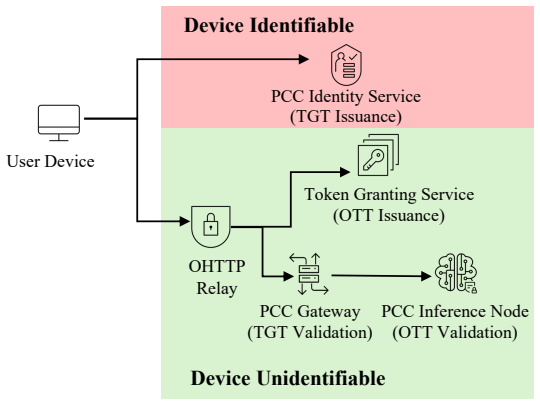
Apple Intelligence is a generative AI (GenAI) service provided by Apple on its devices. While offering a similar set of features as other similar GenAI services, Apple Intelligence is claimed to be designed with an extra focus on user security and privacy through a two-stage authentication and authorization design using anonymous access tokens. In this paper, we present our investigation into this token issuance mechanism with a goal to reveal possible vulnerabilities using traffic analysis, reverse engineering, and cross comparison with Apple's public documentation. Specifically, we present the Serpent attack, the first practical cross-device token replay attack against Apple Intelligence that allows the attacker to steal the access tokens from the victim's device and utilise them on a different device, with all usage rate-limited against the victim. We have achieved successful attacks on the latest macOS 26 Tahoe and demonstrated that an attacker, who even has used up its own allowance, can immediately regain access to Apple Intelligence service. We have responsibly disclosed the vulnerabilities to the vendors and received confirmation from Apple with CVE assigned and bounty given. Our results highlight a general lesson for built-in AI services: Anonymising identity does not by itself make the AI service secure; Enforcing non-transferability requires cryptographic binding to the rightful user.
Editorial analysis
A structured set of objections, weighed in public.
Referee Report
Summary. The manuscript investigates the two-stage anonymous access token mechanism used by Apple Intelligence. Through traffic analysis and reverse engineering, the authors identify and demonstrate the Serpent attack: a practical cross-device token replay that extracts tokens from a victim's device for use on an attacker's device. Usage remains rate-limited against the victim, allowing an attacker who has exhausted their own quota to regain access. The attack is shown to succeed on macOS 26 Tahoe; responsible disclosure produced Apple confirmation, CVE assignment, and a bounty payment. The paper concludes that anonymization alone does not guarantee security without cryptographic binding to the legitimate user.
Significance. If the empirical findings hold, the work is significant for exposing a concrete token-replay vulnerability in a production privacy-focused GenAI service from a major vendor. The external validation via Apple's CVE and bounty payment provides independent corroboration that strengthens the central claim. The result supplies a clear, falsifiable lesson for designers of built-in AI services: non-transferability requires explicit cryptographic binding rather than relying on anonymization. The reproducible demonstration on current hardware and the absence of free parameters or fitted models are notable strengths.
minor comments (2)
- [Abstract] Abstract: the reference to 'macOS 26 Tahoe' should specify whether this is a released version, beta, or internal codename, as this affects the reader's ability to reproduce the exact environment.
- [Methodology] The description of the traffic-analysis and reverse-engineering steps would benefit from an explicit list of tools and packet-capture configurations used to observe the two-stage token issuance, improving verifiability for other researchers.
Simulated Author's Rebuttal
We thank the referee for their positive review, accurate summary of the Serpent attack, and recommendation to accept the manuscript. The external validation via Apple's CVE assignment and bounty payment is correctly noted as strengthening the empirical claims.
Circularity Check
No significant circularity; empirical attack demonstration with external vendor confirmation
full rationale
The paper presents an empirical security analysis based on traffic analysis, reverse engineering of Apple Intelligence's token issuance, and successful cross-device replay attacks on macOS. It reports vendor confirmation via CVE assignment and bounty payout, which constitutes independent external validation rather than self-referential logic. No mathematical derivations, fitted parameters, equations, or load-bearing self-citations appear in the provided text. The central claim reduces to observed behavior and responsible disclosure, not to any input that is redefined or predicted by construction within the paper itself. This is a standard non-circular empirical security report.
Axiom & Free-Parameter Ledger
axioms (1)
- domain assumption Apple's anonymous access tokens are extractable via traffic analysis and lack device-specific cryptographic binding
Reference graph
Works this paper leans on
-
[1]
Apple. Creating distribution-signed code for macOS | Apple Developer Documentation.https: //developer.apple.com/documentation/xcode/creating-distribution-signed-code-f or-the-mac
-
[2]
Keychain Access Groups Entitlement | Apple Developer Documentation
Apple. Keychain Access Groups Entitlement | Apple Developer Documentation. https: //developer.apple.com/documentation/bundleresources/entitlements/keychain-acc ess-groups
-
[3]
XPC | Apple Developer Documentation.https://developer.apple.com/document ation/xpc
Apple. XPC | Apple Developer Documentation.https://developer.apple.com/document ation/xpc
-
[4]
Apple. iCloud Private Relay Overview.https://www.apple.com/privacy/docs/iCloud_Pr ivate_Relay_Overview_Dec2021.PDF, 2021
work page 2021
-
[5]
Apple Intelligence - Apple.https://www.apple.com/apple-intelligence/, 2024
Apple. Apple Intelligence - Apple.https://www.apple.com/apple-intelligence/, 2024
work page 2024
-
[6]
Apple. Secure Enclave - Apple Support.https://support.apple.com/guide/security/sec ure-enclave-sec59b0b31ff/web, 2024
work page 2024
-
[7]
Apple. Keychain Services. https://developer.apple.com/documentation/security/key chain-services, 2025
work page 2025
-
[8]
Balasupramanian, Ben George Ephrem, and Imad Salim Al-Barwani
N. Balasupramanian, Ben George Ephrem, and Imad Salim Al-Barwani. User pattern based online fraud detection and prevention using big data analytics and self organizing maps. In2017 International Conference on Intelligent Computing, Instrumentation and Control Technologies (ICICICT), pages 691–694, 2017.doi:10.1109/ICICICT1.2017.8342647
-
[9]
Adam Barth, Collin Jackson, and John C. Mitchell. Robust defenses for cross-site request forgery. InProceedings of the 15th ACM Conference on Computer and Communications Security, CCS ’08, page 75–88, New York, NY, USA, 2008. Association for Computing Machinery. doi:10.1145/1455770.1455782
-
[10]
Sok: Oblivious pseudorandom functions
Sílvia Casacuberta, Julia Hesse, and Anja Lehmann. Sok: Oblivious pseudorandom functions. In2022 IEEE 7th European Symposium on Security and Privacy (EuroS&P), pages 625–646, 2022.doi:10.1109/EuroSP53844.2022.00045
-
[11]
Sofia Celi, Alex Davidson, Steven Valdez, and Christopher A. Wood. RFC 9578: Privacy Pass Issuance Protocols.https://www.rfc-editor.org/rfc/rfc9578.html
-
[12]
Microsoft Outlook for Mac - Apple Community.https://discussions
Apple Community. Microsoft Outlook for Mac - Apple Community.https://discussions. apple.com/thread/252714597?sortBy=rank
-
[13]
What is my "login" keychain password? My
Apple Community. What is my "login" keychain password? My ... - Apple Community. https://discussions.apple.com/thread/254424961?sortBy=rank
-
[14]
Alexander Davidson. Privacy pass: Bypassing internet challenges anonymously.Proceedings on Privacy Enhancing Technologies, 2018(3):164–180, 2018.doi:10.1515/popets-2018-0026
-
[15]
Ask Different. Transparent network proxy for Apple system services wants to use the "login" keychain - Ask Different.https://apple.stackexchange.com/questions/457623/transpa rent-network-proxy-for-apple-system-services-wants-to-use-the-login-key. 19
-
[16]
IT Leaders Share Cost of API Incidents, Concerns Over AI Threats | Kong Inc
Kong Inc. IT Leaders Share Cost of API Incidents, Concerns Over AI Threats | Kong Inc. https://konghq.com/blog/enterprise/cost-of-api-security-incidents-2025
work page 2025
-
[17]
Formal verification of privacy pass
Kristiana Ivanova, Daniel Gardham, and Stephan Wesemeyer. Formal verification of privacy pass. Cryptology ePrint Archive, Paper 2025/2022, 2025. URL:https://eprint.iacr.org/ 2025/2022
work page 2025
-
[18]
Sandeep Kumar Jangam, Nagireddy Karri, and Partha Sarathi Reddy Pedda Muntala. Advanced api security techniques and service management.International Journal of Emerging Research in Engineering and Technology, 3(4):63–74, Dec. 2022. URL:https://ijeret.org/index.p hp/ijeret/article/view/261,doi:10.63282/3050-922X.IJERET-V3I4P108
-
[19]
Reliable protection against session fixation attacks
Martin Johns, Bastian Braun, Michael Schrank, and Joachim Posegga. Reliable protection against session fixation attacks. InProceedings of the 2011 ACM Symposium on Applied Computing, SAC ’11, page 1531–1537, New York, NY, USA, 2011. Association for Computing Machinery.doi:10.1145/1982185.1982511
-
[20]
Chris Karlof, Umesh Shankar, J. D. Tygar, and David Wagner. Dynamic pharming attacks and locked same-origin policies for web browsers. InProceedings of the 14th ACM Conference on Computer and Communications Security, CCS ’07, page 58–71, New York, NY, USA, 2007. Association for Computing Machinery.doi:10.1145/1315245.1315254
-
[21]
Hyunsoo Kwon, Hyunjae Nam, Sangtae Lee, Changhee Hahn, and Junbeom Hur. (in-)security of cookies in https: Cookie theft by removing cookie flags.IEEE Transactions on Information Forensics and Security, 15:1204–1215, 2020.doi:10.1109/TIFS.2019.2938416
-
[22]
Albert John Lastima. I just searched “OPENAI_API_KEY” on GitHub and found thousands of exposed credentials. https://www.linkedin.com/posts/albert-maquiling-784612138 _cybersecurity-openai-apikeys-activity-7345806283880480769-G_DL/
-
[23]
Optimizing Leak Detection in Open-source Platforms with Machine Learning Techniques
Sofiane Lounici, Marco Rosa, Carlo Maria Negri, Slim Trabelsi, and Melek Önen. Optimizing Leak Detection in Open-source Platforms with Machine Learning Techniques. InProceedings of the 7th International Conference on Information Systems Security and Privacy (ICISSP), pages 145–159. SCITEPRESS, 2021.doi:10.5220/0010238101450159
-
[24]
Android’s sensitive data leakage detection based on api monitoring
MengShanshan, Yang Xiaohui, Song Yubo, ZhuKelong, and Chen Fei. Android’s sensitive data leakage detection based on api monitoring. InInternational Conference on Cyberspace Technology (CCT 2014), pages 1–4, 2014.doi:10.1049/cp.2014.1340
-
[25]
xAI Dev Leaks API Key for Private SpaceX, Tesla LLMs - Krebs on Security
Krebs on Security. xAI Dev Leaks API Key for Private SpaceX, Tesla LLMs - Krebs on Security. https://krebsonsecurity.com/2025/05/xai-dev-leaks-api-key-for-private-space x-tesla-llms/
work page 2025
-
[26]
API Reference - OpenAI API.https://platform.openai.com/docs/api-referen ce/authentication
OpenAI. API Reference - OpenAI API.https://platform.openai.com/docs/api-referen ce/authentication
-
[27]
osy/AMFIExemption: Grant private entitlements to OSX aps.https://github.com/osy /AMFIExemption
osy. osy/AMFIExemption: Grant private entitlements to OSX aps.https://github.com/osy /AMFIExemption
-
[28]
Tommy Pauly, Steven Valdez, and Christopher A. Wood. RFC 9577: The Privacy Pass HTTP Authentication Scheme.https://www.rfc-editor.org/rfc/rfc9577.html. 20
-
[29]
Reddit. This keeps popping up how do i get rid of this: r/mac.https://www.reddit.com/r /mac/comments/zuqdzi/this_keeps_popping_up_how_do_i_get_rid_of_this/
-
[30]
Apple Security Research. Private Cloud Compute: A new frontier for AI privacy in the cloud - Apple Security Research.https://security.apple.com/blog/private-cloud-compute/, 2024
work page 2024
-
[31]
Apple Security Research. Private Cloud Compute Security Guide | Documentation.https: //security.apple.com/documentation/private-cloud-compute, 2024
work page 2024
-
[32]
Secrets in Source Code: Reducing False Positives Using Machine Learning
Aakanksha Saha, Tamara Denning, Vivek Srikumar, and Sneha Kumar Kasera. Secrets in Source Code: Reducing False Positives Using Machine Learning. InProceedings of the 2020 International Conference on COMmunication Systems & NETworkS (COMSNETS), pages 168–175. IEEE, 2020.doi:10.1109/COMSNETS48256.2020.9027350
-
[33]
Gps-based geolocation of consumer ip addresses
James Saxon and Nick Feamster. Gps-based geolocation of consumer ip addresses. In Oliver Hohlfeld, Giovane Moura, and Cristel Pelsser, editors,Passive and Active Measurement, pages 122–151, Cham, 2022. Springer International Publishing.doi:10.1007/978-3-030-98785-5_6
-
[34]
More guidelines than rules: Csrf vulnerabilities from noncompliant oauth 2.0 implementations
Ethan Shernan, Henry Carter, Dave Tian, Patrick Traynor, and Kevin Butler. More guidelines than rules: Csrf vulnerabilities from noncompliant oauth 2.0 implementations. InProceedings of the 12th International Conference on Detection of Intrusions and Malware, and Vulnerability Assessment - Volume 9148, DIMVA 2015, page 239–260, Berlin, Heidelberg, 2015. S...
-
[35]
Detecting and Mitigating Secret-Key Leaks in Source Code Repositories
Vibha Singhal Sinha, Diptikalyan Saha, Pankaj Dhoolia, Rohan Padhye, and Senthil Mani. Detecting and Mitigating Secret-Key Leaks in Source Code Repositories. InProceedings of the 12th Working Conference on Mining Software Repositories (MSR), pages 396–400. IEEE, 2015. doi:10.1109/MSR.2015.48
-
[36]
Vibha Singhal Sinha, Diptikalyan Saha, Pankaj Dhoolia, Rohan Padhye, and Senthil Mani. Detecting and mitigating secret-key leaks in source code repositories. In2015 IEEE/ACM 12th Working Conference on Mining Software Repositories, pages 396–400, 2015.doi:10.1109/MSR. 2015.48
work page doi:10.1109/msr 2015
-
[37]
Moritz Steffin and Jiska Classen. Modern iOS Security Features – A Deep Dive into SPTM, TXM, and Exclaves.https://arxiv.org/abs/2510.09272, 2025.arXiv:2510.09272
-
[38]
Martin Thomson and Christopher A. Wood. RFC 9458: Oblivious HTTP.https://www.rf c-editor.org/rfc/rfc9458.html
-
[39]
Rui Wang, Shuo Chen, and XiaoFeng Wang. Signing me onto your accounts through facebook and google: A traffic-guided security study of commercially deployed single-sign-on web services. In2012 IEEE Symposium on Security and Privacy, pages 365–379, 2012. doi: 10.1109/SP.2012.30
-
[40]
CVE Record: CVE-2017-7150.https://www.cve.org/CVERecord?id=CVE-2 017-7150
Patrick Wardle. CVE Record: CVE-2017-7150.https://www.cve.org/CVERecord?id=CVE-2 017-7150
work page 2017
-
[41]
How far are app secrets from being stolen? a case study on android.Empirical Softw
Lili Wei, Heqing Huang, Shing-Chi Cheung, and Kevin Li. How far are app secrets from being stolen? a case study on android.Empirical Softw. Engg., 30(3), April 2025. doi: 10.1007/s10664-024-10607-9. 21
-
[42]
SecretHunter: A Large-scale Secret Scanner for Public Git Repositories
Elliott Wen, Jia Wang, and Jens Dietrich. SecretHunter: A Large-scale Secret Scanner for Public Git Repositories. InProceedings of the 2022 IEEE International Conference on Trust, Security and Privacy in Computing and Communications (TrustCom), pages 123–130. IEEE, 2022.doi:10.1109/TrustCom56396.2022.00028
-
[43]
Cosmological Aspects of Higgs Vacuum Metastability ,
Haohuang Wen, Juanru Li, Yuanyuan Zhang, and Dawu Gu. An empirical study of sdk credential misuse in ios apps. In2018 25th Asia-Pacific Software Engineering Conference (APSEC), pages 258–267, 2018.doi:10.1109/APSEC.2018.00040
-
[44]
Yvonne Wilson and Abhishek Hingnikar.Logout, pages 219–231. Apress, Berkeley, CA, 2023. doi:10.1007/978-1-4842-8261-8_13
-
[45]
The Skeleton Keys: A Large Scale Analysis of Credential Leakage in Mini-apps
Jiale Zhang, Yue Zhang, Yuqing Yang, and Zhiqiang Lin. The Skeleton Keys: A Large Scale Analysis of Credential Leakage in Mini-apps. InProceedings of the Network and Distributed System Security Symposium (NDSS), San Diego, CA, 2025. The Internet Society
work page 2025
-
[46]
Don’t Leak Your Keys: Understanding, Measuring, and Exploiting the AppSecret Leaks in Mini-Programs
Yue Zhang, Yuqing Yang, and Zhiqiang Lin. Don’t Leak Your Keys: Understanding, Measuring, and Exploiting the AppSecret Leaks in Mini-Programs. InProceedings of the 2023 ACM SIGSAC Conference on Computer and Communications Security, CCS ’23, page 2411–2425, Copenhagen, Denmark, 2023. Association for Computing Machinery.doi:10.1145/3576915.3616591
-
[47]
In: Proceedings of the 2nd International Workshop on Software Health
Chaoshun Zuo, Zhiqiang Lin, and Yinqian Zhang. Why Does Your Data Leak? Uncovering the Data Leakage in Cloud from Mobile Apps. In2019 IEEE Symposium on Security and Privacy (SP), pages 1296–1310, San Francisco, CA, 2019.doi:10.1109/SP.2019.00009
-
[48]
Atomic Stealer: Dissecting 2024’s Most Notorious macOS Infostealer
Sıla Özeren Hacıoğlu. Atomic Stealer: Dissecting 2024’s Most Notorious macOS Infostealer. https://www.picussecurity.com/resource/blog/atomic-stealer-amos-macos-threa t-analysis. 22
work page 2024
discussion (0)
Sign in with ORCID, Apple, or X to comment. Anyone can read and Pith papers without signing in.