Concept-wise Attention for Fine-grained Concept Bottleneck Models
Pith reviewed 2026-05-10 08:31 UTC · model grok-4.3
The pith
Learnable concept-wise visual queries and contrastive optimization fix alignment issues in concept bottleneck models.
A machine-rendered reading of the paper's core claim, the machinery that carries it, and where it could break.
Core claim
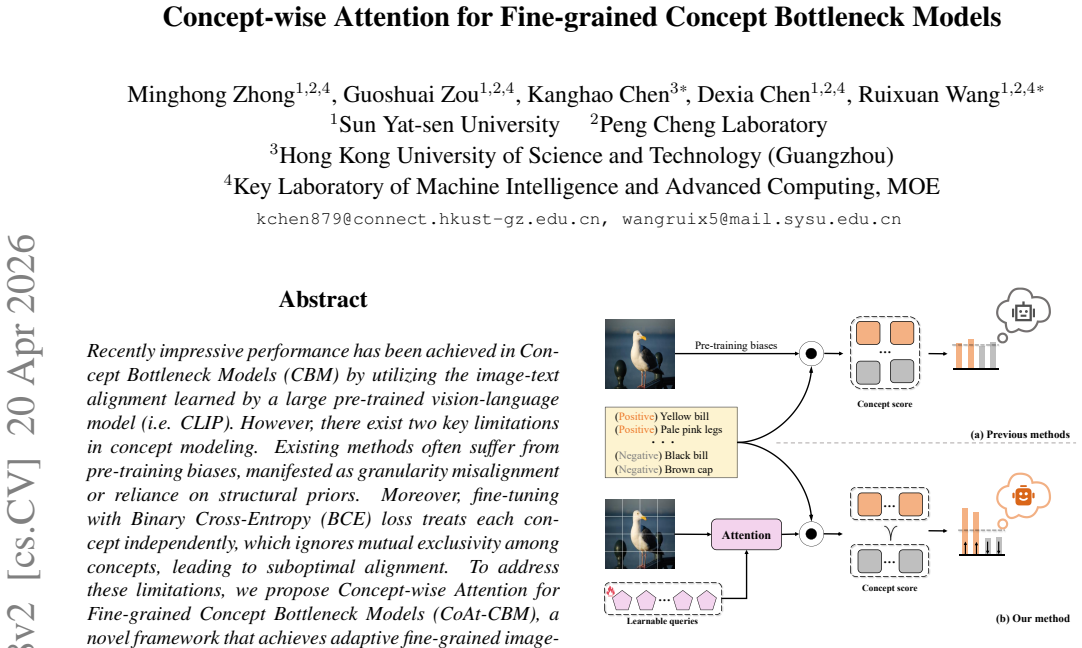
By employing learnable concept-wise visual queries, CoAt-CBM adaptively obtains fine-grained concept-wise visual embeddings to produce concept score vectors. A novel concept contrastive optimization then guides the model to handle the relative importance of these scores, enabling concept predictions to faithfully reflect the image content and achieve improved alignment with reduced effects from pre-training biases and mutual-exclusivity violations.
What carries the argument
Learnable concept-wise visual queries that generate adaptive fine-grained visual embeddings per concept, paired with a concept contrastive optimization objective that enforces relative scoring.
If this is right
- Concept scores become more faithful to image content rather than pre-training artifacts.
- Mutual exclusivity among concepts is better respected, reducing contradictory predictions.
- Overall model performance on downstream tasks improves due to better bottleneck alignment.
- The framework maintains high interpretability through direct concept-to-visual mapping.
Where Pith is reading between the lines
- If the contrastive objective proves central, it could be applied to other concept-based models facing similar independence assumptions.
- Such attention mechanisms might help in reducing the impact of dataset biases in other vision-language applications.
- Future work could explore combining this with dynamic concept selection for even greater flexibility.
Load-bearing premise
The addition of concept-wise queries and the contrastive objective will correct pre-training biases and mutual-exclusivity violations without introducing new alignment problems or requiring extensive hyperparameter tuning.
What would settle it
Observing that concept predictions on images with known mutual exclusive concepts still activate multiple conflicting ones at high scores, or that visual embeddings remain misaligned with concept granularity, would falsify the improvement claim.
Figures


read the original abstract
Recently impressive performance has been achieved in Concept Bottleneck Models (CBM) by utilizing the image-text alignment learned by a large pre-trained vision-language model (i.e. CLIP). However, there exist two key limitations in concept modeling. Existing methods often suffer from pre-training biases, manifested as granularity misalignment or reliance on structural priors. Moreover, fine-tuning with Binary Cross-Entropy (BCE) loss treats each concept independently, which ignores mutual exclusivity among concepts, leading to suboptimal alignment. To address these limitations, we propose Concept-wise Attention for Fine-grained Concept Bottleneck Models (CoAt-CBM), a novel framework that achieves adaptive fine-grained image-concept alignment and high interpretability. Specifically, CoAt-CBM employs learnable concept-wise visual queries to adaptively obtain fine-grained concept-wise visual embeddings, which are then used to produce a concept score vector. Then, a novel concept contrastive optimization guides the model to handle the relative importance of the concept scores, enabling concept predictions to faithfully reflect the image content and improved alignment. Extensive experiments demonstrate that CoAt-CBM consistently outperforms state-of-the-art methods. The codes will be available upon acceptance.
Editorial analysis
A structured set of objections, weighed in public.
Referee Report
Summary. The paper proposes CoAt-CBM, a Concept Bottleneck Model framework that employs learnable concept-wise visual queries to adaptively extract fine-grained concept-wise visual embeddings from CLIP-aligned features, followed by a novel concept contrastive optimization objective that accounts for relative importance among concept scores. This is intended to mitigate pre-training biases (granularity misalignment and structural priors) and the mutual-exclusivity violations induced by independent BCE training, yielding concept predictions that more faithfully reflect image content and improved overall alignment. The abstract states that extensive experiments demonstrate consistent outperformance over state-of-the-art methods.
Significance. If the experimental claims are substantiated with proper controls, the approach could meaningfully advance interpretable fine-grained vision-language modeling by providing an adaptive mechanism for concept alignment that does not rely solely on frozen CLIP embeddings or independent per-concept losses. The introduction of concept-wise queries and contrastive guidance addresses two recognized limitations in current CBM literature, but the absence of any quantitative results, ablation details, or bias-correction metrics in the abstract limits assessment of whether the gains are robust or merely incremental.
major comments (2)
- [Abstract] Abstract: the central claim of 'consistent outperformance' and 'faithful alignment' rests entirely on 'extensive experiments' whose results, baselines, ablations (e.g., queries vs. contrastive term), and bias-correction metrics are not supplied; without these the soundness of the contribution cannot be evaluated.
- [Method] Method description (as summarized): the learnable concept-wise visual queries and contrastive loss are additional trainable parameters whose outputs are not algebraically constrained to reproduce quantities already present in the cited CLIP or CBM baselines; it is therefore unclear whether they reliably correct pre-training biases or simply introduce new degrees of freedom that require extensive hyper-parameter tuning.
minor comments (1)
- [Abstract] Abstract: the phrase 'The codes will be available upon acceptance' is standard but should be accompanied by a concrete reproducibility statement (repository, license, seed values) to support the claimed experimental results.
Circularity Check
No significant circularity detected
full rationale
The paper introduces new trainable components (learnable concept-wise visual queries and a concept contrastive optimization) to address limitations in prior CBM and CLIP-based methods. These additions are described as adaptive mechanisms and a novel loss term that produce concept scores and handle relative importance, without any equations or derivations in the abstract or described framework that algebraically reduce the outputs to previously fitted quantities or self-citations by construction. The central claims rest on empirical outperformance via experiments rather than self-referential definitions or fitted inputs renamed as predictions. No load-bearing self-citation chains or uniqueness theorems imported from the authors' prior work are evident in the provided text.
Axiom & Free-Parameter Ledger
free parameters (1)
- concept-wise visual queries
axioms (1)
- domain assumption CLIP pre-training provides a useful starting point for image-concept alignment that can be corrected by additional attention layers
Reference graph
Works this paper leans on
-
[1]
Alejandro Barredo Arrieta, Natalia D ´ıaz-Rodr´ıguez, Javier Del Ser, Adrien Bennetot, Siham Tabik, Alberto Barbado, Salvador Garc´ıa, Sergio Gil-L´opez, Daniel Molina, Richard Benjamins, et al. Explainable artificial intelligence (xai): Concepts, taxonomies, opportunities and challenges toward responsible ai.Information fusion, pages 82–115, 2020. 1
work page 2020
-
[2]
Food-101 - mining discriminative components with random forests
Lukas Bossard, Matthieu Guillaumin, and Luc Van Gool. Food-101 - mining discriminative components with random forests. InECCV, 2014. 5
work page 2014
-
[3]
Jonathan Brogaard and Abalfazl Zareei. Machine learning and the stock market.Journal of Financial and Quantitative Analysis, pages 1431–1472, 2023. 2
work page 2023
-
[4]
Kirill Bykov, Laura Kopf, Shinichi Nakajima, Marius Kloft, and Marina M.-C. H ¨ohne. Labeling neural representations with inverse recognition. InNeurIPS, 2023. 2
work page 2023
-
[5]
Describing textures in the wild
Mircea Cimpoi, Subhransu Maji, Iasonas Kokkinos, Sammy Mohamed, and Andrea Vedaldi. Describing textures in the wild. InCVPR, 2014. 5
work page 2014
-
[6]
A survey of natural language generation.ACM Computing Surveys, pages 1–38,
Chenhe Dong, Yinghui Li, Haifan Gong, Miaoxin Chen, Junxin Li, Ying Shen, and Min Yang. A survey of natural language generation.ACM Computing Surveys, pages 1–38,
-
[7]
Riccardo Guidotti, Anna Monreale, Salvatore Ruggieri, Franco Turini, Fosca Giannotti, and Dino Pedreschi. A sur- vey of methods for explaining black box models.ACM Com- puting Surveys, pages 93:1–93:42, 2019. 1
work page 2019
-
[8]
A survey on vision transformer
Kai Han, Yunhe Wang, Hanting Chen, Xinghao Chen, Jianyuan Guo, Zhenhua Liu, Yehui Tang, An Xiao, Chun- jing Xu, Yixing Xu, et al. A survey on vision transformer. TPAMI, pages 87–110, 2022. 1
work page 2022
-
[9]
Hu, Yelong Shen, Phillip Wallis, Zeyuan Allen- Zhu, Yuanzhi Li, Shean Wang, Lu Wang, and Weizhu Chen
Edward J. Hu, Yelong Shen, Phillip Wallis, Zeyuan Allen- Zhu, Yuanzhi Li, Shean Wang, Lu Wang, and Weizhu Chen. Lora: Low-rank adaptation of large language models. In ICLR, 2022. 5
work page 2022
-
[10]
Transformers in vision: A survey.ACM Computing Surveys, pages 1–41, 2022
Salman Khan, Muzammal Naseer, Munawar Hayat, Syed Waqas Zamir, Fahad Shahbaz Khan, and Mubarak Shah. Transformers in vision: A survey.ACM Computing Surveys, pages 1–41, 2022. 1
work page 2022
-
[11]
Been Kim, Martin Wattenberg, Justin Gilmer, Carrie Cai, James Wexler, Fernanda Viegas, et al. Interpretability be- yond feature attribution: Quantitative testing with concept activation vectors (tcav). InICML, 2018. 2
work page 2018
-
[12]
Injae Kim, Jongha Kim, Joonmyung Choi, and Hyunwoo J. Kim. Concept bottleneck with visual concept filtering for explainable medical image classification. InMICCAI, 2023
work page 2023
-
[13]
Pang Wei Koh, Thao Nguyen, Yew Siang Tang, Stephen Mussmann, Emma Pierson, Been Kim, and Percy Liang. Concept bottleneck models. InICML, 2020. 1, 2
work page 2020
-
[14]
Learning multiple layers of features from tiny images
Alex Krizhevsky, Geoffrey Hinton, et al. Learning multiple layers of features from tiny images. 2009. 5
work page 2009
-
[15]
Yann LeCun, Yoshua Bengio, and Geoffrey E. Hinton. Deep learning.Nature, pages 436–444, 2015. 1
work page 2015
-
[16]
Paulo JG Lisboa, Sascha Saralajew, Alfredo Vellido, Ricardo Fern´andez-Domenech, and Thomas Villmann. The com- ing of age of interpretable and explainable machine learning models.Neurocomputing, pages 25–39, 2023. 1
work page 2023
-
[17]
Hybrid concept bot- tleneck models
Yang Liu, Tianwei Zhang, and Shi Gu. Hybrid concept bot- tleneck models. InCVPR, 2025. 1, 2, 3, 4, 5, 6
work page 2025
-
[18]
Decoupled weight decay regularization
Ilya Loshchilov and Frank Hutter. Decoupled weight decay regularization. InICLR, 2019. 5
work page 2019
-
[19]
Subhransu Maji, Esa Rahtu, Juho Kannala, Matthew B. Blaschko, and Andrea Vedaldi. Fine-grained visual classi- fication of aircraft.CoRR, 2013. 5
work page 2013
-
[20]
Automated flower classification over a large number of classes
Maria-Elena Nilsback and Andrew Zisserman. Automated flower classification over a large number of classes. In ICVGIP, 2008. 5
work page 2008
-
[21]
Tuomas P. Oikarinen, Subhro Das, Lam M. Nguyen, and Tsui-Wei Weng. Label-free concept bottleneck models. In ICLR, 2023. 1, 2, 3, 5, 6
work page 2023
-
[22]
Daniel W Otter, Julian R Medina, and Jugal K Kalita. A sur- vey of the usages of deep learning for natural language pro- cessing.IEEE Transactions on Neural Networks and Learn- ing Systems, pages 604–624, 2020. 1
work page 2020
-
[23]
Rohit Prabhavalkar, Takaaki Hori, Tara N Sainath, Ralf Schl¨uter, and Shinji Watanabe. End-to-end speech recogni- tion: A survey.IEEE/ACM Transactions on Audio, Speech, and Language Processing, pages 325–351, 2023. 1
work page 2023
-
[24]
Learn- ing transferable visual models from natural language super- vision
Alec Radford, Jong Wook Kim, Chris Hallacy, Aditya Ramesh, Gabriel Goh, Sandhini Agarwal, Girish Sastry, Amanda Askell, Pamela Mishkin, Jack Clark, et al. Learn- ing transferable visual models from natural language super- vision. InICML, 2021. 1
work page 2021
-
[25]
Robust speech recognition via large-scale weak supervision
Alec Radford, Jong Wook Kim, Tao Xu, Greg Brockman, Christine McLeavey, and Ilya Sutskever. Robust speech recognition via large-scale weak supervision. InICML,
-
[26]
”why should I trust you?”: Explaining the predictions of any classifier
Marco T ´ulio Ribeiro, Sameer Singh, and Carlos Guestrin. ”why should I trust you?”: Explaining the predictions of any classifier. InSIGKDD, 2016. 1
work page 2016
-
[27]
Cynthia Rudin. Stop explaining black box machine learning models for high stakes decisions and use interpretable mod- els instead.Nature Machine Intelligence, pages 206–215,
-
[28]
Cynthia Rudin. Stop explaining black box machine learn- ing models for high stakes decisions and use interpretable models instead.Nature machine intelligence, pages 206– 215, 2019. 1
work page 2019
-
[29]
Incremental residual con- cept bottleneck models
Chenming Shang, Shiji Zhou, Hengyuan Zhang, Xinzhe Ni, Yujiu Yang, and Yuwang Wang. Incremental residual con- cept bottleneck models. InCVPR, 2024. 1, 2, 3, 4, 5, 6
work page 2024
-
[30]
Kacper Sokol and Peter A. Flach. Interpretable representa- tions in explainable AI: from theory to practice.Data Min. Knowl. Discov., pages 3102–3140, 2024. 2
work page 2024
-
[31]
UCF101: A dataset of 101 human actions classes from videos in the wild.CoRR, 2012
Khurram Soomro, Amir Roshan Zamir, and Mubarak Shah. UCF101: A dataset of 101 human actions classes from videos in the wild.CoRR, 2012. 5
work page 2012
-
[32]
Concept- net 5.5: An open multilingual graph of general knowledge
Robyn Speer, Joshua Chin, and Catherine Havasi. Concept- net 5.5: An open multilingual graph of general knowledge. InAAAI, 2017. 2
work page 2017
-
[33]
Value of artificial intelligence in neuro- oncology.The Lancet Digital Health, 2025
Sebastian V oigtlaender, Thomas A Nelson, Philipp Karsch- nia, Eugene J Vaios, Michelle M Kim, Philipp Lohmann, Norbert Galldiks, Mariella G Filbin, Shekoofeh Azizi, Vivek Natarajan, et al. Value of artificial intelligence in neuro- oncology.The Lancet Digital Health, 2025. 2
work page 2025
-
[34]
The caltech-ucsd birds-200-2011 dataset
Catherine Wah, Steve Branson, Peter Welinder, Pietro Per- ona, and Serge Belongie. The caltech-ucsd birds-200-2011 dataset. 2011. 5
work page 2011
-
[35]
Yan Xie, Zequn Zeng, Hao Zhang, Yucheng Ding, Yi Wang, Zhengjue Wang, Bo Chen, and Hongwei Liu. Discovering fine-grained visual-concept relations by disentangled opti- mal transport concept bottleneck models. InCVPR, 2025. 2, 5, 6
work page 2025
-
[36]
Yang Yang, Zhiying Cui, Junjie Xu, Changhong Zhong, Wei- Shi Zheng, and Ruixuan Wang. Continual learning with bayesian model based on a fixed pre-trained feature extrac- tor.Visual Intelligence, page 5, 2023. 5
work page 2023
-
[37]
Yue Yang, Artemis Panagopoulou, Shenghao Zhou, Daniel Jin, Chris Callison-Burch, and Mark Yatskar. Language in a bottle: Language model guided concept bottlenecks for in- terpretable image classification. InCVPR, 2023. 2, 3, 5, 6
work page 2023
-
[38]
Post-hoc concept bottleneck models
Mert Y ¨uksekg¨on¨ul, Maggie Wang, and James Zou. Post-hoc concept bottleneck models. InICLR, 2023. 2, 5, 6
work page 2023
-
[39]
Quan-shi Zhang and Song-Chun Zhu. Visual interpretability for deep learning: a survey.Frontiers of Information Tech- nology & Electronic Engineering, pages 27–39, 2018. 1
work page 2018
-
[40]
Yu Zhang, Peter Ti ˇno, Aleˇs Leonardis, and Ke Tang. A sur- vey on neural network interpretability.IEEE transactions on emerging topics in computational intelligence, pages 726– 742, 2021. 1
work page 2021
discussion (0)
Sign in with ORCID, Apple, or X to comment. Anyone can read and Pith papers without signing in.