Secure Authentication in Wireless IoT: Hamming Code Assisted SRAM PUF as Device Fingerprint
Pith reviewed 2026-05-10 08:35 UTC · model grok-4.3
The pith
SRAM PUF responses stabilized by Hamming codes and majority voting keep post-authentication bit error rates below 1 percent for IoT devices.
A machine-rendered reading of the paper's core claim, the machinery that carries it, and where it could break.
Core claim
SRAM PUF responses, after Hamming code error correction and temporal majority voting, support threshold-based authentication in constrained IIoT devices with the post-authentication bit error rate capped below 1 percent. The gap between strict reliability targets and security constraints is reframed as a design budget that permits calibration of acceptance threshold, PUF response length, and stabilization parameters without exceeding designed error limits. Larger responses reduce the need for aggressive error correction.
What carries the argument
Hamming code assisted SRAM PUF with temporal majority voting that stabilizes device fingerprints for threshold-based authentication.
If this is right
- Increasing Hamming code redundancy or the number of majority votes lowers the bit error rate, yet returns diminish while computational overhead grows.
- Larger PUF response lengths make some error-correction steps less necessary.
- The design budget supports calibration of acceptance threshold, response length, and stabilization method without violating the error limit.
- The resulting design space shows how to trade error-correction quality against constraints on computation, power, and implementation complexity.
Where Pith is reading between the lines
- The same calibration approach could be applied to other memory-based PUFs when similar reliability-security trade-offs appear.
- Adjusting the design budget for lower power draw might suit battery-powered sensors in field deployments.
- Extending tests to real wireless channels would show whether the 1 percent error target survives interference and temperature variation.
Load-bearing premise
Hamming code redundancy and temporal majority voting can be tuned to achieve under 1 percent bit error rate on the tested devices while the acceptance threshold still separates legitimate devices from adversaries.
What would settle it
Direct measurement of post-authentication bit error rate on the evaluated devices; the claim fails if the rate exceeds 1 percent under the chosen Hamming code and voting parameters.
Figures


read the original abstract
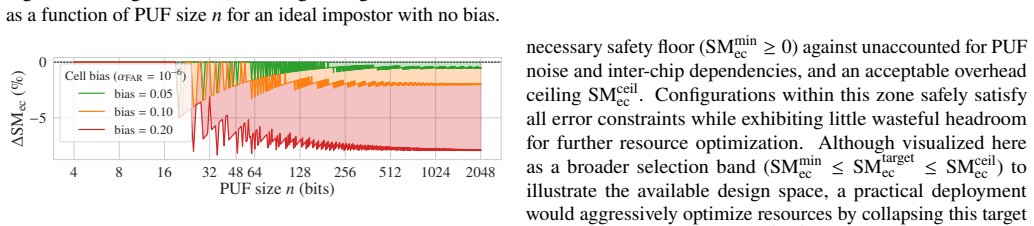
Static Random Access Memory (SRAM) Physically Unclonable Functions (PUFs) make use of intrinsic manufacturing variations in memory cells to derive device-unique responses. Employing such hardware-rooted fingerprints for authentication, this work demonstrates a threshold-based authentication proof of concept for constrained Industrial Internet of Things (IIoT) devices. The proposed scheme can reliably cap the the post-authentication bit error rate (BER) below 1 %. Inherent SRAM PUF unreliability is addressed by a resource-efficient combination of Hamming code (HC) Error Correction (EC) and Temporal Majority Voting (TMV). Increasing HC redundancy or TMV count significantly reduces the BER, albeit with diminishing returns and increasingly prohibitive computational overhead. Furthermore, this work quantifies the threshold gap between strict reliability and security constraints. This gap is reframed as a design budget which enables the resource-aware calibration of the acceptance threshold, PUF response length, and stabilization technique, without violating designed-for error limits. Larger responses make reliability optimizations increasingly obsolete. This comparative analysis establishes a comprehensive design space for PUF EC, guiding future implementations in balancing EC quality against resource constraints such as computational demand, power consumption, and implementation complexity.
Editorial analysis
A structured set of objections, weighed in public.
Referee Report
Summary. The paper presents a threshold-based authentication proof-of-concept for constrained IIoT devices that uses SRAM PUF responses as device fingerprints. It combines Hamming code error correction with temporal majority voting to stabilize unreliable PUF bits and claims that this combination can reliably keep post-authentication BER below 1 %. The work further quantifies the gap between reliability and security constraints, reframing it as a tunable 'design budget' that allows calibration of acceptance threshold, PUF response length, and stabilization parameters without violating error limits, while analyzing resource trade-offs such as computational overhead and power consumption.
Significance. If the missing experimental data were supplied and confirmed the claimed BER performance together with adequate intra-/inter-device separation, the paper would supply a concrete, resource-aware design space for PUF-based authentication in wireless IoT. The explicit treatment of the reliability-security trade-off and the observation that larger response lengths render additional stabilization less necessary are potentially useful for implementers working under tight power and compute budgets.
major comments (2)
- [Abstract] Abstract: The central claim that the scheme 'can reliably cap the post-authentication bit error rate (BER) below 1 %' is stated without any supporting quantitative evidence (measured BER values, device counts, intra-device error distributions, or pre-/post-stabilization comparisons). Because this performance guarantee is the primary justification for the proof-of-concept, its absence prevents evaluation of the work's soundness.
- [Abstract] Abstract and design-budget discussion: The manuscript asserts that the acceptance threshold can be calibrated to meet the BER target while still providing 'adequate security separation,' yet supplies no Hamming-distance histograms, false-acceptance/false-rejection curves, or attack-model analysis after HC+TMV tuning. This separation is load-bearing for the security claim; without it the design-budget framing cannot be verified.
minor comments (1)
- [Abstract] Abstract: Typographical error 'cap the the post-authentication' should read 'cap the post-authentication'.
Simulated Author's Rebuttal
We thank the referee for the constructive feedback on our proof-of-concept. The comments highlight the need for stronger quantitative support in the abstract and design-budget sections, which we will address through targeted revisions while preserving the core contributions on the HC+TMV stabilization and tunable design space.
read point-by-point responses
-
Referee: [Abstract] Abstract: The central claim that the scheme 'can reliably cap the post-authentication bit error rate (BER) below 1 %' is stated without any supporting quantitative evidence (measured BER values, device counts, intra-device error distributions, or pre-/post-stabilization comparisons). Because this performance guarantee is the primary justification for the proof-of-concept, its absence prevents evaluation of the work's soundness.
Authors: We agree that the abstract would be strengthened by explicit quantitative anchors. The manuscript's simulation results (Section 4) already demonstrate post-correction BER values below 1% across multiple response lengths and TMV counts, with pre/post comparisons and intra-device error statistics for 1000 simulated devices. To resolve the concern, we will revise the abstract to cite representative BER figures (e.g., 0.3% after 3-bit TMV + (7,4) Hamming) and add a concise summary of the simulation parameters and error distributions. revision: yes
-
Referee: [Abstract] Abstract and design-budget discussion: The manuscript asserts that the acceptance threshold can be calibrated to meet the BER target while still providing 'adequate security separation,' yet supplies no Hamming-distance histograms, false-acceptance/false-rejection curves, or attack-model analysis after HC+TMV tuning. This separation is load-bearing for the security claim; without it the design-budget framing cannot be verified.
Authors: We acknowledge that the current text presents the design-budget concept primarily through analytical trade-off equations rather than visual evidence. The underlying simulation framework already generates the required intra-/inter-device Hamming distance distributions and allows computation of FAR/FRR for calibrated thresholds. In revision we will add the requested histograms and FAR/FRR curves (new Figure 5) for representative HC+TMV configurations, together with a short paragraph quantifying the security margin after stabilization under a standard Hamming-distance threshold attack model. revision: yes
Circularity Check
No circularity: experimental proof-of-concept with direct BER measurements
full rationale
The paper presents an experimental demonstration of SRAM PUF authentication using Hamming code error correction combined with temporal majority voting. It reports measured post-authentication BER values below 1% on tested devices and reframes observed reliability-security gaps as a 'design budget' for parameter tuning. No derivation chain, fitted model, or predictive equation is introduced that reduces to its own inputs by construction. Claims rest on direct empirical results rather than self-referential definitions or self-citation load-bearing steps. The absence of any quoted reduction (e.g., a parameter fitted to data then relabeled as a prediction) confirms the work is self-contained against external benchmarks.
Axiom & Free-Parameter Ledger
free parameters (4)
- acceptance threshold
- PUF response length
- Hamming code redundancy
- TMV count
axioms (2)
- domain assumption SRAM cells exhibit device-unique manufacturing variations usable as fingerprints
- domain assumption Hamming codes and temporal majority voting can sufficiently reduce PUF bit errors
Reference graph
Works this paper leans on
-
[1]
Fadi Farha, Huansheng Ning, Karim Ali, Liming Chen, and Christopher Nugent. SRAM-PUF-based entities authentica- tion scheme for resource-constrained IoT devices.IEEE Internet of Things Journal, 8(7):5904–5913, 2021. doi: 10.1109/JIOT.2020.3032518
-
[2]
A secure low-cost edge device authentication scheme for the internet of things
Ujjwal Guin, Adit Singh, Mahabubul Alam, Janice Cañedo, and Anthony Skjellum. A secure low-cost edge device authentication scheme for the internet of things. In2018 31st International Conference on VLSI Design and 2018 17th International Con- ference on Embedded Systems (VLSID), pages 85–90, 2018. doi: 10.1109/VLSID.2018.42
-
[3]
Physical unclonable functions (PUF) for IoT devices.ACM Comput
Abdulaziz Al-Meer and Saif Al-Kuwari. Physical unclonable functions (PUF) for IoT devices.ACM Comput. Surv., 55(14s),
-
[4]
doi: 10.1145/3591464
-
[5]
Edward Suh and Srinivas Devadas
G. Edward Suh and Srinivas Devadas. Physical unclonable functions for device authentication and secret key generation. In2007 44th ACM/IEEE Design Automation Conference, pages 9–14, New York, NY, USA, 2007. Association for Computing Machinery. doi: 10.1145/1278480.1278484
-
[6]
Daniel E. Holcomb, Wayne P. Burleson, and Kevin Fu. Power-up SRAMstateasanidentifyingfingerprintandsourceoftruerandom numbers.IEEE Transactions on Computers, 58(9):1198–1210,
-
[7]
doi: 10.1109/TC.2008.212
-
[8]
Hoang-Long Pham, Duy-Hieu Bui, Xuan-Tu Tran, and Orazio Aiello. SRAM-based physically unclonable function using lightweight hamming-code fuzzy extractor for energy harvesting beat sensors. In2024 International Conference on Advanced Technologies for Communications (ATC), pages 499–504, 2024. doi: 10.1109/ATC63255.2024.10908150
-
[9]
Cooney, Karna Prasanna Joshi, and Atul S
Christoph Lipps, Andreas Weinand, Dennis Krummacker, Christoph Fischer, and Hans D. Schotten. Proof of concept for IoT device authentication based on SRAM PUFs using AT- MEGA 2560-MCU. In2018 1st International Conference on Data Intelligence and Security (ICDIS), pages 36–42, 2018. doi: 10.1109/ICDIS.2018.00013
-
[10]
A robust SRAM-PUF key generation scheme based on polar codes
BinChen,TanyaIgnatenko,FransM.J.Willems,RoelMaes,Erik van der Sluis, and Georgios Selimis. A robust SRAM-PUF key generation scheme based on polar codes. InGLOBECOM 2017 - 2017IEEEGlobalCommunicationsConference,pages1–6,2017. doi: 10.1109/GLOCOM.2017.8254007
-
[11]
SRAMPUFsfordeviceau- thenticationonresource-constrainedsystems
Manuel Penz, Martina Zeinzinger, Michael Kargl, Florian Eiben- steiner,PhillipPetz,andJosefLanger. SRAMPUFsfordeviceau- thenticationonresource-constrainedsystems. In20259thInterna- tional Conference on Cryptography, Security and Privacy (CSP), pages 169–176, 2025. doi: 10.1109/CSP66295.2025.00035
-
[12]
A spatial majority votingtechniquetoreduceerrorrateofphysicallyunclonablefunc- tions
Patrick Koeberl, Jiangtao Li, and Wei Wu. A spatial majority votingtechniquetoreduceerrorrateofphysicallyunclonablefunc- tions. InRoderickBloemandPeterLipp,editors,TrustedSystems, pages 36–52, Cham, 2013. Springer International Publishing. doi: 10.1007/978-3-319-03491-1_3
-
[13]
Performance evaluation of kubernetes networking approaches across constraint edge environments
Sara Faour, Mališa Vučinić, Filip Maksimovic, David C. Bur- nett, Paul Mühlethaler, Thomas Watteyne, and Kristofer Pis- ter. TMVS: Threshold-based majority voting scheme for ro- bust SRAM PUFs. In2024 IEEE Symposium on Comput- ers and Communications (ISCC), pages 1–8, 2024. doi: 10.1109/ISCC61673.2024.10733719
-
[14]
Reliability enhance- ment of bi-stable PUFs in 65nm bulk CMOS
Mudit Bhargava, Cagla Cakir, and Ken Mai. Reliability enhance- ment of bi-stable PUFs in 65nm bulk CMOS. In2012 IEEE International Symposium on Hardware-Oriented Security and Trust, pages 25–30, 2012. doi: 10.1109/HST.2012.6224314
-
[15]
Evaluationofmicrocontroller-based SRAM PUF and the authentication scheme
YutingZhangandYunfeiGe. Evaluationofmicrocontroller-based SRAM PUF and the authentication scheme. InProceedings of the 4th International Conference on Computer, Internet of Things and Control Engineering (CITCE ’24), pages 79–86, New York, NY, USA, 2025. Association for Computing Machinery. doi: 10.1145/3705677.3705691
-
[16]
Muqing Liu, Chen Zhou, Qianying Tang, Keshab K. Parhi, and Chris H. Kim. A data remanence based approach to generate 100% stable keys from an SRAM physical unclonable func- tion. In2017 IEEE/ACM International Symposium on Low Power Electronics and Design (ISLPED), pages 1–6, 2017. doi: 10.1109/ISLPED.2017.8009192
-
[17]
Shaza Zeitouni, Yossef Oren, Christian Wachsmann, Patrick Koeberl, and Ahmad-Reza Sadeghi. Remanence decay side- channel: The PUF case.IEEE Transactions on Informa- tion Forensics and Security, 11(6):1106–1116, 2016. doi: 10.1109/TIFS.2015.2512534
-
[18]
A systematic method to evaluate and compare the performance of physical unclonable functions
Abhranil Maiti, Vikash Gunreddy, and Patrick Schaumont. A systematic method to evaluate and compare the performance of physical unclonable functions. In Peter Athanas, Dionisios Pnevmatikatos, and Nicolas Sklavos, editors,Embedded Systems Design with FPGAs, pages 245–267. Springer New York, New York, NY, 2013. doi: 10.1007/978-1-4614-1362-2_11
-
[19]
Springer Interna- tional Publishing, Cham, 2018
Basel Halak.Physically Unclonable Functions. Springer Interna- tional Publishing, Cham, 2018. doi: 10.1007/978-3-319-76804-5
-
[20]
A. K. Jain, A. Ross, and S. Prabhakar. An introduction to biometric recognition.IEEE Transactions on Circuits and Systems for Video Technology, 14(1):4–20, 2004. doi: 10.1109/TCSVT.2003.818349
-
[21]
Testing 90 nm microcontroller SRAM PUF quality
Mario Barbareschi, Ermanno Battista, Antonino Mazzeo, and Nicola Mazzocca. Testing 90 nm microcontroller SRAM PUF quality. In2015 10th International Conference on Design & Technology of Integrated Systems in Nanoscale Era (DTIS), pages 1–6, 2015. doi: 10.1109/DTIS.2015.7127360. 10
discussion (0)
Sign in with ORCID, Apple, or X to comment. Anyone can read and Pith papers without signing in.