Recognition: unknown
Disentangling Mathematical Reasoning in LLMs: A Methodological Investigation of Internal Mechanisms
Pith reviewed 2026-05-10 08:52 UTC · model grok-4.3
The pith
Proficient LLMs detect arithmetic tasks early but output correct answers only in final layers, with attention and MLP modules dividing labor in a way absent from less proficient models.
A machine-rendered reading of the paper's core claim, the machinery that carries it, and where it could break.
Core claim
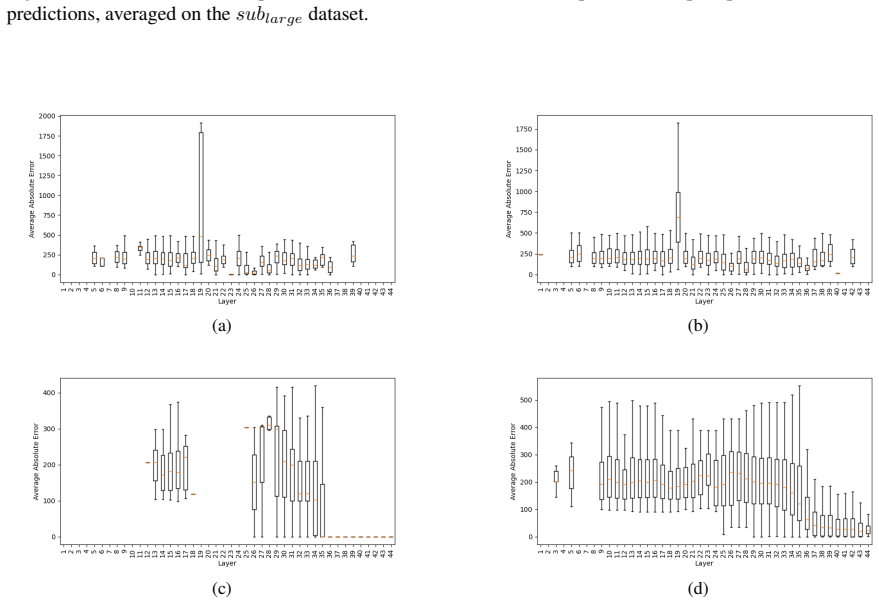
Notably, models proficient in arithmetic exhibit a clear division of labor between attention and MLP modules, where attention propagates input information and MLP modules aggregate it. This division is absent in less proficient models. Furthermore, successful models appear to process more challenging arithmetic tasks functionally, suggesting reasoning capabilities beyond factual recall.
Load-bearing premise
That early decoding faithfully reveals the model's unaltered internal computation flow and that the observed attention-MLP split is a causal mechanism for proficiency rather than a correlated byproduct of model scale or training data.
Figures




read the original abstract
Large language models (LLMs) have demonstrated impressive capabilities, yet their internal mechanisms for handling reasoning-intensive tasks remain underexplored. To advance the understanding of model-internal processing mechanisms, we present an investigation of how LLMs perform arithmetic operations by examining internal mechanisms during task execution. Using early decoding, we trace how next-token predictions are constructed across layers. Our experiments reveal that while the models recognize arithmetic tasks early, correct result generation occurs only in the final layers. Notably, models proficient in arithmetic exhibit a clear division of labor between attention and MLP modules, where attention propagates input information and MLP modules aggregate it. This division is absent in less proficient models. Furthermore, successful models appear to process more challenging arithmetic tasks functionally, suggesting reasoning capabilities beyond factual recall.
Editorial analysis
A structured set of objections, weighed in public.
Axiom & Free-Parameter Ledger
Reference graph
Works this paper leans on
-
[1]
Evaluating LLMs’ Mathematical and Coding Competency Through Ontology-Guided Interventions,
Stuck in the quicksand of numeracy, far from agi summit: Evaluating llms’ mathematical compe- tency through ontology-guided perturbations.arXiv preprint arXiv:2401.09395. Mohammad Javad Hosseini, Hannaneh Hajishirzi, Oren Etzioni, and Nate Kushman. 2014. Learning to solve arithmetic word problems with verb categorization. InProceedings of the 2014 Confere...
-
[2]
Language mod- els implement simple word2vec-style vector arithmetic
Language Models Implement Simple Word2Vec-style Vector Arithmetic.arXiv preprint. ArXiv:2305.16130 [cs]. Shen-Yun Miao, Chao-Chun Liang, and Keh-Yih Su
-
[3]
A diverse corpus for evaluating and developing english math word problem solvers. InProceedings of the 58th Annual Meeting of the Association for Computational Linguistics, pages 975–984. Swaroop Mishra, Arindam Mitra, Neeraj Varshney, Bhavdeep Sachdeva, Peter Clark, Chitta Baral, and Ashwin Kalyan. 2022. NumGLUE: A Suite of Fun- damental yet Challenging ...
-
[4]
Alec Radford, Jeffrey Wu, Rewon Child, David Luan, Dario Amodei, Ilya Sutskever, et al
Are nlp models really able to solve simple math word problems? InProceedings of the 2021 Conference of the North American Chapter of the Association for Computational Linguistics: Human Language Technologies, pages 2080–2094. Alec Radford, Jeffrey Wu, Rewon Child, David Luan, Dario Amodei, Ilya Sutskever, et al. 2019. Language models are unsupervised mult...
2021
-
[5]
CEUR-WS. Alessandro Stolfo, Yonatan Belinkov, and Mrinmaya Sachan. 2023a. A Mechanistic Interpretation of Arithmetic Reasoning in Language Models us- ing Causal Mediation Analysis.arXiv preprint. ArXiv:2305.15054 [cs]. Alessandro Stolfo, Zhijing Jin, Kumar Shridhar, Bern- hard Schölkopf, and Mrinmaya Sachan. 2023b. A Causal Framework to Quantify the Robus...
discussion (0)
Sign in with ORCID, Apple, or X to comment. Anyone can read and Pith papers without signing in.