Geminal wavefunction models in chemistry
Pith reviewed 2026-05-10 07:18 UTC · model grok-4.3
The pith
Geminal wavefunctions capture strong electron correlation compactly and are regaining attention through hybrid methods and quantum algorithm applications.
A machine-rendered reading of the paper's core claim, the machinery that carries it, and where it could break.
Core claim
Geminal wavefunctions, introduced in the late 1950s, compactly capture strong electron correlation yet were historically overshadowed by more efficient methods. Advances in computational resources and theoretical frameworks have renewed interest, with recent developments showing versatility as efficient starting points for correlated wavefunctions, in hybrid formulations blending geminal concepts with coupled-cluster theory, and in quantum algorithms where orbital-pairing provides a natural structure.
What carries the argument
Geminal wavefunctions, which are antisymmetrized products of two-electron geminal functions that directly encode electron pairing to describe strong correlation.
If this is right
- Geminal functions can reduce the effort needed to reach accurate correlated wavefunctions by providing strong initial guesses.
- Hybrid geminal-coupled-cluster models combine compact correlation capture with systematic improvements for better accuracy in molecules.
- Orbital-pairing in geminals aligns directly with qubit mappings, supporting more efficient quantum algorithms for electronic structure.
- These approaches offer tractable options for complex systems where traditional methods scale poorly.
Where Pith is reading between the lines
- The pairing structure might extend usefully to approximate methods in periodic systems or materials beyond isolated molecules.
- If geminals integrate well with machine learning wavefunction ansatze, they could accelerate hybrid quantum-classical workflows.
- Similar revival patterns may appear in other pair-based approximations that were once set aside for computational reasons.
- Scalability tests on larger transition-metal complexes would clarify practical limits of the hybrid formulations.
Load-bearing premise
The cited recent advances represent the main current directions and the story of being overshadowed then revived is both accurate and complete.
What would settle it
A citation or publication count showing no measurable increase in geminal-based papers or applications over the past decade relative to other correlation methods would challenge the claimed resurgence.
Figures
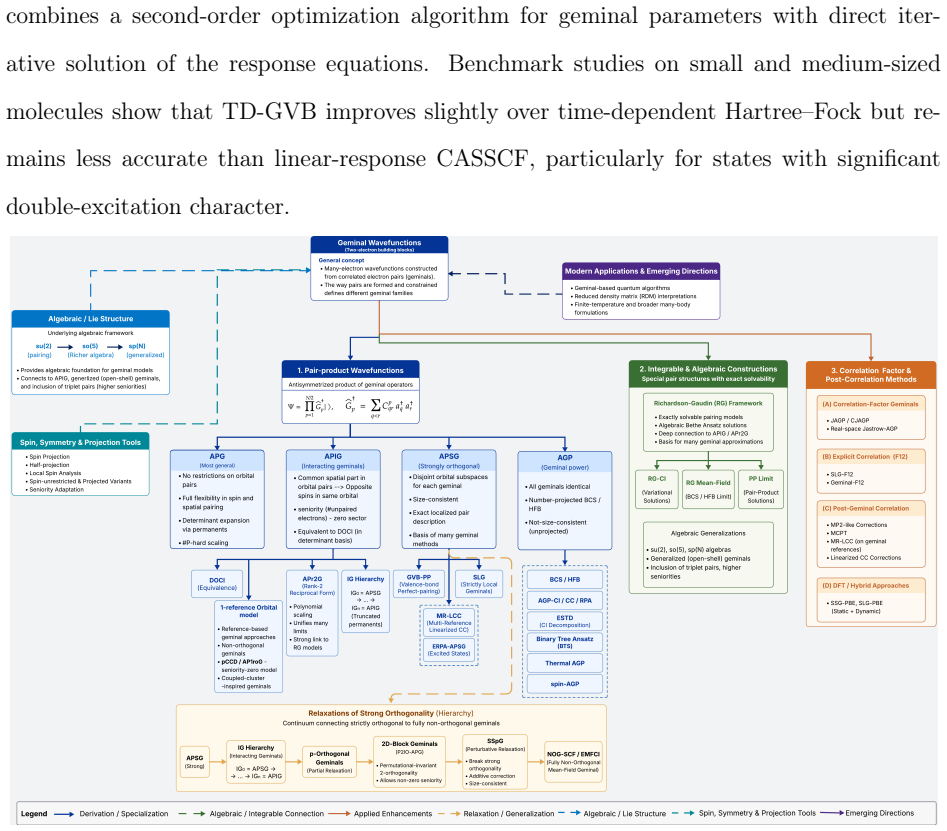
read the original abstract
Geminal wavefunctions, introduced in the late 1950s, have long been recognized for their ability to compactly capture strong electron correlation. Despite their promise, they were historically overshadowed by more computationally efficient methods. Advances in both computational resources and theoretical frameworks have renewed interest in geminal-based approaches, particularly as researchers seek accurate yet tractable wavefunctions for complex electronic systems. Recent developments highlight their versatility: from serving as efficient starting points for correlated wavefunctions, to hybrid formulations that blend geminal concepts with coupled-cluster theory, to emerging applications in quantum algorithms where orbital-pairing provides a natural structure. In this mini-review, we summarize key advances in geminal wavefunction theory, with a focus on their modern resurgence, new methodological innovations, and potential directions for electronic structure theory and quantum computation.
Editorial analysis
A structured set of objections, weighed in public.
Referee Report
Summary. This mini-review traces geminal wavefunction models from their introduction in the late 1950s as compact representations of strong electron correlation, through a period of limited use due to computational constraints, to their recent revival. It highlights applications as efficient starting points for correlated methods, hybrid geminal-coupled-cluster formulations, and orbital-pairing structures in quantum algorithms, while outlining methodological innovations and future directions in electronic structure theory.
Significance. If the literature summary is accurate and representative, the review offers a timely consolidation of geminal approaches for researchers in quantum chemistry and quantum computation. Its strength lies in framing the historical context and versatility without new derivations or benchmarks, serving as a reference that connects traditional methods to emerging quantum applications.
minor comments (3)
- The abstract states that geminals were 'historically overshadowed by more computationally efficient methods,' but the main text should include at least one or two explicit citations to benchmark studies from the 1970s–1990s that demonstrate this shift in preference.
- In the section discussing hybrid geminal-CC formulations, the claim of 'versatility' would be strengthened by briefly noting the scaling or accuracy trade-offs reported in the cited works, rather than listing applications only.
- The final paragraph on 'potential directions' lists broad areas; adding one or two concrete open questions (e.g., extension to larger active spaces or integration with specific quantum hardware) would improve actionability for readers.
Simulated Author's Rebuttal
We thank the referee for their positive and concise assessment of our mini-review. The referee's summary accurately reflects the manuscript's scope, historical framing, and emphasis on modern applications in correlated methods, hybrid formulations, and quantum algorithms. We appreciate the recognition of its potential utility as a reference for researchers in quantum chemistry and quantum computation. No specific major comments were provided, and we are happy to address any minor points during revision.
Circularity Check
No significant circularity
full rationale
The manuscript is a mini-review summarizing the history, recent applications, and potential directions of geminal wavefunctions in electronic structure theory and quantum computation. It contains no new derivations, equations, proofs, fitted parameters, or quantitative predictions. All claims are contextual literature summaries supported by external citations, with no self-referential reductions, self-citation load-bearing arguments, or renamings of results as novel findings. The narrative of historical overshadowing and resurgence is presented as background rather than a derived thesis.
Axiom & Free-Parameter Ledger
Reference graph
Works this paper leans on
-
[1]
(1) Shull, H. Natural spin orbital analysis of hydrogen molecule wave functions.The Jour- nal of Chemical Physics1959,30, 1405–1413. 65 (2) Coleman, A. J. Structure of fermion density matrices.Reviews of modern Physics 1963,35,
work page 1963
-
[2]
Geminal-based electronic structure methods in quantum chemistry
(3) Tecmer, P.; Boguslawski, K. Geminal-based electronic structure methods in quantum chemistry. Toward a geminal model chemistry.Physical Chemistry Chemical Physics 2022,24, 23026–23048. (4) Calero-Osorio, D. F.; Ayers, P. W. Seniority-zero wavefunction parameterizations. Theoretical Chemistry Accounts2025,144, 1–12. (5) Moisset, J.-D.; Fecteau, C.-É.; J...
work page 2022
-
[3]
(38) Limacher, P. A.; Ayers, P. W.; Johnson, P. A.; De Baerdemacker, S.; Van Neck, D.; Bultinck, P. A new mean-field method suitable for strongly correlated electrons: Computationally facile antisymmetric products of nonorthogonal geminals.Journal of chemical theory and computation2013,9, 1394–1401. 69 (39) Boguslawski, K.; Tecmer, P.; Ayers, P. W.; Bulti...
discussion (0)
Sign in with ORCID, Apple, or X to comment. Anyone can read and Pith papers without signing in.