Spin-cavity interactions in relativistic Jahn-Teller systems under strong light-matter coupling
Pith reviewed 2026-05-10 07:13 UTC · model grok-4.3
The pith
Cavity-induced modifications to the electronic g-factor matter in the weak spin-orbit regime of relativistic Jahn-Teller systems but are quenched when spin-orbit coupling is strong.
A machine-rendered reading of the paper's core claim, the machinery that carries it, and where it could break.
Core claim
We extend our recent work on the cavity-modified spin Zeeman effect of an effective spin-1/2-system to a relativistic Jahn-Teller scenario under strong light-matter coupling. The effective spin-1/2-system is realized via a single electron or a single hole in a doubly-degenerate molecular orbital system of trigonal symmetric transition metal complexes. Both single-particle and single-hole systems are subject to both vibronic and spin-orbit coupling (SOC) augmented by interactions with a quantized cavity field via the cavity Zeeman interaction. We derive analytic expressions for Kramers pair energies in weak and strong SOC regimes as well as related cavity-modified effective electronic g-fifff
What carries the argument
relativistic E×e Jahn-Teller model with vibronic and spin-orbit coupling, combined with an effective Hamiltonian obtained from quasi-degenerate perturbation theory that treats the cavity Zeeman interaction to leading order beyond the dipole approximation
If this is right
- Cavity corrections to the g-factor are appreciable in the weak-SOC regime for both single-particle and single-hole realizations.
- The same corrections are effectively quenched once spin-orbit coupling becomes strong.
- The cavity-Zeeman term carries opposite signs for electrons and holes, producing distinct magnetic responses in the two cases.
- Analytic expressions for the cavity-modified Kramers-pair energies are available in both SOC regimes.
- The cavity field therefore provides a tunable handle on the spin Zeeman effect in these molecular systems under strong light-matter coupling.
Where Pith is reading between the lines
- The opposite signs for particles and holes suggest that cavity embedding could be used to differentiate the magnetic behavior of electron-doped versus hole-doped complexes in the same material.
- The quenching under strong SOC implies that cavity control of g-factors is most practical in lighter transition-metal complexes where spin-orbit coupling remains moderate.
- The analytic forms derived here could be inserted into larger models of cavity-coupled molecular ensembles to predict collective magnetic responses.
- Temperature- or vibration-dependent measurements of the g-factor inside versus outside a cavity would provide an independent check on the perturbation treatment.
Load-bearing premise
The cavity-spin interaction can be treated to leading order beyond the dipole approximation via an effective Hamiltonian obtained from quasi-degenerate perturbation theory applied to the relativistic E×e Jahn-Teller model with vibronic and spin-orbit coupling.
What would settle it
Spectroscopic measurement of the effective g-factor for a trigonal transition-metal complex with weak spin-orbit coupling, performed both inside a resonant optical cavity and in free space, would directly test whether the predicted cavity-induced shift appears.
Figures


read the original abstract
We extend our recent work on the cavity-modified spin Zeeman effect of an effective spin-1/2-system[J. Chem. Phys. 163, 174307 (2025)] to a relativistic Jahn-Teller scenario under strong light-matter coupling. Here, the effective spin-1/2-system is realized via a single electron or a single hole in a doubly-degenerate molecular orbital system of trigonal symmetric transition metal complexes. Both single-particle and single-hole systems are subject to both vibronic and spin-orbit coupling (SOC) augmented by interactions with a quantized cavity field via the cavity Zeeman interaction. Methodologically, we combine the relativistic $E\times e$-Jahn-Teller model with a recently introduced effective Hamiltonian formalism based on quasi-degenerate perturbation theory, which treats the cavity-spin interaction in leading order beyond the dipole approximation. We derive analytic expressions for Kramers pair energies in weak and strong SOC regimes as well as related cavity-modified effective electronic g-factors. We find cavity-induced modifications of the electronic g-factor to become relevant in the weak SOC regime for both single-particle and single-hole systems while being effectively quenched under strong SOC. Alternating signs of the cavity-Zeeman correction render single-particle and single-hole scenarios distinct in their response to the cavity field from a g-factor perspective.
Editorial analysis
A structured set of objections, weighed in public.
Referee Report
Summary. The manuscript extends prior work on cavity-modified spin Zeeman effects to relativistic E×e Jahn-Teller systems realized by a single electron or hole in trigonal transition-metal complexes. It augments the JT Hamiltonian with vibronic coupling, spin-orbit coupling, and a cavity Zeeman term, then applies quasi-degenerate perturbation theory to obtain an effective Hamiltonian for the cavity-spin interaction to leading order beyond the dipole approximation. Analytic expressions are derived for Kramers-pair energies and the resulting cavity-corrected electronic g-factors in both weak- and strong-SOC regimes, with the central claim that cavity-induced g-factor shifts are appreciable only in the weak-SOC limit and exhibit opposite signs for single-particle versus single-hole cases.
Significance. If the perturbative construction is valid, the work supplies closed-form, parameter-free expressions that cleanly separate cavity effects by SOC strength and by particle/hole character. These results furnish falsifiable predictions for cavity QED modifications of EPR spectra in degenerate molecular systems and extend the authors’ earlier effective-Hamiltonian approach to a setting that simultaneously includes vibronic and relativistic physics.
major comments (2)
- [§3] §3 (effective-Hamiltonian construction via quasi-degenerate PT): the cavity-spin interaction is treated perturbatively to leading order beyond the dipole approximation, yet the manuscript invokes the “strong light-matter coupling” regime without supplying explicit bounds on the cavity coupling strength relative to the SOC or vibronic energy scales, nor any non-perturbative benchmark. This scale-separation assumption is load-bearing for the claim that cavity corrections remain relevant in the weak-SOC limit and for the reported sign alternation between particle and hole g-factors.
- [Weak-SOC g-factor expressions] Weak-SOC g-factor expressions (derived after Eq. (14)): the cavity-Zeeman correction is stated to be quenched under strong SOC, but the manuscript provides no direct reduction check or numerical diagonalization of the full Hamiltonian in the strong-SOC limit to confirm that the perturbative result is recovered and that higher-order cavity terms remain negligible.
minor comments (2)
- [Abstract] The abstract and introduction use “strong light-matter coupling” while the method is perturbative; a brief clarifying sentence defining the regime in terms of dimensionless ratios would remove ambiguity.
- [Notation] Notation for the cavity-modified g-factor (g_eff) and the bare g-factor should be introduced once and used consistently in all subsequent equations and figures.
Simulated Author's Rebuttal
We thank the referee for their careful reading and constructive comments, which have helped us clarify the scope and validity of our perturbative treatment. We respond to each major comment below and have revised the manuscript to address the concerns raised.
read point-by-point responses
-
Referee: §3 (effective-Hamiltonian construction via quasi-degenerate PT): the cavity-spin interaction is treated perturbatively to leading order beyond the dipole approximation, yet the manuscript invokes the “strong light-matter coupling” regime without supplying explicit bounds on the cavity coupling strength relative to the SOC or vibronic energy scales, nor any non-perturbative benchmark. This scale-separation assumption is load-bearing for the claim that cavity corrections remain relevant in the weak-SOC limit and for the reported sign alternation between particle and hole g-factors.
Authors: We thank the referee for this observation on the perturbative regime. In the manuscript, 'strong light-matter coupling' denotes the resonant regime between the cavity mode and the electronic/vibronic transitions, while the cavity Zeeman term is treated perturbatively via quasi-degenerate perturbation theory. The validity condition is that the cavity coupling strength g satisfies g ≪ min(Δ_SOC, ω_vib, ω_cav), where the energy denominators are set by the SOC splitting, vibrational frequency, and cavity frequency. We have added an explicit statement of these bounds in the revised Section 3, together with a brief discussion of their consistency with typical experimental parameters in molecular cavity QED. The sign alternation between single-particle and single-hole cases originates from the opposite sign of the effective orbital angular momentum in the Kramers doublet and is preserved at leading perturbative order; it does not rely on higher-order cavity terms. A full non-perturbative numerical benchmark of the multi-dimensional Hamiltonian lies outside the analytic scope of the present work, but limiting-case reductions (zero and infinite SOC) recover the expected results and support the leading-order expressions. revision: partial
-
Referee: Weak-SOC g-factor expressions (derived after Eq. (14)): the cavity-Zeeman correction is stated to be quenched under strong SOC, but the manuscript provides no direct reduction check or numerical diagonalization of the full Hamiltonian in the strong-SOC limit to confirm that the perturbative result is recovered and that higher-order cavity terms remain negligible.
Authors: We agree that an explicit verification strengthens the quenching claim. Analytically, in the strong-SOC limit the Kramers doublet is formed from total-angular-momentum states; the cavity Zeeman operator (a pure spin operator) has vanishing first-order matrix elements within the doublet by time-reversal symmetry and orbital quenching. We have added an appendix deriving the reduction of the weak-SOC g-factor formula to this limit by taking the large-SOC expansion. In addition, we performed numerical exact diagonalization for representative parameters (Δ_SOC = 10 ω_vib, g/ω_vib = 0.05) and confirmed that the cavity-induced g-shift falls below 0.1 % while higher-order corrections scale as (g/Δ_SOC)^2 and remain negligible. These analytic and numerical checks are now included as new Appendix C and Figure 5 in the revised manuscript. revision: yes
Circularity Check
No significant circularity; new analytic derivations for JT model
full rationale
The paper extends a prior effective-Hamiltonian formalism (self-cited) by applying quasi-degenerate perturbation theory to the standard relativistic E×e Jahn-Teller Hamiltonian, producing explicit new analytic expressions for Kramers-pair energies and cavity-modified g-factors in weak/strong SOC regimes. These expressions are derived from the model equations rather than fitted or renamed from prior outputs. No self-definitional loops, fitted inputs presented as predictions, or load-bearing uniqueness claims appear. The self-citation supplies a general method but does not force the JT-specific results by construction; the central claims remain independently derivable from the stated Hamiltonian.
Axiom & Free-Parameter Ledger
axioms (2)
- domain assumption Quasi-degenerate perturbation theory yields a valid effective Hamiltonian for the cavity-spin interaction to leading order beyond the dipole approximation
- domain assumption The physical system is accurately described by the relativistic E×e Jahn-Teller model with added vibronic and spin-orbit coupling for a single electron or hole in a doubly degenerate orbital of trigonal symmetry
Reference graph
Works this paper leans on
-
[1]
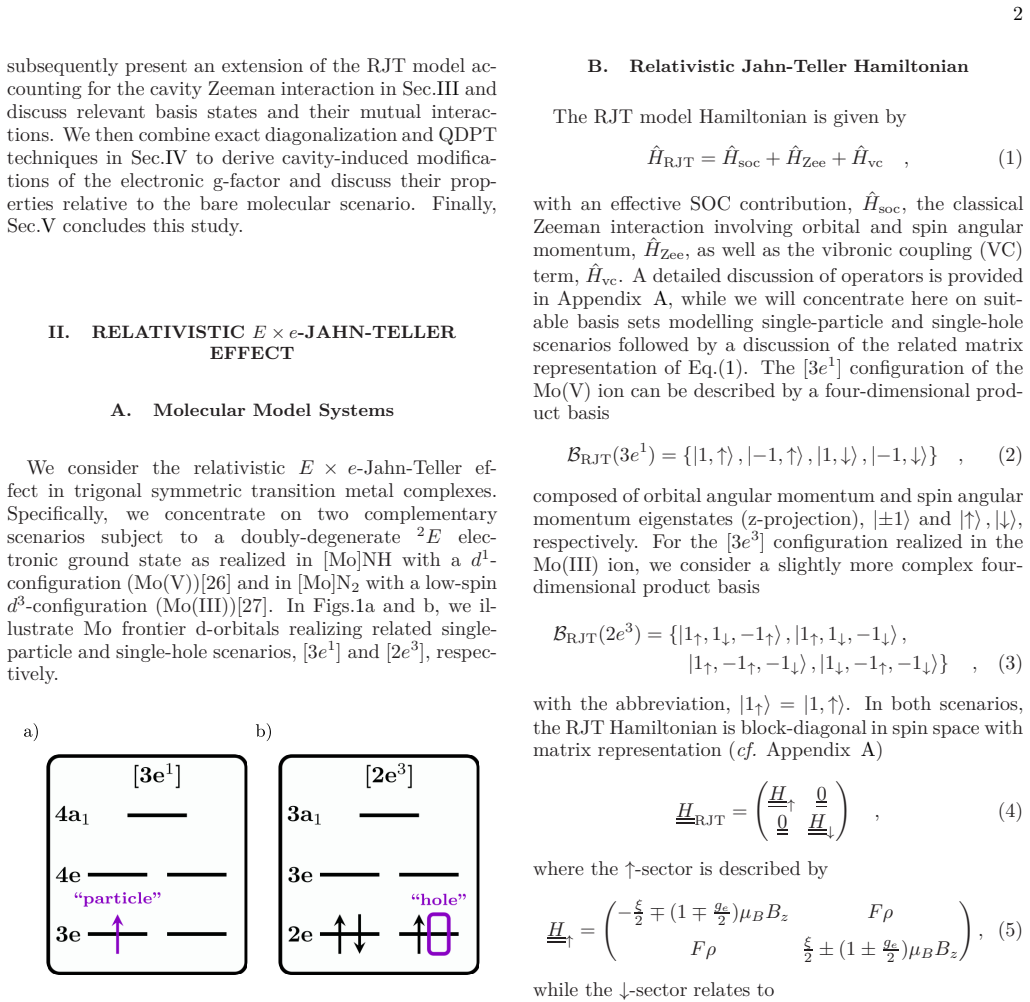
and ( 3) where upper signs refer to the single- particle scenario while lower signs reflect the single-hole case differing only in the classical Zeeman interaction. 3 FIG. 2. Energy schemes for polariton and spectator basis sta tes for (a,b) single-particle (3 e1) and (c,d) single-hole (2 e3) scenarios and their dispersion with respect to classical B- field ...
-
[2]
to the strong coupling regime by 4 accounting for the quantized cavity field and the corre- sponding Zeeman interaction. Motivated by the obser- vation that the RJT model Hamiltonian is diagonal in z-component spin space and recent findings on the rele- vance of polarization for cavity-spin interactions[19], w e consider an effective single cavity mode polar...
-
[3]
Polariton and Spectator Problems We augment the RJT basis in Eqs.(
results from a first-order correction augmenting the commonly employed dipole approximation.[18, 19] B. Polariton and Spectator Problems We augment the RJT basis in Eqs.(
-
[4]
and ( 3) now by zero- and one-photon states, |0z⟩ and |1z⟩, as BcRJT(X) = BRJT(X) ⊗ {| 0z⟩ , |1z⟩} , (14) with configurations, X = 3 e1, 2e3, which ultimately resembles an eight-dimensional model space for single- particle and single-hole scenarios. Inspection of the different interactions in ˆHcRJT allows us to decom- pose the eight-dimensional basis, BcRJ...
-
[5]
(21) 5 where underlying basis states are ordered clockwise in Eqs.(
takes a block-diagonal matrix represen- tation H cRJT = ( H p 0 0 H s ) , (20) with the polariton Hamiltonian being explicitly given by H p = − ξ 2 ∓ (1 ∓ ge 2 )µ BBz F ρ 0 g0 geµ B 2c √ ℏω c 2 F ρ ξ 2 ± (1 ± ge 2 )µ BBz g0 geµ B 2c √ ℏω c 2 0 0 g0 geµ B 2c √ ℏω c 2 − ξ 2 + ℏω c ± (1 ∓ ge 2 )µ BBz F ρ g0 geµ B 2c √ ℏω c 2 0 F...
-
[6]
and ( 17), while sign convention on the diagonal is as before, i.e., upper signs reflect the single-particle and lower signs the single-hole basis. In Figs. 2a and c, we depict energies of zero-order basis states as well as their dispersion with respect to the external classical B- field amplitude. We realize now that the lower 2 × 2- block subject to vibro...
-
[7]
and ( 10)) as de- fined in the weak classical B-field limit (0 < B z ≪ B⋆ z ). This assumption will allows us here to simplify polari- ton and spectator subspaces by neglecting cavity-Zeeman interactions between energetically well-separated groun d and highest-lying excited states to obtain effective three dimensional problems. This approximation is illustra...
-
[8]
and ( 10) besides two distinct cavity- induced corrections to be discussed in the following. FIG. 3. Effective electronic g-factors for (a) single-parti cle and (b) single-hole scenarios as function of vibronic cou- pling strength, F ρ , with SOC strength, ξ = 800 cm − 1 =
-
[9]
65 × 10− 3Eh and effective light-matter interaction constant, ˜g0 = √ N g0, for a collection of N = 10 5 molecules and g0 = 0 . 03√ Eh/ea 0[15]. Dashed blue and bold green graphs reflect molecular and cavity-corrected approximations, re - spectively, for weak SOC ( ξ ≪ F ρ ) and strong SOC ( ξ ≫ F ρ ) regimes. In Fig. 3, we depict effective electronic g-fact...
-
[10]
converges to antiferromagnet- ically quenched ( ge − 2) and ferromagnetically enhanced (ge + 2) limits as F → 0 (strong SOC, ξ ≫ F ρ ). The “spin-only” regime determined by the free electronic g- factor, ge, is reached for both scenarios as F → ∞ (weak SOC, ξ ≪ F ρ ) since orbital angular momentum is then quenched by vibronic coupling. We turn now to cavi...
-
[11]
and ( 40) equally written as ∆˜ geff = ∓ ( ξ − g2 0g2 e µ 2 B 8c2 ) 1 F ρ + O(ξ 3) , (41) ∆˜ geff = ± ( 4 + g2 0g2 e µ 2 B c2 1 ξ ) F 2ρ 2 ξ 2 + O(F 3) . (42) The weak SOC regime translates into a small SOC strength, ξ , such that the cavity-Zeeman correction in Eq.(
-
[12]
can become relevant relative to the leading- order “molecular” correction linear in ξ . In the strong SOC regime in contrast, the cavity-Zeeman interaction is quenched as ξ − 1 (cf. Eq.( 42)) for large SOC strengths ξ . Our analysis thus suggests that spin systems subject to weak SOC might be more prone to cavity-induced cor- rections due to a more promin...
-
[13]
Single-Particle Scenario The single-particle SOC operator reads ˆHsoc = ξ ˆLz ˆSz , (A.1) with SOC coupling strength, ξ , besides single-electron orbital and spin angular momentum operators ˆLz = ℏ(|1⟩ ⟨1| − |− 1⟩ ⟨− 1|) , (A.2) ˆSz = ℏ 2 (|↑⟩ ⟨↑| − |↓⟩ ⟨↓| ) , (A.3) acting on orbital and spin angular momentum eigenstates in z-axis projection, |± 1⟩ and |...
-
[14]
are given by ⟨1, ↑ | ˆHsoc|1, ↑⟩ = ξ 2 , ⟨1, ↓ | ˆHsoc|1, ↓⟩ = − ξ 2 , ⟨− 1, ↑ | ˆHsoc| − 1, ↑⟩ = − ξ 2 , ⟨− 1, ↓ | ˆHsoc| − 1, ↓⟩ = ξ 2 , (A.6) and ⟨1, ↑ | ˆHZee|1, ↑⟩ = (1 + ge 2 )µ BBz , ⟨1, ↓ | ˆHZee|1, ↓⟩ = (1 − ge 2 )µ BBz , ⟨− 1, ↑ | ˆHZee| − 1, ↑⟩ = − (1 − ge 2 )µ BBz , ⟨− 1, ↓ | ˆHZee| − 1, ↓⟩ = − (1 + ge 2 )µ BBz , (A.7) while all off-diagonal el...
-
[15]
Single-Hole Scenario For the single-hole scenario, we consider three elec- trons in a doubly-degenerate d-orbital ( e) with SOC and Zeeman operators ˆHsoc = ξ Ne∑ i ˆLi z ˆSi z , (A.8) ˆHZee = µ B ℏ Ne∑ i ( ˆLi z + ge ˆSi z ) Bz , (A.9) 9 where Ne = 3 while ˆLi z and ˆSi z are similar to Eqs.( A.2) and ( A.3), respectively. The vibronic coupling interac- ...
-
[16]
Ground State The energetically lower-lying states of H ↑ and H ↓ (cf. Eqs.(5) and ( 6)) correspond to Ei 0(X) in Eq.( 29) given by Ei 0(X) = Ep 0 (X) = E↑ 0 , (B.1) Ei 0(X) = Es 0(X) = E↓ 0 . (B.2) Explicitly, we have E↑ 0 = geµ B 2 Bz − √( µ BBz ± ξ 2 ) 2 + F 2ρ 2 , (B.3) and E↓ 0 = − geµ B 2 Bz − √( µ BBz ∓ ξ 2 ) 2 + F 2ρ 2 , (B.4) where upper signs refl...
-
[17]
and ( 10), respectively
-
[18]
First Excited State First-excited states of H ↑ and H ↓ (cf. Eqs.(5) and ( 6)) correspond to Ei 1(X) in Eq.( 29) with Ei 1(X) = Ep 1 (X) = E↑ 1 , (B.11) Ei 1(X) = Es 1(X) = E↓ 1 . (B.12) 10 Here, we find E↑ 1 = geµ B 2 Bz + √( µ BBz ± ξ 2 ) 2 + F 2ρ 2 , (B.13) and E↓ 1 = − geµ B 2 Bz + √( µ BBz ∓ ξ 2 ) 2 + F 2ρ 2 , (B.14) with sign convention as above. In ...
-
[19]
Hybrid light-matter states in a molecular and material science perspective
Ebbesen, T.W. Hybrid light-matter states in a molecular and material science perspective. Acc. Chem. Res. 49, 2403 (2016)
work page 2016
-
[20]
Manipulat- ing matter by strong coupling to vacuum fields
Garcia-Vidal, F.J.; Ciuti, C.; Ebbesen, T.W. Manipulat- ing matter by strong coupling to vacuum fields. Science 373, 6551 (2021)
work page 2021
-
[21]
Modifying Chemical Landscapes by Cou- pling to Vacuum Fields
Hutchison, J.A.; Schwartz, T.; Genet, C.; Devaux, E.; Ebbesen, T.W. Modifying Chemical Landscapes by Cou- pling to Vacuum Fields. Angew. Chem. Int. Ed. 51, 1592 (2012)
work page 2012
-
[22]
Ground- state chemical reactivity under vibrational coupling to the vacuum electromagnetic field
Thomas, A.; George, J.; Shalabney, A.; Dryzhakov, M.; Varma, S.J.; Moran, J.; Chervy, T.; Zhong, X.; Devaux, E.; Genet, C.; Hutchison, J.A.; Ebbesen, T.W. Ground- state chemical reactivity under vibrational coupling to the vacuum electromagnetic field. Angew. Chem. Int. Ed. 55, 11462 (2016)
work page 2016
-
[23]
Direct Observation of Polaritonic Chemistry by Nuclear Mag- netic Resonance Spectroscopy
Patrahau, B.; Piejko, M.; Mayer, R.J.; Antheaume, C.; Sangchai, T.; Ragazzon, G.; Jayachandran, A.; De- vaux, E.; Genet, C.; Moran, J.; Ebbesen, T.W. Direct Observation of Polaritonic Chemistry by Nuclear Mag- netic Resonance Spectroscopy. Angew. Chem. Int. Ed. 63, e202401368 (2024).-
work page 2024
-
[24]
Eddins, A. W.; Beedle, C. C.; Hendrickson, D. N.; Fried- man, J. R. Collective Coupling of a Macroscopic Num- ber of Single-Molecule Magnets with a Microwave Cavity Mode. Phys. Rev. Lett. 112, 120501 (2014)
work page 2014
-
[25]
D.; Zueco, D.; Roubeau, O.; AromÃ, G.; Majer, J.; Luis, F
Jenkins, M. D.; Zueco, D.; Roubeau, O.; AromÃ, G.; Majer, J.; Luis, F. A scalable architecture for quantum computation with molecular nanomagnets. Dalton Trans. 45, 16682 (2016)
work page 2016
-
[26]
Bonizzoni, C.; Ghirri, A.; Atzori, M.; Sorace, L.; Sessoli, R.; Affronte, M. Coherent coupling between Vanadyl Ph- thalocyanine spin ensemble and microwave photons: To- wards integration of molecular spin qubits into quantum circuits. Sci. Rep. 7, 13096 (2017)
work page 2017
-
[27]
Coupled cluster theory for molecular polari- tons: Changing ground and excited states
Haugland, T.; Ronca, E.; Kjønstad, E.; Rubio, A.; Koch, H. Coupled cluster theory for molecular polari- tons: Changing ground and excited states. Phys. Rev. X 10, 041043 (2020)
work page 2020
-
[28]
Molec- ular orbital theory in cavity QED environments
Riso, R.R.; Haugland, T.S.; Ronca, E.; Koch, H. Molec- ular orbital theory in cavity QED environments. Nat. Commun. 13, 1368 (2022)
work page 2022
-
[29]
Time-dependent density functional theory for many-electron systems interacting with cavity pho- tons
Tokatly, I.V. Time-dependent density functional theory for many-electron systems interacting with cavity pho- tons. Phys. Rev. Lett. 110, 233001 (2013)
work page 2013
-
[30]
Ruggenthaler, M.; Flick, J.; Pellegrini, C.; Appel, H.; Tokatly, I.V.; Rubio, A. Quantum-electrodynamical density-functional theory: Bridging quantum optics and electronic structure theory. Phys. Rev. A 90, 012508 (2014)
work page 2014
-
[31]
Schnappinger, T.; Sidler, D.; Ruggenthaler, M.; Rubio, A., Kowalewski, M. Cavity Born-Oppenheimer Hartree- Fock Ansatz: Light-Matter Properties of Strongly Cou- pled Molecular Ensembles. J. Phys. Chem. Lett. 14, 8024 (2023)
work page 2023
-
[32]
Fischer, E.W. Cavity-modified local and non-local elec- tronic interactions in molecular ensembles under vibra- tional strong coupling. J. Chem. Phys. 161, 164112 (2024)
work page 2024
-
[33]
Fischer, E.W. Cavity Born-Oppenheimer Coupled Clus- ter Theory: Toward Electron Correlation in the Vibra- tional Strong Light-Matter Coupling Regime. J. Chem. Theory Comput. 21, 12081 (2025)
work page 2025
-
[34]
A.; Ruggenthaler, M.; Rubio, A
Rokaj, V.; Penz, M.; Sentef, M. A.; Ruggenthaler, M.; Rubio, A. Quantum Electrodynamical Bloch Theory with Homogeneous Magnetic Fields. Phys. Rev. Lett. 123, 047202 (2019)
work page 2019
-
[35]
A.; Ruggenthaler, M.; Rubio, A
Rokaj, V.; Penz, M.; Sentef, M. A.; Ruggenthaler, M.; Rubio, A. Polaritonic Hofstadter butterfly and cavity control of the quantized Hall conductance. Phys. Rev. B 105, 205424 (2022)
work page 2022
-
[36]
Barlini, A.; Bianchi, A.; Ronca, E.; Koch, H. Theory of Magnetic Properties in Quantum Electrodynamics En- vironments: Application to Molecular Aromaticity. J. Chem. Theory Comput. 20, 7841 (2024)
work page 2024
-
[37]
Cavity-modified Zeeman ef- fect via spin-polariton formation
Fischer, E.W.; Roemelt, M. Cavity-modified Zeeman ef- fect via spin-polariton formation. J. Chem. Phys. 163, 174307 (2025)
work page 2025
-
[38]
Relativistic Linear Response in Quantum- Electrodynamical Density Functional Theory
Konecny, L.; Kosheleva, V.P.; Appel, H.; Ruggenthaler, M.; Rubio, A. Relativistic Linear Response in Quantum- Electrodynamical Density Functional Theory. Phys. Rev. X 15, 031052 (2025)
work page 2025
-
[39]
Konecny, L.; Kosheleva, V.P.; Ruggenthaler, M.; Repisky, M.: Rubio, A. Linear-response quantum- electrodynamical density functional theory based on two- component X2C Hamiltonians. Phys. Rev. X 15, 031052 (2025)
work page 2025
-
[40]
Thiam, G.: Rossi, R.; Koch, H.; Belpassi, L.; Ronca, E. A Comprehensive Theory for Relativistic Polaritonic Chemistry: A Four-Component Ab Initio Treatment of Molecular Systems Coupled to Quantum Fields. JACS Au 5, 3775 (2025)
work page 2025
-
[41]
The Jahn-Teller Effect, 1st ed.; Cambridge University Press: Cambridge (2006)
Bersuker, I.B. The Jahn-Teller Effect, 1st ed.; Cambridge University Press: Cambridge (2006)
work page 2006
-
[42]
Collective Jahn-Teller Interactions through Light-Matter Coupling in a Cavity
Vendrell, O. Collective Jahn-Teller Interactions through Light-Matter Coupling in a Cavity. Phys. Rev. Lett. 121, 253001 (2018)
work page 2018
-
[43]
Cavity Jahn-Teller polari- tons in molecules
Nandipati, K.R.; Vendrell, O. Cavity Jahn-Teller polari- tons in molecules. Phys. Rev. A 107, L061101 (2023)
work page 2023
-
[44]
Sharma, A.; Roemelt, M.; Reithofer, M.; Schrock, R.R.; Hoffman, B.M.; Neese, F. Experimental and Theoretical EPR Study of Jahn-Teller-Active [HIPTN 3N]MoL Com- plexes (L=N 2,CO,NH3). Inorg. Chem. (2017) 56, 6906- 6919
work page 2017
-
[45]
McNaughton, R.L.; Roemelt, M.; Chin, J.M.; Schrock, R.R.; Neese, F.; Hoffman, B.M. Experimental and Theo- retical EPR Study of Jahn-Teller-Active [HIPTN 3N]MoL Complexes (L=N 2,CO,NH3). J. Am. Chem. Soc. (2010) 132, 25, 8645-8656
work page 2010
-
[46]
On the Origin of Spin-Hamiltonian Param- eters
McWeeny, R. On the Origin of Spin-Hamiltonian Param- eters. J. Chem. Phys. 42, 1717 (1965)
work page 1965
-
[47]
Neese, F.; Solomon, E.I. Calculation of Zero-Field Split- tings, g-Values, and the Relativistic Nephelauxetic Effect in Transition Metal Complexes. Application to High-Spin Ferric Complexes. Inorg.Chem. 37, 6568 (1998)
work page 1998
-
[48]
Quantum Chemistry and EPR Parameters
Neese, F. Quantum Chemistry and EPR Parameters. In Goldfarb D.; Stoll, S. EPR Spectroscopy - Fundamentals and Methods. John Wiley & Sons Ltd (2018)
work page 2018
-
[49]
Fischer, E.W.; Syska, J.A.; Saalfrank, P. A Quan- tum Chemistry Approach to Linear Vibro-Polaritonic In- frared Spectra with Perturbative Electron-Photon Corre- lation. J. Phys. Chem. Lett. 15, 2262 (2024)
work page 2024
discussion (0)
Sign in with ORCID, Apple, or X to comment. Anyone can read and Pith papers without signing in.