Motion-Adapter: A Diffusion Model Adapter for Text-to-Motion Generation of Compound Actions
Pith reviewed 2026-05-10 08:09 UTC · model grok-4.3
The pith
A plug-and-play adapter enables text-to-motion diffusion models to generate coherent compound actions from simple text by using decoupled cross-attention maps as structural masks.
A machine-rendered reading of the paper's core claim, the machinery that carries it, and where it could break.
Core claim
We propose the Motion-Adapter, a plug-and-play module that guides text-to-motion diffusion models in generating compound actions by computing decoupled cross-attention maps, which serve as structural masks during the denoising process. This directly counters catastrophic neglect of earlier actions and attention collapse from excessive feature fusion, allowing the model to produce faithful and coherent full-body motions from diverse textual prompts without requiring detailed descriptions, explicit body-part edits, or large language models.
What carries the argument
The Motion-Adapter module, which computes decoupled cross-attention maps that act as structural masks to guide the denoising process in a pre-trained text-to-motion diffusion model.
If this is right
- Compound actions can be synthesized from concise text without explicit body-part specifications or external language models.
- Existing diffusion models gain the ability to handle concurrent motions while preserving temporal order and physical coherence.
- Performance improves consistently across varied textual prompts compared with prior state-of-the-art methods.
- The approach maintains plug-and-play compatibility, so no full model retraining is required.
Where Pith is reading between the lines
- The masking technique could transfer to other diffusion tasks that require simultaneous generation of multiple elements, such as multi-object scene synthesis.
- Integration with longer or more complex motion sequences would test whether the structural masks scale without additional modifications.
- The method opens a route for combining motion generation with other modalities like speech or music by treating them as additional conditioning signals under the same masking logic.
Load-bearing premise
Decoupled cross-attention maps will separate concurrent actions reliably enough to prevent overwriting and collapse across all prompts and motion types without introducing new artifacts or needing base-model retraining.
What would settle it
Running the adapter on prompts that combine two independent actions, such as 'greeting while walking,' and checking whether both actions appear simultaneously and without one overwriting the other in the generated sequence.
Figures
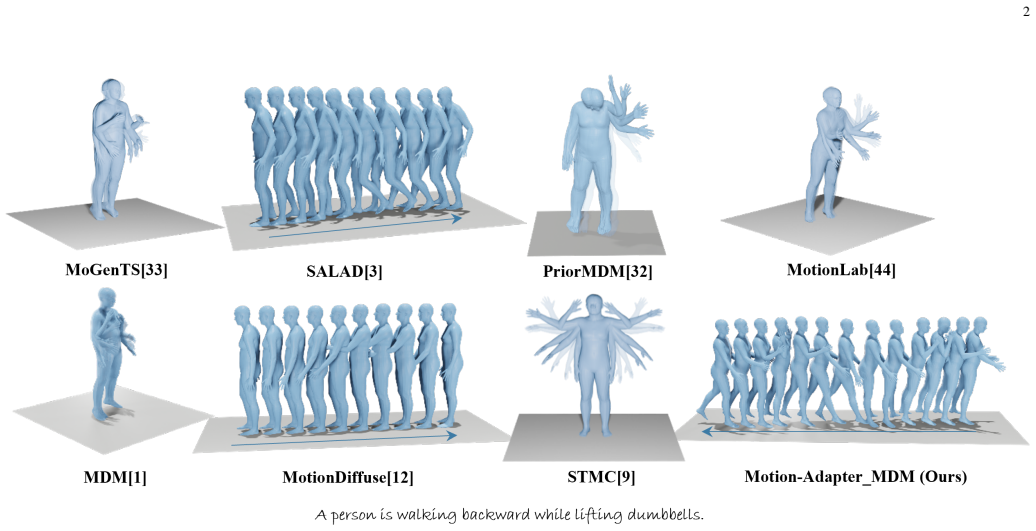


read the original abstract
Recent advances in generative motion synthesis have enabled the production of realistic human motions from diverse input modalities. However, synthesizing compound actions from texts, which integrate multiple concurrent actions into coherent full-body sequences, remains a major challenge. We identify two key limitations in current text-to-motion diffusion models: (i) catastrophic neglect, where earlier actions are overwritten by later ones due to improper handling of temporal information, and (ii) attention collapse, which arises from excessive feature fusion in cross-attention mechanisms. As a result, existing approaches often depend on overly detailed textual descriptions (e.g., raising right hand), explicit body-part specifications (e.g., editing the upper body), or the use of large language models (LLMs) for body-part interpretation. These strategies lead to deficient semantic representations of physical structures and kinematic mechanisms, limiting the ability to incorporate natural behaviors such as greeting while walking. To address these issues, we propose the Motion-Adapter, a plug-and-play module that guides text-to-motion diffusion models in generating compound actions by computing decoupled cross-attention maps, which serve as structural masks during the denoising process. Extensive experiments demonstrate that our method consistently produces more faithful and coherent compound motions across diverse textual prompts, surpassing state-of-the-art approaches.
Editorial analysis
A structured set of objections, weighed in public.
Referee Report
Summary. The paper claims to solve the problem of generating compound actions (multiple concurrent motions) from text using diffusion models by introducing Motion-Adapter. This plug-and-play module computes decoupled cross-attention maps that act as structural masks in the denoising process to prevent catastrophic neglect of early actions and attention collapse. It asserts that this leads to more coherent motions from simple prompts and outperforms existing methods in experiments.
Significance. Should the proposed adapter prove effective, it would represent a meaningful advance in text-to-motion generation by enabling natural compound behaviors without reliance on overly specific prompts or auxiliary LLMs. This could broaden the applicability of diffusion-based motion synthesis in fields like computer animation and human-robot interaction. The plug-and-play design is particularly promising for adoption.
major comments (2)
- The mechanism for decoupling cross-attention maps and integrating them as masks during denoising is described conceptually but lacks the precise algorithmic steps or pseudocode needed to fully evaluate its impact on temporal information handling.
- While the abstract states that the method surpasses SOTA, the experimental section should provide detailed quantitative results, including specific metrics, dataset information, and comparisons to baselines to substantiate the claims of consistent improvement across diverse prompts.
minor comments (1)
- Include at least one key performance metric to support the superiority claim.
Simulated Author's Rebuttal
We thank the referee for the positive evaluation of our work's potential impact and for the constructive feedback. We address each major comment below and will revise the manuscript to incorporate clarifications and additional details where appropriate.
read point-by-point responses
-
Referee: The mechanism for decoupling cross-attention maps and integrating them as masks during denoising is described conceptually but lacks the precise algorithmic steps or pseudocode needed to fully evaluate its impact on temporal information handling.
Authors: We appreciate this observation. Section 3 of the manuscript describes the decoupling of cross-attention maps and their use as structural masks, including how they preserve temporal information across denoising steps to mitigate catastrophic neglect. However, we agree that explicit algorithmic steps and pseudocode would improve reproducibility and allow better assessment of the temporal handling. In the revised version, we will add a dedicated algorithm box with precise pseudocode outlining the map computation, decoupling, masking, and integration into the diffusion process. revision: yes
-
Referee: While the abstract states that the method surpasses SOTA, the experimental section should provide detailed quantitative results, including specific metrics, dataset information, and comparisons to baselines to substantiate the claims of consistent improvement across diverse prompts.
Authors: We thank the referee for this point. The experimental section reports quantitative results on standard benchmarks (HumanML3D and KIT) using metrics such as FID, R-Precision, and diversity scores, along with comparisons to baselines including MDM, MLD, and others, plus user studies on compound action coherence. These demonstrate consistent improvements. To further substantiate the claims, we will expand the section in revision with additional tables containing exact numerical values, dataset statistics and splits, and more baseline comparisons across a broader set of diverse compound prompts. revision: partial
Circularity Check
No significant circularity detected
full rationale
The paper proposes Motion-Adapter as an independent plug-and-play module that computes decoupled cross-attention maps to serve as structural masks in existing text-to-motion diffusion models. This directly addresses the stated problems of catastrophic neglect and attention collapse without any derivation that reduces to self-definition, fitted inputs renamed as predictions, or self-citation chains. The approach is presented as an additive technical contribution with claimed experimental support across prompts, and no equation or step in the provided description equates to its own inputs by construction. The derivation remains self-contained against external benchmarks.
Axiom & Free-Parameter Ledger
Reference graph
Works this paper leans on
-
[1]
G. Tevet, S. Raab, B. Gordon, Y . Shafir, D. Cohen-or, and A. H. Bermano, “Human motion diffusion model,” inThe Eleventh Interna- tional Conference on Learning Representations, 2023
work page 2023
-
[2]
Action2motion: Conditioned generation of 3d human motions,
C. Guo, X. Zuo, S. Wang, S. Zou, Q. Sun, A. Deng, M. Gong, and L. Cheng, “Action2motion: Conditioned generation of 3d human motions,” inProceedings of the 28th ACM International Conference on Multimedia, ser. MM ’20. New York, NY , USA: Association for Computing Machinery, 2020, p. 2021–2029
work page 2020
-
[3]
Salad: Skeleton- aware latent diffusion for text-driven motion generation and editing,
S. Hong, C. Kim, S. Yoon, J. Nam, S. Cha, and J. Noh, “Salad: Skeleton- aware latent diffusion for text-driven motion generation and editing,” inProceedings of the IEEE/CVF Conference on Computer Vision and Pattern Recognition (CVPR), June 2025, p. 13836
work page 2025
-
[4]
arXiv preprint arXiv:2509.04058 , year=
L. Zhong, Y . Yang, and L. Changjian, “Smoogpt: Stylized motion generation using large language models,” inarXiv:2509.04058, 2025
-
[5]
C. Mo, K. Hu, C. Long, D. Yuan, and Z. Wang, “Motion keyframe interpolation for any human skeleton via temporally consistent point cloud sampling and reconstruction,” inProceedings of the European Conference on Computer Vision (ECCV), ser. Lecture Notes in Computer Science, vol. 15140. Springer, Cham, 2024, pp. 159–175
work page 2024
-
[6]
Temos: Generating diverse human motions from textual descriptions,
M. Petrovich, M. J. Black, and G. Varol, “Temos: Generating diverse human motions from textual descriptions,” inProceedings of the Euro- pean Conference on Computer Vision (ECCV). Cham: Springer Nature Switzerland, 2022, pp. 480–497
work page 2022
-
[7]
Optimizing diffusion noise can serve as universal motion priors,
K. Karunratanakul, K. Preechakul, E. Aksan, T. Beeler, S. Suwajanakorn, and S. Tang, “Optimizing diffusion noise can serve as universal motion priors,” inProceedings of the IEEE/CVF Conference on Computer Vision and Pattern Recognition (CVPR), June 2024, pp. 1334–1345
work page 2024
-
[8]
Sinc: Spatial composition of 3d human motions for simultaneous action generation,
N. Athanasiou, M. Petrovich, M. J. Black, and G. Varol, “Sinc: Spatial composition of 3d human motions for simultaneous action generation,” inProceedings of the IEEE/CVF International Conference on Computer Vision, 2023, pp. 9984–9995
work page 2023
-
[9]
Multi-track timeline control for text-driven 3d human motion generation,
M. Petrovich, O. Litany, U. Iqbal, M. J. Black, G. Varol, X. B. Peng, and D. Rempe, “Multi-track timeline control for text-driven 3d human motion generation,” inCVPR Workshop on Human Motion Generation, 2024
work page 2024
-
[10]
Mmm: Generative masked motion model,
E. Pinyoanuntapong, P. Wang, M. Lee, and C. Chen, “Mmm: Generative masked motion model,” inProceedings of the IEEE/CVF Conference on Computer Vision and Pattern Recognition (CVPR), June 2024, pp. 1546–1555
work page 2024
-
[11]
Motionfix: Text-driven 3d human motion editing,
N. Athanasiou, A. Cseke, M. Diomataris, M. J. Black, and G. Varol, “Motionfix: Text-driven 3d human motion editing,” inSIGGRAPH Asia 2024 Conference Papers. ACM, 2024. [Online]. Available: https://dl.acm.org/doi/10.1145/3680528.3687559
-
[12]
Motiondiffuse: Text-driven human motion generation with diffusion model,
M. Zhang, Z. Cai, L. Pan, F. Hong, X. Guo, L. Yang, and Z. Liu, “Motiondiffuse: Text-driven human motion generation with diffusion model,”IEEE Transactions on Pattern Analysis and Machine Intelli- gence, vol. 46, no. 6, pp. 4115–4128, 2024
work page 2024
-
[13]
Action-conditioned 3d human motion synthesis with transformer vae,
M. Petrovich, M. J. Black, and G. Varol, “Action-conditioned 3d human motion synthesis with transformer vae,” inProceedings of the IEEE/CVF International Conference on Computer Vision (ICCV), October 2021, pp. 10 985–10 995
work page 2021
-
[14]
Global-local motion transformer for unsupervised skeleton-based action learning,
B. Kim, H. J. Chang, J. Kim, and J. Y . Choi, “Global-local motion transformer for unsupervised skeleton-based action learning,” inCom- puter Vision – ECCV 2022. Cham: Springer Nature Switzerland, 2022, pp. 209–225
work page 2022
-
[15]
Weakly-supervised action transition learning for stochastic human motion prediction,
W. Mao, M. Liu, and M. Salzmann, “Weakly-supervised action transition learning for stochastic human motion prediction,” inProceedings of the IEEE/CVF Conference on Computer Vision and Pattern Recognition (CVPR), June 2022, pp. 8151–8160
work page 2022
-
[16]
Learning uncoupled-modulation cvae for 3d action-conditioned human motion synthesis,
C. Zhong, L. Hu, Z. Zhang, and S. Xia, “Learning uncoupled-modulation cvae for 3d action-conditioned human motion synthesis,” inComputer Vision–ECCV 2022: 17th European Conference, 2022, pp. 716–732
work page 2022
-
[17]
Posegpt: Quantization-based 3d human motion generation and forecasting,
T. Lucas, F. Baradel, P. Weinzaepfel, and G. Rogez, “Posegpt: Quantization-based 3d human motion generation and forecasting,” in Proceedings of the European Conference on Computer Vision (ECCV). Cham: Springer Nature Switzerland, 2022, pp. 417–435
work page 2022
-
[18]
Language2pose: Natural language grounded pose forecasting,
C. Ahuja and L.-P. Morency, “Language2pose: Natural language grounded pose forecasting,” in2019 International Conference on 3D Vision (3DV), 2019, pp. 719–728
work page 2019
-
[19]
Tm2t: Stochastic and tokenized modeling for the reciprocal generation of 3d human motions and texts,
C. Gu, X. Zuo, S. Wang, and L. Cheng, “Tm2t: Stochastic and tokenized modeling for the reciprocal generation of 3d human motions and texts,” inEuropean Conference on Computer Vision (ECCV), 2022
work page 2022
-
[20]
Generating diverse and natural 3d human motions from text,
C. Guo, S. Zou, X. Zuo, S. Wang, W. Ji, X. Li, and L. Cheng, “Generating diverse and natural 3d human motions from text,” in Proceedings of the IEEE/CVF Conference on Computer Vision and Pattern Recognition (CVPR), June 2022, pp. 5152–5161
work page 2022
-
[21]
Exploring vision transformers for 3d human motion-language models with motion patches,
Q. Yu, M. Tanaka, and K. Fujiwara, “Exploring vision transformers for 3d human motion-language models with motion patches,” inPro- ceedings of the IEEE/CVF Conference on Computer Vision and Pattern Recognition (CVPR), June 2024, pp. 937–946
work page 2024
-
[22]
Momask: Generative masked modeling of 3d human motions,
C. Guo, Y . Mu, M. G. Javed, S. Wang, and L. Cheng, “Momask: Generative masked modeling of 3d human motions,” inProceedings of the IEEE/CVF Conference on Computer Vision and Pattern Recognition (CVPR), June 2024, pp. 1900–1910
work page 2024
-
[23]
Emdm: Efficient motion diffusion model for fast and high-quality motion generation,
W. Zhou, Z. Dou, Z. Cao, Z. Liao, J. Wang, W. Wang, Y . Liu, T. Komura, W. Wang, and L. Liu, “Emdm: Efficient motion diffusion model for fast and high-quality motion generation,” inProceedings of the European Conference on Computer Vision (ECCV). Cham: Springer Nature Switzerland, 2025, pp. 18–38. 12
work page 2025
-
[24]
Seamless human motion composition with blended positional encodings,
G. Barquero, S. Escalera, and C. Palmero, “Seamless human motion composition with blended positional encodings,” inProceedings of the IEEE/CVF Conference on Computer Vision and Pattern Recognition (CVPR), June 2024, pp. 457–469
work page 2024
-
[25]
Motion mamba: Efficient and long sequence motion generation,
Z. Zhang, A. Liu, I. Reid, R. Hartley, B. Zhuang, and H. Tang, “Motion mamba: Efficient and long sequence motion generation,” inComputer Vision – ECCV 2024. Cham: Springer Nature Switzerland, 2025, pp. 265–282
work page 2024
-
[26]
Z. Gao, D. Song, D. Jiang, C. Xue, and A.-A. Liu, “Motionflux: Efficient text-guided motion generation through rectified flow matching and preference alignment,” inarxiv:2508.19527, 2025
-
[27]
Motionclip: Exposing human motion generation to clip space,
G. Tevet, B. Gordon, A. Hertz, A. H. Bermano, and D. Cohen-Or, “Motionclip: Exposing human motion generation to clip space,” in Proceedings of the European Conference on Computer Vision (ECCV). Cham: Springer Nature Switzerland, 2022, pp. 358–374
work page 2022
-
[28]
Flame: Free-form language-based motion synthesis & editing,
J. Kim, J. Kim, and S. Choi, “Flame: Free-form language-based motion synthesis & editing,” inProceedings of the AAAI Conference on Artificial Intelligence, vol. 37, no. 7. AAAI Press, 2023, pp. 8255–8263
work page 2023
-
[29]
Transactions on Machine Learning Research (2022) https: //doi.org/10.1007/978-3-031-73397-0 4
Y . Huang, W. Wan, Y . Yang, C. Callison-Burch, M. Yatskar, and L. Liu, “Como: Controllable motion generation through language guided pose code editing,” inProceedings of the European Conference on Computer Vision (ECCV). Springer, 2024, pp. 180–196. [Online]. Available: https://link.springer.com/chapter/10.1007/978-3-031-73397-0 11
-
[30]
Finemogen: Fine- grained spatio-temporal motion generation and editing,
M. Zhang, H. Li, Z. Cai, J. Ren, L. Yang, and Z. Liu, “Finemogen: Fine- grained spatio-temporal motion generation and editing,” inAdvances in Neural Information Processing Systems (NeurIPS), 2023. [Online]. Available: https://arxiv.org/abs/2312.15004
-
[31]
TEACH: Temporal Action Composition for 3D Humans ,
N. Athanasiou, M. Petrovich, M. J. Black, and G. Varol, “ TEACH: Temporal Action Composition for 3D Humans ,” in2022 International Conference on 3D Vision (3DV). Los Alamitos, CA, USA: IEEE Computer Society, Sep. 2022, pp. 414–423
work page 2022
-
[32]
Priormdm: Human motion diffusion as a generative prior,
Y . Shafir, G. Tevet, R. Kapon, and A. H. Bermano, “Priormdm: Human motion diffusion as a generative prior,” inThe Twelfth International Conference on Learning Representations, 2024
work page 2024
-
[33]
Mogents: Motion generation based on spatial-temporal joint modeling,
W. Yuan, W. Shen, Y . He, Y . Dong, X. Gu, Z. Dong, L. Bo, and Q. Huang, “Mogents: Motion generation based on spatial-temporal joint modeling,” inConference on Neural Information Processing Systems, 2024
work page 2024
-
[34]
Generation of complex 3d human motion by temporal and spatial composition of diffusion models,
L. Mandelli and S. Berretti, “Generation of complex 3d human motion by temporal and spatial composition of diffusion models,” in2025 IEEE/CVF Winter Conference on Applications of Computer Vision (WACV), 2025, pp. 1279–1288
work page 2025
-
[35]
J. Zhang, H. Fan, and Y . Yang, “Energymogen: Compositional human motion generation with energy-based diffusion model in latent space,” inProceedings of the IEEE/CVF Conference on Computer Vision and Pattern Recognition (CVPR), 2024
work page 2024
-
[36]
Generating diverse and natural 3d human motions from text,
C. Guo, S. Zou, X. Zuo, S. Wang, L. Wang, and Y . Zhou, “Generating diverse and natural 3d human motions from text,” inProceedings of the IEEE/CVF Conference on Computer Vision and Pattern Recognition (CVPR), 2022, pp. 5152–5161
work page 2022
-
[37]
Spatial temporal graph convolutional networks for skeleton-based action recognition,
S. Yan, Y . Xiong, and D. Lin, “Spatial temporal graph convolutional networks for skeleton-based action recognition,” inProceedings of the AAAI Conference on Artificial Intelligence, vol. 32, no. 1, 2018
work page 2018
-
[38]
A. Vaswani, N. Shazeer, N. Parmar, J. Uszkoreit, L. Jones, A. N. Gomez, Ł. Kaiser, and I. Polosukhin, “Attention is all you need,” inAdvances in Neural Information Processing Systems, vol. 30. Curran Associates, Inc., 2017
work page 2017
-
[39]
Learning transferable visual models from natural language supervi- sion,
A. Radford, J. W. Kim, C. Hallacy, A. Ramesh, G. Goh, S. Agarwal, G. Sastry, A. Askell, P. Mishkin, J. Clark, G. Krueger, and I. Sutskever, “Learning transferable visual models from natural language supervi- sion,” inProceedings of the 38th International Conference on Machine Learning (ICML), vol. 139. PMLR, 2021, pp. 8748–8763
work page 2021
-
[40]
Learning repre- sentations by back-propagating errors,
D. E. Rumelhart, G. E. Hinton, and R. J. Williams, “Learning repre- sentations by back-propagating errors,”Nature, vol. 323, no. 6088, pp. 533–536, 1986
work page 1986
-
[41]
Decoupled Weight Decay Regularization
I. Loshchilov and F. Hutter, “Decoupled weight decay regularization,” arXiv preprint arXiv:1711.05101, 2019
work page internal anchor Pith review Pith/arXiv arXiv 2019
-
[42]
Real-time inverse kinematics techniques for anthropomorphic limbs,
D. Tolani, A. Goswami, and N. I. Badler, “Real-time inverse kinematics techniques for anthropomorphic limbs,” inGraphical Models, vol. 62, no. 5. Elsevier, 2000, pp. 353–388
work page 2000
-
[43]
Smpl: A skinned multi-person linear model,
M. Loper, N. Mahmood, J. Romero, G. Pons-Moll, and M. J. Black, “Smpl: A skinned multi-person linear model,”ACM Transactions on Graphics (TOG), vol. 34, no. 6, pp. 248:1–248:16, 2015
work page 2015
-
[44]
Motionlab: Unified human mo- tion generation and editing via the motion-condition-motion paradigm,
Z. Guo, Z. Hu, N. Zhao, and D. W. Soh, “Motionlab: Unified human mo- tion generation and editing via the motion-condition-motion paradigm,” inProceedings of the IEEE/CVF International Conference on Computer Vision (ICCV), 2025
work page 2025
-
[45]
Attend-and- excite: Attention-based semantic guidance for text-to-image diffusion models,
H. Chefer, Y . Alaluf, Y . Vinker, L. Wolf, and D. Cohen-Or, “Attend-and- excite: Attention-based semantic guidance for text-to-image diffusion models,”ACM Trans. Graph., vol. 42, no. 4, Jul. 2023. Yue Jiangreceived the B.S. degree in Software Engineering from Northwest University, China, in
work page 2023
-
[46]
degree in Software Engineering at Northwest University
Since July 2023, She has been pursuing the M.S. degree in Software Engineering at Northwest University. Her research interests include computer graphics, motion synthesis, and deep learning. Mingyu Yanghas been pursuing the B.S. degree in Software Engineering at the School of Computer Science, Northwest University of China, since 2022. His research intere...
work page 2023
-
[47]
Her research interests include visualized analysis and deep learning
She is currently working toward the M.S degree in software engineering with the School of Computer Science, Northwest University of China. Her research interests include visualized analysis and deep learning. Yang Xureceived his B.E. and Ph.D. degrees from Beihang University in 2014 and 2020, respectively. He is currently an associate professor in the Sch...
work page 2014
discussion (0)
Sign in with ORCID, Apple, or X to comment. Anyone can read and Pith papers without signing in.