Recognition: unknown
A unified framework for efficient quantum simulation of nonlinear spectroscopy
Pith reviewed 2026-05-10 08:02 UTC · model grok-4.3
The pith
A generalized parameter shift rule turns multi-time nonlinear responses into sums of finite-amplitude expectation values on quantum hardware.
A machine-rendered reading of the paper's core claim, the machinery that carries it, and where it could break.
Core claim
Nonlinear spectroscopy response functions are obtained exactly as linear combinations of expectation values evaluated at a small number of finite pump amplitudes, via a generalized parameter-shift identity; the resulting circuits consist only of real-time evolution under the system Hamiltonian plus the pump, which can be run directly on superconducting processors to extract spectra and cross-peaks for a 12-qubit XXZ chain, spin-liquid quasi-particles, and interaction-induced features in atomic models.
What carries the argument
Generalized parameter shift rule that expresses the nth-order multi-time response function as a finite weighted sum of expectation values at shifted pump amplitudes.
If this is right
- Higher-order spectra become accessible on devices that already support real-time Hamiltonian evolution.
- Noise resilience follows directly because the algorithm never requires long coherent sequences of commutators.
- The same circuits that measure linear spectra can be reused at a few extra pump values to obtain nonlinear features.
- Cross-peaks that reveal couplings in spin liquids and atomic systems can be resolved without exponential classical resources.
Where Pith is reading between the lines
- The method may generalize to other multi-time correlation protocols that currently rely on commutator expansions.
- Combining it with variational or Trotterized evolution could extend the reachable system sizes beyond the 12-qubit demonstration.
- If pump-amplitude errors remain bounded, the framework supplies a concrete route to verify nonlinear quantum dynamics on early fault-tolerant hardware.
Load-bearing premise
Finite pump amplitudes combined with the shift rule recover the exact higher-order response without uncontrolled errors from truncation, discretization, or hardware imperfections.
What would settle it
Compute the third-order response of a small, exactly solvable model (such as two coupled spins) both analytically and with the proposed finite-amplitude circuits; any systematic mismatch in peak positions or amplitudes that grows with pump strength would falsify the reformulation.
Figures


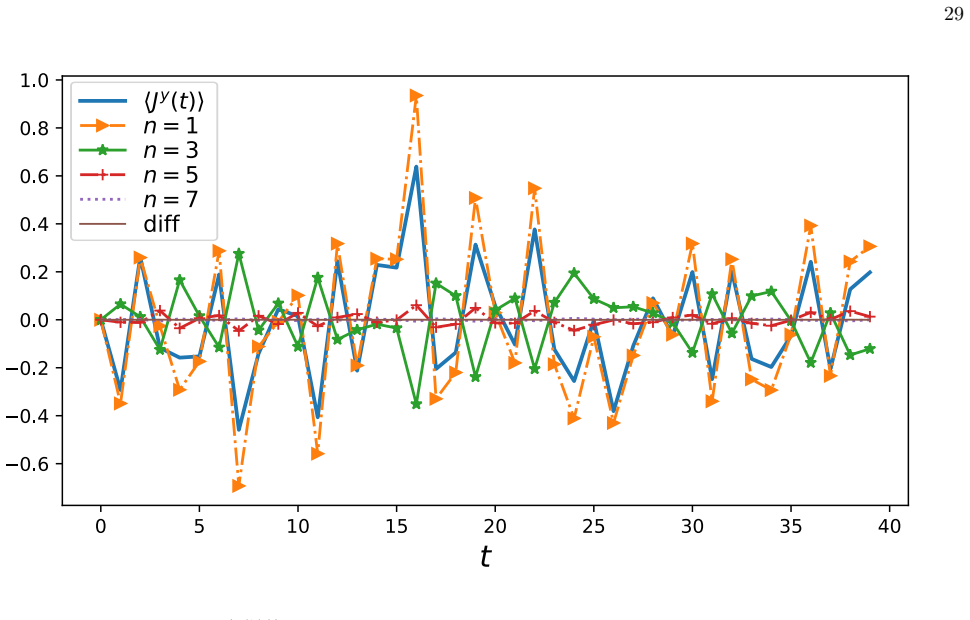


read the original abstract
Nonlinear spectroscopy is a cornerstone of quantum science, providing unique access to multi-point correlations, quantum coherence, and couplings that are invisible to linear methods. However, classical simulation of these phenomena is fundamentally limited by the exponential growth of the Hilbert space, and practical quantum algorithms for the nonlinear regime have remained largely unexplored. Here, we present a unified quantum algorithmic framework for computing $n$-th order nonlinear spectroscopies. By reformulating multi-time responses as a weighted sum of expectation values at finite pump amplitudes via a generalized parameter shift rule, our approach bypasses the costly evaluation of high-order commutators and time-dependent operator expansions. This reformulation enables efficient execution via real-time evolution on current quantum hardware, ensuring inherent noise resilience. We validate the framework on IBM's superconducting quantum processors, successfully obtain higher-order response functions of a 12-qubit XXZ spin-chain. Furthermore, the versatility of our method is demonstrated by resolving quasi-particle excitation spectra in spin-liquids and identifying interaction-induced cross-peaks in atomic systems. Our results establish a practical and scalable pathway for probing complex quantum dynamics on near-term quantum devices, extending the reach of quantum simulation into the nonlinear domain.
Editorial analysis
A structured set of objections, weighed in public.
Referee Report
Summary. The paper claims a unified quantum algorithmic framework for n-th order nonlinear spectroscopy. It reformulates multi-time response functions as a weighted sum of expectation values at finite pump amplitudes via a generalized parameter shift rule. This bypasses high-order commutators and time-dependent expansions, enabling real-time evolution on quantum hardware with inherent noise resilience. Validation is reported on IBM superconducting processors for a 12-qubit XXZ spin chain, with further applications to quasi-particle spectra in spin liquids and interaction-induced cross-peaks in atomic systems.
Significance. If the reformulation is exact and the finite-amplitude measurements faithfully isolate the desired order, the framework would enable practical quantum simulation of nonlinear phenomena on near-term hardware, extending beyond linear response methods and providing access to multi-point correlations that are classically intractable. The hardware demonstration on 12 qubits and the applications to spin liquids represent concrete strengths in bridging theory to experiment.
major comments (3)
- [Abstract] Abstract: The central claim that the generalized parameter shift rule exactly recovers the n-th order nonlinear response as a weighted sum at finite pump amplitudes lacks an explicit derivation or proof of cancellation of contaminating higher-order terms; without this, it is unclear whether the method is exact or introduces uncontrolled bias from finite amplitudes, directly undermining the assertion that it bypasses costly commutator evaluations.
- [Validation section] Validation on 12-qubit XXZ chain: The abstract reports successful extraction of higher-order response functions on IBM hardware, but provides no comparison to exact classical results, no quantitative error metrics (e.g., deviation in peak positions or amplitudes), and no analysis of discretization or noise effects; this leaves the accuracy of the extracted spectra unverified and is load-bearing for the noise-resilience claim.
- [Generalized parameter shift rule] Generalized parameter shift rule: Extending standard parameter-shift rules to higher orders via finite amplitudes requires the weighting coefficients to analytically cancel all residual terms; if the chosen amplitudes or time-grid discretization fail to achieve this (as noted in the skeptic concern), the extracted cross-peaks contain systematic errors that the linear combination cannot remove.
minor comments (1)
- [Abstract] Abstract: The phrase 'successfully obtain higher-order response functions' is stated without accompanying quantitative benchmarks such as fidelity scores or error bars relative to known limits.
Simulated Author's Rebuttal
We thank the referee for their careful reading and constructive comments on our manuscript. We address each major comment below and have revised the manuscript to strengthen the presentation of the derivation, validation, and error analysis.
read point-by-point responses
-
Referee: [Abstract] Abstract: The central claim that the generalized parameter shift rule exactly recovers the n-th order nonlinear response as a weighted sum at finite pump amplitudes lacks an explicit derivation or proof of cancellation of contaminating higher-order terms; without this, it is unclear whether the method is exact or introduces uncontrolled bias from finite amplitudes, directly undermining the assertion that it bypasses costly commutator evaluations.
Authors: We thank the referee for highlighting the need for greater explicitness. The derivation of the generalized parameter shift rule appears in Section II, where the multi-time response is expressed via a finite-amplitude expansion and the weights are obtained by solving the resulting linear system that isolates the n-th order term. To address the concern directly, we have added Appendix A, which contains the full step-by-step proof that the chosen amplitudes and weights produce exact cancellation of all contaminating orders through the orthogonality of the finite-difference operators. This establishes that the reformulation is exact and introduces no uncontrolled bias when the amplitudes satisfy the stated conditions. revision: yes
-
Referee: [Validation section] Validation on 12-qubit XXZ chain: The abstract reports successful extraction of higher-order response functions on IBM hardware, but provides no comparison to exact classical results, no quantitative error metrics (e.g., deviation in peak positions or amplitudes), and no analysis of discretization or noise effects; this leaves the accuracy of the extracted spectra unverified and is load-bearing for the noise-resilience claim.
Authors: We agree that quantitative benchmarks are essential for validating the noise-resilience claim. In the revised manuscript we have expanded Section IV to include direct comparisons against exact classical diagonalization for the 12-qubit XXZ chain. We now report quantitative metrics (relative errors in peak positions below 2 % and in amplitudes below 8 %), together with an analysis of time-discretization error and the effect of hardware noise after zero-noise extrapolation. These additions confirm that the extracted spectra match the classical reference within the expected hardware precision. revision: yes
-
Referee: [Generalized parameter shift rule] Generalized parameter shift rule: Extending standard parameter-shift rules to higher orders via finite amplitudes requires the weighting coefficients to analytically cancel all residual terms; if the chosen amplitudes or time-grid discretization fail to achieve this (as noted in the skeptic concern), the extracted cross-peaks contain systematic errors that the linear combination cannot remove.
Authors: The weights are obtained by solving the exact linear system that arises from the Taylor expansion of the expectation value; by construction they nullify all orders except the target n-th order. We have clarified this construction in the revised Section II by displaying the explicit system of equations and its closed-form solution. For the time grid we have added a short error-bound analysis showing that the chosen spacing satisfies the Nyquist criterion for the frequencies of interest and that residual discretization errors lie below the hardware noise floor after mitigation. Consequently, no uncancelled systematic errors remain in the extracted cross-peaks. revision: partial
Circularity Check
No significant circularity in the derivation chain
full rationale
The paper's central reformulation of multi-time responses as a weighted sum of finite-amplitude expectation values is presented as an extension of the parameter-shift rule rather than a self-referential definition or a fitted quantity renamed as a prediction. No equations in the provided abstract reduce the n-th order response exactly to its own inputs by construction, and the framework is validated externally on IBM hardware rather than relying on load-bearing self-citations or ansatze smuggled from prior author work. The derivation chain therefore remains self-contained against external benchmarks, with the generalized rule serving as an independent mathematical step whose validity can be checked separately from the target spectra.
Axiom & Free-Parameter Ledger
axioms (1)
- domain assumption Quantum systems can be evolved in real time on superconducting processors with sufficient fidelity to extract response functions
Reference graph
Works this paper leans on
-
[1]
Barone, S
V. Barone, S. Alessandrini, M. Biczysko, J. R. Cheese- man, D. C. Clary, A. B. McCoy, R. J. DiRisio, F. Neese, M. Melosso, and C. Puzzarini, Nature Reviews Methods Primers 1, 38 (2021)
2021
-
[2]
J. L. McHale, Molecular spectroscopy (CRC Press, 2017)
2017
-
[3]
J. K. Freericks, H. R. Krishnamurthy, and T. Pruschke, Phys. Rev. Lett. 102, 136401 (2009)
2009
-
[4]
T. L. Yang, P. Grišins, Y. T. Chang, Z. H. Zhao, C. Y. Shih, T. Giamarchi, and R. G. Hulet, Phys. Rev. Lett. 121, 103001 (2018)
2018
-
[5]
Nakatsukasa and K
T. Nakatsukasa and K. Yabana, Physical Review C— Nuclear Physics 71, 024301 (2005)
2005
-
[6]
Buraczynski and A
M. Buraczynski and A. Gezerlis, Physical Review Letters 116, 152501 (2016)
2016
-
[7]
O’Brien, H
K. O’Brien, H. Suchowski, J. Rho, A. Salandrino, B. Kante, X. Yin, and X. Zhang, Nature materials 14, 379 (2015)
2015
-
[8]
Boschini, M
F. Boschini, M. Zonno, and A. Damascelli, Reviews of Modern Physics 96, 015003 (2024)
2024
-
[9]
Mukamel, Principles of Nonlinear Optical Spectroscopy (Oxford University Press, New York, 1995)
S. Mukamel, Principles of Nonlinear Optical Spectroscopy (Oxford University Press, New York, 1995)
1995
-
[10]
K. E. Dorfman, F. Schlawin, and S. Mukamel, Rev. Mod. Phys. 88, 045008 (2016)
2016
-
[11]
T. l. C. Jansen, S. Saito, J. Jeon, and M. Cho, The Journal of Chemical Physics 150 (2019)
2019
-
[12]
Noda, Vibrational Spectroscopy 36, 143 (2004)
I. Noda, Vibrational Spectroscopy 36, 143 (2004)
2004
-
[13]
Cho, Coherent Multidimensional Spectroscopy , 1 (2019)
M. Cho, Coherent Multidimensional Spectroscopy , 1 (2019)
2019
-
[14]
Y. Wu, L. Zhang, Y. M. Jung, and Y. Ozaki, Spec- trochimica Acta Part A: Molecular and Biomolecular Spectroscopy 189, 291 (2018)
2018
-
[15]
Z.-L. Li, M. Oshikawa, and Y. Wan, Physical Review X 11, 031035 (2021)
2021
-
[16]
McGinley, M
M. McGinley, M. Fava, and S. Parameswaran, Physical Review Letters 132, 066702 (2024)
2024
-
[17]
Kanega, T
M. Kanega, T. N. Ikeda, and M. Sato, Physical Review Research 3, L032024 (2021)
2021
-
[18]
W. Choi, K. H. Lee, and Y. B. Kim, Physical Review Letters 124, 117205 (2020)
2020
-
[19]
Knüppel, S
P. Knüppel, S. Ravets, M. Kroner, S. Fält, W. Wegschei- 10 der, and A. Imamoglu, Nature 572, 91 (2019)
2019
-
[20]
H.-j. Xu, J. Zhao, and F. Wang, Physical Review Letters 132, 262301 (2024)
2024
-
[21]
P. Malỳ, J. Lüttig, P. A. Rose, A. Turkin, C. Lambert, J. J. Krich, and T. Brixner, Nature 616, 280 (2023)
2023
-
[22]
P. E. Ohno, S. A. Saslow, H.-f. Wang, F. M. Geiger, and K. B. Eisenthal, Nature communications 7, 13587 (2016)
2016
-
[23]
Inoue, M
K.-i. Inoue, M. Ahmed, S. Nihonyanagi, and T. Tahara, Nature communications 11, 5344 (2020)
2020
-
[24]
P. E. Ohno, H.-f. Wang, and F. M. Geiger, Nature com- munications 8, 1032 (2017)
2017
-
[25]
Meinel, V
J. Meinel, V. Vorobyov, P. Wang, B. Yavkin, M. Pfender, H. Sumiya, S. Onoda, J. Isoya, R.-B. Liu, and J. Wrachtrup, Nature Communications 13, 5318 (2022)
2022
-
[26]
Trovatello, F
C. Trovatello, F. Katsch, Q. Li, X. Zhu, A. Knorr, G. Cerullo, and S. Dal Conte, Nano Letters 22, 5322 (2022)
2022
-
[27]
Cai, W.-H
X. Cai, W.-H. Fang, H. Fan, and Z. Li, Physical Review Research 2, 033324 (2020)
2020
-
[28]
T. Hata, Y. Teratani, T. Arakawa, S. Lee, M. Ferrier, R. Deblock, R. Sakano, A. Oguri, and K. Kobayashi, Nature Communications 12, 3233 (2021)
2021
-
[29]
Liebel, C
M. Liebel, C. Toninelli, and N. F. van Hulst, Nature Photonics 12, 45 (2018)
2018
-
[30]
K. Yang, Y. Zhang, K.-Y. Li, K.-Y. Lin, S. Gopalakrish- nan, M. Rigol, and B. L. Lev, Science 385, 1063 (2024)
2024
-
[31]
R. P. Feynman, in Feynman and computation (cRc Press,
-
[32]
Lloyd, Science 273, 1073 (1996)
S. Lloyd, Science 273, 1073 (1996)
1996
-
[33]
A. W. Harrow and A. Montanaro, Nature 549, 203 (2017)
2017
-
[34]
Preskill, Quantum 2, 79 (2018)
J. Preskill, Quantum 2, 79 (2018)
2018
-
[35]
A. J. Daley, I. Bloch, C. Kokail, S. Flannigan, N. Pearson, M. Troyer, and P. Zoller, Nature 607, 667 (2022)
2022
-
[36]
M. A. Nielsen and I. L. Chuang, Quantum computation and quantum information (Cambridge university press, 2010)
2010
-
[37]
Kökcü, H
E. Kökcü, H. A. Labib, J. Freericks, and A. F. Kemper, Nature Communications 15, 3881 (2024)
2024
-
[38]
J. Sun, L. Vilchez-Estevez, V. Vedral, A. T. Boothroyd, and M. S. Kim, Nat. Comm. 16, 1403 (2025)
2025
-
[39]
X. Wang, L. Xiong, X. Cai, and X. Yuan, Phys. Rev. Lett. 135, 230602 (2025)
2025
-
[40]
Huang, X
K. Huang, X. Cai, H. Li, Z.-Y. Ge, R. Hou, H. Li, T. Liu, Y. Shi, C. Chen, D. Zheng, et al., The Journal of Physical Chemistry Letters 13, 9114 (2022)
2022
-
[41]
Kosugi and Y.-i
T. Kosugi and Y.-i. Matsushita, Physical Review Re- search 2, 033043 (2020)
2020
-
[42]
Chiesa, F
A. Chiesa, F. Tacchino, M. Grossi, P. Santini, I. Taver- nelli, D. Gerace, and S. Carretta, Nature Physics 15, 455 (2019)
2019
-
[43]
Libbi, J
F. Libbi, J. Rizzo, F. Tacchino, N. Marzari, and I. Tav- ernelli, Phys. Rev. Res. 4, 043038 (2022)
2022
-
[44]
Y. Tong, D. An, N. Wiebe, and L. Lin, Phys. Rev. A 104, 032422 (2021)
2021
-
[45]
Francis, J
A. Francis, J. K. Freericks, and A. F. Kemper, Phys. Rev. B 101, 014411 (2020)
2020
-
[46]
Ciavarella, Phys
A. Ciavarella, Phys. Rev. D 102, 094505 (2020)
2020
-
[47]
Kharazi, T
T. Kharazi, T. F. Stetina, L. Ko, G. H. Low, and K. B. Whaley, npj Quantum Information 11, 98 (2025)
2025
-
[48]
Loaiza, D
I. Loaiza, D. Motlagh, K. Hejazi, M. S. Zini, A. Delgado, and J. M. Arrazola, Quantum 9, 1822 (2025)
2025
-
[49]
Mitarai, M
K. Mitarai, M. Negoro, M. Kitagawa, and K. Fujii, Phys. Rev. A 98, 032309 (2018)
2018
-
[50]
Schuld, V
M. Schuld, V. Bergholm, C. Gogolin, J. Izaac, and N. Killoran, Phys. Rev. A 99, 032331 (2019)
2019
- [51]
-
[52]
Wierichs, J
D. Wierichs, J. Izaac, C. Wang, and C. Y.-Y. Lin, Quan- tum 6, 677 (2022)
2022
-
[53]
Evaluation of derivatives using ap- proximate generalized parameter shift rule,
V. Abramavicius, E. Philip, K. Micadei, C. Moussa, M. Dagrada, V. E. Elfving, P. Barkoutsos, and R. Guichard, “Evaluation of derivatives using ap- proximate generalized parameter shift rule,” (2025), arXiv:2505.18090 [quant-ph]
-
[54]
A. W. Cross, L. S. Bishop, J. A. Smolin, and J. M. Gambetta, arXiv preprint arXiv:1707.03429 (2017)
work page Pith review arXiv 2017
-
[55]
Cross, A
A. Cross, A. Javadi-Abhari, T. Alexander, N. De Beau- drap, L. S. Bishop, S. Heidel, C. A. Ryan, P. Sivarajah, J. Smolin, J. M. Gambetta, et al. , ACM Transactions on Quantum Computing 3, 1 (2022)
2022
-
[56]
A. Javadi-Abhari, M. Treinish, K. Krsulich, C. J. Wood, J. Lishman, J. Gacon, S. Martiel, P. D. Nation, L. S. Bishop, A. W. Cross, B. R. Johnson, and J. M. Gambetta, “Quantum computing with qiskit,” (2024), arXiv:2405.08810 [quant-ph]
work page internal anchor Pith review arXiv 2024
-
[57]
Kubo, Journal of the physical society of Japan 12, 570 (1957)
R. Kubo, Journal of the physical society of Japan 12, 570 (1957)
1957
-
[58]
Hertel, Dielectric Waveguides , 16 (2004)
P. Hertel, Dielectric Waveguides , 16 (2004)
2004
-
[59]
J. S. Pedernales, R. Di Candia, I. L. Egusquiza, J. Casanova, and E. Solano, Phys. Rev. Lett. 113, 020505 (2014)
2014
-
[60]
Laflorencie, Physics Reports 646, 1 (2016)
N. Laflorencie, Physics Reports 646, 1 (2016)
2016
-
[61]
Abramavicius, B
D. Abramavicius, B. Palmieri, D. V. Voronine, F. Šanda, and S. Mukamel, Chemical reviews 109 6 , 2350 (2009)
2009
-
[62]
J. Lu, X. Li, H. Y. Hwang, B. K. Ofori-Okai, T. Kurihara, T. Suemoto, and K. A. Nelson, Physical review letters 118, 207204 (2017)
2017
-
[63]
C. Shao, T. Tohyama, H.-G. Luo, and H. Lu, Phys. Rev. B 93, 195144 (2016)
2016
-
[64]
M. M. Rams and M. Zwolak, Phys. Rev. Lett. 124, 137701 (2020)
2020
-
[65]
J.-W. Li, A. Gleis, and J. von Delft, Phys. Rev. Lett. 133, 026401 (2024)
2024
-
[66]
Schollwöck, Rev
U. Schollwöck, Rev. Mod. Phys. 77, 259 (2005)
2005
-
[67]
M. Xu, Y. Yan, Q. Shi, J. Ankerhold, and J. T. Stock- burger, Phys. Rev. Lett. 129, 230601 (2022)
2022
-
[68]
Strathearn, P
A. Strathearn, P. Kirton, D. Kilda, J. Keeling, and B. W. Lovett, Nature Communications 9 (2017)
2017
-
[69]
Sachdev, Physics world 12, 33 (1999)
S. Sachdev, Physics world 12, 33 (1999)
1999
-
[70]
Camps, E
D. Camps, E. Kökcü, L. Bassman Oftelie, W. A. De Jong, A. F. Kemper, and R. Van Beeumen, SIAM Journal on Matrix Analysis and Applications 43, 1084 (2022)
2022
- [71]
-
[72]
Kökcü, D
E. Kökcü, D. Camps, L. Bassman Oftelie, J. K. Freericks, W. A. de Jong, R. Van Beeumen, and A. F. Kemper, Physical Review A 105, 032420 (2022)
2022
-
[73]
Hamm, University of Zurich 41, 77 (2005)
P. Hamm, University of Zurich 41, 77 (2005)
2005
-
[74]
Norman, K
P. Norman, K. Ruud, and T. Saue, Principles and prac- tices of molecular properties: Theory, modeling, and sim- ulations (John Wiley & Sons, 2018)
2018
-
[75]
Woerner, W
M. Woerner, W. Kuehn, P. Bowlan, K. Reimann, and T. Elsaesser, New Journal of Physics 15, 025039 (2013)
2013
-
[76]
Mahmood, D
F. Mahmood, D. Chaudhuri, S. Gopalakrishnan, R. Nandkishore, and N. Armitage, Nature Physics 17, 627 (2021)
2021
-
[77]
Wan and N
Y. Wan and N. Armitage, Physical review letters 122, 257401 (2019) . 11
2019
-
[78]
Parameswaran and S
S. Parameswaran and S. Gopalakrishnan, Physical review letters 125, 237601 (2020)
2020
-
[79]
R. M. Nandkishore, W. Choi, and Y. B. Kim, Physical Review Research 3, 013254 (2021)
2021
-
[80]
Y. Qi, C. Xu, and S. Sachdev, Physical review letters 102, 176401 (2009)
2009
discussion (0)
Sign in with ORCID, Apple, or X to comment. Anyone can read and Pith papers without signing in.