Saturation-Aware Space-Variant Blind Image Deblurring
Pith reviewed 2026-05-10 08:48 UTC · model grok-4.3
The pith
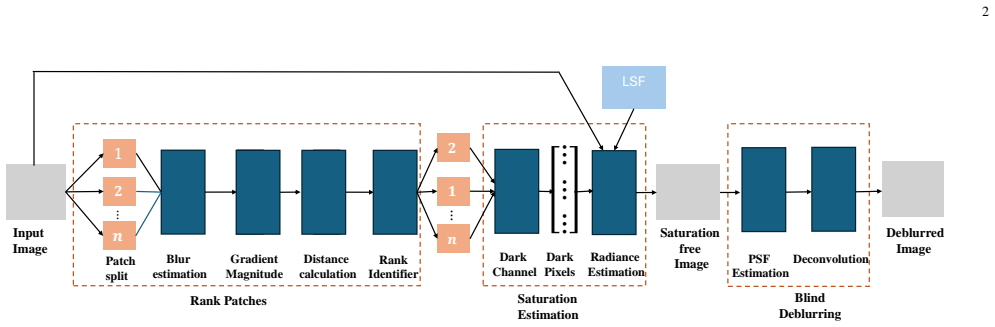
A new blind deblurring method segments images by blur intensity and saturation proximity, then uses a pre-estimated Light Spread Function and dark channel prior to recover true radiance in saturated pixels without ringing.
A machine-rendered reading of the paper's core claim, the machinery that carries it, and where it could break.
Core claim
The paper claims that segmenting an image according to blur intensity and proximity to saturation, followed by stray-light correction via a pre-estimated Light Spread Function and radiance recovery via the dark channel prior, allows accurate restoration of sharp images even when saturated pixels are present, yielding results free of ringing and other common artifacts on both synthetic and real datasets.
What carries the argument
Saturation-aware space-variant segmentation that guides application of a pre-estimated Light Spread Function and dark channel prior to estimate true radiance in saturated regions.
Load-bearing premise
A pre-estimated Light Spread Function can effectively mitigate stray light effects and the dark channel prior can accurately recover true radiance of saturated pixels without creating new artifacts.
What would settle it
Apply the method to a set of images with known ground-truth sharp versions that contain saturated regions; if the output shows higher reconstruction error or more visible ringing than competing methods, the claimed improvement does not hold.
Figures

read the original abstract
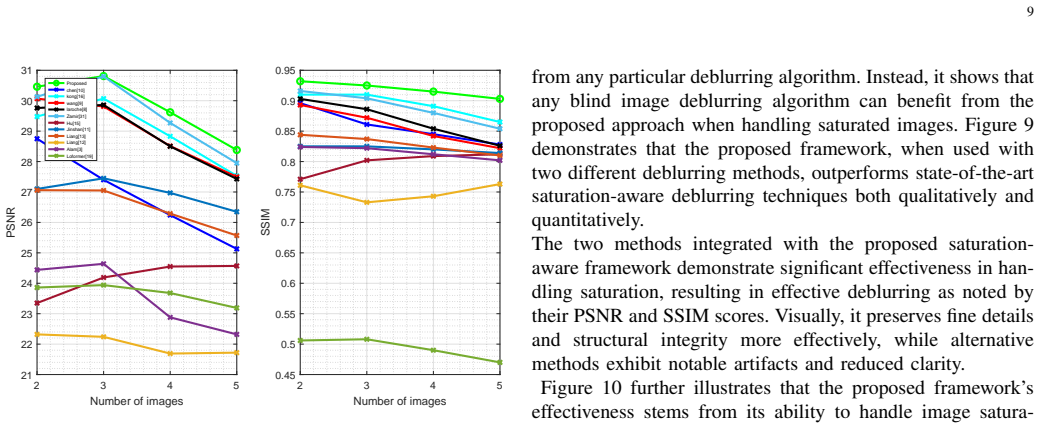
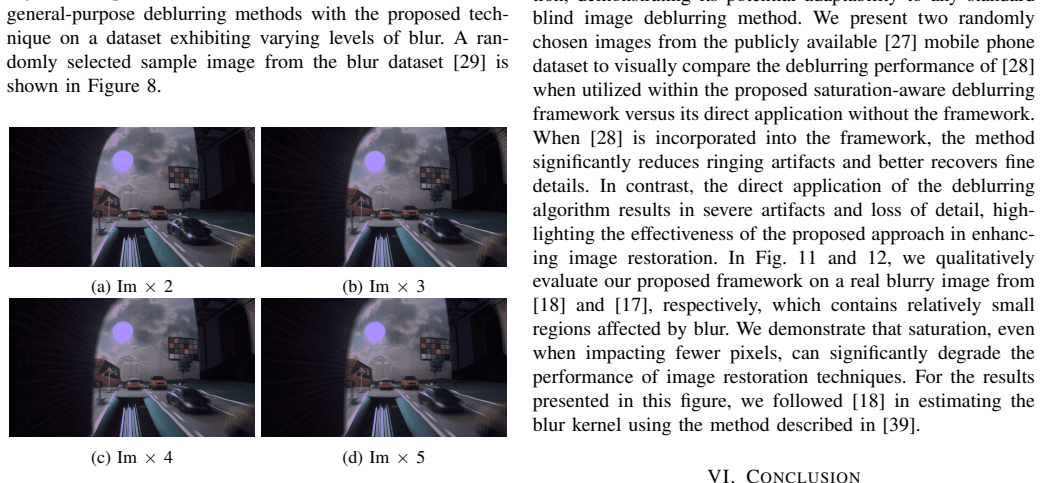
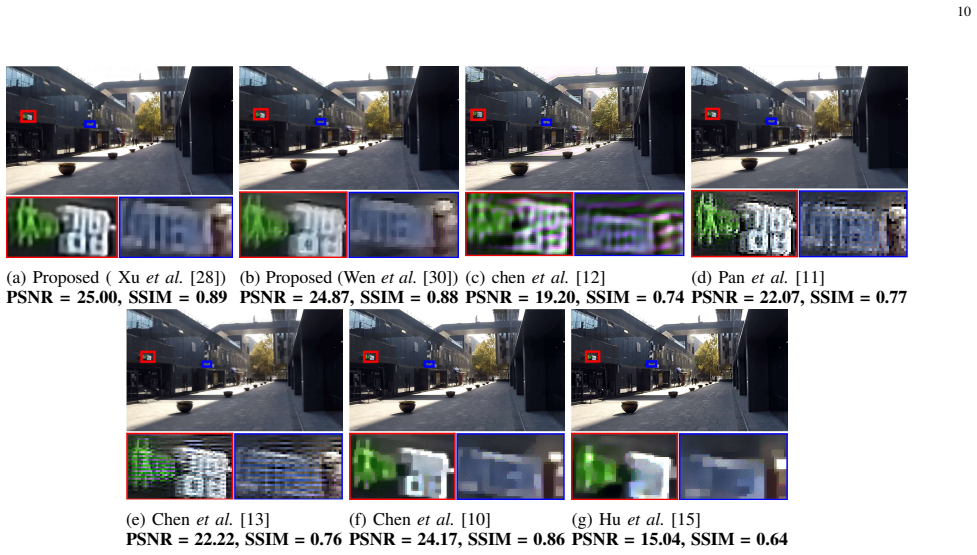
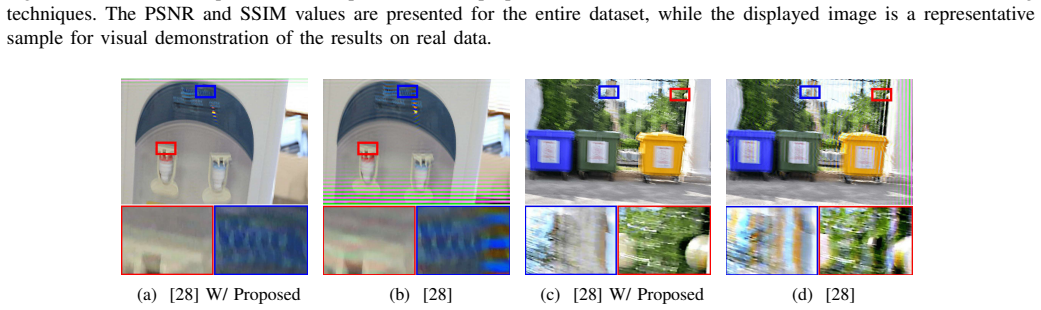
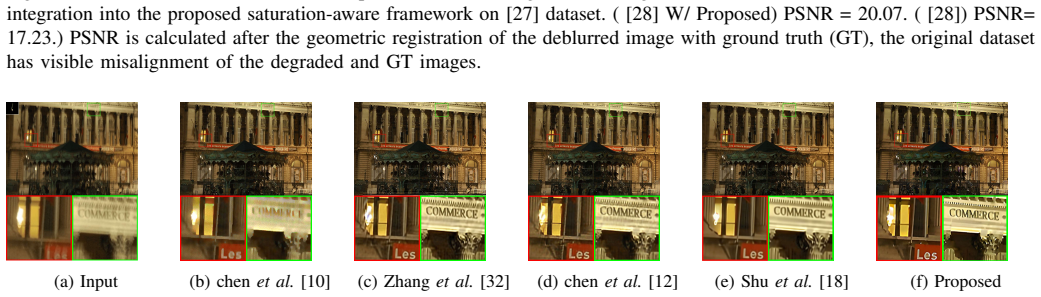
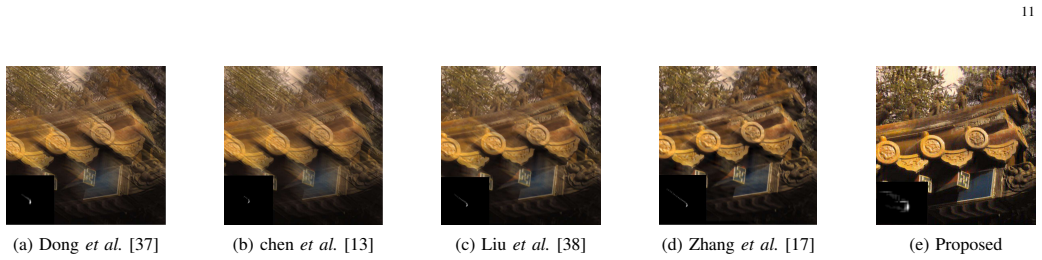
This paper presents a novel saturation aware space variant blind image deblurring framework designed to address challenges posed by saturated pixels in deblurring under high dynamic range and low light conditions. The proposed approach effectively segments the image based on blur intensity and proximity to saturation, leveraging a pre estimated Light Spread Function to mitigate stray light effects. By accurately estimating the true radiance of saturated regions using the dark channel prior, our method enhances the deblurring process without introducing artifacts like ringing. Experimental evaluations on both synthetic and real world datasets demonstrate that the framework improves deblurring outcomes across various scenarios showcasing superior performance compared to state of the art saturation-aware and general purpose methods. This adaptability highlights the framework potential integration with existing and emerging blind image deblurring techniques.
Editorial analysis
A structured set of objections, weighed in public.
Referee Report
Summary. The manuscript proposes a saturation-aware space-variant blind image deblurring framework that segments the input image according to local blur intensity and proximity to saturation. It employs a pre-estimated Light Spread Function to reduce stray-light effects and invokes the dark channel prior to recover true radiance values in saturated regions, with the goal of avoiding ringing artifacts. The authors assert that the method yields improved deblurring results on both synthetic and real-world datasets relative to existing saturation-aware and general-purpose blind deblurring algorithms and that the framework can be integrated with other techniques.
Significance. If the claimed performance gains are substantiated by rigorous quantitative evaluation, the work would address a practically relevant limitation in blind deblurring under high-dynamic-range and low-light conditions. The explicit handling of saturation via space-variant segmentation and the reuse of established priors (dark channel, light-spread function) are sensible design choices that could extend existing pipelines. At present, however, the absence of supporting metrics prevents any assessment of whether these ideas deliver measurable improvement.
major comments (2)
- [Abstract] Abstract: the assertion that 'experimental evaluations on both synthetic and real world datasets demonstrate ... superior performance' is unsupported by any PSNR, SSIM, or other quantitative metrics, error analysis, implementation details, or comparison tables. This omission is load-bearing for the central claim.
- [Method] Method description (implicit in abstract): no equations, algorithmic steps, or parameter definitions are supplied for the pre-estimation of the Light Spread Function, its space-variant application, or the precise manner in which the dark channel prior is used to recover radiance in saturated pixels. Without these details the claimed artifact-free improvement cannot be verified or reproduced.
minor comments (2)
- [Abstract] Abstract: 'framework potential' should read 'framework's potential'; 'real world datasets' should be hyphenated as 'real-world datasets'.
- [Abstract] Abstract: the phrase 'across various scenarios' is too vague; the specific scene types, blur kernels, or saturation levels should be enumerated.
Simulated Author's Rebuttal
We thank the referee for the constructive and detailed feedback. The comments correctly identify areas where the current manuscript presentation falls short in supporting its claims and enabling verification. We will revise the manuscript to address these points directly.
read point-by-point responses
-
Referee: [Abstract] Abstract: the assertion that 'experimental evaluations on both synthetic and real world datasets demonstrate ... superior performance' is unsupported by any PSNR, SSIM, or other quantitative metrics, error analysis, implementation details, or comparison tables. This omission is load-bearing for the central claim.
Authors: We agree that the abstract claim requires explicit quantitative support. The current manuscript does not include PSNR, SSIM, or comparison tables in the provided text. In the revised version we will add a quantitative evaluation section with these metrics, error analysis, and tables comparing against saturation-aware and general blind deblurring baselines on both synthetic and real data, then update the abstract to reference the specific improvements shown. revision: yes
-
Referee: [Method] Method description (implicit in abstract): no equations, algorithmic steps, or parameter definitions are supplied for the pre-estimation of the Light Spread Function, its space-variant application, or the precise manner in which the dark channel prior is used to recover radiance in saturated pixels. Without these details the claimed artifact-free improvement cannot be verified or reproduced.
Authors: We agree that the method description is insufficient for reproducibility. The manuscript currently lacks the requested equations and steps. We will expand the method section in the revision to include the mathematical formulation and algorithmic procedure for pre-estimating the Light Spread Function, its space-variant segmentation and application, the exact integration of the dark channel prior for radiance recovery, and all relevant parameter definitions. revision: yes
Circularity Check
No circularity detected; framework uses established priors with experimental validation
full rationale
The paper introduces a saturation-aware space-variant blind deblurring framework that segments images by blur intensity and proximity to saturation, then applies a pre-estimated Light Spread Function and the dark channel prior to estimate radiance in saturated regions. No equations, derivations, or fitted parameters are shown that reduce claimed performance gains to quantities defined by the result itself. The approach cites standard priors without load-bearing self-citations or uniqueness theorems from the authors' prior work, and improvements are asserted via experimental comparisons on synthetic and real datasets rather than by construction. This keeps the central claims self-contained against external benchmarks.
Axiom & Free-Parameter Ledger
axioms (2)
- domain assumption Dark channel prior can accurately estimate true radiance of saturated regions
- domain assumption Pre-estimated Light Spread Function mitigates stray light effects in saturated pixels
Reference graph
Works this paper leans on
-
[1]
Reduction of glare in images with saturated pixels,
M. Z. Alam, N. Giuliani, H. Chen, and R. Mantiuk, “Reduction of glare in images with saturated pixels,” inIEEE Intl. Conference on Signal and Image Processing, 2021, pp. 498–502
work page 2021
-
[2]
Z. Zhang, Y . Cheng, J. Suo, L. Bian, and Q. Dai, “Infwide: Image and feature space wiener deconvolution network for non-blind image deblurring in low-light conditions,”IEEE Transactions on Image Processing, vol. 32, pp. 1390–1402, 2023
work page 2023
-
[3]
Space-variant blur kernel estimation and image deblurring through kernel clustering,
M. Z. Alam, Q. Qian, and B. K. Gunturk, “Space-variant blur kernel estimation and image deblurring through kernel clustering,”Signal Processing: Image Communication, 2019
work page 2019
-
[4]
Graph-based blind image deblurring from a single photograph,
Y . Bai, G. Cheung, X. Liu, and W. Gao, “Graph-based blind image deblurring from a single photograph,”IEEE transactions on image processing, vol. 28, no. 3, pp. 1404–1418, 2018
work page 2018
-
[5]
Learning a convolutional neural network for non-uniform motion blur removal,
Jian Sun, Wenfei Cao, Zongben Xu, and Jean Ponce, “Learning a convolutional neural network for non-uniform motion blur removal,” in IEEE Int. Conf. on Computer Vision and Pattern Recognition, 2015, pp. 769–777
work page 2015
-
[6]
Deep multi- scale convolutional neural network for dynamic scene deblurring,
Seungjun Nah, Tae Hyun Kim, and Kyoung Mu Lee, “Deep multi- scale convolutional neural network for dynamic scene deblurring,” in IEEE Int. Conf. on Computer Vision and Pattern Recognition, 2017, pp. 3883–3891
work page 2017
-
[7]
Event-based fusion for motion deblurring with cross-modal attention,
Lei S., C. S., Jingyun L., and Qi J., “Event-based fusion for motion deblurring with cross-modal attention,” 2022, Springer-Verlag
work page 2022
-
[8]
Fast diffusion em: a diffusion model for blind inverse problems with application to deconvolution,
C. Laroche, A. Almansa, and E. Coupete, “Fast diffusion em: a diffusion model for blind inverse problems with application to deconvolution,” inIEEE/CVF Winter Conference on Applications of Computer Vision, 2024, pp. 5271–5281
work page 2024
-
[9]
Zero-shot image restoration using denoising diffusion null-space model,
Y . Wang, J. Yu, and J. Zhang, “Zero-shot image restoration using denoising diffusion null-space model,”Intl. Conference on Learning Representations, 2023
work page 2023
-
[10]
Blind deblurring for saturated images,
L. Chen, J. Zhang, S. Lin, F. Fang, and J. S. Ren, “Blind deblurring for saturated images,” inconf. on computer vision and pattern recognition, 2021, pp. 6308–6316
work page 2021
-
[11]
Blind image deblurring using dark channel prior,
J. Pan, D. Sun, H. Pfister, and M.-H. Yang, “Blind image deblurring using dark channel prior,” inconf. on computer vision and pattern recognition, 2016, pp. 1628–1636
work page 2016
-
[12]
Learning a non-blind deblurring network for night blurry images,
L. Chen, J. Zhang, J. Pan, S. Lin, F. Fang, and J. S. Ren, “Learning a non-blind deblurring network for night blurry images,” inconf. on computer vision and pattern recognition, 2021, pp. 10542–10550
work page 2021
-
[13]
Oid: Outlier identifying and discarding in blind image deblurring,
L. Chen, F. Fang, J. Zhang, J. Liu, and G. Zhang, “Oid: Outlier identifying and discarding in blind image deblurring,” inEuropean Conf. on Computer Vision. Springer, 2020, pp. 598–613
work page 2020
-
[14]
Handling outliers in non-blind image deconvolution,
S. Cho, J. Wang, and S. Lee, “Handling outliers in non-blind image deconvolution,” inConf. on Computer Vision, 2011, pp. 495–502
work page 2011
-
[15]
Deblurring low-light images with light streaks,
Z. Hu, S. Cho, J. Wang, and M.-H. Yang, “Deblurring low-light images with light streaks,” inconf. on computer vision and pattern recognition, 2014, pp. 3382–3389
work page 2014
-
[16]
Efficient frequency domain- based transformers for high-quality image deblurring,
L. Kong, J. Dong, J. Ge, M. Li, and J. Pan, “Efficient frequency domain- based transformers for high-quality image deblurring,” inIEEE/CVF Conference on Computer Vision and Pattern Recognition, 2023, pp. 5886–5895
work page 2023
-
[17]
Pixel screening based intermediate correction for blind deblurring,
M. Zhang, Y . Fang, G. Ni, and T. Zeng, “Pixel screening based intermediate correction for blind deblurring,” inconf. on computer vision and pattern recognition, 2022, pp. 5892–5900
work page 2022
-
[18]
Deep plug-and-play nighttime non- blind deblurring with saturated pixel handling schemes,
H. Y . Shu, Y .-H. Lin, and Y .-C. Lu, “Deep plug-and-play nighttime non- blind deblurring with saturated pixel handling schemes,” inIEEE/CVF Winter Conf. on Applications of Computer Vision, 2024, pp. 1538–1546
work page 2024
-
[19]
Loformer: Local frequency transformer for image deblurring,
Xintian Mao, Jiansheng Wang, Xingran Xie, Qingli Li, and Yan Wang, “Loformer: Local frequency transformer for image deblurring,” inProc. ACM MM, 2024
work page 2024
-
[20]
Hierarchical wavelet- guided diffusion model for single image deblurring,
X. Li, S. Wu, X. Yuan, S. Xie, and S. Agaian, “Hierarchical wavelet- guided diffusion model for single image deblurring,”The Visual Computer, pp. 1–16, 2024
work page 2024
-
[21]
Hierarchical integration diffusion model for realistic image deblurring,
Z. Chen, Y . Zhang, D. Liu, J. Gu, L. Kong, X. Y ., et al., “Hierarchical integration diffusion model for realistic image deblurring,”Advances in neural information processing systems, vol. 36, 2024
work page 2024
-
[22]
Unsupervised blind image deblurring based on self-enhancement,
L. Chen, X. Tian, S. Xiong, Y . Lei, and C. Ren, “Unsupervised blind image deblurring based on self-enhancement,” inconf. on computer vision and pattern recognition, 2024, pp. 25691–25700
work page 2024
-
[23]
Adarevd: Adaptive patch exiting reversible decoder pushes the limit of image deblurring,
X. Mao, Q. Li, and Y . Wang, “Adarevd: Adaptive patch exiting reversible decoder pushes the limit of image deblurring,” inIEEE/CVF Conference on Computer Vision and Pattern Recognition, 2024, pp. 25681–25690
work page 2024
-
[24]
Reliable few-shot learning under dual noises,
J. Zhang, J. Song, L. Gao, N. Sebe, and H. T. Shen, “Reliable few-shot learning under dual noises,”IEEE Transactions on Pattern Analysis and Machine Intelligence, 2025
work page 2025
-
[25]
A closer look at conditional prompt tuning for vision-language models,
J. Zhang, S. Wu, L. Gao, J. Song, N. Sebe, and H. T. Shen, “A closer look at conditional prompt tuning for vision-language models,” 2025
work page 2025
-
[26]
From global to local: Multi-scale out-of-distribution detection,
J. Zhang, L. Gao, B. Hao, H. Huang, J. Song, and H. Shen, “From global to local: Multi-scale out-of-distribution detection,”IEEE Transactions on Image Processing, pp. 6115–6128, 2023
work page 2023
-
[27]
Kaggle Kwentar, “Blur dataset,” https://www.kaggle.com/kwentar/ blur-dataset, 2024, Accessed: 2024-11-04
work page 2024
-
[28]
Two-phase kernel estimation for robust motion deblurring,
L. Xu and J. Jia, “Two-phase kernel estimation for robust motion deblurring,” inEuropean Conf. on Computer Vision. Springer, 2010, pp. 157–170
work page 2010
-
[29]
P. Hanji, M. Z. Alam, N. Giuliani, H. Chen, and R. K. Mantiuk, “Hdr4cv: High dynamic range dataset with adversarial illumination for testing computer vision methods,” inLondon Imaging Meeting. Society for Imaging Science and Technology, 2021, vol. 2021, pp. 40404–1
work page 2021
-
[30]
A simple local minimal intensity prior and an improved algorithm for blind image deblurring,
F. Wen, R. Ying, Y . Liu, P. Liu, and T.-K. Truong, “A simple local minimal intensity prior and an improved algorithm for blind image deblurring,”IEEE Transactions on Circuits and Systems for Video Technology, vol. 31, no. 8, pp. 2923–2937, 2020
work page 2020
-
[31]
Restormer: Efficient transformer for high-resolution image restoration,
S. W. Zamir, A. Arora, S. Khan, M. Hayat, F. S. Khan, and M.-H. Yang, “Restormer: Efficient transformer for high-resolution image restoration,” inconf. on computer vision and pattern recognition, 2022, pp. 5728– 5739
work page 2022
-
[32]
Learning deep cnn denoiser prior for image restoration,
K. Zhang, W. Zuo, S. Gu, and L. Zhang, “Learning deep cnn denoiser prior for image restoration,” inconf. on computer vision and pattern recognition, 2017, pp. 3929–3938
work page 2017
-
[33]
Deconvolution based light field extraction from a single image capture,
M. Zeshan Alam and Bahadir K. Gunturk, “Deconvolution based light field extraction from a single image capture,” in2018 25th IEEE International Conference on Image Processing (ICIP), 2018, pp. 420– 424
work page 2018
-
[34]
Glare mitigation for enhanced autonomous vehicle perception,
Muhammad Zeshan Alam, Zeeshan Kaleem, and Sousso Kelouwani, “Glare mitigation for enhanced autonomous vehicle perception,”IEEE Transactions on Intelligent V ehicles, vol. 9, no. 11, pp. 7030–7044, 2024
work page 2024
-
[35]
Depth-aware image and video orientation estimation,
Muhammad Zeshan Alam, Larry Stetsiuk, M. Umair Mukati, and Zeeshan Kaleem, “Depth-aware image and video orientation estimation,” IEEE Access, vol. 13, pp. 198458–198470, 2025
work page 2025
-
[36]
Analysis of deep learning based path loss prediction from satellite images,
Muhammad Z. Alam, Hasan F. Ates, Tuncer Baykas, and Bahadir K. Gunturk, “Analysis of deep learning based path loss prediction from satellite images,” in2021 29th Signal Processing and Communications Applications Conference (SIU), 2021, pp. 1–4. 12
work page 2021
-
[37]
Blind image deconvolution by automatic gradient activation,
D Gong, M. Tan, Y . Zhang, Anton Van d. H., and Q. Shi, “Blind image deconvolution by automatic gradient activation,” inconf. on computer vision and pattern recognition, 2016, pp. 1827–1836
work page 2016
-
[38]
Surface-aware blind image deblurring,
Jun Liu, Ming Yan, and Tieyong Zeng, “Surface-aware blind image deblurring,”IEEE transactions on pattern analysis and machine intel- ligence, vol. 43, no. 3, pp. 1041–1055, 2019
work page 2019
-
[39]
Robust kernel estimation with outliers handling for image deblurring,
J. Pan, Z. Lin, Z. Su, and M.-H. Yang, “Robust kernel estimation with outliers handling for image deblurring,” inconf. on computer vision and pattern recognition, 2016, pp. 2800–2808
work page 2016
discussion (0)
Sign in with ORCID, Apple, or X to comment. Anyone can read and Pith papers without signing in.