Degradation mechanisms and efficiency of heavily cratered regions on Ceres
Pith reviewed 2026-05-10 07:14 UTC · model grok-4.3
The pith
Ceres reaches crater equilibrium at higher densities than the Moon because degradation per impact is comparable or greater.
A machine-rendered reading of the paper's core claim, the machinery that carries it, and where it could break.
Core claim
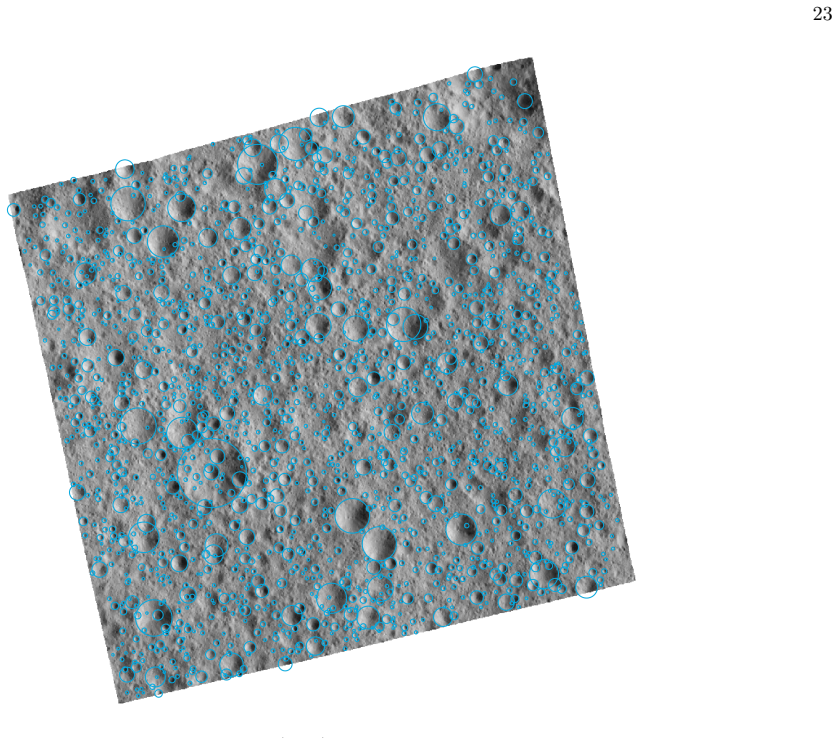
The crater equilibrium state on Ceres resembles that on the Moon but is denser. Performing model fitting with crater counting data under negligible ejecta blanketing for crater erasure, we further show that crater degradation per single crater production on Ceres is comparable to or higher than that on the Moon. Combining this finding and the impact flux on Ceres, which is orders of magnitude higher than that on the Moon, suggests that crater degradation is much more elevated on Ceres than on the Moon, despite its denser crater population.
What carries the argument
The extended crater equilibrium model fitted to cumulative size-frequency distributions from Dawn images at eight sites, which isolates degradation efficiency per crater under the assumption of negligible ejecta blanketing.
Load-bearing premise
Ejecta blanketing from impacts has negligible influence on crater erasure, so the observed equilibrium can be attributed to other impact-driven degradation processes.
What would settle it
New high-resolution images that directly measure substantial crater erasure by ejecta deposits would show the assumption is invalid and force revision of the derived degradation rates.
Figures


read the original abstract
Ceres, the dwarf planet in the main asteroid belt, hosts heavily cratered surfaces where craters are continuously eroded mainly due to impact bombardment with a limited influence by non-impact processes. Over continuous bombardment, such regions experience both crater production and erasure, eventually ceasing the crater population growth. This end-state, known as crater equilibrium, provides key information to constrain the mechanisms of crater degradation. The present study applies a recently extended crater equilibrium model to the crater equilibrium features and constrains the conditions for crater degradation on Ceres. We select eight heavily cratered sites as our test locations across four quadrangles (two sites per quadrangle) and collect crater counts using Dawn Framing Camera imagery. All sites exhibit cumulative size-frequency distributions (CSFD) with slopes slightly shallower than a power law of -2 at diameters below a few kilometers, strongly suggesting that the tested sites are at crater equilibrium. Our results show that the crater equilibrium state on Ceres resembles that on the Moon but is denser. Performing model fitting with crater counting data under negligible ejecta blanketing for crater erasure, we further show that crater degradation per single crater production on Ceres is comparable to or higher than that on the Moon. Combining this finding and the impact flux on Ceres, which is orders of magnitude higher than that on the Moon, suggests that crater degradation is much more elevated on Ceres than on the Moon, despite its denser crater population.
Editorial analysis
A structured set of objections, weighed in public.
Referee Report
Summary. The paper analyzes crater size-frequency distributions (CSFDs) from Dawn Framing Camera imagery at eight heavily cratered sites on Ceres (two per quadrangle across four quadrangles). It reports cumulative slopes slightly shallower than -2 at diameters below a few km, interprets this as crater equilibrium, fits an extended equilibrium model to the counts under the assumption of negligible ejecta blanketing, and concludes that degradation efficiency per crater production is comparable to or higher than on the Moon; combined with Ceres' much higher impact flux, this implies substantially elevated overall degradation rates on Ceres despite its denser crater population.
Significance. If the model assumptions and fits hold, the work supplies a quantitative comparison of impact-driven degradation efficiency between Ceres and the Moon, using multi-site data to constrain surface evolution on a main-belt dwarf planet. The explicit use of an extended equilibrium model and the flux scaling step are strengths that could inform regolith and crater-retention models for low-gravity bodies.
major comments (2)
- [Model fitting and results] Model-fitting section (and abstract statement on 'negligible ejecta blanketing'): Setting ejecta blanketing to zero directly determines the fitted degradation-efficiency parameter. A sensitivity analysis or quantitative justification is required showing that ejecta contributions remain negligible on Ceres given its lower gravity and regolith properties; otherwise the inferred per-crater degradation rate (and the subsequent claim of comparability or elevation relative to the Moon) could decrease substantially.
- [Crater counting and CSFDs] Crater-counting and CSFD analysis (likely §4 or methods): The manuscript does not provide the raw crater counts, diameter binning details, or formal uncertainties on the reported CSFD slopes. Without these, it is impossible to verify whether the equilibrium interpretation or the model-fit results are robust to reasonable choices in site boundaries, minimum diameter, or binning.
minor comments (1)
- [Abstract] The abstract states 'two sites per quadrangle' but does not name the quadrangles or give their locations; adding this would improve reproducibility.
Simulated Author's Rebuttal
We thank the referee for their constructive and detailed comments, which have helped us improve the clarity and robustness of the manuscript. We address each major comment below and have incorporated revisions to provide additional justification, data transparency, and sensitivity tests as requested.
read point-by-point responses
-
Referee: [Model fitting and results] Model-fitting section (and abstract statement on 'negligible ejecta blanketing'): Setting ejecta blanketing to zero directly determines the fitted degradation-efficiency parameter. A sensitivity analysis or quantitative justification is required showing that ejecta contributions remain negligible on Ceres given its lower gravity and regolith properties; otherwise the inferred per-crater degradation rate (and the subsequent claim of comparability or elevation relative to the Moon) could decrease substantially.
Authors: We agree that the assumption of negligible ejecta blanketing is a key modeling choice that influences the fitted degradation-efficiency parameter. Our original justification rested on Ceres' low gravity (~0.029 m/s²) and thin regolith, which disperses ejecta over wide areas and minimizes local blanketing in the selected heavily cratered sites. To strengthen this, we have added a quantitative sensitivity analysis in the revised manuscript (new subsection in Section 5). We re-fit the extended equilibrium model while varying the ejecta blanketing efficiency from 0 to 0.3 and show that the inferred per-crater degradation rate on Ceres remains comparable to or higher than the lunar value across this range, with the overall conclusion unchanged. We have also expanded the methods discussion to include supporting references on Ceres regolith properties and impactor velocities. revision: yes
-
Referee: [Crater counting and CSFDs] Crater-counting and CSFD analysis (likely §4 or methods): The manuscript does not provide the raw crater counts, diameter binning details, or formal uncertainties on the reported CSFD slopes. Without these, it is impossible to verify whether the equilibrium interpretation or the model-fit results are robust to reasonable choices in site boundaries, minimum diameter, or binning.
Authors: We fully agree that raw data, binning details, and uncertainties are necessary for verification and reproducibility. In the revised manuscript we have added a new appendix (Appendix A) that tabulates all raw crater diameters and counts for the eight sites. We now explicitly describe the binning (logarithmic bins with factor 2^{1/4}), the minimum reliable diameter (0.5 km set by image resolution), and the site boundary definitions tied to the quadrangle maps. Formal Poisson uncertainties have been added to all CSFD plots and slope fits. We have also included a brief robustness subsection reporting that the equilibrium slopes and model results remain consistent when varying minimum diameter (0.3–1 km) and site boundaries within reasonable limits. revision: yes
Circularity Check
No significant circularity: data-driven fit under explicit assumption yields independent comparison
full rationale
The derivation fits an extended equilibrium model directly to eight observed CSFDs from Ceres sites, obtaining a degradation efficiency parameter under the stated assumption of negligible ejecta blanketing. This parameter is compared to independent lunar literature values and then scaled by an external impact-flux ratio. No claimed result reduces by construction to the input counts or to a self-citation; the model application remains falsifiable against the crater data and does not rename or smuggle prior results as new predictions.
Axiom & Free-Parameter Ledger
free parameters (1)
- degradation efficiency per crater
axioms (1)
- domain assumption The extended crater equilibrium model correctly captures the balance between crater production and erasure on Ceres when ejecta blanketing is negligible.
Reference graph
Works this paper leans on
-
[1]
Ammannito, E., DeSanctis, M. C., Ciarniello, M., et al. 2016, Science, 353, aaf4279, doi: 10.1126/science.aaf4279
-
[2]
L., Conway, S., Jabaud, B., Tobie, G., & Artoni, R
Becq, N. L., Conway, S., Jabaud, B., Tobie, G., & Artoni, R. 2025, Icarus, 428, 116353, doi: 10.1016/j.icarus.2024.116353
-
[3]
Bierhaus, E. B., McEwen, A. S., Robbins, S. J., et al. 2018, Meteoritics & Planetary Science, 53, 638, doi: 10.1111/maps.13057
-
[4]
Bland, M. T., Raymond, C. A., Schenk, P. M., et al. 2016, Nature Geoscience, 9, 538, doi: 10.1038/ngeo2743
-
[5]
Bottke, W. F., Durda, D. D., Nesvorn´ y, D., et al. 2005, Icarus, 179, 63, doi: 10.1016/j.icarus.2005.05.017
-
[6]
Buczkowski, D. L., Schmidt, B. E., Williams, D. A., et al. 2016, Science, 353, doi: 10.1126/science.aaf4332
-
[7]
Buczkowski, D. L., Scully, J. E., Quick, L., et al. 2019, Icarus, 320, 49, doi: 10.1016/j.icarus.2018.05.012
-
[8]
Castillo-Rogez, J. C., Hesse, M. A., Formisano, M., et al. 2019, Geophysical Research Letters, 46, 1963, doi: 10.1029/2018GL081473
-
[9]
Chilton, H. T., Schmidt, B. E., Duarte, K., et al. 2019, Journal of Geophysical Research: Planets, 124, 1512, doi: 10.1029/2018JE005634
-
[10]
Combe, J.-P., McCord, T. B., Tosi, F., et al. 2016, Science, 353, aaf3010, doi: 10.1126/science.aaf3010
-
[11]
Costello, E. S., Ghent, R. R., Hirabayashi, M., & Lucey, P. G. 2020, Journal of Geophysical Research: Planets, 125, e2019JE006172, doi: 10.1029/2019JE006172
-
[12]
Costello, E. S., Ghent, R. R., & Lucey, P. G. 2021, Geophysical Research Letters, 48, e2021GL092960, doi: 10.1029/2021GL092960 Crater Analysis Techniques Working Group. 1979, Icarus, 37, doi: 10.1016/0019-1035(79)90009-5
-
[13]
Duarte, K. D., Schmidt, B. E., Chilton, H. T., et al. 2019, Journal of Geophysical Research: Planets, 124, 3329, doi: 10.1029/2018JE005673
-
[14]
Hughson, K. H. G., & Park, R. S. 2019, Journal of Geophysical Research: Planets, 124, 14, doi: 10.1029/2018JE005813
-
[15]
Fassett, C. I., & Thomson, B. J. 2014, Journal of Geophysical Research: Planets, 119, 2255, doi: 10.1002/2014JE004698
-
[16]
Fassett, C. I., Beyer, R. A., Deutsch, A. N., et al. 2022, Journal of Geophysical Research: Planets, 127, doi: 10.1029/2022JE007510
-
[17]
Formisano, M., Federico, C., De Sanctis, M. C., et al. 2018, Journal of Geophysical Research: Planets, 123, 2445, doi: 10.1029/2017JE005417
-
[18]
2018, Icarus, 316, doi: 10.1016/j.icarus.2018.08.015
Frigeri, A., Schmedemann, N., Williams, D., et al. 2018, Icarus, 316, doi: 10.1016/j.icarus.2018.08.015
-
[19]
Fu, R. R., Ermakov, A. I., Marchi, S., et al. 2017, Earth and Planetary Science Letters, 476, 153, doi: 10.1016/j.epsl.2017.07.053
-
[20]
2018, Icarus, 302, 296, doi: 10.1016/j.icarus.2017.11.028
Gou, S., Yue, Z., Di, K., & Liu, Z. 2018, Icarus, 302, 296, doi: 10.1016/j.icarus.2017.11.028
-
[21]
Hartmann, W. K. 1984, Icarus, 60, 56, doi: 10.1016/0019-1035(84)90138-6
-
[22]
2023, Planetary and Space Science, 231, 105687, doi: 10.1016/j.pss.2023.105687
Heyer, T., Iqbal, W., Oetting, A., et al. 2023, Planetary and Space Science, 231, 105687, doi: 10.1016/j.pss.2023.105687
-
[23]
2016, Science, 353, doi: 10.1126/science.aaf4759
Hiesinger, H., Marchi, S., Schmedemann, N., et al. 2016, Science, 353, doi: 10.1126/science.aaf4759
-
[24]
Hirabayashi, M., Fassett, C. I., Costello, E. S., & Minton, D. A. 2024, The Planetary Science Journal, 5, 250, doi: 10.3847/psj/ad8883
-
[25]
Hirabayashi, M., Howl, B. A., Fassett, C. I., et al. 2018, Journal of Geophysical Research: Planets, 123, 527, doi: 10.1002/2017JE005377
-
[26]
Hirabayashi, M., Minton, D. A., & Fassett, C. I. 2017, Icarus, 289, 134–143, doi: 10.1016/j.icarus.2016.12.032
-
[27]
Hughson, K. H. G., Russell, C. T., Schmidt, B. E., et al. 2019, Journal of Geophysical Research: Planets, 124, 1819, doi: 10.1029/2018JE005666
-
[28]
Ivanov, B. A., Neukum, G., Bottke, W. F., & Hartmann, W. K. 2002, The Comparison of Size-Frequency Distributions of Impact Craters and Asteroids and the Planetary Cratering Rate (The University of Arizona Press), 89–102, doi: 10.2307/j.ctv1v7zdn4.13
-
[29]
Krohn, K., Jaumann, R., Otto, K., et al. 2018, Icarus, 316, 84, doi: 10.1016/j.icarus.2017.09.014 Kurt Menke, G., Smith Jr, R., Pirelli, L., John Van Hoesen, G., et al. 2016, Mastering QGIS (Packt Publishing Ltd)
-
[30]
E., Byrne, S., Sch¨ orghofer, N., et al
Landis, M. E., Byrne, S., Sch¨ orghofer, N., et al. 2017, Journal of Geophysical Research: Planets, 122, 1984, doi: 10.1002/2017JE005335
-
[31]
Marchi, S., Ermakov, A. I., Raymond, C. A., et al. 2016, Nature Communications, 7, doi: 10.1038/ncomms12257
-
[32]
McEwen, A. S., & Bierhaus, E. B. 2006, Annual Review of Earth and Planetary Sciences, 34, 535, doi: 10.1146/annurev.earth.34.031405.125018
-
[33]
Melosh, H. J. 1989, in Oxford Monographs on Geology and
work page 1989
-
[34]
Mest, S., Williams, D. A., Crown, D., et al. 2016, in Geophysical Research Abstracts, Vol. 18, EGU General Assembly 2016 25
work page 2016
-
[35]
Minton, D. A., Fassett, C. I., Hirabayashi, M., Howl, B. A., & Richardson, J. E. 2019, Icarus, 326, 63, doi: 10.1016/j.icarus.2019.02.021
-
[36]
Minton, D. A., & Malhotra, R. 2010, Icarus, 207, 744, doi: 10.1016/j.icarus.2009.12.008
-
[37]
Minton, D. A., Richardson, J. E., & Fassett, C. I. 2015, Icarus, 247, 172, doi: 10.1016/j.icarus.2014.10.018
-
[38]
2022, in Lunar and Planetary Science Conference
Fassett, C. 2022, in Lunar and Planetary Science Conference
work page 2022
-
[39]
2010, The Astronomical Journal, 140, 1391, doi: 10.1088/0004-6256/140/5/1391
Tsiganis, K. 2010, The Astronomical Journal, 140, 1391, doi: 10.1088/0004-6256/140/5/1391
-
[40]
2016,, Dataset ID: DAWN-A-FC2-3-RDR-CERES-IMAGES-V1.0 NASA Planetary Data System
Nathues, A., Sierks, H., Gutierrez-Marques, P., et al. 2016,, Dataset ID: DAWN-A-FC2-3-RDR-CERES-IMAGES-V1.0 NASA Planetary Data System
work page 2016
-
[41]
2017, The Astronomical Journal, 153, 112, doi: 10.3847/1538-3881/153/3/112
Nathues, A., Platz, T., Thangjam, G., et al. 2017, The Astronomical Journal, 153, 112, doi: 10.3847/1538-3881/153/3/112
-
[42]
2020, Nature Astronomy, 4, 794, doi: 10.1038/s41550-020-1146-8 Nesvorn´ y, D., Roig, F., & Bottke, W
Nathues, A., Schmedemann, N., Thangjam, G., et al. 2020, Nature Astronomy, 4, 794, doi: 10.1038/s41550-020-1146-8 Nesvorn´ y, D., Roig, F., & Bottke, W. F. 2017, The Astronomical Journal, 153, 103, doi: 10.3847/1538-3881/153/3/103
-
[43]
2001, Space Science Reviews, 96, 55–86, doi: 10.1023/a:1011989004263 O’Brien, D
Neukum, G., Ivanov, B., & Hartmann, W. 2001, Space Science Reviews, 96, 55–86, doi: 10.1023/a:1011989004263 O’Brien, D. P., Marchi, S., Morbidelli, A., et al. 2014, Planetary and Space Science, 103, 131, doi: 10.1016/j.pss.2014.05.013
-
[44]
Sizemore, H. G. 2019, Journal of Geophysical Research: Planets, 124, 1188, doi: 10.1029/2018JE005660
-
[45]
2018, Icarus, 316, 28, doi: 10.1016/j.icarus.2017.06.015
Pasckert, J., Hiesinger, H., Ruesch, O., et al. 2018, Icarus, 316, 28, doi: 10.1016/j.icarus.2017.06.015
-
[46]
2016, Nature Astronomy, 1, 0007 Pokorn´ y, P., Mazarico, E., & Schorghofer, N
Platz, T., Nathues, A., Schorghofer, N., et al. 2016, Nature Astronomy, 1, 0007 Pokorn´ y, P., Mazarico, E., & Schorghofer, N. 2021,
work page 2016
-
[47]
2018, Planetary and Space Science, 162, 41, doi: 10.1016/j.pss.2017.05.006 QGIS Development Team
Povilaitis, R., Robinson, M., van der Bogert, C., et al. 2018, Planetary and Space Science, 162, 41, doi: 10.1016/j.pss.2017.05.006 QGIS Development Team. 2021, QGIS Geographic Information System, QGIS Association. https://www.qgis.org
-
[48]
Quick, L. C., Buczkowski, D. L., Ruesch, O., et al. 2019, Icarus, 320, 119, doi: 10.1016/j.icarus.2018.07.016
-
[49]
Richardson, J. E. 2009, Icarus, 204, 697, doi: 10.1016/j.icarus.2009.07.029
-
[50]
Riedel, C., Minton, D. A., Michael, G., et al. 2020, Journal of Geophysical Research: Planets, 125, doi: 10.1029/2019JE006273
-
[51]
Robbins, S. J., Kirchoff, M. R., & Ostrach, L. R. 2025, Geophysical Research Letters, 52, doi: 10.1029/2024GL110570
-
[52]
J., Antonenko, I., Kirchoff, M
Robbins, S. J., Antonenko, I., Kirchoff, M. R., et al. 2014, Icarus, 234, 109, doi: 10.1016/j.icarus.2014.02.022
-
[53]
2016, Science, 353, aaf4286, doi: 10.1126/science.aaf4286
Ruesch, O., Platz, T., Schenk, P., et al. 2016, Science, 353, aaf4286, doi: 10.1126/science.aaf4286
-
[54]
Russell, C. T., & Raymond, C. A. 2011, Space Science Reviews, 163, 3, doi: 10.1007/s11214-011-9836-2
-
[55]
Russell, C. T., Raymond, C. A., Ammannito, E., et al. 2016, Science, 353, doi: 10.1126/science.aaf4219
-
[56]
Schenk, P., Chapman, C. R., Zahnle, K., & Moore, J. M. 2004, Ages and interiors: the cratering record of the Galilean satellites
work page 2004
-
[57]
2020, Nature Communications, 11, 3679
Schenk, P., Scully, J., Buczkowski, D., et al. 2020, Nature Communications, 11, 3679
work page 2020
-
[58]
2014, Planetary and Space Science, 103, 104, doi: 10.1016/j.pss.2014.04.004
Schmedemann, N., Kneissl, T., Ivanov, B., et al. 2014, Planetary and Space Science, 103, 104, doi: 10.1016/j.pss.2014.04.004
-
[59]
Schmidt, B. E., Hughson, K. H. G., Chilton, H. T., et al. 2017, Nature Geoscience, 10, 338, doi: 10.1038/ngeo2936
-
[60]
Schmidt, B. E., Sizemore, H. G., Hughson, K. H. G., et al. 2020, Nature Geoscience, 13, 605, doi: 10.1038/s41561-020-0581-6 Schr¨ oder, S. E., Poch, O., Ferrari, M., et al. 2021, Nature Communications, 12, 274, doi: 10.1038/s41467-020-20494-5
-
[62]
E., Buczkowski, D., Neesemann, A., et al
Scully, J. E., Buczkowski, D., Neesemann, A., et al. 2018, Icarus, 316, 46, doi: 10.1016/j.icarus.2017.10.038
-
[63]
Scully, J. E., Buczkowski, D. L., Raymond, C. A., et al. 2019a, Icarus, 320, 7, doi: 10.1016/j.icarus.2018.04.014
-
[64]
E., Bowling, T., Bu, C., et al
Scully, J. E., Bowling, T., Bu, C., et al. 2019b, Icarus, 320, 213, doi: 10.1016/j.icarus.2018.08.029
-
[65]
Sierks, H., Keller, H. U., Jaumann, R., et al. 2011, Space Science Reviews, 163, 263, doi: 10.1007/s11214-011-9745-4
-
[66]
K., Bergantini, A., Zhu, C., et al
Singh, S. K., Bergantini, A., Zhu, C., et al. 2021, Nature Communications, 12, 2690
work page 2021
-
[67]
Soderblom, L. A. 1970, Journal of Geophysical Research (1896-1977), 75, 2655, doi: 10.1029/JB075i014p02655
-
[68]
Sori, M. M., Byrne, S., Bland, M. T., et al. 2017, Geophysical Research Letters, 44, 1243, doi: 10.1002/2016GL072319
-
[69]
2018, Icarus, 302, 104, doi: 10.1016/j.icarus.2017.11.013 26
Strom, R., Marchi, S., & Malhotra, R. 2018, Icarus, 302, 104, doi: 10.1016/j.icarus.2017.11.013 26
-
[70]
L., Hirabayashi, M., Montalvo, P
Talkington, C. L., Hirabayashi, M., Montalvo, P. E., et al. 2022, Geophysical Research Letters, 49, doi: 10.1029/2022GL099241
-
[71]
2022, Icarus, 377, 114909, doi: 10.1016/j.icarus.2022.114909
Iwata, T. 2022, Icarus, 377, 114909, doi: 10.1016/j.icarus.2022.114909
-
[72]
Xiao, Z., & Werner, S. C. 2015, Journal of Geophysical Research: Planets, 120, 2277, doi: 10.1002/2015JE004860
-
[73]
2020, PhD thesis, Northern Arizona University
Zeilnhofer, M. 2020, PhD thesis, Northern Arizona University
work page 2020
-
[74]
Zeilnhofer, M. F., & Barlow, N. G. 2020, in Lunar and Planetary Science Conference
work page 2020
discussion (0)
Sign in with ORCID, Apple, or X to comment. Anyone can read and Pith papers without signing in.