CrossTraffic: An Open-Source Framework for Reproducible and Executable Transportation Analysis and Knowledge Management
Pith reviewed 2026-05-16 05:41 UTC · model grok-4.3
The pith
CrossTraffic embeds transportation rules in a knowledge graph so large language models can run accurate, validated analyses via natural language.
A machine-rendered reading of the paper's core claim, the machinery that carries it, and where it could break.
Core claim
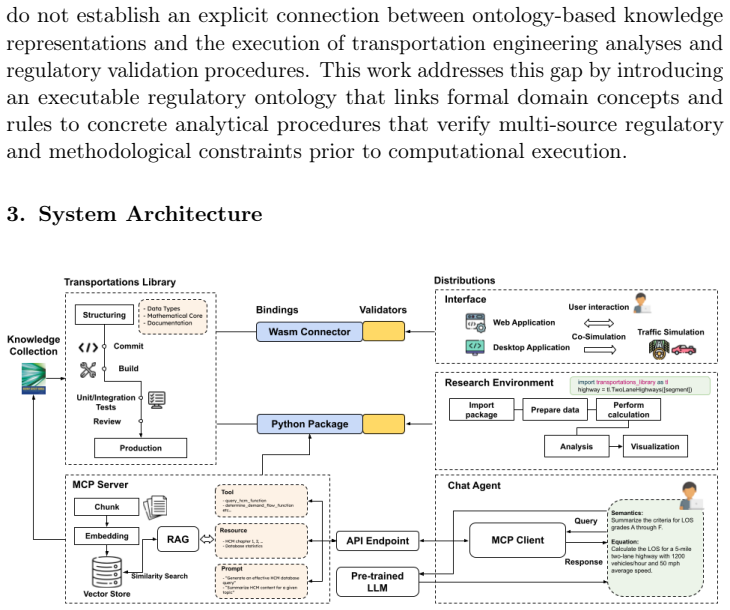
CrossTraffic treats transportation methodologies as continuously deployable software infrastructure. An ontology-driven knowledge graph encodes rules and provenance from sources such as the Highway Capacity Manual and acts as a semantic validation layer. A conversational interface links large language models to this layer through structured tool calls, allowing natural-language access while blocking procedurally invalid analyses. Tests across multiple models report mean absolute error below 0.50 and perfect detection of invalid inputs (F1 approximately 1.0).
What carries the argument
The ontology-driven knowledge graph that encodes engineering rules, provenance, and validation logic from source manuals and serves as the semantic validation layer for LLM-driven analytical workflows.
If this is right
- Analyses become reproducible across users and platforms because the same validated execution core is invoked every time.
- Updates to manuals can be propagated once through the graph and immediately affect all connected tools and LLM interfaces.
- New transportation models and additional manuals can be added modularly without rebuilding the core system.
- Collaborative development is enabled because the executable core and validation rules are openly available rather than locked in proprietary software.
Where Pith is reading between the lines
- The same pattern of graph-constrained execution could be applied to other domains that rely on dense technical manuals, such as structural engineering or environmental permitting.
- Over time the framework might reduce dependence on proprietary traffic software by offering an open, extensible alternative that still meets regulatory standards.
- Periodic audits of the knowledge graph against the latest manual editions would be a practical way to maintain long-term accuracy.
Load-bearing premise
The knowledge graph correctly and completely encodes every engineering rule, provenance detail, and validation check from the source manuals without omissions or encoding errors.
What would settle it
Run a set of standard Highway Capacity Manual calculations both by hand and through the framework after deliberately omitting one rule from the graph, then check whether numerical outputs diverge or invalid inputs go undetected.
Figures


read the original abstract
Transportation engineering often relies on technical manuals and analytical tools for planning, design, and operations. However, the dissemination and management of these methodologies, such as those defined in the Highway Capacity Manual (HCM), remain fragmented. Computational procedures are often embedded within proprietary tools, updates are inconsistently propagated across platforms, and knowledge transfer is limited. These challenges hinder reproducibility, interoperability, and collaborative advancement in transportation analysis. This paper introduces CrossTraffic, an open-source framework that treats transportation methodologies and regulatory knowledge as continuously deployable and verifiable software infrastructure. CrossTraffic provides an executable computational core for transportation analysis with cross-platform access through standardized interfaces. An ontology-driven knowledge graph encodes engineering rules and provenance and serves as a semantic validation layer for analytical workflows. A conversational interface further connects large language models to this validated execution environment through structured tool invocation, enabling natural-language access while preventing procedurally invalid analyses. Experimental results show that knowledge-graph-constrained execution substantially improves numerical accuracy and methodological fidelity compared with context-only approaches, achieving near-zero numerical error (MAE<0.50) across multiple large language models and perfect detection of invalid analytical inputs in stress testing (F1~=~1.0). Its modular architecture supports the integration of additional transportation manuals and research models, providing a foundation for an open and collaborative transportation science ecosystem with a reproducible computational core. The system implementation is publicly available at https://github.com/crosstraffic.
Editorial analysis
A structured set of objections, weighed in public.
Referee Report
Summary. The paper introduces CrossTraffic, an open-source framework for transportation analysis that uses an ontology-driven knowledge graph to encode engineering rules and provenance from sources like the Highway Capacity Manual. It provides executable computational cores, standardized interfaces, and a conversational LLM interface with structured tool invocation for validated analyses. Experiments claim that KG-constrained execution achieves MAE < 0.50 and F1 ≈ 1.0 for validity detection compared to context-only approaches.
Significance. If the results hold, this framework could significantly advance reproducibility and accessibility in transportation engineering by providing a verifiable, open-source platform that integrates knowledge management with computational execution, potentially reducing reliance on proprietary tools and improving knowledge transfer.
major comments (3)
- [Experimental results] Experimental results section: The headline claims of MAE<0.50 numerical accuracy and F1≈1.0 for invalid-input detection are presented as summary statistics with no description of the test cases, baselines, data splits, number of trials, or error-bar reporting, so the central performance claims cannot be verified from the manuscript.
- [Methods / Knowledge Graph] Knowledge-graph construction: The abstract and methods state that the ontology-driven KG 'encodes engineering rules and provenance' from the Highway Capacity Manual, but supply no account of the encoding process, expert review, automated consistency checks, or side-by-side validation against reference manual calculations; this omission directly undermines the claim that KG-constrained execution improves methodological fidelity.
- [Evaluation / Stress testing] Evaluation design: The stress-testing protocol for perfect detection of invalid analyses risks circularity because the test inputs may have been generated from the same KG that is used for validation; without an independently sourced test set, the F1≈1.0 result cannot be taken as evidence of general robustness.
minor comments (1)
- [Abstract] The phrase 'near-zero numerical error (MAE<0.50)' should be clarified as to whether the MAE is absolute or relative and what units are used for the transportation metrics.
Simulated Author's Rebuttal
We thank the referee for their constructive and detailed feedback. We address each major comment below and have revised the manuscript to strengthen the verifiability of our claims.
read point-by-point responses
-
Referee: Experimental results section: The headline claims of MAE<0.50 numerical accuracy and F1≈1.0 for invalid-input detection are presented as summary statistics with no description of the test cases, baselines, data splits, number of trials, or error-bar reporting, so the central performance claims cannot be verified from the manuscript.
Authors: We agree that the original Experimental Results section provided insufficient detail on the experimental protocol. In the revised manuscript we have expanded this section to describe the full set of test cases (including specific HCM-derived scenarios and synthetic invalid inputs), the context-only and other baselines, the train/test splits used, the number of independent trials, and error bars on all reported metrics. These additions enable direct verification of the MAE < 0.50 and F1 ≈ 1.0 figures. revision: yes
-
Referee: Knowledge-graph construction: The abstract and methods state that the ontology-driven KG 'encodes engineering rules and provenance' from the Highway Capacity Manual, but supply no account of the encoding process, expert review, automated consistency checks, or side-by-side validation against reference manual calculations; this omission directly undermines the claim that KG-constrained execution improves methodological fidelity.
Authors: We acknowledge that the manuscript omitted a detailed description of KG construction. We have added a new subsection in Methods that documents the encoding workflow, the mapping of specific HCM procedures into ontology classes and relations, the expert review process, the automated consistency checks applied, and quantitative side-by-side comparisons of KG-derived results against reference manual calculations. This material directly supports the fidelity claims. revision: yes
-
Referee: Evaluation design: The stress-testing protocol for perfect detection of invalid analyses risks circularity because the test inputs may have been generated from the same KG that is used for validation; without an independently sourced test set, the F1≈1.0 result cannot be taken as evidence of general robustness.
Authors: We have revised the Evaluation section to clarify that the invalid-input test cases were drawn from an independent collection of published transportation case studies and expert-authored scenarios that were never used during KG construction or rule encoding. We now report the provenance of this test set and the procedure used to ensure it is disjoint from the KG content, thereby removing the circularity concern while preserving the reported F1 score. revision: yes
Circularity Check
No significant circularity; framework presents independent experimental results
full rationale
The paper describes a software framework (CrossTraffic) that integrates an ontology-driven knowledge graph for validating transportation analysis workflows and constraining LLM tool calls. Reported metrics (MAE<0.50 numerical error and F1≈1.0 invalid-input detection) arise from direct empirical comparisons of KG-constrained execution versus context-only baselines across multiple LLMs, plus stress testing. No equations, fitted parameters, or derivations appear in the provided text that would reduce these outcomes to self-referential definitions or inputs by construction. The knowledge graph is positioned as an encoding of external manuals (e.g., HCM), and the evaluation is framed as testing fidelity against that encoding rather than deriving the metrics from the encoding itself. This matches the reader's assessment of minimal circularity risk and qualifies as self-contained against external benchmarks per the guidelines.
Axiom & Free-Parameter Ledger
axioms (1)
- domain assumption Transportation engineering rules from manuals such as the Highway Capacity Manual can be encoded completely and correctly into an ontology that supports semantic validation of workflows.
invented entities (1)
-
CrossTraffic knowledge graph
no independent evidence
Lean theorems connected to this paper
-
IndisputableMonolith/Foundation/AbsoluteFloorClosure.leanreality_from_one_distinction unclear?
unclearRelation between the paper passage and the cited Recognition theorem.
An ontology-driven knowledge graph encodes engineering rules and provenance and serves as a semantic validation layer for analytical workflows.
What do these tags mean?
- matches
- The paper's claim is directly supported by a theorem in the formal canon.
- supports
- The theorem supports part of the paper's argument, but the paper may add assumptions or extra steps.
- extends
- The paper goes beyond the formal theorem; the theorem is a base layer rather than the whole result.
- uses
- The paper appears to rely on the theorem as machinery.
- contradicts
- The paper's claim conflicts with a theorem or certificate in the canon.
- unclear
- Pith found a possible connection, but the passage is too broad, indirect, or ambiguous to say the theorem truly supports the claim.
Reference graph
Works this paper leans on
-
[1]
L. Oman, A. J. Wilson, F. D. Harrison, Implementing transportation knowledge networks, Research Report 20-75, National Academies of Sciences, Engineering, and Medicine, 2009
work page 2009
-
[2]
E. Kleinsteuber, T. Al Mustafa, F. Zander, B. König-Ries, S. Babalou, Managing provenance data in knowledge graph management platforms, Datenbank Spektrum 24 (2024) 43–52
work page 2024
-
[3]
C. W. Jenks, C. Hedges, A. C. Lemer, S. Moore, E. P. Delaney, S. E. Hitchcock, A guide to agency-wide knowledge management for state departments of transportation, NCHRP Report 813, National Academies of Sciences, Engineering, and Medicine, 2015
work page 2015
-
[4]
F. D. Harrison, C. Brown, K. Admas, T. Hall, Knowledge management at state departments of transportation research roadmap, Research Report 1134, National Academies of Sciences, Engineering, and Medicine, 2025
work page 2025
-
[5]
X. Bai, S. He, Y. Li, X. Yabo, Z. Xin, D. Wenli, L. Jian-Rong, Con- struction of a knowledge graph for framework material enabled by large language models and its application, npj Computational Materials 11 (2025). 21
work page 2025
-
[6]
Sparks of Artificial General Intelligence: Early experiments with GPT-4
S. Bubeck, V. Chandrasekaran, R. Eldan, J. Gehrke, E. Horvitz, E. Ka- mar, P. Lee, Y. T. Lee, Y. Li, S. Lundberg, et al., Sparks of artificial general intelligence: Early experiments with gpt-4, arXiv preprint arXiv:2303.12712 (2023)
work page internal anchor Pith review Pith/arXiv arXiv 2023
-
[7]
L. Pangaribuan, A. Satrya, The role of knowledge management, trans- formational leadership, and organizational commitment on employee performance: empirical study in public sector, Journal of Theory and Applied Management 17 (2024) 355–371
work page 2024
-
[8]
E. Bolisani, C. Bratianu, The elusive definition of knowledge, volume None ofKnowledge Management and Organizational Learning, none ed., Springer, 2018
work page 2018
-
[9]
F. Olan, O. E. Arakpogun, J. Suklan, F. Nakpodia, N. Damij, U. Jayaw- ickrama, Artificial intelligence and knowledge sharing: Contributing factors to organizational performance, Journal of Business Research 145 (2022) 605–615
work page 2022
-
[10]
M. H. Jarrahi, D. Askay, A. Eshraghi, P. Smith, Artificial intelligence and knowledge management: A partnership between human and ai, Business Horizons 66 (2023) 87–99
work page 2023
-
[11]
V. Weerakkody, M. Janssen, R. El-Haddadeh, The resurgence of business process re-engineering in public sector transformation efforts: Exploring the systemic challenges and unintended consequences, Inf Syst E-Bus Manage 19 (2021) 993–1014
work page 2021
-
[12]
S. Higgins, The dcc curation lifecycle model, International Journal of Digital Curation 3 (2008) 134–140
work page 2008
- [13]
-
[14]
M. Chowdhury, K. Dey, A. Apon, Data analytics for intelligent trans- portation systems, Elsevier, 2024
work page 2024
- [15]
-
[16]
C. Goumopoulos, Smart city middleware: A survey and a conceptual framework, IEEE Access 12 (2024) 4015–4047
work page 2024
- [17]
-
[18]
E. F. Z. Santana, A. P. Chaves, M. A. Gerosa, F. Kon, D. S. Milojicic, Software platforms for smart cities: Concepts, requirements, challenges, and a unified reference architecture, ACM Comput. Surv. 50 (2017)
work page 2017
- [19]
-
[20]
M. K., M. F., Ontologies for transportation research: A survey, Trans- portation Research Part C: Emerging Technologies 89 (2018) 53–82
work page 2018
- [21]
- [22]
-
[23]
J. Tupayachi, H. Xu, O. A. Omitaomu, M. C. Camur, A. Sharmin, X. Li, Towards next-generation urban decision support systems through ai-powered construction of scientific ontology using large language mod- els—a case in optimizing intermodal freight transportation, Smart Cities 7 (2024) 2392–2421
work page 2024
-
[24]
S. Ye, Q. Wu, P. Fan, Q. Fan, A survey on semantic communications in internet of vehicles, Entropy 27 (2025)
work page 2025
-
[25]
Y. Lu, B. Yao, H. Gu, J. Huang, Z. J. Wang, Y. Li, J. Gesi, Q. He, T. J. Li, D. Wang, Uxagent: An llm agent-based usability testing framework for web design, in: Proceedings of the Extended Abstracts of the CHI Conference on Human Factors in Computing Systems, CHI EA ’25, Association for Computing Machinery, New York, NY, USA, 2025
work page 2025
- [26]
-
[27]
H. Yang, M. Siew, C. Joe-Wong, An llm-based digital twin for optimizing human-in-the loop systems, in: 2024 IEEE International Workshop on Foundation Models for Cyber-Physical Systems & Internet of Things (FMSys), 2024, pp. 26–31
work page 2024
-
[28]
C. Cui, Y. Ma, X. Cao, W. Ye, Y. Zhou, K. Liang, J. Chen, J. Lu, Z. Yang, K. Liao, T. Gao, E. Li, K. Tang, Z. Cao, T. Zhou, A. Liu, X. Yan, S. Mei, J. Cao, Z. Wang, C. Zheng, A survey on multimodal large language models for autonomous driving, in: Proceedings of the IEEE/CVF Winter Conference on Applications of Computer Vision (WACV) Workshops, 2024, pp. 958–979
work page 2024
-
[29]
T. Nie, J. Sun, W. Ma, Exploring the roles of large language models in reshaping transportation systems: A survey, framework, and roadmap, Artificial Intelligence for Transportation 1 (2025) 100003
work page 2025
-
[30]
T. R. Gruber, A translation approach to portable ontology specifications, Knowledge Acquisition 5 (1993) 199–220
work page 1993
- [31]
- [32]
-
[33]
M. Mora, F. Wang, J. M. Gómez, G. Phillips-Wren, Development methodologies for ontology-based knowledge management systems: A review, Expert Systems 39 (2022) e12851
work page 2022
-
[34]
B. McBride, The resource description framework (RDF) and its vocab- ulary description language RDFS, Springer Berlin Heidelberg, Berlin, Heidelberg, 2004, pp. 51–65
work page 2004
-
[35]
K. Janowicz, P. Hitzler, W. Li, D. Rehberger, M. Schildhauer, R. Zhu, C. Shimizu, C. Fisher, L. Cai, G. Mai, et al., Know, know where, knowwheregraph: A densely connected, cross-domain knowledge graph and geo-enrichment service stack for applications in environmental intel- ligence, AI Magazine 43 (2022) 30–39
work page 2022
-
[36]
S. Fernandez, R. Hadfi, T. Ito, I. Marsa-Maestre, J. R. Velasco, Ontology- based architecture for intelligent transportation systems using a traffic sensor network, Sensors 16 (2016) 1287. 24
work page 2016
-
[37]
B. Gan, D. Zhang, Z. Huang, F. Zheng, R. Zhu, W. Zhang, Ontology- driven knowledge graph for decision-making in resilience enhancement of underground structures: Framework and application, Tunnelling and Underground Space Technology 163 (2025) 106739
work page 2025
- [38]
-
[39]
N. D. Matsakis, F. S. K., The rust language, Proceedings of the 2014 ACM SIGAda annual conference on High integrity language technology (2014)
work page 2014
-
[40]
URL:https://www.w3.org/TR/ wasm-core-2/
WebAssembly Project and Contributors, WebAssembly core specifica- tion, Technical Report, W3C, 2022. URL:https://www.w3.org/TR/ wasm-core-2/
work page 2022
-
[41]
PyO3 Project and Contributors, PyO3, https://github.com/PyO3/ pyo3, 2017–2025
work page 2017
-
[42]
P. A. Lopez, M. Behrisch, L. Bieker-Walz, J. Erdmann, Y. Flötteröd, R. Hilbrich, L. Lücken, J. Rummel, P. Wagner, E. Wiessner, Microscopic traffic simulation using sumo, in: 2018 21st International Conference on Intelligent Transportation Systems (ITSC), 2018, pp. 2575–2582
work page 2018
-
[43]
S. Shankar, J. Zamfirescu-Pereira, B. Hartmann, A. Parameswaran, I. Arawjo, Who validates the validators? aligning llm-assisted evaluation of llm outputs with human preferences, in: Proceedings of the 37th Annual ACM Symposium on User Interface Software and Technology, UIST ’24, Association for Computing Machinery, New York, NY, USA, 2024
work page 2024
- [44]
- [45]
-
[46]
S. Gupta, R. Ranjan, S. N. Singh, A comprehensive survey of retrieval- augmented generation (rag): Evolution, current landscape and future directions, arXiv preprint arXiv:2410.12837 (2024). 25
-
[47]
J. Wood, I. Schalkwyk, Reproducibility in transportation research: Importance, best practices, and dealing with protected and sensitive data, Journal of Transportation Technologies 15 (2025) 179–202. 26
work page 2025
discussion (0)
Sign in with ORCID, Apple, or X to comment. Anyone can read and Pith papers without signing in.