Recognition: no theorem link
Automating Sexual Injustice: Epistemic Injustice in Fembot Design and Feminist Directions for Equitable HRI
Pith reviewed 2026-05-15 00:10 UTC · model grok-4.3
The pith
Fembot designs create epistemic injustice by privileging male sexual fantasies over women's lived knowledge and physiological evidence.
A machine-rendered reading of the paper's core claim, the machinery that carries it, and where it could break.
Core claim
The paper claims that fembot development constitutes a failure in equitable robotics by perpetuating epistemic injustice through design decisions that prioritize male hedonistic fantasies over empirical truths of female sexual experience. Using Fricker's framework, it shows how fembot interfaces discredit women's lived sexual knowledge and physiological research while privileging male-centred stereotypes. The work advances three feminist design directions—empirical grounding, epistemic plurality, and active consent modelling—grounded in Haraway's situated knowledge and accompanied by evaluation criteria to enable a transition toward evidence-based intimate AI that prioritizes epistemic j ust
What carries the argument
Epistemic injustice applied to fembot interfaces through testimonial and hermeneutical lenses, which works by excluding women's sexual knowledge and empirical physiology data in favor of male fantasies.
Load-bearing premise
Fembot development decisions are driven primarily by male hedonistic fantasies and pornographic stereotypes rather than empirical input on female sexual physiology.
What would settle it
A systematic review of fembot design documents or manufacturer specifications showing direct incorporation of empirical studies on female sexual responses would falsify the claim that designs systematically privilege fantasies over evidence.
Figures
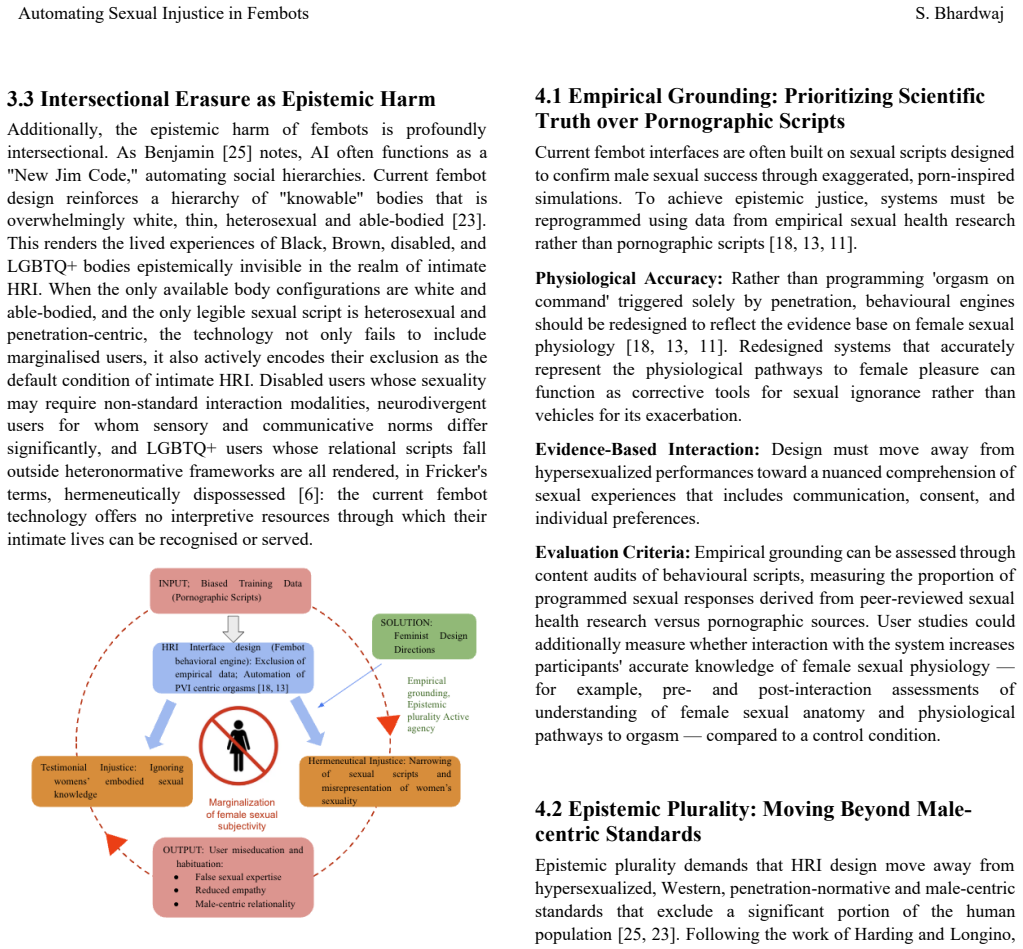
read the original abstract
Current AI-enabled female sex robots, or "fembots," are primarily designed to simulate female sexual responses through a lens of male-centric bias and pornographic stereotypes. This paper analyses fembot development as a failure in equitable robotics, arguing that these machines perpetuate "epistemic injustice" by prioritizing male hedonistic fantasies over empirical truths of female sexual experience in their design decisions. Drawing on Miranda Fricker's framework of testimonial and hermeneutical injustice, this analysis demonstrates how fembot interfaces discredit women's lived sexual knowledge and empirical research on female sexual physiology while privileging male-centred fantasies. This paper proposes three Feminist Design Directions including empirical grounding, epistemic plurality, and active consent modelling, which are grounded in Donna Haraway's concept of "Situated Knowledge" and accompanied by concrete evaluation criteria. These directions aim to facilitate a transition toward evidence-based intimate AI that prioritizes epistemic justice, mutuality, and inclusive design for marginalized users including disabled, neurodivergent, and LGBTQ+ communities.
Editorial analysis
A structured set of objections, weighed in public.
Referee Report
Summary. The manuscript claims that AI-enabled female sex robots (fembots) are designed primarily through a male-centric lens of pornographic stereotypes and hedonistic fantasies, thereby perpetuating epistemic injustice by discrediting women's lived sexual knowledge and empirical research on female physiology. Drawing on Miranda Fricker's testimonial and hermeneutical injustice frameworks, it analyzes this as a failure of equitable robotics. Grounded in Donna Haraway's situated knowledge, the paper proposes three feminist design directions—empirical grounding, epistemic plurality, and active consent modelling—accompanied by concrete evaluation criteria to support evidence-based intimate AI that prioritizes mutuality and inclusion for marginalized users.
Significance. If the interpretive application holds and the design motivations are substantiated, the work would contribute to critical HRI and AI ethics by extending philosophical concepts of epistemic injustice to sex robot interfaces and offering normative guidelines for more inclusive development. It could inform ethical standards in intimate robotics and highlight risks for diverse user groups. The absence of empirical verification for the claimed design drivers, however, constrains its significance to speculative critique rather than demonstrated analysis.
major comments (2)
- [Abstract and Introduction] Abstract and core argument: The claim that fembot interfaces 'prioritize male hedonistic fantasies over empirical truths of female sexual experience' and thereby enact epistemic injustice requires evidence that actual design decisions (e.g., sensor specifications, response algorithms, or interface choices) are driven by these stereotypes rather than technical or market factors. No patents, developer statements, or empirical studies are cited to establish this causal premise, leaving the application of Fricker's framework unanchored.
- [Feminist Design Directions] Feminist Design Directions section: The three proposed directions (empirical grounding, epistemic plurality, active consent modelling) are presented as solutions grounded in Haraway, yet the manuscript provides no mapping to existing fembot architectures, no pilot implementations, and no falsifiable evaluation criteria that could be tested against current systems, rendering the recommendations normative without demonstrated feasibility.
minor comments (1)
- [Abstract] The abstract could more explicitly separate the descriptive critique of existing designs from the normative proposals to improve clarity for readers unfamiliar with the philosophical frameworks.
Simulated Author's Rebuttal
We thank the referee for their insightful comments, which highlight important areas for strengthening the manuscript's grounding and applicability. We address each major comment below, indicating where revisions will be made to enhance clarity and evidence while preserving the paper's conceptual focus.
read point-by-point responses
-
Referee: [Abstract and Introduction] Abstract and core argument: The claim that fembot interfaces 'prioritize male hedonistic fantasies over empirical truths of female sexual experience' and thereby enact epistemic injustice requires evidence that actual design decisions (e.g., sensor specifications, response algorithms, or interface choices) are driven by these stereotypes rather than technical or market factors. No patents, developer statements, or empirical studies are cited to establish this causal premise, leaving the application of Fricker's framework unanchored.
Authors: We agree that the causal premise benefits from more explicit anchoring. Our analysis is based on publicly documented design features and marketing of commercial fembots (e.g., emphasis on specific anatomical simulations and response patterns drawn from pornographic tropes, as analyzed in prior works by Levy and Richardson), rather than proprietary internal documents. These observable choices systematically sideline empirical research on female sexual physiology. We will revise the abstract and introduction to include targeted citations to these design examples and clarify that the epistemic injustice arises from the privileging of such representations in the resulting interfaces, thereby better supporting the application of Fricker's framework without overstating direct access to developer intent. revision: partial
-
Referee: [Feminist Design Directions] Feminist Design Directions section: The three proposed directions (empirical grounding, epistemic plurality, active consent modelling) are presented as solutions grounded in Haraway, yet the manuscript provides no mapping to existing fembot architectures, no pilot implementations, and no falsifiable evaluation criteria that could be tested against current systems, rendering the recommendations normative without demonstrated feasibility.
Authors: We accept this critique and will strengthen the section accordingly. The directions are framed as normative pathways informed by Haraway's situated knowledge, not as ready-to-deploy implementations. In revision, we will add explicit mappings (e.g., empirical grounding applied to recalibrating arousal-detection sensors based on physiological studies) and propose falsifiable evaluation criteria, such as measurable improvements in user-reported validation of sexual knowledge via HRI user studies. While full pilot implementations exceed the scope of this conceptual paper, the added details will outline testable steps for future work and demonstrate practical feasibility. revision: yes
Circularity Check
No significant circularity; external philosophical frameworks applied without self-referential reduction
full rationale
The paper applies Miranda Fricker's testimonial and hermeneutical injustice concepts plus Donna Haraway's situated knowledge to analyze fembot design decisions. No equations, fitted parameters, or derivations exist that reduce claims to the paper's own inputs by construction. Central premises rest on external citations and cultural critique rather than self-definition, self-citation load-bearing, or renaming known results. The argument structure is self-contained against external benchmarks with no load-bearing internal loops.
Axiom & Free-Parameter Ledger
axioms (3)
- domain assumption Current fembot designs prioritize male hedonistic fantasies and pornographic stereotypes over empirical truths of female sexual experience
- domain assumption Miranda Fricker's testimonial and hermeneutical injustice framework applies directly to robotics interface design decisions
- domain assumption Donna Haraway's situated knowledge concept provides grounding for equitable design directions
Reference graph
Works this paper leans on
-
[1]
J. Danaher. 2018. Should we be thinking about robot sex? In Robot Sex, J. Danaher and N. McArthur (Eds.). MIT Press, 3–14
work page 2018
-
[2]
C. Tonna -Barthet. 2018. The harmful effects of sex robots. Trinity Women & Gender Minorities Review 2, 1 (2018), 23–32
work page 2018
-
[3]
R. S. Eskens. 2017. Is sex with robots rape? Journal of Practical Ethics. Automating Sexual Injustice in Fembots S. Bhardwaj
work page 2017
-
[4]
K. R. Hanson and C. C. Locatelli. 2022. From sex dolls to sex robots and beyond: A narrative review. Current Sexual Health Reports 14, 3 (2022), 106–117
work page 2022
-
[5]
Grand View Research. 2024. SexTech Market Size, Share & Trends Analysis Report
work page 2024
-
[6]
M. Fricker. 2007. Epistemic Injustice: Power and the Ethics of Knowing. Oxford University Press
work page 2007
- [7]
-
[8]
D. Haraway. 2013. Situated knowledges: The science question in feminism and the privilege of partial perspective. In M. Wyer, M. Barbercheck, D. Cookmeyer, H. Örün Öztürk, and M. Wayne (Eds.), Women, Science, and Technology: A Reader in Feminist Science Studies (pp. 455–472). Routledge
work page 2013
-
[9]
S. M. Gutiu. 2016. The roboticization of consent. In Robot Law, R. Calo et al. (Eds.). Edward Elgar Publishing, 186–212
work page 2016
-
[10]
D. Levy. 2007. Love and Sex with Robots: The Evolution of Human-Robot Relationships. Harper
work page 2007
-
[11]
E. A. Mahar, L. B. Mintz, and B. M. Akers. 2020. Orgasm equality: Scientific findings and societal implications. Current Sexual Health Reports 12, 1 (2020), 24–32
work page 2020
- [12]
-
[13]
S. Hite. 2005. The Hite Report: A Nationwide Study of Female Sexuality (Reprint of 1976 ed.). Seven Stories Press, New York
work page 2005
-
[14]
E. M. Kaufman. 2020. Reprogramming consent: Implications of sexual relationships with artificially intelligent partners. Psychology & Sexuality 11, 4 (2020), 372–383
work page 2020
-
[15]
K. Richardson. 2016. Sex robot matters. IEEE Technology and Society Magazine 35, 2 (2016), 46–53
work page 2016
-
[16]
T. Oleksy and A. Wnuk. 2021. Do women perceive sex robots as threatening? Computers in Human Behavior 117
work page 2021
-
[17]
R. Sparrow. 2017. Robots, rape, and representation. (as cited in Eskens)
work page 2017
-
[18]
E. A. Armstrong, P. England, and A. C. K. Fogarty. 2012. Accounting for women's orgasm and sexual enjoyment in college hookups and relationships. American Sociological Review 77, 3 (2012), 435–462
work page 2012
-
[19]
S. Harding. 1990. Whose Science? Whose Knowledge? Thinking from Women's Lives. Cornell University Press
work page 1990
-
[20]
H. E. Longino. 2017. Feminist epistemology. In The Blackwell Guide to Epistemology. Wiley, 325–353
work page 2017
-
[21]
N. Andrejek, T. Fetner, and M. Heath. 2022. Climax as work: Heteronormativity, gender labor, and the gap in orgasms. Gender & Society 36, 2 (2022), 189–213
work page 2022
-
[22]
G. M. Wetzel. 2023. Challenging biological justifications for the orgasm gap. Rutgers University
work page 2023
- [23]
-
[24]
B. Fahs. 2014. Coming to power: Women's fake orgasms and best orgasm experiences illuminate the failures of (hetero)sex. Culture, Health & Sexuality 16, 8 (2014), 974–988
work page 2014
- [25]
-
[26]
A. Peeters and P. Haselager. 2021. Designing virtuous sex robots. International Journal of Social Robotics 13, 1 (2021), 55 – 66
work page 2021
-
[27]
L. Frank and S. Nyholm. 2017. Robot sex and consent. Artificial Intelligence and Law 25, 3 (2017), 305–323
work page 2017
- [28]
discussion (0)
Sign in with ORCID, Apple, or X to comment. Anyone can read and Pith papers without signing in.