Parametric Resonance and RF-to-THz Frequency Conversion in Semiconductor Plasmonic Crystals
Pith reviewed 2026-05-10 13:08 UTC · model grok-4.3
The pith
Plasmonic crystals in transistors support rotonic plasmons with parabolic dispersion that enable parametric RF-to-THz conversion via gate-voltage pumping.
A machine-rendered reading of the paper's core claim, the machinery that carries it, and where it could break.
Core claim
Plasma excitations in plasmonic crystals consisting of periodic gated and ungated regions exhibit a parabolic dispersion law with finite effective mass, unlike the linear dispersion of gated plasmons or the square-root dispersion of ungated plasmons. These rotonic plasmons obey a generalized Mathieu equation that describes either resonant or non-resonant parametric excitations depending on damping. Gate-voltage pumping excites them efficiently without spatial nonuniformities or electron drift saturation, enabling a unified theory that predicts parametric instabilities and demonstrates applications in tunable THz sources, detectors, and frequency converters.
What carries the argument
Rotonic plasmons, the collective plasma modes in periodic gated-ungated plasmonic crystals that follow a parabolic dispersion relation with finite effective mass and whose dynamics are governed by the generalized Mathieu equation for parametric driving.
If this is right
- Parametric instabilities arise in III-N and III-V plasmonic crystals under gate-voltage pumping.
- The structures function as tunable compact THz sources and detectors.
- RF-to-THz frequency multiplication and generation occur with higher power levels than current-driven excitation.
- Gate-voltage pumping maintains the same voltage swing over large-area transistors or arrays.
Where Pith is reading between the lines
- This pumping method could integrate directly with standard semiconductor processing for compact 6G devices.
- The finite effective mass of rotonic plasmons may enable new resonance conditions or transport behaviors in periodic 2D electron systems.
- Similar Mathieu-driven parametric effects could appear in other engineered periodic plasmonic or photonic structures.
Load-bearing premise
The collective modes follow a generalized Mathieu equation describing parametric excitations without spatial nonuniformities, and gate-voltage pumping supplies uniform swing over large areas without introducing new instabilities or saturation effects.
What would settle it
Experimental measurement of the plasmon spectrum in such periodic structures confirming parabolic wavevector dependence, or demonstration of THz emission and frequency conversion under pure gate-voltage modulation without source-drain current flow.
Figures

read the original abstract
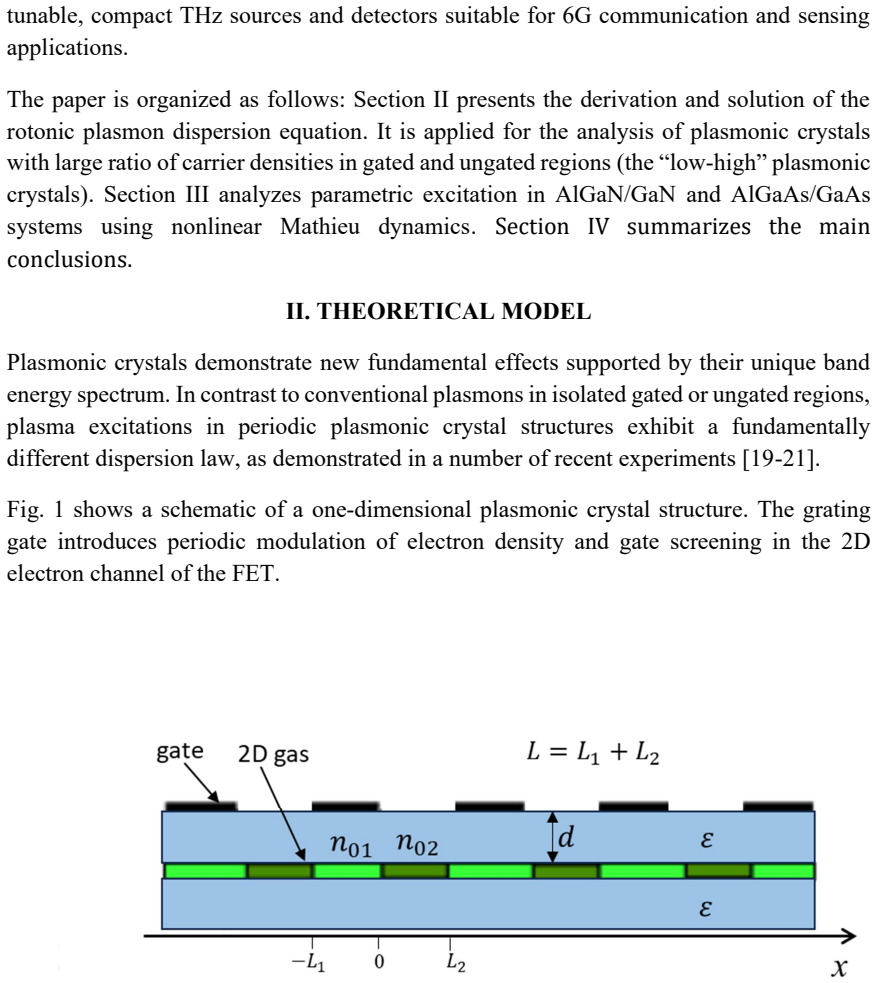
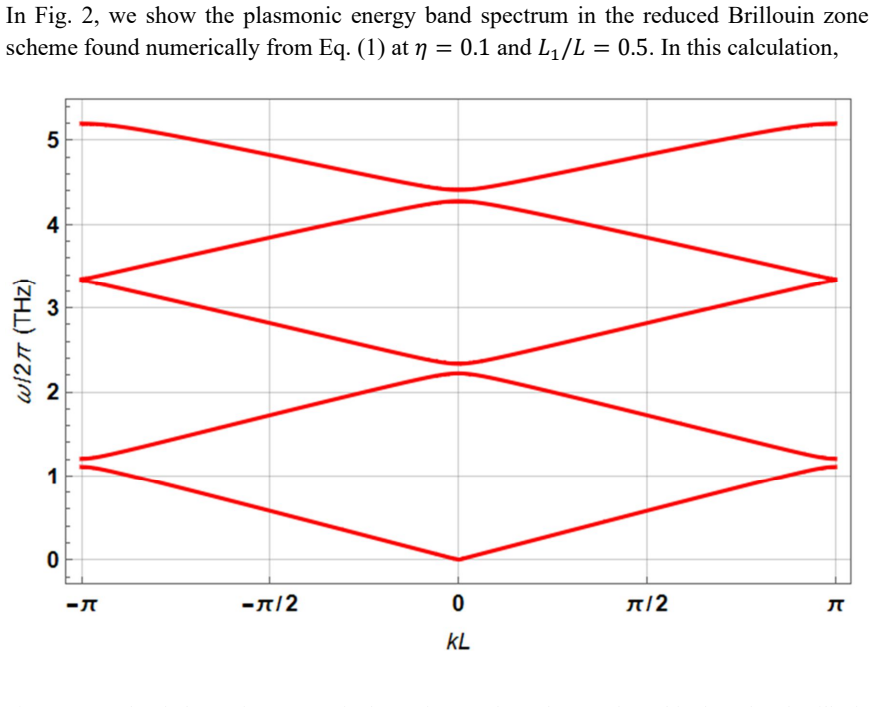
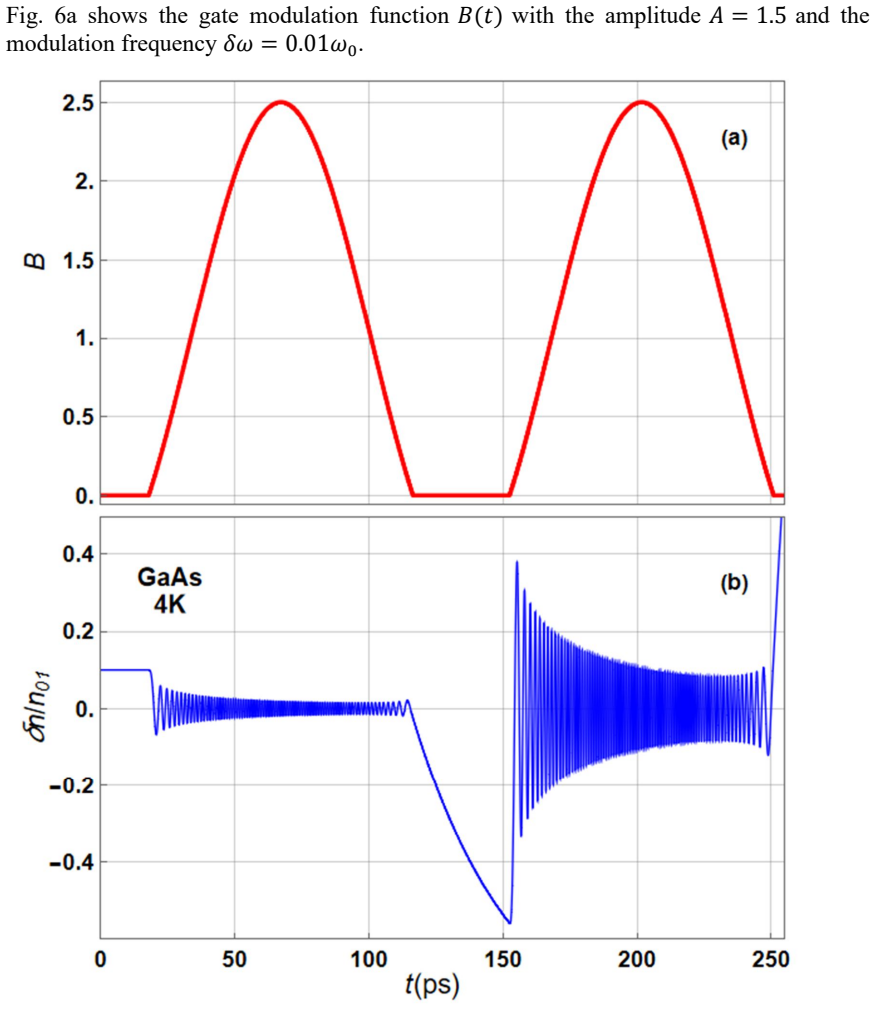
We show that plasma excitations in nanoscale field-effect transistor structures with periodic alternation of gated and ungated regions (plasmonic crystals) differ fundamentally from conventional plasmons in isolated gated or ungated regions. In contrast to the linear dispersion of purely gated plasmons and the square-root dispersion of ungated plasmons, these collective modes also exhibit a parabolic dispersion law characterized by a finite effective mass. We call these excitations "rotonic plasmons" emphasizing the analogy to roton-like excitations. The dynamics of rotonic plasmons are governed by a generalized Mathieu equation, describing either resonant or non-resonant parametric excitations of rotonic plasmons depending on damping. These nonlinear resonances can be efficiently driven by gate-voltage pumping, avoiding the spatial nonuniformities and electron drift velocity saturation effects associated with current-driven excitation. Gate-voltage pumping enables much higher terahertz (THz) power levels in plasmonic crystals. More importantly, in contrast to source-drain excitation, gate voltage pumping has the same gate voltage swing over large area transistors or transistor arrays. We develop a unified theory of rotonic plasmons and demonstrate their application for RF to THz frequency multiplication and THz generation. Starting from the general dispersion relation in plasmonic crystals based on coupled gated-ungated regions with two-dimensional electron gas, we derive the parabolic ("rotonic") plasmon spectrum and establish its analogy with roton-like excitations. The analysis predicts parametric instabilities in III-N and III-V plasmonic crystals under gate-voltage pumping. The results confirm that these systems can function as tunable, compact THz sources and detectors suitable for emerging 6G communications and sensing applications.
Editorial analysis
A structured set of objections, weighed in public.
Referee Report
Summary. The manuscript develops a theory of plasma excitations ('rotonic plasmons') in plasmonic crystals formed by periodic alternation of gated and ungated regions in nanoscale FET structures with 2DEG. Starting from the general dispersion relation for coupled gated-ungated regions, it derives a parabolic dispersion law with finite effective mass (distinct from linear gated or sqrt ungated plasmons), establishes an analogy to roton excitations, and shows that the dynamics obey a generalized Mathieu equation under time-periodic gate-voltage pumping. This predicts resonant or non-resonant parametric instabilities, enabling efficient RF-to-THz frequency multiplication and generation with higher power levels than current-driven methods, due to spatially uniform pumping without drift-velocity saturation. Applications to tunable THz sources/detectors for 6G are discussed, with focus on III-N and III-V materials.
Significance. If the central derivations hold, the work offers a potentially important route to compact, electrically tunable THz sources via parametric resonance in semiconductor plasmonic crystals. The shift to gate-voltage pumping (avoiding spatial nonuniformities) and the parameter-free derivation of the parabolic spectrum from the general dispersion relation are notable strengths, as is the emphasis on falsifiable predictions for instabilities. This could impact emerging 6G sensing and communications if the effective-mass plasmons and clean Mathieu reduction are confirmed experimentally. The unified treatment provides a coherent framework, though its novelty relative to prior plasmonic-crystal literature requires careful positioning.
major comments (2)
- [derivation of Mathieu equation from general dispersion] The reduction of the hydrodynamic equations to a purely temporal generalized Mathieu equation (central to the parametric instabilities and RF-THz conversion claims) requires explicit demonstration that time-periodic gate-voltage modulation remains spatially uniform across the periodic gated-ungated geometry. The abstract asserts that this pumping 'avoids the spatial nonuniformities' of current drive, yet the starting point is the general dispersion in coupled regions; finite gate fringing or periodic boundary conditions could introduce position-dependent density modulation and additional spatial operators, preventing reduction to a single ODE for the amplitude. Please provide the step-by-step derivation (likely in the section following the dispersion relation) showing how spatial gradients are eliminated and confirm that the effective-mass parabolic spectrum and instability thresholds do
- [parametric instabilities and THz generation] The prediction of parametric instabilities and higher THz power levels under gate-voltage pumping (abstract and application section) rests on the assumption of uniform swing over large-area transistors without new saturation effects or mode couplings. No error analysis, damping dependence quantification, or comparison to numerical solutions of the full spatially periodic system is provided; this undermines the quantitative claims for power scaling and 6G suitability. A concrete test (e.g., solving the coupled equations with small spatial perturbations) should be added.
minor comments (2)
- [introduction] The term 'rotonic plasmons' is introduced as an analogy; a brief comparison table or reference to prior roton-like modes in other condensed-matter systems would clarify the distinction and avoid potential overlap with existing nomenclature.
- [dispersion derivation] Notation for the effective mass and dispersion parameters should be defined consistently when transitioning from the general dispersion relation to the parabolic form; a dedicated equation numbering for the final rotonic spectrum would improve readability.
Simulated Author's Rebuttal
We thank the referee for the careful and constructive review of our manuscript on rotonic plasmons in plasmonic crystals. The points raised about the explicit reduction to the Mathieu equation and the need for quantitative support on instabilities are addressed below with clarifications and commitments to revisions.
read point-by-point responses
-
Referee: The reduction of the hydrodynamic equations to a purely temporal generalized Mathieu equation (central to the parametric instabilities and RF-THz conversion claims) requires explicit demonstration that time-periodic gate-voltage modulation remains spatially uniform across the periodic gated-ungated geometry. The abstract asserts that this pumping 'avoids the spatial nonuniformities' of current drive, yet the starting point is the general dispersion in coupled regions; finite gate fringing or periodic boundary conditions could introduce position-dependent density modulation and additional spatial operators, preventing reduction to a single ODE for the amplitude. Please provide the step-by-step derivation (likely in the section following the dispersion relation) showing how spatial gradients are eliminated and confirm that the effective-mass parabolic spectrum and instability thresholds do
Authors: We agree that the step-by-step reduction requires more explicit presentation. Starting from the general dispersion relation for coupled gated-ungated regions, the parabolic effective-mass spectrum is obtained by expanding around the Brillouin zone center. For time-periodic uniform gate-voltage modulation (valid when the device area is large compared to the plasmonic crystal period, rendering fringing negligible), the hydrodynamic equations separate into a spatial eigenmode (fixed by the parabolic dispersion) multiplied by a purely temporal amplitude. Spatial gradient operators then act only on the fixed mode and cancel in the uniform-pumping limit, yielding the generalized Mathieu equation for the amplitude. We will insert this detailed derivation immediately after the dispersion relation in the revised manuscript and explicitly state the uniformity assumption together with its validity range for the instability thresholds. revision: yes
-
Referee: The prediction of parametric instabilities and higher THz power levels under gate-voltage pumping (abstract and application section) rests on the assumption of uniform swing over large-area transistors without new saturation effects or mode couplings. No error analysis, damping dependence quantification, or comparison to numerical solutions of the full spatially periodic system is provided; this undermines the quantitative claims for power scaling and 6G suitability. A concrete test (e.g., solving the coupled equations with small spatial perturbations) should be added.
Authors: The referee correctly identifies the absence of explicit error analysis and numerical cross-checks. The analytical thresholds already incorporate damping through the Mathieu stability diagram; we will add a new paragraph quantifying the growth rate versus damping coefficient and the resulting power scaling for typical III-N and III-V parameters. A brief perturbative estimate will be included showing that small spatial non-uniformities (e.g., from gate fringing) produce only higher-order corrections that do not alter the leading instability condition. A full numerical solution of the spatially periodic system lies outside the present theoretical scope and will be noted as future work, but the added analytic estimates address the immediate concern for the 6G suitability claims. revision: partial
Circularity Check
Derivation begins from general dispersion relation of coupled gated-ungated 2DEG regions without reduction to inputs by construction.
full rationale
The paper states it starts from the general dispersion relation in plasmonic crystals based on coupled gated-ungated regions with two-dimensional electron gas, then derives the parabolic rotonic spectrum and its Mathieu-equation dynamics. No quoted step shows the parabolic law or parametric instabilities being defined in terms of themselves, a fitted parameter renamed as prediction, or load-bearing self-citation chains. The central claims remain independent of the target results and are not forced by ansatz smuggling or renaming of known patterns.
Axiom & Free-Parameter Ledger
axioms (1)
- domain assumption The dynamics of rotonic plasmons are governed by a generalized Mathieu equation describing resonant or non-resonant parametric excitations depending on damping.
invented entities (1)
-
rotonic plasmons
no independent evidence
Reference graph
Works this paper leans on
-
[1]
E. J. Oughton, W. Lehr, K. Katsaros, J. Selinis, D. Bubley, and J. Kusuma, Revisiting wireless internet connectivity: 5G vs Wi - Fi 6, Telecomm. Policy 45 , 102127 (2021)
work page 2021
-
[2]
I. F. Akyildiz, C. Han, Z. Hu, S. Nie, and J. M. Jornet, Terahertz band communication: An old problem revisited and research directions for the next decade, IEEE Trans. Commun. 70 , 4250 - 4285 (2022)
work page 2022
-
[3]
M. Shur, G. Aizin, T. Otsuji, and V. Ryzhii. Plasmonic Field - Effect Transistors (TeraFETs) for 6G Communications. Sensors 21 , 7907 (2021)
work page 2021
-
[4]
T. A. Elkhatib, V. Y. Kachorovskii, W. J. Stillman, D. B. Veksler, K. N. Salama, X - C. Zhang, and M. S. Shur, Enhanced Plasma Wave Detection of Terahertz Radiation Using High Electron - Mobility Transistors Connected in Series, IEEE Trans. Microw. Theory T ech. 58 , 331 - 339 ( 2010)
work page 2010
-
[5]
V. V. Popov, D. M. Yermolaev, K. V. Maremyanin, V. E. Zemlyakov, N. A. Maleev, V. I. Gavrilenko, V. A. Bespalov, V. I. Yegorkin, V. M. Ustinov, and S. Yu. Shapoval, Detection of terahertz radiation by tightly concatenated InGaAs field - effect transistors integrated on a single chip, Appl. Phys. Lett. 104 , 163508 (2014)
work page 2014
-
[6]
G. C. Dyer, G. R. Aizin, S. Preu, N. Q. Vinh, S. J. Allen, J. L. Reno, and E. A. Shaner, Inducing an incipient Terahertz finite plasmonic crystal in coupled two - dimensional plasmonic cavities, Phys. Rev. Lett. 109 , 126803 (2012)
work page 2012
-
[7]
W. F. Andress, H. Yoon, K. Y. M. Yeung, L. Qin, K. West, L. Pfeiffer, and D. Ham, Ultra - subwavelength two - dimensional plasmonic circuits, Nano Lett. 12 , 2272 - 2277 (2012)
work page 2012
-
[8]
G. R. Aizin and G. Dyer, Transmission line theory of collective plasma excitations in periodic two - dimensional electron systems: finite plasmonic crystals and Tamm states, Phys. Rev. B, 86 , 253316 (2012)
work page 2012
-
[9]
V. Y. Kachorovskii and M. S. Shur, Current induced terahertz oscillations in plasmonic crystal, Appl. Phys. Lett. 100 , 232108 (2012). 19
work page 2012
-
[10]
K. Y. M. Yeung, J Chee, H. Yoon, Y. Song, J. Kong, and D. Ham, Far - infrared graphene plasmonic crystals for plasmonic band engineering, Nano Lett. 14 , 2479 - 2484 (2014)
work page 2014
-
[11]
H. Yoon, K. Y. M. Yeung, P. Kim, and D. Ham, Plasmonics with two - dimensional conductors, Philos. Trans. Royal Soc. A 372 , 20130104 (2014)
work page 2014
-
[12]
A. Bylinkin, E. Titova, V. Mikheev, E. Zhukova, S. Zhukov, M. Belyanchikov, M. Kashchenko, A. Miakonkikh, and D. Svintsov, Tight - Binding Terahertz Plasmons in Chemical - Vapor - Deposited Graphene, Phys. Rev. Appl. 11 , 054017 (2019). 13.S. Boubanga - Tombet, W. Knap, D. Yadav, A. Satou, D. B. But, V. V. Popov, I. V. Gorbenko, V. Kachorovskii, and T. Ot...
work page 2019
-
[13]
P. Sai, V. V. Korotyeyev, M. Dub, M. Słowikowski, M. Filipiak, D. B. But, Yu. Ivonyak , M. Sakowicz, Yu. M. Lyaschuk, S. M. Kukhtaruk, G. Cywiński, and W. Knap, Electrical Tuning of Terahertz Plasmonic Crystal Phases, Phys. Rev. X 13 , 041003 (2023)
work page 2023
-
[14]
G. R. Aizin, J. Mikalopas, and M. Shur, Plasma instability and amplified mode switching effect in THz field effect transistors with a grating gate, Phys. Rev. B 107 , 245424 (2023)
work page 2023
-
[15]
I. V. Gorbenko and V. Yu. Kachorovskii, Lateral plasmonic crystals: tunability, dark modes, and weak - to - strong coupling transition, Phys. Rev. B 110 , 155406 (2024)
work page 2024
-
[16]
A. V. Nikonov, A. A. Zabolotnykh, and V. A. Volkov, Plasmons in two - dimensional electron systems with infinite and semi - infinite metal gratings, Phys. Rev. B 110 , 125425 (2024)
work page 2024
-
[17]
G. R. Aizin, S. Mundaganur, A. Mundaganur, and J. Bird, Terahertz - frequency plasmonic crystal instability in field - effect transistors with asymmetric gate arrays, Sci. Rep. 14 , 11856 (2024)
work page 2024
-
[18]
A. R. Khisameeva, A. Shuvaev, A. A. Zabolotnykh, A. S. Astrakhantseva, D. A. Khudaiberdiev, A. Pimenov, I. V. Kukushkin, and V. M. Muraviev , Spectrum of plasma excitations in a plasmonic crystal fabricated in an AlGaAs/GaAs heterostructure, Phys. Rev. Res. 7 , 033224 (2025)
work page 2025
-
[19]
V. M. Muraviev , K. R. Dzhikirba , A. A. Zabolotnykh, A. Shuvaev, M. S. Ryzhkov, D. A. Khudaiberdiev, A. S. Astrakhantseva, I. V. Kukushkin, and A. Pimenov, Novel Superlattice Plasmon mode in a Grating o f 2D Electron Strips, Phys. Rev. Res. 8 , 20 013066 (2026) 21.A. R. Khisameeva, A. Shuvaev, A. A. I. M. Moiseenko, P. A. Gusikhin, A. S. Astrakhantseva, ...
-
[20]
G. R. Aizin, J. Mikalopas, and M. Shur, Plasmonic instabilities in two - dimensional electron channels of variable width, Phys. Rev. B 101 , 245404 (2020)
work page 2020
-
[21]
S. J. Allen, D. C. Tsui, and R. A. Logan, Observation of the two - dimensional plasmon in silicon inversion layers, Phys. Rev. Lett. 38 , 980 - 983 (1977)
work page 1977
-
[22]
M. V. Krasheninnikov and A. V. Chaplik, Two - dimensional plasma waves in superlattices, Sov. Phys. Semicond. 15 , 19 - 23 (1981)
work page 1981
-
[23]
U. Mackens, D. Heitmann, L. Prager, J. P. Kotthaus, and W. Beinvogl, Minigaps in the plasmon dispersion of a two - dimensional electron gas with spatially modulated charge density, Phys. Rev. Lett. 53 , 1485 - 1488 (1984). 2 6 . L . Ruby , Applications of the Mathieu equation, Am. J. Phys. 64 , 39 – 44 (1996). 2 7 . N. W. McLachlan, Theory and Application...
work page 1984
-
[24]
Rana, Graphene terahertz plasmon oscillations, IEEE Trans
F. Rana, Graphene terahertz plasmon oscillations, IEEE Trans. Nanotech. 7 , 91 - 99 (2008)
work page 2008
discussion (0)
Sign in with ORCID, Apple, or X to comment. Anyone can read and Pith papers without signing in.