Recognition: unknown
Zak-OTFS: A Predictable Physical Layer for Communications and Sensing
Pith reviewed 2026-05-10 07:28 UTC · model grok-4.3
The pith
Zak-OTFS carriers make the wireless channel input-output relation predictable and non-selective when spreads are bounded.
A machine-rendered reading of the paper's core claim, the machinery that carries it, and where it could break.
Core claim
The central claim is that under the condition that the channel delay spread is less than the delay period and the channel Doppler spread is less than the Doppler period, the Zak-OTFS input-output relation is predictable and non-selective. Given the I/O response at one DD point in a frame, it is possible to predict the I/O response at all other points, without recourse to some mathematical model of the channel. This follows from the ambiguity properties of the basis of carrier waveforms, which share a common pulse train modulated by a Hadamard matrix structure.
What carries the argument
The Zak-OTFS carrier waveform, defined as a quasi-periodic localized function in the delay-Doppler domain and realized as a pulsone in the time domain, serving as geometric modes or common eigenvectors of a maximal commutative subgroup of the discrete Heisenberg-Weyl group.
If this is right
- The full input-output relation across all delay-Doppler points can be determined from a single measurement.
- The predictability holds without needing any specific channel model.
- Similar predictability applies to other waveforms sharing the pulse train modulated by Hadamard matrix, such as AFDM, OTSM, and ODDM.
- This enables a physical layer suitable for both communications and sensing applications.
Where Pith is reading between the lines
- This approach could simplify receiver design in environments with limited mobility by reducing the need for continuous channel tracking.
- Extensions might include adapting the periods to match expected channel conditions in different scenarios.
- Testing in real-world channels with known spread limits would verify if the prediction holds as expected.
- Neighbouring problems in integrated sensing and communications could benefit from this non-selective property.
Load-bearing premise
The channel delay spread must not exceed the delay period and the Doppler spread must not exceed the Doppler period, and the carrier waveforms must satisfy the required ambiguity properties.
What would settle it
Observing that the input-output responses at different delay-Doppler points cannot be predicted from one another in a channel where the spreads are within the periods would falsify the claim.
Figures








read the original abstract
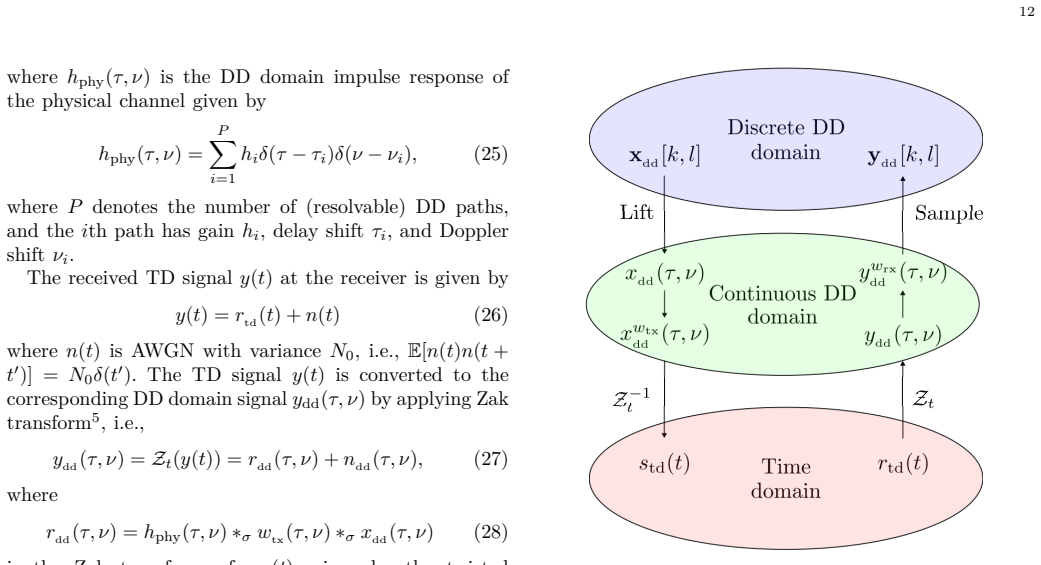
This tutorial derives the mathematical foundations of what it means for a carrier waveform to be predictable and non-selective. We focus on Zak-OTFS, where each carrier waveform is a pulse in the delay-Doppler (DD) domain, formally a quasi-periodic localized function with specific periods along delay and Doppler. Viewed in the time domain, the Zak-OTFS carrier is realized as a pulse train modulated by a tone (termed a pulsone). We start by providing physical intuition, describing what it means for the Zak-OTFS carrier waveforms to be geometric modes of the Heisenberg-Weyl (HW) group of discrete delay and Doppler shifts that define the discrete-time communication model. In fact, we show that these geometric modes are common eigenvectors of a maximal commutative subgroup of our discrete HW group. When the channel delay spread is less than the delay period, and the channel Doppler spread is less than the Doppler period, we show that the Zak-OTFS input-output (I/O) relation is predictable and non-selective. Given the I/O response at one DD point in a frame, it is possible to predict the I/O response at all other points, without recourse to some mathematical model of the channel. While it may be intuitive that geometric modes of the HW group are predictable and non-selective wireless carriers, this is not a requirement. We provide a necessary and sufficient condition that depends on the ambiguity properties of the basis of carrier waveforms. In fact, we show that the structure of a pulse train modulated by a Hadamard matrix is common to several families of waveforms proposed for 6G, including Zak-OTFS, AFDM, OTSM and ODDM.
Editorial analysis
A structured set of objections, weighed in public.
Referee Report
Summary. The manuscript is a tutorial deriving the mathematical foundations of predictable and non-selective carrier waveforms for Zak-OTFS. It establishes that Zak-OTFS carriers are quasi-periodic localized pulse trains in the delay-Doppler domain (pulsone in time domain) that serve as common eigenvectors of a maximal commutative subgroup of the discrete Heisenberg-Weyl group. Under the explicit conditions that the channel delay spread is less than the delay period and the Doppler spread is less than the Doppler period, the input-output relation is shown to be predictable and non-selective: the response at one DD point determines the responses at all other points without requiring a channel model. A necessary and sufficient condition on the ambiguity function of the carrier basis is provided, and the same pulse-train modulated by Hadamard structure is shown to appear in AFDM, OTSM, and ODDM.
Significance. If the central derivations hold, the work supplies a rigorous group-theoretic and ambiguity-function basis for predictability in DD-domain modulations, which could simplify channel estimation, equalization, and integrated sensing in high-mobility 6G scenarios by making the I/O map deterministic under bounded-spread conditions. The explicit unification with other proposed waveforms adds cross-family insight.
major comments (2)
- [Ambiguity-function argument (around the predictability condition)] The section deriving the necessary and sufficient ambiguity-function condition for predictability: the manuscript states that the Zak-OTFS basis satisfies the condition when the spread bounds hold, but the explicit computation showing that the ambiguity function vanishes outside the relevant delay-Doppler support (thereby making the I/O relation non-selective) is not carried out in sufficient detail to verify the claim that prediction requires no channel model.
- [Heisenberg-Weyl eigenvector discussion] The paragraph linking the common-eigenvector property to the I/O predictability: while the HW-group eigenvectors are correctly identified, the step from this algebraic property to the concrete statement that one DD-point response predicts all others is asserted rather than derived from the quasi-periodic structure and the spread inequalities; an intermediate equation relating the received DD symbol to the transmitted one via the ambiguity kernel would make the argument load-bearing.
minor comments (2)
- Notation for the delay and Doppler periods is introduced without an explicit symbol table or consistent use of subscripts throughout the derivations.
- The tutorial would benefit from a short table comparing the ambiguity-function supports of Zak-OTFS versus AFDM/OTSM/ODDM to make the unification claim immediately verifiable.
Simulated Author's Rebuttal
We thank the referee for the thorough review and valuable feedback on our tutorial manuscript. The comments highlight opportunities to strengthen the explicit derivations of the ambiguity-function condition and the link from the Heisenberg-Weyl eigenvector property to I/O predictability. We address each major comment below and will revise the manuscript to incorporate the suggested details.
read point-by-point responses
-
Referee: The section deriving the necessary and sufficient ambiguity-function condition for predictability: the manuscript states that the Zak-OTFS basis satisfies the condition when the spread bounds hold, but the explicit computation showing that the ambiguity function vanishes outside the relevant delay-Doppler support (thereby making the I/O relation non-selective) is not carried out in sufficient detail to verify the claim that prediction requires no channel model.
Authors: We agree that the explicit computation was insufficiently detailed. In the revised version, we will expand this section with a step-by-step calculation of the ambiguity function for the Zak-OTFS pulsone basis. Starting from the quasi-periodic localized pulse-train structure in the delay-Doppler domain, we will show that under the conditions (channel delay spread less than the delay period and Doppler spread less than the Doppler period), the ambiguity function is identically zero outside the relevant bounded support. This vanishing directly implies that the input-output relation is non-selective, so that the response at any single DD point determines all others without invoking a channel model. The added equations will make the necessary-and-sufficient condition fully verifiable. revision: yes
-
Referee: The paragraph linking the common-eigenvector property to the I/O predictability: while the HW-group eigenvectors are correctly identified, the step from this algebraic property to the concrete statement that one DD-point response predicts all others is asserted rather than derived from the quasi-periodic structure and the spread inequalities; an intermediate equation relating the received DD symbol to the transmitted one via the ambiguity kernel would make the argument load-bearing.
Authors: We accept that the transition requires an explicit intermediate step. In the revision, we will insert a new equation immediately after identifying the common eigenvectors of the maximal commutative subgroup. This equation will express the received DD symbol as the transmitted symbol multiplied by the ambiguity kernel evaluated at the channel spread offsets. Applying the spread inequalities to the quasi-periodic structure then shows that the kernel reduces to a constant (or zero) factor independent of the specific DD point, thereby proving that the response at one point predicts all others. This derivation will connect the algebraic eigenvector property directly to the predictability claim. revision: yes
Circularity Check
No significant circularity in derivation chain
full rationale
The paper derives the predictability and non-selectivity of Zak-OTFS carriers directly from the quasi-periodic pulse-train structure as common eigenvectors of a maximal commutative subgroup of the discrete Heisenberg-Weyl group, together with the explicit spread conditions (delay spread < delay period, Doppler spread < Doppler period) and the necessary-and-sufficient ambiguity-function condition on the basis. These steps are conditional on stated assumptions that are independent of the target conclusion and rest on standard group-theoretic and ambiguity-function properties rather than any fitted parameter, self-referential definition, or load-bearing self-citation. The extension to AFDM/OTSM/ODDM is presented as an observation of shared structure, not as a derivation that reduces to the Zak-OTFS result. No step equates a prediction to its own input by construction.
Axiom & Free-Parameter Ledger
free parameters (2)
- delay period
- Doppler period
axioms (2)
- domain assumption Zak-OTFS carriers are common eigenvectors of a maximal commutative subgroup of the discrete Heisenberg-Weyl group
- domain assumption The ambiguity properties of the carrier basis provide a necessary and sufficient condition for predictability and non-selectivity
Reference graph
Works this paper leans on
-
[1]
Prolate Spheroidal Wave Func- tions, Fourier Analysis and Uncertainty — I,
D. Slepian and H. O. Pollak, “Prolate Spheroidal Wave Func- tions, Fourier Analysis and Uncertainty — I,” The Bell System Technical Journal, vol. 40, no. 1, pp. 43–63, 1961
1961
-
[2]
Prolate Spheroidal Wave Functions, Fourier Analysis and Uncertainty — II,
H. J. Landau and H. O. Pollak, “Prolate Spheroidal Wave Functions, Fourier Analysis and Uncertainty — II,” The Bell System Technical Journal, vol. 40, no. 1, pp. 65–84, 1961
1961
-
[3]
A Perspective on Massive Random-Access,
Y. Polyanskiy, “A Perspective on Massive Random-Access,” in Proc. 2017 IEEE Int. Symp. Inf. Theory, Aachen, Germany, Jun. 2017, pp. 2523–2527
2017
-
[4]
P. M. Woodward, Probability and Information Theory, with Applications to Radar (Second Edition), ser. International Series of Monographs on Electronics and Instrumentation, D. W. Fry, Ed. Oxford, London: Pergamon, 1953
1953
-
[5]
Radar Ambiguity Functions and Group Theory,
L. Auslander and R. Tolimieri, “Radar Ambiguity Functions and Group Theory,” SIAM Journal on Mathematical Analysis, vol. 16, no. 3, pp. 577–601, 1985
1985
-
[6]
Guidelines for Evaluation of Radio Transmis- sion Technologies for IMT-2000,
ITU–R M.1225, “Guidelines for Evaluation of Radio Transmis- sion Technologies for IMT-2000,” International Telecommuni- cation Union Radio communication, 1997
2000
-
[7]
Iwaniec and E
H. Iwaniec and E. Kowalski, Analytic Number Theory. Prov- idence, RI: American Mathematical Soc., 2004, vol. 53
2004
-
[8]
Evaluation of the Quadratic Gauss sum,
M. Murty and S. Pathak, “Evaluation of the Quadratic Gauss sum,” Evaluation, vol. 86, no. 1-2, 2017
2017
-
[9]
Phase-Coded Waveforms and Their Design,
J. J. Benedetto, I. Konstantinidis, and M. Rangaswamy, “Phase-Coded Waveforms and Their Design,” IEEE Signal Processing Magazine, vol. 26, no. 1, pp. 22–31, 2009
2009
-
[10]
Quantum Mechanics as a Statistical Theory,
J. E. Moyal, “Quantum Mechanics as a Statistical Theory,” Mathematical Proceedings of the Cambridge Philosophical Society, vol. 45, no. 1, p. 99–124, 1949
1949
-
[11]
Topics in Harmonic Analysis with Applications to Radar and Sonar,
W. Miller, R. Blahut, and C. Wilcox, “Topics in Harmonic Analysis with Applications to Radar and Sonar,” IMA Volumes in Mathematics and its Applications, 1991
1991
-
[12]
Mathematics of Radar,
W. Moran, “Mathematics of Radar,” in Twentieth Century Harmonic Analysis—A Celebration, 2001, pp. 295 – 328
2001
-
[13]
Group Theory in Radar and Signal Processing,
W. Moran and J. H. Manton, “Group Theory in Radar and Signal Processing,” in Computational Noncommutative Algebra and Applications, 2004, pp. 339–362
2004
-
[14]
The Finite Heisenberg-Weyl Groups in Radar and Communications,
S. D. Howard, A. R. Calderbank, and W. Moran, “The Finite Heisenberg-Weyl Groups in Radar and Communications,” EURASIP Journal on Advances in Signal Processing, vol. 2006, pp. 1–12, 2006
2006
-
[15]
Characterization of Randomly Time-Variant Linear Channels,
P. Bello, “Characterization of Randomly Time-Variant Linear Channels,” IEEE Transactions on Communications Systems, vol. 11, no. 4, pp. 360–393, 1963
1963
-
[16]
OTFS—A Mathematical Foundation for Communication and Radar Sensing in the Delay-Doppler Do- 36 main,
S. K. Mohammed, R. Hadani, A. Chockalingam, and R. Calderbank, “OTFS—A Mathematical Foundation for Communication and Radar Sensing in the Delay-Doppler Do- 36 main,” IEEE BITS the Information Theory Magazine, vol. 2, no. 2, pp. 36–55, 2022
2022
-
[17]
OTFS—Predictability in the Delay-Doppler Domain and Its Value to Communication and Radar Sensing,
——, “OTFS—Predictability in the Delay-Doppler Domain and Its Value to Communication and Radar Sensing,” IEEE BITS the Information Theory Magazine, vol. 3, no. 2, pp. 7–31, 2023
2023
-
[18]
S. K. Mohammed, R. Hadani, and A. Chockalingam, OTFS Modulation: Theory and Applications. Hoboken, NJ: Wiley- IEEE Press, 2024
2024
-
[19]
Discrete Radar based on Modulo Arithmetic,
N. Mehrotra, S. R. Mattu, S. K. Mohammed, R. Hadani, and R. Calderbank, “Discrete Radar based on Modulo Arithmetic,” EURASIP Journal on Advances in Signal Processing, vol. 2025, no. 1, p. 55, 2025
2025
-
[20]
Low-Complexity Equalization of Zak-OTFS in the Frequency Domain,
S. R. Mattu, N. Mehrotra, S. K. Mohammed, V. Khammam- metti, and R. Calderbank, “Low-Complexity Equalization of Zak-OTFS in the Frequency Domain,” npj Wireless Technol- ogy, vol. 2, no. 9, 2026
2026
-
[21]
A Design Framework that Unifies 6G Modulation Schemes for Double Selectivity,
N. Mehrotra, S. R. Mattu, and R. Calderbank, “A Design Framework that Unifies 6G Modulation Schemes for Double Selectivity,” 2026. [Online]. A vailable: https://arxiv.org/abs/2511.09418
-
[22]
Data Transmission by Frequency- Division Multiplexing Using the Discrete Fourier Transform,
S. Weinstein and P. Ebert, “Data Transmission by Frequency- Division Multiplexing Using the Discrete Fourier Transform,” IEEE Transactions on Communication Technology, vol. 19, no. 5, pp. 628–634, 1971
1971
-
[23]
Multicarrier Modulation for Data Transmission: An Idea Whose Time Has Come,
J. Bingham, “Multicarrier Modulation for Data Transmission: An Idea Whose Time Has Come,” IEEE Communications Magazine, vol. 28, no. 5, pp. 5–14, 1990
1990
-
[24]
Affine Frequency Division Multiplexing for Next Generation Wireless Commu- nications,
A. Bemani, N. Ksairi, and M. Kountouris, “Affine Frequency Division Multiplexing for Next Generation Wireless Commu- nications,” IEEE Transactions on Wireless Communications, vol. 22, no. 11, pp. 8214–8229, 2023
2023
-
[25]
DFT-p-FDMA: A Waveform for Doubly Selective Channels,
N. Ferdinand, J. Cho, C. J. Zhang, and J. Lee, “DFT-p-FDMA: A Waveform for Doubly Selective Channels,” in 2025 IEEE International Conference on Communications Workshops (ICC Workshops), 2025, pp. 1055–1060
2025
-
[26]
Generalized Spatial Modulation Aided Affine Frequency Division Multiplexing,
Z. Sui, Z. Liu, L. Musavian, L.-L. Yang, and L. Hanzo, “Generalized Spatial Modulation Aided Affine Frequency Division Multiplexing,” 2025. [Online]. A vailable: https://arxiv.org/abs/2501.10865
-
[27]
Orthogonal Delay-Doppler Division Multiplexing Modulation,
H. Lin and J. Yuan, “Orthogonal Delay-Doppler Division Multiplexing Modulation,” IEEE Transactions on Wireless Communications, vol. 21, no. 12, pp. 11 024–11 037, 2022
2022
-
[28]
Orthogonal Delay-Doppler Division Multiplexing (ODDM) Over General Physical Chan- nels,
J. Tong, J. Yuan, H. Lin, and J. Xi, “Orthogonal Delay-Doppler Division Multiplexing (ODDM) Over General Physical Chan- nels,” IEEE Transactions on Communications, vol. 72, no. 12, pp. 7938–7953, 2024
2024
-
[29]
Orthogonal Time Sequency Multiplexing Modulation: Analysis and Low-Complexity Re- ceiver Design,
T. Thaj, E. Viterbo, and Y. Hong, “Orthogonal Time Sequency Multiplexing Modulation: Analysis and Low-Complexity Re- ceiver Design,” IEEE Transactions on Wireless Communica- tions, vol. 20, no. 12, pp. 7842–7855, 2021
2021
-
[30]
Performance Analysis and Approximate Message Passing Detection of Orthogonal Time Sequency Multiplexing Modulation,
Z. Sui, S. Yan, H. Zhang, S. Sun, Y. Zeng, L.-L. Yang, and L. Hanzo, “Performance Analysis and Approximate Message Passing Detection of Orthogonal Time Sequency Multiplexing Modulation,” IEEE Transactions on Wireless Communica- tions, vol. 23, no. 3, pp. 1913–1928, 2024
1913
-
[32]
Generalized Hadamard Matrices,
A. T. Butson, “Generalized Hadamard Matrices,” Proceedings of the American Mathematical Society, vol. 13, no. 6, pp. 894–898, 1962. [Online]. A vailable: http://www.jstor.org/stable/2034082
-
[33]
A Concise Guide to Complex Hadamard Matrices,
W. Tadej and K. Życzkowski, “A Concise Guide to Complex Hadamard Matrices,” Open Systems & Information Dynamics, vol. 13, no. 2, pp. 133–177, 2006
2006
-
[34]
Complex Hadamard Matrices and Ap- plications,
T. Banica, “Complex Hadamard Matrices and Ap- plications,” Jul. 2021, preprint. [Online]. A vailable: https://hal.science/hal-02317067
2021
-
[35]
Invitation to Hadamard Matrices,
——, “Invitation to Hadamard Matrices,” 2024. [Online]. A vailable: https://arxiv.org/abs/1910.06911
-
[36]
Zak-OTFS With Spread Carrier Waveforms,
N. Mehrotra, S. R. Mattu, and R. Calderbank, “Zak-OTFS With Spread Carrier Waveforms,” IEEE Wireless Communi- cations Letters, vol. 14, no. 10, pp. 3244–3248, 2025
2025
-
[37]
Discrete Zak Transforms, Polyphase Transforms, and Applications,
H. Bolcskei and F. Hlawatsch, “Discrete Zak Transforms, Polyphase Transforms, and Applications,” IEEE Transactions on Signal Processing, vol. 45, no. 4, pp. 851–866, 1997
1997
-
[39]
CAZAC Sequences and Haagerup’s Characterization of Cyclic N-roots,
J. J. Benedetto, K. Cordwell, and M. Magsino, “CAZAC Sequences and Haagerup’s Characterization of Cyclic N-roots,” New Trends in Applied Harmonic Analysis, Volume 2: Har- monic Analysis, Geometric Measure Theory, and Applications, pp. 1–43, 2019
2019
-
[40]
Over-the-air transmission of zak-otfs with spread pilots on sub-thz communications testbed,
C. Parisi, V. Khammammetti, R. Calderbank, and L. Huie, “Over-the-air transmission of zak-otfs with spread pilots on sub-thz communications testbed,” 2025. [Online]. A vailable: https://arxiv.org/abs/2504.15947
-
[41]
Zak-otfs with spread pilot in sub-6 ghz: Implementation and over-the-air experimentation,
J. Zheng, V. Khammammetti, B. Dabak, S. R. Mattu, T. Chen, and R. Calderbank, “Zak-otfs with spread pilot in sub-6 ghz: Implementation and over-the-air experimentation,” in MIL- COM 2025 - 2025 IEEE Military Communications Conference (MILCOM), 2025, pp. 563–568
2025
-
[42]
Over-the-air transmis- sion of zak-otfs on mmwave communications testbed,
S. Ramachandran, V. Khammammetti, P. Maddala, N. Man- dayam, I. Seskar, and R. Calderbank, “Over-the-air transmis- sion of zak-otfs on mmwave communications testbed,” arXiv preprint arXiv:2511.07610, 2025
-
[43]
COSMOS – Cloud Enhanced Open Software Defined Mobile Wireless Testbed,
COSMOS Testbed, “COSMOS – Cloud Enhanced Open Software Defined Mobile Wireless Testbed,” 2025, accessed: Oct. 7, 2025. [Online]. A vailable: https://www.cosmos-lab.org/
2025
-
[44]
Zak-OTFS: Pulse Shaping and the Tradeoff between Time/Bandwidth Expansion and Predictability,
J. Jayachandran, R. K. Jaiswal, S. K. Mohammed, R. Hadani, A. Chockalingam, and R. Calderbank, “Zak-OTFS: Pulse Shaping and the Tradeoff between Time/Bandwidth Expansion and Predictability,” 2024. [Online]. A vailable: https://arxiv.org/abs/2405.02718
-
[45]
Zak-OTFS with Inter- leaved Pilots to Extend the Region of Predictable Operation,
J. Jayachandran, I. A. Khan, S. K. Mohammed, R. Hadani, A. Chockalingam, and R. Calderbank, “Zak-OTFS with Inter- leaved Pilots to Extend the Region of Predictable Operation,” IEEE Transactions on Vehicular Technology, pp. 1–15, 2025
2025
-
[46]
Zak-OTFS Implementation via Time and Frequency Windowing,
S. Gopalam, I. B. Collings, S. V. Hanly, H. Inaltekin, S. R. B. Pillai, and P. Whiting, “Zak-OTFS Implementation via Time and Frequency Windowing,” IEEE Transactions on Commu- nications, vol. 72, no. 7, pp. 3873–3889, 2024
2024
-
[47]
Delay-Doppler Si gnal Pro- cessing with Zadoff-Chu Sequences,
S. R. Mattu, I. A. Khan, V. Khammammetti, B. Dabak, S. K. Mohammed, K. Narayanan, and R. Calderbank, “Delay- Doppler Signal Processing with Zadoff-Chu Sequences,” arXiv preprint arXiv:2412.04295, 2024
-
[48]
A Gaussian-Sinc Pulse Shaping Filter for Zak-OTFS,
A. Das, F. Jesbin, and A. Chockalingam, “A Gaussian-Sinc Pulse Shaping Filter for Zak-OTFS,” IEEE Transactions on Vehicular Technology, pp. 1–16, 2025
2025
-
[49]
Pulse Shaping Filter Design for Integrated Sensing & Communication with Zak-OTFS,
N. Mehrotra, S. R. Mattu, and R. Calderbank, “Pulse Shaping Filter Design for Integrated Sensing & Communication with Zak-OTFS,” 2025. [Online]. A vailable: https://arxiv.org/abs/2510.15195
-
[50]
Delay-Doppler Pulse Shaping in Zak-OTFS Using Hermite Basis Functions,
F. Jesbin and A. Chockalingam, “Delay-Doppler Pulse Shaping in Zak-OTFS Using Hermite Basis Functions,” 2025. [Online]. A vailable: https://arxiv.org/abs/2510.17466
-
[51]
Differentiation and the Balian-Low Theorem,
J. J. Benedetto, C. Heil, and D. F. Walnut, “Differentiation and the Balian-Low Theorem,” Journal of Fourier Analysis and Applications, vol. 1, no. 4, pp. 355–402, 1994
1994
-
[52]
Improving the Spectral Efficiency of Zak-OTFS via Mutually Unbiased Bases,
S. R. Mattu, N. Mehrotra, and R. Calderbank, “Improving the Spectral Efficiency of Zak-OTFS via Mutually Unbiased Bases,” arXiv preprint arXiv:2508.02950, 2025
-
[53]
R. A. Horn and C. R. Johnson, Matrix Analysis. Cambridge university press, 2012
2012
-
[54]
Differential Communication in Channels With Mobility and Delay Spread Using Zak-OTFS,
S. R. Mattu, N. Mehrotra, and R. Calderbank, “Differential Communication in Channels With Mobility and Delay Spread Using Zak-OTFS,” IEEE Wireless Communications Letters, vol. 14, no. 11, pp. 3680–3684, 2025
2025
-
[55]
Differential Phase Shift Keying: A Robust Modu- lation Technique,
K. Feher, “Differential Phase Shift Keying: A Robust Modu- lation Technique,” IRE Transactions on Communication Sys- tems, vol. 8, no. 3, pp. 196–205, 1960
1960
-
[56]
M. K. Simon and M.-S. Alouini, Digital Communication over Fading Channels, 2nd ed. Wiley, 2005
2005
-
[57]
J. G. Proakis, Digital Communications, 4th ed. McGraw-Hill, 2001
2001
-
[58]
Differential Unitary Space- Time Modulation,
B. M. Hochwald and W. Sweldens, “Differential Unitary Space- Time Modulation,” IEEE Transactions on Communications, vol. 48, no. 12, pp. 2041–2052, 2000
2041
-
[59]
Noncooperative Cellular Wireless with Unlim- ited Numbers of Base Station Antennas,
T. L. Marzetta, “Noncooperative Cellular Wireless with Unlim- ited Numbers of Base Station Antennas,” IEEE Transactions 37 on Wireless Communications, vol. 9, no. 11, pp. 3590–3600, 2010
2010
-
[60]
Differential Communication in Channels with Mobility and Delay Spread using Zak-OTFS,
S. R. Mattu, N. Mehrotra, and R. Calderbank, “Differential Communication in Channels with Mobility and Delay Spread using Zak-OTFS,” arXiv preprint arXiv:2507.12593v2, 2025
-
[61]
Massive machine- type communications in 5g: physical and mac-layer solutions,
C. Bockelmann, N. Pratas, H. Nikopour, K. Au, T. Svensson, C. Stefanovic, P. Popovski, and A. Dekorsy, “Massive machine- type communications in 5g: physical and mac-layer solutions,” IEEE Communications Magazine, vol. 54, no. 9, pp. 59–65, 2016
2016
-
[62]
Towards massive connectivity support for scalable mmtc communications in 5g networks,
C. Bockelmann, N. K. Pratas, G. Wunder, S. Saur, M. Navarro, D. Gregoratti, G. Vivier, E. De Carvalho, Y. Ji, Č. Ste- fanović, P. Popovski, Q. Wang, M. Schellmann, E. Kosmatos, P. Demestichas, M. Raceala-Motoc, P. Jung, S. Stanczak, and A. Dekorsy, “Towards massive connectivity support for scalable mmtc communications in 5g networks,” IEEE Access, vol. 6,...
2018
-
[63]
White paper on critical and massive machine type communication towards 6g,
N. H. Mahmood, O. López, O.-S. Park, I. Moerman, K. Mikhaylov, E. Mercier, A. Munari, F. Clazzer, S. Böcker, and H. Bartz, “White paper on critical and massive machine type communication towards 6g,” University of Oulu, Oulu, Finland, White Paper 11, 2020
2020
-
[64]
Massive access for future wireless communication systems,
Y. Wu, X. Gao, S. Zhou, W. Yang, Y. Polyanskiy, and G. Caire, “Massive access for future wireless communication systems,” IEEE Wireless Communications, vol. 27, no. 4, pp. 148–156, 2020
2020
-
[65]
Massive access for 5g and beyond,
X. Chen, D. W. K. Ng, W. Yu, E. G. Larsson, N. Al-Dhahir, and R. Schober, “Massive access for 5g and beyond,” IEEE Journal on Selected Areas in Communications, vol. 39, no. 3, pp. 615–637, 2021
2021
-
[66]
Con- tention resolution diversity slotted aloha (crdsa): An enhanced random access schemefor satellite access packet networks,
E. Casini, R. De Gaudenzi, and O. Del Rio Herrero, “Con- tention resolution diversity slotted aloha (crdsa): An enhanced random access schemefor satellite access packet networks,” IEEE Transactions on Wireless Communications, vol. 6, no. 4, pp. 1408–1419, 2007
2007
-
[67]
Graph-based analysis and optimization of contention resolution diversity slotted aloha,
G. Liva, “Graph-based analysis and optimization of contention resolution diversity slotted aloha,” IEEE Transactions on Communications, vol. 59, no. 2, pp. 477–487, 2011
2011
-
[68]
Coded slotted aloha: A graph-based method for uncoordinated multiple access,
E. Paolini, G. Liva, and M. Chiani, “Coded slotted aloha: A graph-based method for uncoordinated multiple access,” IEEE Transactions on Information Theory, vol. 61, no. 12, pp. 6815– 6832, 2015
2015
-
[69]
Modern ran- dom access protocols,
M. Berioli, G. Cocco, G. Liva, and A. Munari, “Modern ran- dom access protocols,” Foundations and Trends in Networking, vol. 10, no. 4, pp. 317–446, 2016
2016
-
[70]
A perspective on massive random-access,
Y. Polyanskiy, “A perspective on massive random-access,” in 2017 IEEE International Symposium on Information Theory (ISIT), 2017, pp. 2523–2527
2017
-
[71]
Aloha packet system with and without slots and capture,
L. G. Roberts, “Aloha packet system with and without slots and capture,” ACM SIGCOMM Computer Communication Review, vol. 5, no. 2, pp. 28–42, 1975
1975
-
[72]
A user-independent successive interference cancellation based coding scheme for the unsourced random access gaussian channel,
A. Vem, K. R. Narayanan, J.-F. Chamberland, and J. Cheng, “A user-independent successive interference cancellation based coding scheme for the unsourced random access gaussian channel,” IEEE Transactions on Communications, vol. 67, no. 12, pp. 8258–8272, 2019
2019
-
[73]
Irsa-based unsourced random access over gaussian channel,
V. Tralli and E. Paolini, “Irsa-based unsourced random access over gaussian channel,” in 2023 12th International Symposium on Topics in Coding (ISTC), 2023, pp. 1–5
2023
-
[74]
Ir- regular repetition slotted aloha over the rayleigh block fading channel with capture,
F. Clazzer, E. Paolini, I. Mambelli, and Č. Stefanović, “Ir- regular repetition slotted aloha over the rayleigh block fading channel with capture,” in 2017 IEEE International Conference on Communications (ICC), 2017, pp. 1–6
2017
-
[75]
Coded slotted aloha over the on-off fading channel: Performance bounds,
G. Liva, E. Paolini, Č. Stefanović, and A. G. i Amat, “Coded slotted aloha over the on-off fading channel: Performance bounds,” in 2019 53rd Asilomar Conference on Signals, Sys- tems, and Computers. IEEE, 2019, pp. 31–35
2019
-
[76]
Zak-otfs-based coded random access for uplink mmtc,
A. Mirri, V. Khammammetti, B. Dabak, E. Paolini, K. R. Narayanan, and R. Calderbank, “Zak-otfs-based coded random access for uplink mmtc,” EURASIP Journal on Advances in Signal Processing, 2026, article number may be assigned by journal
2026
-
[77]
Diversity aloha - a random access scheme for satellite communications,
G. Choudhury and S. Rappaport, “Diversity aloha - a random access scheme for satellite communications,” IEEE Transac- tions on Communications, vol. 31, no. 3, pp. 450–457, 1983
1983
-
[78]
Y. S. Cho, J. Kim, W. Y. Yang, and C. G. Kang, MIMO- OFDM wireless communications with MATLAB. John Wiley & Sons, 2010
2010
-
[79]
An energy-efficient feedback- aided irregular repetition slotted aloha scheme and its asymp- totic performance analysis,
J. Haghighat and T. M. Duman, “An energy-efficient feedback- aided irregular repetition slotted aloha scheme and its asymp- totic performance analysis,” IEEE Transactions on Wireless Communications, vol. 22, no. 12, pp. 9808–9820, 2023
2023
-
[80]
Finite-length analysis of irregular repetition slotted aloha in the waterfall region,
A. Graell i Amat and G. Liva, “Finite-length analysis of irregular repetition slotted aloha in the waterfall region,” IEEE Communications Letters, vol. 22, no. 5, pp. 886–889, 2018
2018
-
[81]
Tse and P
D. Tse and P. Viswanath, Fundamentals of Wireless Commu- nication. Cambridge university press, 2005
2005
-
[82]
Faster-than-Nyquist Signaling,
J. E. Mazo, “Faster-than-Nyquist Signaling,” The Bell System Technical Journal, vol. 54, no. 8, pp. 1451–1462, 1975
1975
discussion (0)
Sign in with ORCID, Apple, or X to comment. Anyone can read and Pith papers without signing in.