UCd₁₁: A strongly localized 5f³ material
Pith reviewed 2026-05-10 07:08 UTC · model grok-4.3
The pith
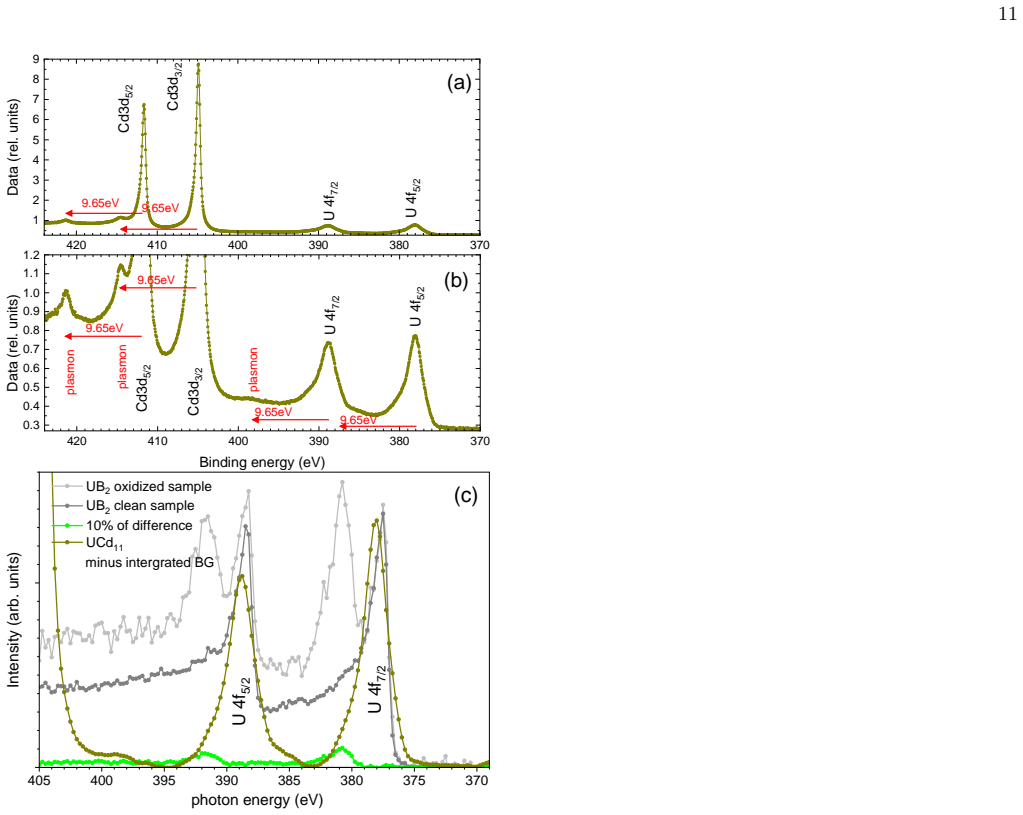
UCd11 is a highly localized uranium 5f^3 system, and satellite features in core-level spectra do not reliably indicate itinerant 5f behavior.
A machine-rendered reading of the paper's core claim, the machinery that carries it, and where it could break.
Core claim
UCd11 is a highly localized uranium 5f^3 system. Core-level spectra obtained from a DFT+DMFT Anderson impurity model reveal that, contrary to common assumptions, the presence or absence of satellite structures is not a reliable indicator of strong correlations or itinerant 5f behavior.
What carries the argument
DFT+DMFT Anderson impurity model with material-specific parameters tuned to match valence-band photoemission spectra at multiple photon energies, exploiting the energy dependence of photoionization cross sections.
If this is right
- The 5f electrons in UCd11 remain weakly hybridized and localized despite the compound's antiferromagnetic order below 5.3 K.
- Satellite structures in core-level photoemission cannot be treated as a simple diagnostic for 5f itinerancy or correlation strength in uranium intermetallics.
- The formal U^{3+} 5f^3 valence state is realized in a localized setting consistent with the large uranium-uranium separation.
- Similar parameter-tuned DFT+DMFT modeling may be required to settle localization questions in other uranium compounds that show ambiguous spectral features.
Where Pith is reading between the lines
- Energy-dependent photoemission fitting offers a route to resolve localization debates in other actinide materials where satellite presence alone has been misleading.
- Some compounds previously labeled itinerant on the basis of missing satellites might prove localized under equivalent analysis.
- The result suggests that large U-U spacing combined with this spectral modeling reliably signals localized 5f behavior and enhanced mass from local moments.
- Further tests on related large-spacing uranium compounds could check whether the same modeling always yields localized solutions.
Load-bearing premise
That material-specific parameters adjusted to fit valence-band photoemission spectra at varying photon energies accurately capture the true degree of 5f localization without bias introduced by the fitting procedure.
What would settle it
Momentum-resolved measurements such as ARPES that detect clear 5f band dispersion or a substantial 5f contribution to the Fermi surface would contradict the strong localization conclusion.
Figures


read the original abstract
UCd$_{11}$ is an antiferromagnetic uranium intermetallic compound ($T_{\rm N}$ = 5.3K) with enhanced electron mass and uranium-uranium spacings nearly twice the Hill limit, suggesting a weakly hybridized 5$f$ electronic character. Various x-ray spectroscopy techniques indicate that uranium in UCd$_{11}$ adopts the formal U$^{3+}$ 5$f^3$ configuration, while core-level photoemission spectroscopy (PES) data of UCd$_{11}$ reveal only a weak satellite feature, typically interpreted as a signature of itinerancy. In this work, we present density functional theory (DFT) combined with dynamical mean-field theory (DMFT) calculations of UCd$_{11}$, using material-specific parameters tuned to reproduce valence-band PES spectra at different photon energies, thereby exploiting the energy dependence of photoionization cross sections. Our results demonstrate that UCd$_{11}$ is a highly localized uranium 5$f^3$ system. Furthermore, core-level spectra obtained from a DFT+DMFT Anderson impurity model reveal that, contrary to common assumptions, the presence or absence of satellite structures is not a reliable indicator of strong correlations or itinerant 5$f$ behavior.
Editorial analysis
A structured set of objections, weighed in public.
Referee Report
Summary. The manuscript presents DFT+DMFT calculations for the antiferromagnetic uranium intermetallic UCd11 (TN=5.3 K). Material-specific parameters (U, J, hybridization V) are tuned to reproduce valence-band PES spectra at multiple photon energies, exploiting the energy dependence of 5f vs. ligand cross-sections. The authors conclude that UCd11 is a highly localized 5f^3 system and that weak satellite features in core-level spectra do not reliably indicate itinerant 5f behavior, contrary to common assumptions.
Significance. If the localization assignment is robust, the work would help reconcile structural indicators (large U-U spacing), formal U3+ valence, and spectral data in this compound, while challenging the use of satellite presence/absence as a proxy for correlation strength in 5f systems. The multi-photon-energy fitting strategy is a methodological strength that leverages known cross-section variations. However, the parameter-tuning approach requires demonstration of uniqueness to elevate the result beyond a calibrated model.
major comments (2)
- Abstract and the DFT+DMFT setup section: the central claim that UCd11 is 'highly localized' rests on tuning U, J, and V to match PES data. The manuscript must demonstrate that this fit is unique by showing that alternative parameter combinations (e.g., lower effective U or larger V, corresponding to more itinerant 5f character) cannot reproduce the photon-energy-dependent spectra within experimental uncertainty. Without such analysis, the localization conclusion is not uniquely determined by the data.
- Core-level spectra results (Anderson impurity model): the argument that satellite structures are not a reliable indicator of itinerancy inherits the same fitted parameters. Sensitivity tests or comparisons to unfitted or alternative models are needed to establish that this conclusion is independent of the specific tuning procedure.
minor comments (1)
- The manuscript should include explicit convergence checks, error bars on spectral comparisons, and details on how the multi-photon-energy data constrain the parameters (e.g., via a table of fit quality metrics).
Simulated Author's Rebuttal
We thank the referee for the positive overall assessment of our work and for the constructive comments, which help strengthen the manuscript. We agree that additional analysis is needed to demonstrate the uniqueness of the parameter fit and the robustness of the core-level conclusions. We will revise the manuscript accordingly, as detailed below.
read point-by-point responses
-
Referee: Abstract and the DFT+DMFT setup section: the central claim that UCd11 is 'highly localized' rests on tuning U, J, and V to match PES data. The manuscript must demonstrate that this fit is unique by showing that alternative parameter combinations (e.g., lower effective U or larger V, corresponding to more itinerant 5f character) cannot reproduce the photon-energy-dependent spectra within experimental uncertainty. Without such analysis, the localization conclusion is not uniquely determined by the data.
Authors: We agree that an explicit demonstration of uniqueness strengthens the localization assignment. While the multi-photon-energy fitting already imposes strong constraints through the contrasting energy dependence of 5f and ligand cross sections, we will add a dedicated sensitivity analysis in the revised manuscript. This will include calculations for a grid of U, J, and V values (e.g., U reduced by 1-2 eV and V increased by 20-30%) and quantitative comparison of the resulting spectra to experiment, showing that only the reported parameter set reproduces the observed intensity ratios within experimental error bars. The new analysis will appear in a supplementary section with an accompanying figure. revision: yes
-
Referee: Core-level spectra results (Anderson impurity model): the argument that satellite structures are not a reliable indicator of itinerancy inherits the same fitted parameters. Sensitivity tests or comparisons to unfitted or alternative models are needed to establish that this conclusion is independent of the specific tuning procedure.
Authors: We accept this criticism. In the revision we will perform and report core-level spectra for both our optimal parameters and for several alternative sets (including literature values for related U compounds and parameter choices that give visibly worse valence-band fits). These comparisons will show that the weak satellite intensity remains a robust feature across the explored range, thereby supporting that the conclusion does not hinge on the precise tuning. The additional spectra and discussion will be incorporated into the main text or a new supplementary figure. revision: yes
Circularity Check
No significant circularity; derivation is data-driven fitting followed by model interpretation
full rationale
The paper explicitly tunes DFT+DMFT parameters (U, J, hybridization) to reproduce experimental valence-band PES spectra at multiple photon energies by exploiting cross-section energy dependence, then uses the resulting model to compute core-level spectra and interpret the weak satellite feature. This is a standard calibration-to-data workflow rather than a closed loop in which the localization conclusion is presupposed by definition or by a self-citation chain. No quoted step equates a 'prediction' to its own fitted input by construction, and the central claim is presented as the outcome of the fit rather than an independent first-principles result. The derivation remains self-contained against the provided PES benchmarks.
Axiom & Free-Parameter Ledger
free parameters (1)
- material-specific parameters
axioms (1)
- domain assumption DFT+DMFT framework is appropriate for describing the correlated 5f electrons in UCd11
Reference graph
Works this paper leans on
-
[1]
A. Georges, G. Kotliar, W. Krauth, and M. J. Rozen- berg, Dynamical mean-field theory of strongly correlated fermion systems and the limit of infinite dimensions, Rev. Mod. Phys.68, 13 (1996)
work page 1996
-
[2]
G. Kotliar, S. Y. Savrasov, K. Haule, V. S. Oudovenko, O. Parcollet, and C. A. Marianetti, Electronic struc- ture calculations with dynamical mean-field theory, Rev. Mod. Phys.78, 865 (2006)
work page 2006
-
[3]
J. c. v. Kolorenˇ c, A. B. Shick, and A. I. Lichtenstein, Electronic structure and core-level spectra of light ac- tinide dioxides in the dynamical mean-field theory, Phys. Rev. B92, 085125 (2015)
work page 2015
-
[4]
K. Haule and G. Kotliar, Arrested kondo effect and hid- den order in URu 2Si2, Nat. Phys.5, 796 (2009)
work page 2009
-
[5]
L. Miao, S. Liu, Y. Xu, E. C. Kotta, C.-J. Kang, S. Ran, J. Paglione, G. Kotliar, N. P. Butch, J. D. Denlinger, and L. A. Wray, Low energy band structure and sym- metries UTe 2 from angle-resolved photoemission spec- troscopy, Phys. Rev. Lett.124, 076401 (2020)
work page 2020
-
[6]
Y. Xu, Y. Sheng, and Y.-f. Yang, Quasi-two-dimensional fermi surfaces and unitary spin-triplet pairing in the heavy fermion superconductor UTe 2, Phys. Rev. Lett. 123, 217002 (2019)
work page 2019
-
[7]
H. C. Choi, S. H. Lee, and B.-J. Yang, Correlated nor- 12 mal state fermiology and topological superconductivity in UTe2, Commun. Phys.7, 10.1038/s42005-024-01708-4 (2024)
-
[8]
B. Kang, Y. Lee, L. Ke, H. Kim, M.-H. Kim, and C. H. Park, Dual nature of magnetism driven by momentum dependent f-d Kondo hybridization, Commun. Phys.7, 10.1038/s42005-024-01631-8 (2024)
-
[9]
B. Chatterjee and J. c. v. Kolorenˇ c, Electronic structure and magnetism in UGa2: DFT+ DMFT approach, Phys. Rev. B103, 205146 (2021)
work page 2021
-
[10]
M. Karolak, G. Ulm, T. Wehling, V. Mazurenko, A. Poteryaev, and A. Lichtenstein, Double counting in LDA+DMFT—the example of NiO, J. Electron Spec- trosc. Relat. Phenom.181, 11 (2010)
work page 2010
-
[11]
A. Marino, D. S. Christovam, D. Takegami, J. Falke, M. M. F. Carvalho, T. Okauchi, C.-F. Chang, S. G. Al- tendorf, A. Amorese, M. Sundermann, A. Gloskovskii, H. Gretarsson, B. Keimer, A. V. Andreev, L. Havela, A. Leithe-Jasper, A. Severing, J. Kunes, L. H. Tjeng, and A. Hariki, Quantifying the U 5fcovalence and de- gree of localization in U intermetallics...
work page 2024
-
[12]
M. Sundermann, T. Okauchi, N. Ito, D. S. Christovam, A. Marino, D. Takegami, A. Golskovskii, P. F. S. Rosa, J. Kuneˇ s, S. ichi Fujimori, L. H. Tjeng, A. Severing, and A. Hariki, UTe 2: a narrow band superconductor (2025), arXiv:2509.07915 [cond-mat.str-el]
-
[13]
A. Amorese, M. Sundermann, B. Leedahl, A. Marino, D. Takegami, H. Gretarsson, A. Gloskovskii, C. Schlueter, M. W. Haverkort, Y. Huang, M. Szlawska, D. Kaczorowski, S. Ran, M. B. Maple, E. D. Bauer, A. Leithe-Jasper, P. Hansmann, P. Thalmeier, L. H. Tjeng, and A. Severing, From antiferromagnetic and hidden order to Pauli paramagnetism in UM 2Si2 com- pound...
work page 2020
-
[14]
D. S. Christovam, M. Sundermann, A. Marino, D. Takegami, J. Falke, P. Dolmantas, M. Harder, H. Gre- tarsson, B. Keimer, A. Gloskovskii, M. W. Haverkort, I. Elfimov, G. Zwicknagl, A. V. Andreev, L. Havela, M. M. Bordelon, E. D. Bauer, P. F. S. Rosa, A. Severing, and L. H. Tjeng, Stabilization of u 5f 2 configuration in UTe2 through U 6ddimers in the presen...
work page 2024
-
[15]
E. Yamamoto, Y. Hirose, K. Enoki, K. Mitamura, K. Sugiyama, T. Takeuchi, M. Hagiwara, K. Kindo, Y. Haga, R. Settai, and Y. Onuki, Heavy fermion state in antiferromagnet UCd11, J. Phys. Soc. Jpn.81, SB023 (2012)
work page 2012
-
[16]
F. A. Cafasso, H. M. Feder, and D. M. Gruen, Electronic configuration and valency of uranium in UCd 11, a mag- netically dilute alloy, The Journal of Chemical Physics 38, 1256 (1963), https://pubs.aip.org/aip/jcp/article- pdf/38/5/1256/18828467/1256 1 online.pdf
work page 1963
-
[17]
Z. Fisk, G. R. Stewart, J. O. Willis, H. R. Ott, and F. Hulliger, Low-temperature properties of the heavy- fermion system UCd 11, Phys. Rev. B30, 6360 (1984)
work page 1984
-
[18]
N. Zaremba, K. Witthaut, Y. Prots, M. Krnel, U. Burkhardt, Z. Fisk, Y. Grin, and E. Svanidze, Crystal chemistry and physics of UCd11, Inorg. Chem.61, 19695 (2022)
work page 2022
-
[19]
M. W. McElfresh, J. H. Hall, R. R. Ryan, J. L. Smith, and Z. Fisk, Structure of the heavy-fermion superconduc- tor UBe 13, Acta Crystallographica Section C46, 1579 (1990)
work page 1990
-
[20]
Y. Hirose, Y. Miura, H. Tsutsumi, S. Yoshiuchi, M. Ohya, K. Sugiyama, T. Takeuchi, H. Yamagami, E. Yamamoto, Y. Haga, R. Settai, and Y. ¯Onuki, Elec- tronic states in antiferromagnet UCd 11 and reference compound ThCd 11: studied by the de haas–van alphen effect, Phys. Status Solidi B Basic Res.250, 642 (2013)
work page 2013
-
[21]
Doniach, The Kondo lattice and weak antiferromag- netism, Physica B+C91, 231 (1977)
S. Doniach, The Kondo lattice and weak antiferromag- netism, Physica B+C91, 231 (1977)
work page 1977
-
[22]
J. Thompson, A. Lawson, M. McElfresh, A. Sattelberger, and Z. Fisk, Elastic neutron scattering in UCd 11, J. Magn. Magn. Mat.76-77, 437 (1988)
work page 1988
-
[23]
C. H. Booth, Y. Jiang, D. L. Wang, J. N. Mitchell, P. H. Tobash, E. D. Bauer, M. A. Wall, P. G. Allen, D. Sokaras, D. Nordlund, T.-C. Weng, M. A. Torrez, and J. L. Sar- rao, Multiconfigurational nature of 5forbitals in ura- nium and plutonium intermetallics, Proc. Natl. Acad. Sci. USA109, 10205 (2012)
work page 2012
-
[24]
P. S¨ oderlind, A. Landa, J. G. Tobin, P. Allen, S. Medling, C. H. Booth, E. D. Bauer, J. C. Cooley, D. Sokaras, T.- C. Weng, and D. Nordlund, On the valence fluctuation in the early actinide metals, J. Elec. Spectr. Rel. Phen. 207, 14 (2016)
work page 2016
-
[25]
C. H. Booth, S. A. Medling, J. G. Tobin, R. E. Baum- bach, E. D. Bauer, D. Sokaras, D. Nordlund, and T.-C. Weng, Probing 5f-state configurations in URu 2Si2 with uL III -edge resonant x-ray emission spectroscopy, Phys. Rev. B94, 045121 (2016)
work page 2016
-
[26]
J. G. Tobin, S. Nowak, C. H. Booth, E. D. Bauer, S.- W. Yu, R. Alonso-Mori, T. Kroll, D. Nordlund, T.-C. Weng, and D. Sokaras, Separate measurement of the 5f5/2 and 5f7/2 unoccupied density of states of UO 2, J. Elec. Spectr. Rel. Phen.232, 100 (2019)
work page 2019
-
[27]
S.-i. Fujimori, T. Ohkochi, I. Kawasaki, A. Yasui, Y. Takeda, T. Okane, Y. Saitoh, A. Fujimori, H. Yam- agami, Y. Haga, E. Yamamoto, and Y. ¯Onuki, Electronic structures of ferromagnetic superconductors UGe 2 and UCoGe studied by angle-resolved photoelectron spec- troscopy, Phys. Rev. B91, 174503 (2015)
work page 2015
-
[28]
H.-M. Tsai, H.-W. Fu, C.-Y. Kuo, L.-J. Huang, C.-S. Lee, C.-Y. Hua, K.-Y. Kao, H.-J. Lin, H.-S. Fung, S.-C. Chung, C.-F. Chang, A. Chainani, L. H. Tjeng, and C.-T. Chen, A submicron soft x-ray active grating monochro- mator beamline for ultra-high resolution angle-resolved photoemission spectroscopy, AIP Conference Proceed- ings2054, 060047 (2019)
work page 2019
-
[29]
C. Schlueter, A. Gloskovskii, K. Ederer, I. Schostak, S. Piec, I. Sarkar, Y. Matveyev, P. L¨ omker, M. Sing, R. Claessen, C. Wiemann, C. M. Schneider, K. Med- janik, G. Sch¨ onhense, P. Amann, A. Nilsson, and W. Drube, The new dedicated HAXPES beamline P22 at PETRAIII, AIP Conference Proceedings2054, 040010 (2019)
work page 2019
- [30]
-
[31]
J. Kuneˇ s, R. Arita, P. Wissgott, A. Toschi, H. Ikeda, and K. Held, Wien2wannier: From linearized augmented plane waves to maximally localized wannier functions, Comput. Phys. Commun.181, 1888 (2010)
work page 2010
-
[32]
A. A. Mostofi, J. R. Yates, G. Pizzi, Y.-S. Lee, I. Souza, D. Vanderbilt, and N. Marzari, An updated version 13 of wannier90: A tool for obtaining maximally-localised wannier functions, Comput. Phys. Commun.185, 2309 (2014)
work page 2014
- [33]
-
[34]
E. Gull, A. J. Millis, A. I. Lichtenstein, A. N. Rubtsov, M. Troyer, and P. Werner, Continuous-time monte carlo methods for quantum impurity models, Rev. Mod. Phys. 83, 349 (2011)
work page 2011
-
[35]
L. Boehnke, H. Hafermann, M. Ferrero, F. Lechermann, and O. Parcollet, Orthogonal polynomial representation of imaginary-time green’s functions, Phys. Rev. B84, 075145 (2011)
work page 2011
-
[36]
H. Hafermann, K. R. Patton, and P. Werner, Im- proved estimators for the self-energy and vertex func- tion in hybridization-expansion continuous-time quan- tum monte carlo simulations, Phys. Rev. B85, 205106 (2012)
work page 2012
-
[37]
M. Jarrell and J. Gubernatis, Bayesian inference and the analytic continuation of imaginary-time quantum monte carlo data, Phys. Rep.269, 133 (1996)
work page 1996
- [38]
-
[39]
K. Haule, Exact double counting in combining the dy- namical mean field theory and the density functional the- ory, Phys. Rev. Lett.115, 196403 (2015)
work page 2015
-
[40]
M. Trzhaskovskaya, V. Needov, and V. Yarzhemsky, Pho- toelectron angular distribution parameters for elements z=1 to z=54 in the photoelectron energy range 100–5000 ev, At. Data Nucl. Data Tables77, 97 (2001)
work page 2001
-
[41]
M. Trzhaskovskaya, V. Needov, and V. Yarzhemsky, Photoelectron angular distribution parameters for ele- ments z=55 to z=100 in the photoelectron energy range 100–5000 ev, At. Data Nucl. Data Tables82, 257 (2002)
work page 2002
-
[42]
M. Trzhaskovskaya and V. Yarzhemsky, Dirac–Fock photoionization parameters for HAXPES applications, Atomic Data and Nuclear Data Tables119, 99 (2018)
work page 2018
-
[43]
D. Takegami, L. Nicola¨ ı, T. C. Koethe, D. Kasinathan, C. Y. Kuo, Y. F. Liao, K. D. Tsuei, G. Panaccione, F. Offi, G. Monaco, N. B. Brookes, J. Min´ ar, and L. H. Tjeng, Valence band hard x-ray photoelectron spec- troscopy on 3dtransition-metal oxides containing rare- earth elements, Phys. Rev. B99, 165101 (2019)
work page 2019
-
[44]
X. H. Liu, A. D. Rata, C. F. Chang, A. C. Komarek, and L. H. Tjeng, Verwey transition in Fe 3O4 thin films: Influence of oxygen stoichiometry and substrate-induced microstructure, Phys. Rev. B90, 125142 (2014)
work page 2014
-
[45]
A. Marino, M. Sundermann, D. S. Christovam, A. Amorese, C.-F. Chang, P. Dolmantas, A. H. Said, H. Gretarsson, B. Keimer, M. W. Haverkort, A. V. An- dreev, L. Havela, P. Thalmeier, L. H. Tjeng, and A. Sev- ering, Singlet magnetism in intermetallic UGa 2 unveiled by inelastic x-ray scattering, Phys. Rev. B108, 045142 (2023)
work page 2023
-
[46]
A. Marino, D. S. Christovam, C.-F. Chang, J. Falke, C.- Y. Kuo, C.-N. Wu, M. Sundermann, A. Amorese, H. Gre- tarsson, E. Lee-Wong, C. M. Moir, Y. Deng, M. B. Maple, P. Thalmeier, L. H. Tjeng, and A. Severing, Fe substitu- tion in URu 2Si2: Singlet magnetism in an extended Do- niach phase diagram, Phys. Rev. B108, 085128 (2023)
work page 2023
discussion (0)
Sign in with ORCID, Apple, or X to comment. Anyone can read and Pith papers without signing in.