Quantum Computing of Phonon Spectra and Thermal Properties of Crystalline Solids
Pith reviewed 2026-05-10 07:08 UTC · model grok-4.3
The pith
Phonon spectra and thermal properties of solids like silicon and graphene can be obtained from variational quantum algorithms applied to qubit-mapped dynamical matrices.
A machine-rendered reading of the paper's core claim, the machinery that carries it, and where it could break.
Core claim
The phonon Hamiltonian, constructed from first-principles force constants, is mapped onto a qubit-encoded Hermitian operator. Variational quantum eigensolver and variational quantum deflation then recover the complete set of phonon eigenvalues for silicon and graphene. These eigenvalues determine vibrational entropy, constant-volume specific heat, and thermal expansion coefficient, which display the correct low-temperature quantum regime and approach the Dulong-Petit limit at high temperature, with error mitigation restoring consistency with classical benchmarks on current quantum devices.
What carries the argument
Mapping the mass-weighted dynamical matrix to a qubit-encoded Hermitian operator, which variational quantum algorithms diagonalize to obtain phonon frequencies.
If this is right
- Phonon dispersions for small crystalline systems can be computed on quantum hardware using reduced qubit registers.
- Thermodynamic properties follow directly from the quantum spectrum and match standard limiting behaviors.
- Error mitigation enables consistent physical results for both spectra and derived quantities on noisy devices.
- Phonon thermodynamics offers a clear, low-overhead benchmark for variational quantum algorithms in materials applications.
Where Pith is reading between the lines
- If the qubit overhead scales favorably, the method could address unit cells too large for routine classical phonon calculations.
- The same mapping might be extended to treat anharmonic corrections or electron-phonon interactions on quantum hardware.
- Success on this benchmark would indicate that variational methods are ready for other lattice-based problems in condensed matter.
Load-bearing premise
The variational quantum eigensolver and deflation algorithms, after error mitigation, recover the phonon eigenvalues to sufficient accuracy that thermodynamic quantities match exact classical diagonalization.
What would settle it
A clear deviation between quantum-computed and classically computed constant-volume specific heat at intermediate temperatures for the graphene system would show the recovered spectrum is not accurate enough.
Figures
read the original abstract
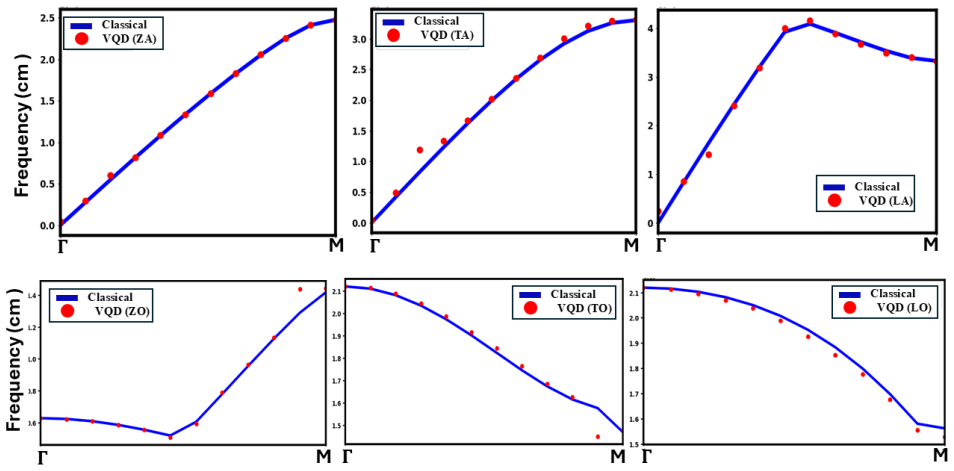
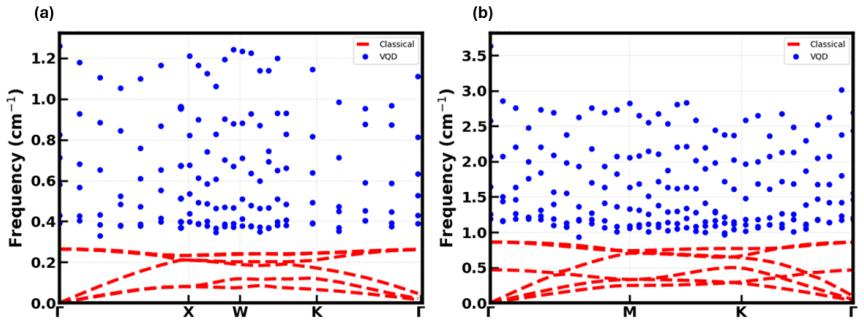
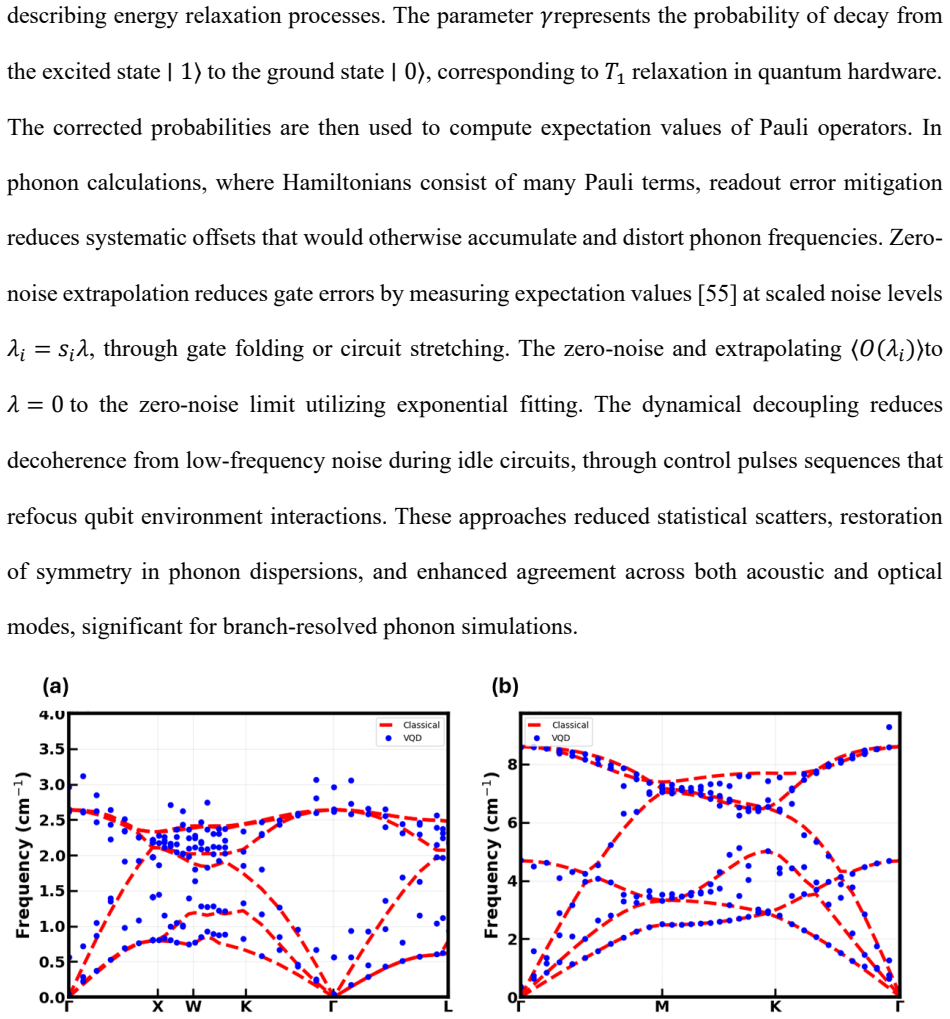
Variational quantum algorithms offer a promising framework for solving eigenvalue problems on near-term quantum hardware, yet their applicability beyond electronic structure calculations remains relatively unexplored. In this work, we investigate the quantum computing of lattice vibrational and thermodynamical properties by applying the variational quantum eigensolver and variational quantum deflation to phonon Hamiltonians derived from first-principles force constants obtained using density functional theory. The mass-weighted dynamical matrix is mapped onto a qubit-encoded Hermitian operator, enabling computation of the full set of acoustic and optical phonon branches of crystalline silicon and graphene using a reduced qubit register and direct benchmarking against classical diagonalization. The quantum-computed phonon spectrum is further used to evaluate vibrational entropy, constant-volume specific heat, and thermal expansion coefficient, reproducing expected low-temperature quantum behavior and the high-temperature Dulong-Petit limit. We further demonstrate that combined error mitigation strategies help recover phonon dispersions and thermodynamic behavior consistent with expected trends on near-term quantum hardware. Although classical phonon methods remain computationally superior, our results establish phonon-based thermodynamics as a stringent and physically transparent benchmark for assessing variational quantum algorithms on near-term quantum devices.
Editorial analysis
A structured set of objections, weighed in public.
Referee Report
Summary. The manuscript applies the variational quantum eigensolver (VQE) and variational quantum deflation (VQD) to phonon Hamiltonians obtained by mapping mass-weighted dynamical matrices from DFT force constants onto qubit operators. For small unit cells of silicon and graphene (6 modes each), the full phonon spectrum is recovered via VQD with deflation, benchmarked directly against classical diagonalization, and used to compute vibrational entropy, constant-volume specific heat, and the thermal expansion coefficient within the quasi-harmonic approximation. The quantum results are shown to reproduce the classical values and the expected low-T T^3 behavior plus high-T Dulong-Petit limit; combined readout and zero-noise extrapolation mitigation is demonstrated on both simulators and hardware.
Significance. If the numerical agreement holds under the reported conditions, the work supplies a concrete, physically transparent benchmark for variational quantum algorithms on a problem outside electronic structure. Phonon thermodynamics offers falsifiable predictions (T^3 law, Dulong-Petit limit) that are directly comparable to classical diagonalization, thereby providing a useful testbed for assessing ansatz quality, mitigation, and hardware performance on near-term devices. The demonstration remains limited to small systems where classical methods are already efficient.
major comments (2)
- [Results section (phonon frequencies and thermodynamic properties)] The central claim of quantitative agreement between quantum-computed and classically diagonalized phonon frequencies (and the consequent thermodynamic quantities) is not supported by explicit error metrics such as root-mean-square deviation, maximum absolute error, or per-branch deviations. Without these numbers or convergence data versus shot count and mitigation parameters, it is difficult to judge whether the observed match is within the tolerance required for reliable thermodynamic derivatives.
- [Methods (mapping and VQE/VQD implementation)] The description of the variational ansatz (form, depth, number of parameters) and the deflation procedure for VQD is insufficient to allow independent reproduction or assessment of whether the recovered eigenvalues are converged to the precision needed for the reported thermodynamic agreement.
minor comments (2)
- [Abstract and §2] The abstract and main text would benefit from a brief statement of the qubit count and Pauli-term count after the dynamical-matrix mapping for the two materials.
- [Figure captions] Figure captions should explicitly state whether the plotted dispersions are from quantum or classical diagonalization and whether error bars represent statistical or mitigation uncertainty.
Simulated Author's Rebuttal
We thank the referee for their constructive review and positive assessment of the work. We address each major comment below and have revised the manuscript to incorporate the suggested improvements for clarity and reproducibility.
read point-by-point responses
-
Referee: [Results section (phonon frequencies and thermodynamic properties)] The central claim of quantitative agreement between quantum-computed and classically diagonalized phonon frequencies (and the consequent thermodynamic quantities) is not supported by explicit error metrics such as root-mean-square deviation, maximum absolute error, or per-branch deviations. Without these numbers or convergence data versus shot count and mitigation parameters, it is difficult to judge whether the observed match is within the tolerance required for reliable thermodynamic derivatives.
Authors: We agree that explicit quantitative error metrics strengthen the presentation and allow better assessment of the results. In the revised manuscript we have added root-mean-square deviations, maximum absolute errors, and per-branch deviations between the quantum-computed and classically diagonalized phonon frequencies for both silicon and graphene. We have also included additional figures and tables that show the convergence of these errors with respect to shot count and the parameters of the combined readout and zero-noise extrapolation mitigation. These additions confirm that the deviations remain sufficiently small to support the reported thermodynamic quantities and their expected temperature dependence. revision: yes
-
Referee: [Methods (mapping and VQE/VQD implementation)] The description of the variational ansatz (form, depth, number of parameters) and the deflation procedure for VQD is insufficient to allow independent reproduction or assessment of whether the recovered eigenvalues are converged to the precision needed for the reported thermodynamic agreement.
Authors: We appreciate the referee's emphasis on reproducibility. In the revised manuscript we have substantially expanded the Methods section to provide a complete specification of the variational ansatz, including its explicit form, circuit depth, and the total number of variational parameters. We have also added a detailed description of the VQD deflation procedure, including the form of the penalty terms, the optimization protocol, and the convergence criteria used to ensure the eigenvalues are obtained to the precision required for the thermodynamic calculations. revision: yes
Circularity Check
No significant circularity detected
full rationale
The derivation takes external DFT force constants as input to construct the dynamical matrix, maps it to a qubit operator, applies VQE/VQD with explicit benchmarking against independent classical diagonalization of the identical matrix, and recomputes thermodynamic quantities from the obtained frequencies. All central results are validated by direct numerical agreement with classical references and by reproduction of known physical limits (low-T T^3 behavior and high-T Dulong-Petit), with no self-definitional reductions, fitted inputs renamed as predictions, or load-bearing self-citations that collapse the claims to the paper's own inputs by construction.
Axiom & Free-Parameter Ledger
axioms (2)
- domain assumption Density functional theory supplies sufficiently accurate interatomic force constants for phonon calculations in silicon and graphene
- domain assumption The mass-weighted dynamical matrix can be faithfully encoded as a qubit Hermitian operator whose eigenvalues correspond to phonon frequencies
Reference graph
Works this paper leans on
-
[1]
Sherbert, K., A. Jayaraj, and M. Buongiorno Nardelli, Quantum algorithm for electronic band structures with local tight-binding orbitals. Scientific Reports, 2022. 12(1): p. 9867
work page 2022
-
[2]
Parrish, R.M., et al., Quantum computation of electronic transitions using a variational quantum eigensolver. Physical review letters, 2019. 122(23): p. 230401
work page 2019
-
[3]
al., Recent progress towards large -scale integrated photonic quantum computation
Zhu, H., et. al., Recent progress towards large -scale integrated photonic quantum computation. npj nanophotonics 2026. 3: p. 20
work page 2026
-
[4]
Physical Chemistry Chemical Physics, 2020
Cerasoli, F.T., et al., Quantum computation of silicon electronic band structure. Physical Chemistry Chemical Physics, 2020. 22(38): p. 21816-21822
work page 2020
-
[5]
Journal of Physics: Condensed Matter, 2021
Choudhary, K., Quantum computation for predicting electron and phonon properties of solids. Journal of Physics: Condensed Matter, 2021. 33(38): p. 385501
work page 2021
-
[6]
Khandelwal, N., et al., Quantum computation of the electronic structure of some prototype solids. Scientific Reports, 2025. 15(1): p. 44074. 28
work page 2025
-
[7]
Macridin, A., et al., Electron-phonon systems on a universal quantum computer. Physical review letters, 2018. 121(11): p. 110504
work page 2018
-
[8]
Reinke, C.M. and I. El -Kady, Phonon-based scalable platform for chip -scale quantum computing. AIP Advances, 2016. 6(12)
work page 2016
-
[9]
Bonča, J. and S. Trugman, Dynamic properties of a polaron coupled to dispersive optical phonons. Physical Review B, 2021. 103(5): p. 054304
work page 2021
-
[10]
Callaway, J., Model for lattice thermal conductivity at low temperatures. Physical Review,
-
[11]
Tesch, C.M. and R. de Vivie -Riedle, Quantum computation with vibrationally excited molecules. Physical review letters, 2002. 89(15): p. 157901
work page 2002
-
[12]
Wecker, D., et al., Solving strongly correlated electron models on a quantum computer. Physical Review A, 2015. 92(6): p. 062318
work page 2015
-
[13]
McClean, J.R., et al., The theory of variational hybrid quantum-classical algorithms. New Journal of Physics, 2016. 18(2): p. 023023
work page 2016
-
[14]
Giannozzi, P., et al., Ab initio calculation of phonon dispersions in semiconductors. Physical Review B, 1991. 43(9): p. 7231
work page 1991
-
[15]
Wei, S. and M. Chou, Ab initio calculation of force constants and full phonon dispersions. Physical review letters, 1992. 69(19): p. 2799
work page 1992
-
[16]
Physical Review B —Condensed Matter and Materials Physics, 2009
Zhang, Y ., et al., Thermodynamic properties of PbTe, PbSe, and PbS: First -principles study. Physical Review B —Condensed Matter and Materials Physics, 2009. 80(2): p. 024304
work page 2009
-
[17]
Zhou, F., et al., Compressive sensing lattice dynamics. II. Efficient phonon calculations and long-range interactions. Physical Review B, 2019. 100(18): p. 184309. 29
work page 2019
-
[18]
Macridin, A., et al., Digital quantum computation of fermion -boson interacting systems. Physical Review A, 2018. 98(4): p. 042312
work page 2018
-
[19]
The Journal of chemical physics, 2023
Van Benschoten, W.Z., et al., Electronic specific heat capacities and entropies from density matrix quantum Monte Carlo using Gaussian process regression to find gradients of noisy data. The Journal of chemical physics, 2023. 158(21)
work page 2023
-
[20]
Chen, C.-F., et al., Efficient quantum thermal simulation. Nature, 2025. 646(8085): p. 561- 566
work page 2025
-
[21]
Stavrou, V ., et al., Electron scattering and capture rates in quantum wells by emission of hybrid optical phonons. Physical Review B, 2001. 63(20): p. 205304
work page 2001
-
[22]
Kresse, G. and J. Furthmüller, Efficient iterative schemes for ab initio total -energy calculations using a plane-wave basis set. Physical review B, 1996. 54(16): p. 11169
work page 1996
-
[23]
Physical Review B—Condensed Matter and Materials Physics, 2006
Mattsson, A.E., et al., Nonequivalence of the generalized gradient approximations PBE and PW91. Physical Review B—Condensed Matter and Materials Physics, 2006. 73(19): p. 195123
work page 2006
-
[24]
Journal of chemical theory and computation, 2019
Zhang, J., et al., Large-scale phonon calculations using the real -space multigrid method. Journal of chemical theory and computation, 2019. 15(12): p. 6859-6864
work page 2019
-
[25]
Gurunathan, R., K. Choudhary, and F. Tavazza, Rapid prediction of phonon structure and properties using the atomistic line graph neural network (ALIGNN). Physical Review Materials, 2023. 7(2): p. 023803
work page 2023
-
[26]
Zhou, W. -X. and K. -Q. Chen, First-principles determination of ultralow thermal conductivity of monolayer WSe2. Scientific reports, 2015. 5(1): p. 15070. 30
work page 2015
-
[27]
Lindsay, L., D. Broido, and N. Mingo, Flexural phonons and thermal transport in graphene. Physical Review B—Condensed Matter and Materials Physics, 2010. 82(11): p. 115427
work page 2010
-
[28]
Sawaya, N.P., F. Paesani, and D.P. Tabor, Near-and long -term quantum algorithmic approaches for vibrational spectroscopy. Physical Review A, 2021. 104(6): p. 062419
work page 2021
-
[29]
Ollitrault, P.J., et al., Hardware efficient quantum algorithms for vibrational structure calculations. Chemical science, 2020. 11(26): p. 6842-6855
work page 2020
-
[30]
Lötstedt, E., et al., Calculation of vibrational eigenenergies on a quantum computer: Application to the Fermi resonance in CO 2. Physical Review A, 2021. 103(6): p. 062609
work page 2021
-
[31]
Wen, J., et al., Variational quantum packaged deflation for arbitrary excited states. Quantum Engineering, 2021. 3(4): p. e80
work page 2021
-
[32]
Physical Review Research, 2022
Ibe, Y ., et al., Calculating transition amplitudes by variational quantum deflation. Physical Review Research, 2022. 4(1): p. 013173
work page 2022
-
[33]
Ďuriška, M., I. Miháliková, and M. Friák, Quantum computing of the electronic structure of crystals by the variational quantum deflation algorithm. Physica Scripta, 2025. 100(4): p. 045105
work page 2025
-
[34]
Stober, S.T., et al., Considerations for evaluating thermodynamic properties with hybrid quantum-classical computing work flows. Physical Review A, 2022. 105(1): p. 012425
work page 2022
-
[35]
das Neves Silva, A.C., L.Q. Galvão, and C. Cruz, Simulating thermodynamic properties of dinuclear metal complexes using Variational Quantum Algorithms. Physica Scripta, 2024. 99(9): p. 095131
work page 2024
-
[36]
Powers, C., et al., Exploring finite temperature properties of materials with quantum computers. Scientific reports, 2023. 13(1): p. 1986. 31
work page 2023
-
[37]
Journal of Applied Physics, 2006
Zhao, H., et al., Quasiharmonic models for the calculation of thermodynamic properties of crystalline silicon under strain. Journal of Applied Physics, 2006. 99(6)
work page 2006
-
[38]
Dallaire-Demers, P. -L. and F.K. Wilhelm, Method to efficiently simulate the thermodynamic properties of the Fermi-Hubbard model on a quantum computer. Physical Review A, 2016. 93(3): p. 032303
work page 2016
-
[39]
Perez, R.E., P.W. Jansen, and J.R. Martins, pyOpt: a Python -based object -oriented framework for nonlinear constrained optimization. Structural and Multidisciplinary Optimization, 2012. 45(1): p. 101-118
work page 2012
-
[40]
ACM Transactions on Mathematical Software (TOMS), 1994
Kraft, D., Algorithm 733: TOMP–Fortran modules for optimal control calculations. ACM Transactions on Mathematical Software (TOMS), 1994. 20(3): p. 262-281
work page 1994
-
[41]
Stiefel, E., Methods of conjugate gradients for solving linear systems. J. Res. Nat. Bur. Standards, 1952. 49: p. 409-435
work page 1952
-
[42]
ACM Transactions on Modeling and Computer Simulation (TOMACS), 2005
Bhatnagar, S., Adaptive multivariate three-timescale stochastic approximation algorithms for simulation based optimization. ACM Transactions on Modeling and Computer Simulation (TOMACS), 2005. 15(1): p. 74-107
work page 2005
-
[43]
Reviews of modern Physics, 2001
Baroni, S., et al., Phonons and related crystal properties from density -functional perturbation theory. Reviews of modern Physics, 2001. 73(2): p. 515
work page 2001
-
[44]
Shanmukha, M., et al., Expected values of Sombor indices and their entropy measures for graphene. Molecular Physics, 2024. 122(10): p. e2276905
work page 2024
-
[45]
Kim, D., et al., Phonon anharmonicity in silicon from 100 to 1500 K. Physical Review B,
-
[46]
91(1): p. 014307. 32
-
[47]
Okada, Y . and Y . Tokumaru, Precise determination of lattice parameter and thermal expansion coefficient of silicon between 300 and 1500 K. Journal of applied physics, 1984. 56(2): p. 314-320
work page 1984
-
[48]
Domingo, L., G. Carlo, and F. Borondo, Taking advantage of noise in quantum reservoir computing. Scientific Reports, 2023. 13(1)
work page 2023
-
[49]
Georgopoulos, K., C. Emary, and P. Zuliani, Modeling and simulating the noisy behavior of near-term quantum computers. Physical Review A, 2021. 104(6): p. 062432
work page 2021
-
[50]
Physical Review Research, 2023
Di Bartolomeo, G., et al., Noisy gates for simulating quantum computers. Physical Review Research, 2023. 5(4): p. 043210
work page 2023
-
[51]
Meher, A., Y . Liu, and H. Zhou. Error Mitigation of Hamiltonian Simulations from an Analog-Based Compiler (SimuQ) . in 2024 IEEE International Conference on Quantum Computing and Engineering (QCE). 2024. IEEE
work page 2024
-
[52]
Kim, J., et al., Quantum readout error mitigation via deep learning. New Journal of Physics, 2022. 24(7): p. 073009
work page 2022
-
[53]
Mena López, A. and L. -A. Wu, Protectability of IBMQ qubits by dynamical decoupling technique. Symmetry, 2022. 15(1): p. 62
work page 2022
-
[54]
Vaqem: A variational approach to quantum error mitigation
Ravi, G.S., et al. Vaqem: A variational approach to quantum error mitigation. in 2022 IEEE International Symposium on High -Performance Computer Architecture (HPCA) . 2022. IEEE
work page 2022
-
[55]
Kandala, A., et al., Error mitigation extends the computational reach of a noisy quantum processor. Nature, 2019. 567(7749): p. 491-495
work page 2019
-
[56]
Endo, S., S.C. Benjamin, and Y . Li, Practical quantum error mitigation for near -future applications. Physical Review X, 2018. 8(3): p. 031027. 33
work page 2018
-
[57]
Sun, X. and P. Zhao, Decoherence mitigation for geometric quantum computation. Physical Review A, 2025. 112(3): p. 032403
work page 2025
discussion (0)
Sign in with ORCID, Apple, or X to comment. Anyone can read and Pith papers without signing in.