Anomalous nonlocality of information masked in quantum correlations
Pith reviewed 2026-05-10 06:53 UTC · model grok-4.3
The pith
Quantum correlations as information carriers allow willful instantaneous choice to decode locally or dispatch to a distant site without classical signals.
A machine-rendered reading of the paper's core claim, the machinery that carries it, and where it could break.
Core claim
Although information requires physical carriers that cannot exceed light speed, quantum correlations used as such carriers exhibit a nonlocality permitting an observer to select at will whether to decode the information at one location or dispatch it to another far away without needing classical information, so the choice occurs instantaneously without violating the speed of light; this differs from particle nonlocality, where detection location is governed by quantum uncertainty that cannot be chosen freely.
What carries the argument
Quantum correlations functioning as carriers of information, which support a nonlocal choice between local decoding and remote dispatch.
If this is right
- The location where information can be decoded can be selected or reassigned instantaneously by the choice to decode or not decode locally.
- No classical communication is needed to enact the selection or dispatch.
- Superluminal signaling remains impossible, so special relativity is preserved.
- Both quantum and classical information can exhibit this behavior when carried by quantum correlations.
- The phenomenon is distinct from particle nonlocality because the choice is deliberate rather than uncertain.
Where Pith is reading between the lines
- This framing might allow construction of quantum protocols in which control over information accessibility is exercised without measurement-induced collapse.
- It suggests possible links to no-signaling constraints that could be tested in standard entangled-state experiments.
- If the mechanism holds, it could be extended to multipartite correlations to explore multi-site dispatch choices.
Load-bearing premise
Quantum correlations can serve as carriers that permit a free, instantaneous choice of decoding location while still forbidding any superluminal signaling.
What would settle it
A demonstration that any such choice of decode-or-dispatch always requires an accompanying classical signal or reduces to probabilistic uncertainty rather than willful control would falsify the central claim.
Figures
read the original abstract
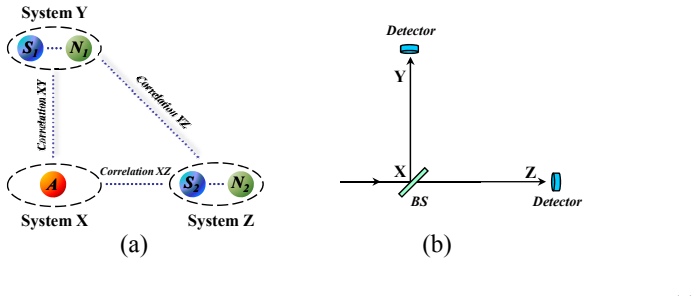
Although information, strictly speaking, is not a physical entity, it generally requires physical entities as its carriers, e.g., writing it down on paper, encoding it with quantum particles, or transmitting it using electro-magnetic fields. And it seems natural that these carriers cannot travel faster than light. Here we reveal that if we use quantum correlations as the carrier of information (either quantum or classical), then it can display a kind of nonlocality, which bears both similarities to and distinctions from the nonlocality of physical particles. Notably, though superluminal signaling is still not allowed so that the special relativity is not violated, it is possible to select at our will whether to decode the information at one location, or to dispatch it to another location far away (i.e., to give up the chance of decoding the information and let it be decodable in somewhere else only) without needing the assistance of classical information, so that it occurs instantaneously without being limited by the speed of light. This phenomenon differs sharply from the nonlocality of physical particles that we once knew, where whether a particle can be detected in one location or another is governed by quantum uncertainty, which cannot be chosen freely.
Editorial analysis
A structured set of objections, weighed in public.
Referee Report
Summary. The paper claims that quantum correlations, when used as carriers of information (classical or quantum), exhibit an 'anomalous nonlocality' allowing a party to freely and instantaneously choose—without classical communication—whether to decode the information locally or dispatch it for decoding only at a distant site. This choice is said to occur faster than light yet without enabling superluminal signaling, distinguishing it from the nonlocality of physical particles governed by quantum uncertainty.
Significance. If the central claim were correct and consistent with quantum mechanics, it would represent a novel form of information nonlocality with potential implications for quantum communication protocols. However, the manuscript provides no mathematical framework, explicit protocols, or derivations in the abstract, and the described mechanism appears to conflict with the no-communication theorem.
major comments (2)
- [Abstract] Abstract: The assertion that one can 'select at our will whether to decode the information at one location, or to dispatch it to another location far away ... without needing the assistance of classical information' implies that a local choice (e.g., measurement or not) controllably alters the distant party's decoding capability. This contradicts the no-communication theorem, as any local operation leaves the distant reduced density matrix invariant, preventing the distant party from obtaining information about the choice without classical bits.
- [Abstract] Abstract: The claim distinguishes this 'nonlocality of information' from particle nonlocality by asserting free choice of decoding location, yet provides no concrete protocol, state preparation, or measurement scheme demonstrating how the selection occurs while preserving the invariance of reduced states. Without such details, the central claim cannot be verified against standard quantum mechanics.
Simulated Author's Rebuttal
We thank the referee for their thorough review and constructive comments on our manuscript arXiv:2604.16951. We address the major concerns regarding potential conflict with the no-communication theorem and the need for explicit protocols. Our responses clarify that the proposed nonlocality does not enable superluminal signaling, consistent with quantum mechanics, while highlighting the novel aspect of information carrier nonlocality.
read point-by-point responses
-
Referee: The assertion that one can 'select at our will whether to decode the information at one location, or to dispatch it to another location far away ... without needing the assistance of classical information' implies that a local choice (e.g., measurement or not) controllably alters the distant party's decoding capability. This contradicts the no-communication theorem, as any local operation leaves the distant reduced density matrix invariant, preventing the distant party from obtaining information about the choice without classical bits.
Authors: We agree that the no-communication theorem holds and that local operations cannot alter the distant reduced density matrix. Our manuscript does not claim otherwise. The local choice of decoding or dispatching does not provide the distant party with any information about the choice itself, as they cannot distinguish the scenarios without classical communication. The anomalous nonlocality pertains to the freedom in selecting the decoding location using the quantum correlations as the information carrier, which is instantaneous in the sense that no classical signal is needed for the choice, yet no actual information is transmitted superluminally. This is distinct from particle nonlocality. We will revise the abstract and add a clarifying paragraph in the introduction to emphasize this point. revision: partial
-
Referee: The claim distinguishes this 'nonlocality of information' from particle nonlocality by asserting free choice of decoding location, yet provides no concrete protocol, state preparation, or measurement scheme demonstrating how the selection occurs while preserving the invariance of reduced states. Without such details, the central claim cannot be verified against standard quantum mechanics.
Authors: The full text of the manuscript discusses the mechanism in terms of quantum correlations and how the choice is implemented. However, to facilitate verification, we will include an explicit protocol, including a specific entangled state, the encoding of information, and the local measurement choices that allow the sender to select the decoding location while keeping reduced states invariant. This addition will be made in a new section or appendix in the revised manuscript. revision: yes
Circularity Check
No circularity: conceptual claim grounded in standard QM without self-referential reduction
full rationale
The paper's central claim—that quantum correlations as information carriers permit willful instantaneous selection of decoding location without classical assistance—is presented as a direct revelation from the properties of quantum correlations. No equations, fitted parameters, or derivations appear in the abstract or provided text that reduce the result to its own inputs by construction. No self-citations, ansatzes, or uniqueness theorems are invoked in a load-bearing way. The derivation chain, to the extent visible, remains self-contained against external benchmarks such as the no-communication theorem (which the paper explicitly acknowledges is not violated). This is the normal honest outcome for a conceptual paper without explicit mathematical reductions.
Axiom & Free-Parameter Ledger
axioms (2)
- domain assumption Quantum correlations can serve as carriers of information
- standard math No superluminal signaling is allowed
invented entities (1)
-
Nonlocality of information
no independent evidence
Reference graph
Works this paper leans on
-
[1]
K. Modi, A. K. Pati, A. Sen(De), and U. Sen, Phys. Rev. Lett. 120(23), 230501 (2018). Masking quantum informa- tion is impossible
work page 2018
-
[2]
X. -B. Liang, B. Li, and S. -M. Fei, Phys. Rev. A 100, 030304(R) (2019). Complete characterization of qubit masking
work page 2019
-
[3]
Z. -H. Liu, X. -B. Liang, K. Sun, Q. Li, Y. Meng, M. Yang, B. Li, J. -L. Chen, J. -S. Xu, C. -F. Li, and G. -C. Guo, Phys. Rev. Lett. 126(17), 170505 (2021). Photonic implementation of quantum information masking
work page 2021
-
[4]
M. -S. Li and Y. -L. Wang, Phys. Rev. A 98, 062306 (2018). Masking quantum information in multipartite scenario
work page 2018
-
[5]
K. Y. Han, Z. H. Guo, H. X. Cao, Y. X. Du, and C. Yang, EPL 131, 3 (2020). Quantum multipartite maskers vs. quantum error-correcting codes
work page 2020
-
[6]
Z. -F. Liu, et al., Commun. Phys. 8, 30 (2025). Experi- mental demonstration of complete quantum information masking and generalization of quantum secret sharing
work page 2025
-
[7]
K. Yamaguchi and A. Kempf, Phys. Rev. Lett. 136(1), 010801 (2026). Encrypted qubits can be cloned
work page 2026
-
[8]
K. Yamaguchi, L. Rullk¨ otter, I. Shehzad, S. J. Wagner, C. Tutschku, and A. Kempf, arXiv:2602.10695. Experi- mental demonstration that qubits can be cloned at will, if encrypted with a single-use decryption key
-
[9]
W. K. Wootters and W. H. Zurek, Nature 299, 802 (1982). A single quantum cannot be cloned
work page 1982
-
[10]
C. H. Bennett, G. Brassard, C. Cr´ epeau, R. Jozsa, A. Peres, and W. K. Wootters, Phys. Rev. Lett. 70, 1895 (1993). Teleporting an unknown quantum state via dual classical and Einstein-Podolsky-Rosen channels
work page 1993
-
[11]
S. H. Lie and H. Jeong, Phys. Rev. A 101(5), 052322 (2020). Randomness cost of masking quantum informa- tion and the information conservation law
work page 2020
-
[12]
W. H. Zurek, Nat. Phys. 5, 181 (2009). Quantum Dar- winism
work page 2009
discussion (0)
Sign in with ORCID, Apple, or X to comment. Anyone can read and Pith papers without signing in.