Efficient characterization of general Gottesman-Kitaev-Preskill qubits
Pith reviewed 2026-05-10 06:22 UTC · model grok-4.3
The pith
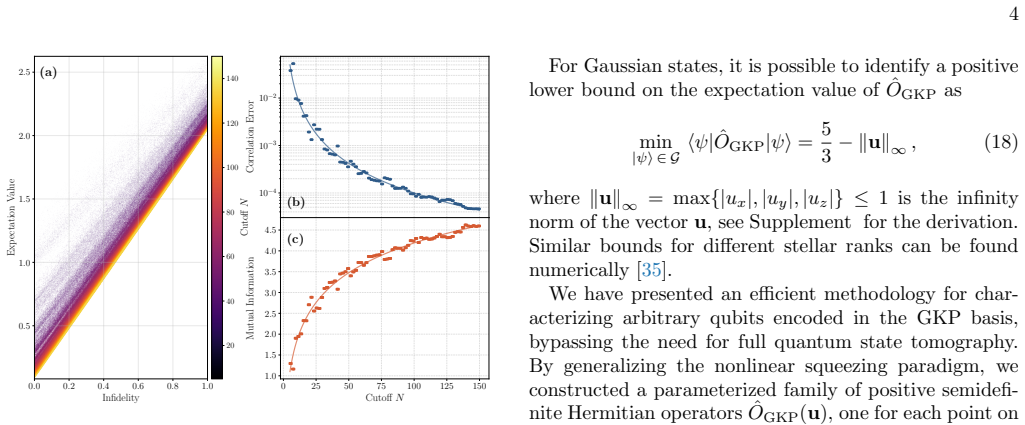
A family of operators on the logical Bloch sphere has ideal GKP states as unique ground states and their expectation values equal twice the logical infidelity.
A machine-rendered reading of the paper's core claim, the machinery that carries it, and where it could break.
Core claim
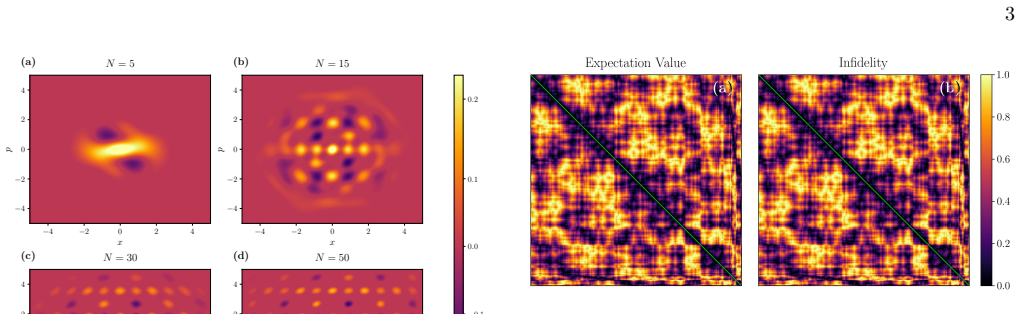
The authors construct a family of positive semidefinite Hermitian operators indexed by points on the logical Bloch sphere. For each point the operator possesses a unique zero-eigenvalue ground state that is exactly the ideal GKP logical state at that point. Inside the ideal logical subspace the expectation value of the operator equals twice the logical infidelity and serves as a witness of non-Gaussianity. Finite-dimensional truncations of these operators have ground states that approximate arbitrary ideal GKP states to arbitrary precision.
What carries the argument
A family of positive semidefinite Hermitian operators, one per logical Bloch-sphere point, whose unique zero-eigenvalue ground states are the ideal GKP logical states.
If this is right
- Expectation values of the operators provide an efficient witness for non-Gaussianity without full tomography.
- Inside the ideal GKP subspace the expectation value equals twice the logical infidelity for any superposition.
- Truncated finite-dimensional versions of the operators yield practical physical approximations to arbitrary GKP states as ground states.
- Evaluation of each operator requires only three quadrature measurements.
- The framework supports numerical optimization of circuits that prepare arbitrary GKP states.
Where Pith is reading between the lines
- The method could replace resource-intensive tomography when benchmarking GKP state preparation in current experiments.
- Similar operator constructions might extend to other bosonic error-correcting codes for efficient fidelity witnesses.
- Ground-state preparation of the truncated operators offers a variational route to generate target GKP states on hardware.
- The three-measurement protocol may enable real-time feedback stabilization of GKP qubits during computation.
Load-bearing premise
The operators possess unique zero-eigenvalue ground states that exactly match the ideal GKP logical states for every point on the Bloch sphere, and the infidelity correspondence holds only inside the ideal logical subspace.
What would settle it
A direct calculation or numerical diagonalization showing that the ground state of the operator for any chosen Bloch-sphere point differs from the corresponding ideal GKP state, or an experiment in which the measured expectation value fails to equal twice the independently computed logical infidelity for a prepared state known to lie in the ideal subspace.
Figures
read the original abstract
Practical utilization of Gottesman-Kitaev-Preskill (GKP) qubits requires not only the preparation of logical basis states, but also the ability to prepare and evaluate arbitrary logical qubit superpositions. Currently, this is typically done via quantum state tomography, which is resource-intensive. We introduce a family of positive semidefinite Hermitian operators, one for each point on the logical Bloch sphere, whose unique zero-eigenvalue ground states are the corresponding ideal GKP qubit states. We show that the expectation value of each operator serves as a witness of non-Gaussianity, and corresponds to twice the logical infidelity for states in the ideal logical GKP subspace. Furthermore, the truncated finite-dimensional counterparts of these operators yield physical approximations of arbitrary logical GKP states as their ground states. The evaluation of the proposed operators requires only three quadrature measurements, making this framework practical for both the experimental characterization and numerical optimization of GKP state preparation circuits.
Editorial analysis
A structured set of objections, weighed in public.
Referee Report
Summary. The manuscript introduces a family of positive semidefinite Hermitian operators indexed by points on the logical Bloch sphere for Gottesman-Kitaev-Preskill (GKP) qubits. Each operator is asserted to possess a unique zero-eigenvalue ground state exactly matching the corresponding ideal (non-normalizable) GKP logical state. The expectation value of each operator is claimed to witness non-Gaussianity and to equal twice the logical infidelity for any state confined to the ideal logical GKP subspace. Finite-dimensional truncations of the operators are shown to have ground states that approximate arbitrary logical GKP states, and each operator can be evaluated using only three quadrature measurements.
Significance. If the uniqueness of the kernels is rigorously established, the construction supplies a practical, low-measurement alternative to full tomography for characterizing arbitrary GKP superpositions. This would be valuable for both experimental verification of GKP state preparation and for numerical optimization of circuits that target general logical states rather than only the computational basis.
major comments (2)
- [§3] §3 (operator construction): The central claim requires that each operator O_θ is positive semidefinite with kernel exactly spanned by the ideal GKP state at Bloch point θ. The manuscript must supply an explicit argument showing that O_θ ψ = 0 implies ψ is proportional to the regularized GKP wavefunction on the lattice; any additional null vectors (e.g., higher-order lattice modes or non-periodic components) would invalidate both the uniqueness statement and the factor-of-two infidelity relation inside the logical subspace.
- [§4.2] §4.2 (infidelity correspondence): The equality between the expectation value and twice the logical infidelity is stated to hold only for states inside the ideal logical GKP subspace. The paper should derive the precise bound or correction term that applies when the state has support outside this subspace, because the non-Gaussianity witness interpretation otherwise rests on an unstated assumption about the support of the prepared state.
minor comments (2)
- [§5] The truncation procedure for the finite-dimensional operators (dimension, cutoff scheme, and convergence rate) is referenced but not given an explicit formula or pseudocode; adding this in §5 would improve reproducibility.
- [§2] Notation for the logical Bloch-sphere parametrization (angles θ, φ) should be introduced once with a clear diagram or equation reference to avoid ambiguity when the same symbols appear in the quadrature operators.
Simulated Author's Rebuttal
We thank the referee for their careful reading of the manuscript and for the constructive major comments. We address each point below and will incorporate the suggested clarifications and additions into the revised version.
read point-by-point responses
-
Referee: [§3] §3 (operator construction): The central claim requires that each operator O_θ is positive semidefinite with kernel exactly spanned by the ideal GKP state at Bloch point θ. The manuscript must supply an explicit argument showing that O_θ ψ = 0 implies ψ is proportional to the regularized GKP wavefunction on the lattice; any additional null vectors (e.g., higher-order lattice modes or non-periodic components) would invalidate both the uniqueness statement and the factor-of-two infidelity relation inside the logical subspace.
Authors: We agree that an explicit proof of kernel uniqueness is required to rigorously support the central claims. Although the manuscript constructs each O_θ so that it annihilates the target ideal GKP state and is positive semidefinite, a complete demonstration that no other null vectors exist (such as higher-order lattice modes) was not supplied. In the revised manuscript we will add, in §3, a detailed argument in the quadrature representation: we decompose an arbitrary wavefunction into components compatible with the GKP lattice periodicity, show that the operator’s quadratic form forces all but the fundamental mode to have strictly positive expectation value, and thereby prove that O_θ ψ = 0 if and only if ψ is proportional to the regularized GKP state. This will also confirm the factor-of-two infidelity relation inside the logical subspace. revision: yes
-
Referee: [§4.2] §4.2 (infidelity correspondence): The equality between the expectation value and twice the logical infidelity is stated to hold only for states inside the ideal logical GKP subspace. The paper should derive the precise bound or correction term that applies when the state has support outside this subspace, because the non-Gaussianity witness interpretation otherwise rests on an unstated assumption about the support of the prepared state.
Authors: The referee correctly observes that the exact equality ⟨O_θ⟩ = 2 × logical infidelity is derived under the assumption of support strictly inside the ideal logical GKP subspace. For states with leakage outside this subspace the expectation value remains nonnegative and vanishes only for the ideal state, thereby still functioning as a non-Gaussianity witness, but the direct numerical relation to infidelity requires a correction. In the revised §4.2 we will derive the bound ⟨O_θ⟩ ≥ 2 × infidelity + c ‖P_⊥ ρ P_⊥‖, where P_⊥ projects onto the orthogonal complement of the logical subspace and c > 0 is obtained from the lowest positive eigenvalue of O_θ restricted to that complement. This supplies the requested precise correction term and clarifies the conditions under which the witness is tight. revision: yes
Circularity Check
No significant circularity; operators and infidelity relation derived from explicit construction
full rationale
The paper defines a family of Hermitian operators explicitly for each Bloch-sphere point and states their ground-state property as a direct consequence of that definition. The claimed factor-of-two correspondence between expectation value and logical infidelity is shown as an algebraic identity holding inside the ideal GKP subspace, not obtained by fitting or by renaming an input. No self-citation is load-bearing for the uniqueness or infidelity claims, and the finite-dimensional truncation is presented as a separate numerical approximation. The derivation chain remains self-contained without any step reducing to its own inputs by construction.
Axiom & Free-Parameter Ledger
axioms (1)
- standard math Standard definitions of GKP code space and logical Pauli operators in continuous-variable quantum mechanics
invented entities (1)
-
Family of positive semidefinite Hermitian operators indexed by the logical Bloch sphere
no independent evidence
discussion (0)
Sign in with ORCID, Apple, or X to comment. Anyone can read and Pith papers without signing in.