Formal Foundations of Agentic Business Process Management
Pith reviewed 2026-05-10 06:38 UTC · model grok-4.3
The pith
Agentic business process management receives formal mathematical foundations by augmenting process specifications with explicit goals for autonomous agents.
A machine-rendered reading of the paper's core claim, the machinery that carries it, and where it could break.
Core claim
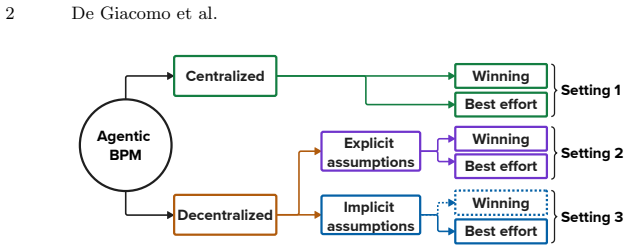
This paper sets up the mathematical foundations of agentic BPM systems in three key settings and analyzes four foundational problems of agentic BPM. The distinguishing feature is that execution is driven by autonomous decision-makers, so the process specification is augmented with explicit objectives assigned to the participating agents. Agents then pursue these goals, at least to the best of their efforts, under suitable assumptions on the behavior of others, by adopting appropriate strategies. Centrally, the organization enacting the process can use these specifications to provide guardrails on the decision-making capabilities of agents at the strategy level.
What carries the argument
Goal-augmented process specifications that assign explicit objectives to autonomous agents and enable organizations to impose strategy-level guardrails.
If this is right
- Organizations gain the ability to constrain agent decision-making at the level of strategies rather than individual actions.
- Four foundational problems of agentic BPM receive formal treatment across three standard settings.
- Process execution remains reliable even when agents act autonomously, provided their objectives are explicitly specified.
- Guardrails derived from the specifications can be enforced without assuming complete control over every agent choice.
Where Pith is reading between the lines
- The framework could be implemented in enterprise software to automatically translate high-level goals into enforceable constraints on deployed AI agents.
- It opens a route to verifying compliance in multi-agent business workflows by checking whether observed agent strategies stay inside the formally defined guardrails.
- Extensions might combine these foundations with existing workflow engines to simulate and validate agent behaviors before live deployment.
- The same approach could apply to regulatory oversight of autonomous systems in other domains where full control is impossible.
Load-bearing premise
Agents cannot be fully controlled, so the process specification must include explicit objectives that agents pursue under assumptions about how others will behave.
What would settle it
A concrete counter-example in which autonomous agents operating in a real business process systematically violate the assumed strategies or fail to respect the guardrails derived from the three formal settings.
Figures
read the original abstract
Just like traditional BPM systems, agentic BPM systems are built around a specification of the process under consideration. Their distinguishing feature, however, is that the execution of the process is driven by multiple autonomous decision-makers, referred to as agents. Since such agents cannot be fully controlled, the process specification is augmented with explicit objectives, or goals, assigned to the participating agents. Agents then pursue these goals, at least to the best of their efforts, under suitable assumptions on the behavior of others, by adopting appropriate strategies. Centrally, the organization enacting the process can use these specifications to provide guardrails on the decision-making capabilities of agents at the strategy level. This paper sets up the mathematical foundations of such systems in three key settings and analyzes four foundational problems of agentic BPM.
Editorial analysis
A structured set of objections, weighed in public.
Referee Report
Summary. The paper claims to establish mathematical foundations for agentic Business Process Management (BPM) systems, which extend traditional BPM by having processes executed by multiple autonomous agents. Process specifications are augmented with explicit objectives assigned to agents; agents pursue these goals via strategies under assumptions about others' behavior. Organizations can impose guardrails at the strategy level. The work defines these foundations in three key settings and analyzes four foundational problems of agentic BPM.
Significance. If the formalizations prove rigorous and the analyses of the four problems are substantive, the paper could offer a useful definitional bridge between BPM and multi-agent systems, clarifying how autonomy and guardrails can be modeled without full control over agents. This aligns with standard game-theoretic and strategic modeling approaches and may support future work on verifiable agentic processes.
minor comments (2)
- The abstract and high-level description do not specify the three key settings or the four foundational problems; including brief characterizations or section references in the introduction would improve clarity for readers.
- Notation for agent objectives, strategies, and guardrails should be introduced with explicit definitions and examples early in the manuscript to aid comprehension of the subsequent formal development.
Simulated Author's Rebuttal
We thank the referee for their positive summary of the paper and for recommending minor revision. The assessment that the work provides a useful definitional bridge between BPM and multi-agent systems is appreciated. No specific major comments were listed in the report, so we have no point-by-point responses to provide at this stage. We remain ready to make any minor adjustments required for the revised version.
Circularity Check
No significant circularity
full rationale
The paper establishes mathematical foundations for agentic BPM by defining process specifications augmented with explicit agent objectives and strategies pursued under assumptions about others' behavior. This construction draws from standard multi-agent system formalisms and BPM concepts without any derivation that reduces to its own inputs by construction. No self-definitional loops, fitted parameters renamed as predictions, load-bearing self-citations, uniqueness theorems imported from prior author work, or smuggled ansatzes are present in the provided abstract and high-level description. The work is positioned as a definitional setup and analysis of four foundational problems across three settings, remaining self-contained against external benchmarks in formal methods.
Axiom & Free-Parameter Ledger
axioms (1)
- domain assumption Agents pursue assigned goals to the best of their efforts under suitable assumptions on the behavior of others.
invented entities (1)
-
agentic BPM systems
no independent evidence
Reference graph
Works this paper leans on
-
[1]
van der Aalst, W.M.P., Lohmann, N., La Rosa, M.: Ensuring correctness during process configuration via partner synthesis. Inf. Syst.37(6), 574–592 (2012)
work page 2012
- [2]
-
[3]
Aminof, B., De Giacomo, G., Perelli, G., Rubin, S.: LTL Synthesis Under Multi- Agent Environment Assumptions. In: KR. pp. 719–728 (2025)
work page 2025
- [4]
-
[5]
Baier, C., Katoen, J.: Principles of Model Checking. MIT Press (2008)
work page 2008
-
[6]
Barros, A., Dumas, M., Oaks, P.: Standards for web service choreography and orchestration: Status and perspectives. In: BPM Workshops. pp. 61–74 (2005)
work page 2005
- [7]
-
[8]
Calvanese, D., De Giacomo, G., Kampik, T., Lesperance, Y., Marrella, A., Matta, A.: Autonomy in business process execution: why we need first-class abstractions for goals and normative frames. In: ECAI Workshops (2025)
work page 2025
- [9]
- [10]
- [11]
-
[12]
In: Process Mining Handbook, LNBIP, vol
Di Ciccio, C., Montali, M.: Declarative process specifications: Reasoning, discovery, monitoring. In: Process Mining Handbook, LNBIP, vol. 448 (2022)
work page 2022
- [13]
-
[14]
Geatti, L., Montali, M., Rivkin, A.: Foundations of collaborative declare. In: BPM (Forum). pp. 55–72 (2023)
work page 2023
-
[15]
Haarmann, S., Weske, M.: Correlating data objects in fragment-based case man- agement. In: BIS. LNBIP, vol. 389, pp. 197–209. Springer (2020)
work page 2020
-
[16]
van Hee, K.M., Sidorova, N., van der Werf, J.M.: Business process modeling using petri nets. In: ToPNoC VII. pp. 116–161 (2013)
work page 2013
-
[17]
Heindel, T., Weber, I.: Incentive alignment of business processes. In: BPM. pp. 93–110 (2020)
work page 2020
- [18]
-
[19]
Massuthe, P., Serebrenik, A., Sidorova, N., Wolf, K.: Can I find a partner? unde- cidability of partner existence for open nets. Inf. Process. Lett.108(6), 374–378 (2008)
work page 2008
-
[20]
Montali, M., Torroni, P., Zannone, N., Mello, P., Bryl, V.: Engineering and verify- ing agent-oriented requirements augmented by business constraints withB-tropos. Auton. Agents Multi Agent Syst.23(2), 193–223 (2011)
work page 2011
-
[21]
Ruiz, M., Costal, D., Espa˜ na, S., Franch, X., Pastor, O.: Gobis: An integrated framework to analyse the goal and business process perspectives in information systems. Inf. Syst.53, 330–345 (2015)
work page 2015
-
[22]
Tour, A., Polyvyanyy, A., Kalenkova, A.A., Senderovich, A.: Agent miner: An algorithm for discovering agent systems from event data. In: BPM. pp. 284–302 (2023)
work page 2023
-
[23]
Vu, H., Klievtsova, N., Leopold, H., Rinderle-Ma, S., Kampik, T.: Agentic business process management: Practitioner perspectives on agent governance in business processes. In: Responsible BPM Forum. pp. 29–43 (2026)
work page 2026
-
[24]
Weske, M.: Business Process Management: Concepts, Languages, Architectures. Springer (2024)
work page 2024
-
[25]
John Wiley & Sons, Chichester, UK, 2 edn
Wooldridge, M.: An Introduction to MultiAgent Systems. John Wiley & Sons, Chichester, UK, 2 edn. (2009)
work page 2009
discussion (0)
Sign in with ORCID, Apple, or X to comment. Anyone can read and Pith papers without signing in.