Modern Solid Electrolytes for All-Solid-State Batteries: Materials Chemistry, Structure, and Transport
Pith reviewed 2026-05-10 05:51 UTC · model grok-4.3
The pith
Ion transport in solid electrolytes emerges from networks of low-barrier local migration events rather than single fixed pathways.
A machine-rendered reading of the paper's core claim, the machinery that carries it, and where it could break.
Core claim
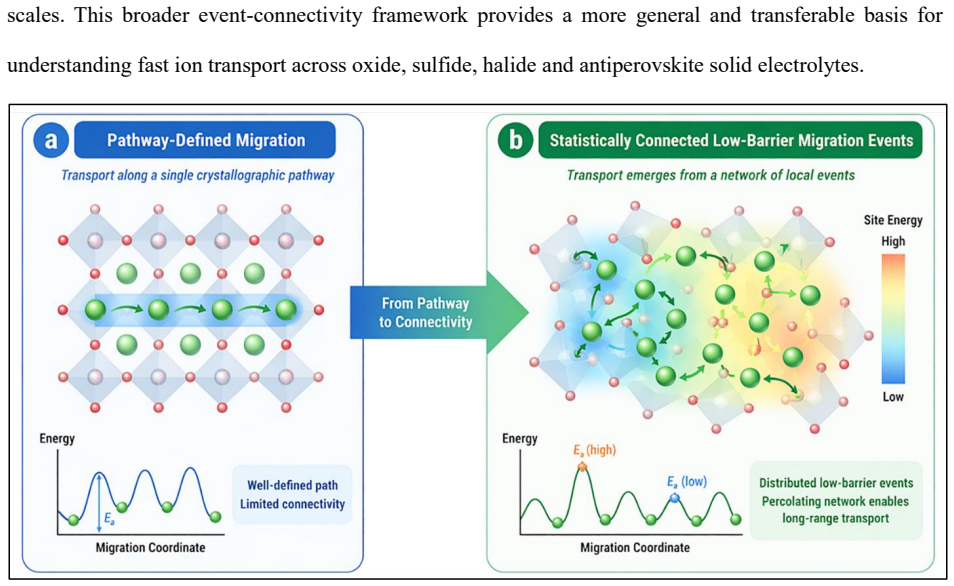
Across these families, fast ion conduction depends not simply on composition or crystallographic diffusion pathways, but on the coupled effects of framework topology, site energy distribution, defect chemistry, bottleneck response, and local anion flexibility. Halide solid electrolytes and their derivatives introduce new ways to regulate local coordination chemistry, defect populations, and transport active frameworks. Building on these comparisons, long range ion transport is increasingly understood not as motion along a single idealized pathway, but as the macroscopic outcome of statistically connected low barrier local migration events distributed across the structure.
What carries the argument
Multiscale structure-property relationships across oxide, sulfide, and halide frameworks, where statistically connected low-barrier local migration events produce macroscopic long-range conduction.
Load-bearing premise
The reviewed literature on oxides, sulfides, and halides sufficiently captures the coupled effects of framework topology, site energy distribution, defect chemistry, bottleneck response, and local anion flexibility as the dominant factors controlling transport.
What would settle it
Discovery of a high-conductivity solid electrolyte where long-range ion motion occurs exclusively along one isolated crystallographic pathway, with no measurable contribution from alternative distributed local routes, would contradict the central claim.
Figures
read the original abstract
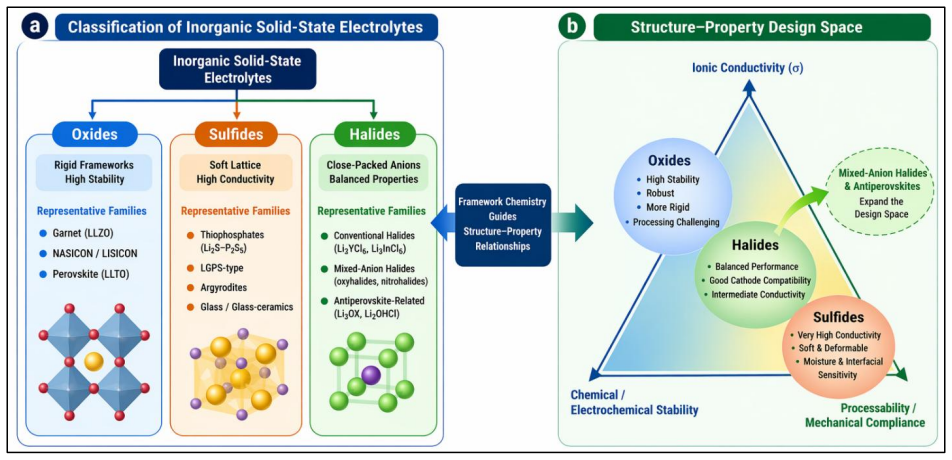
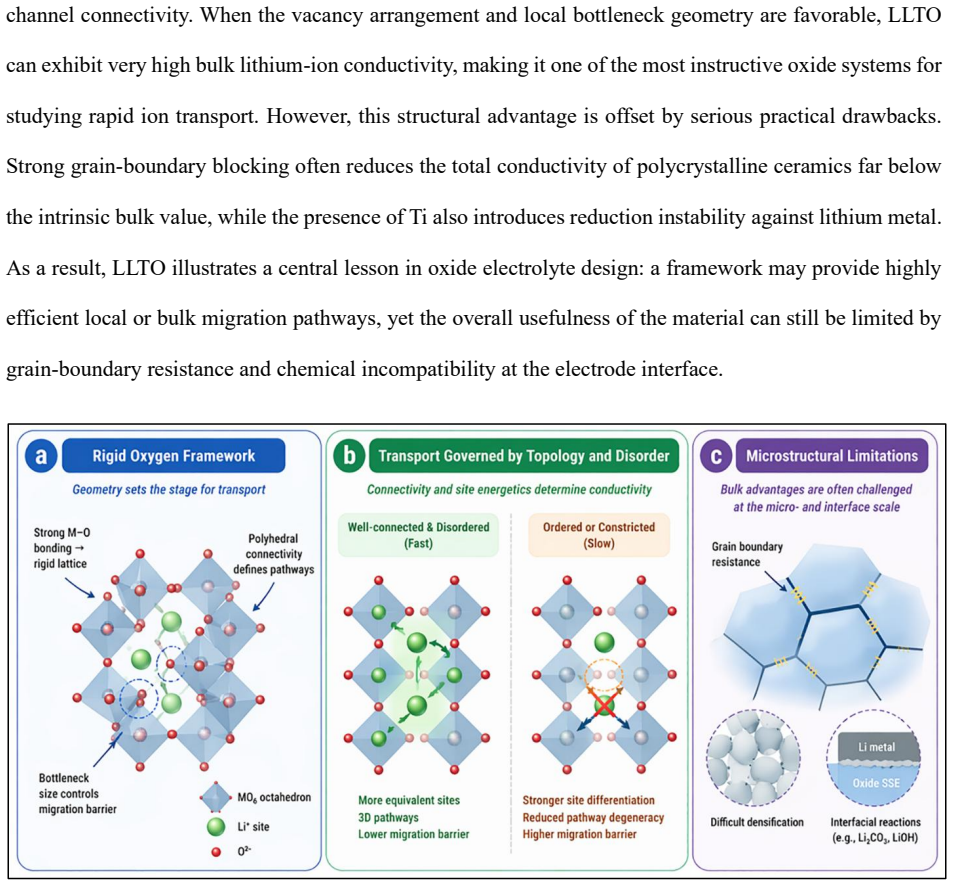
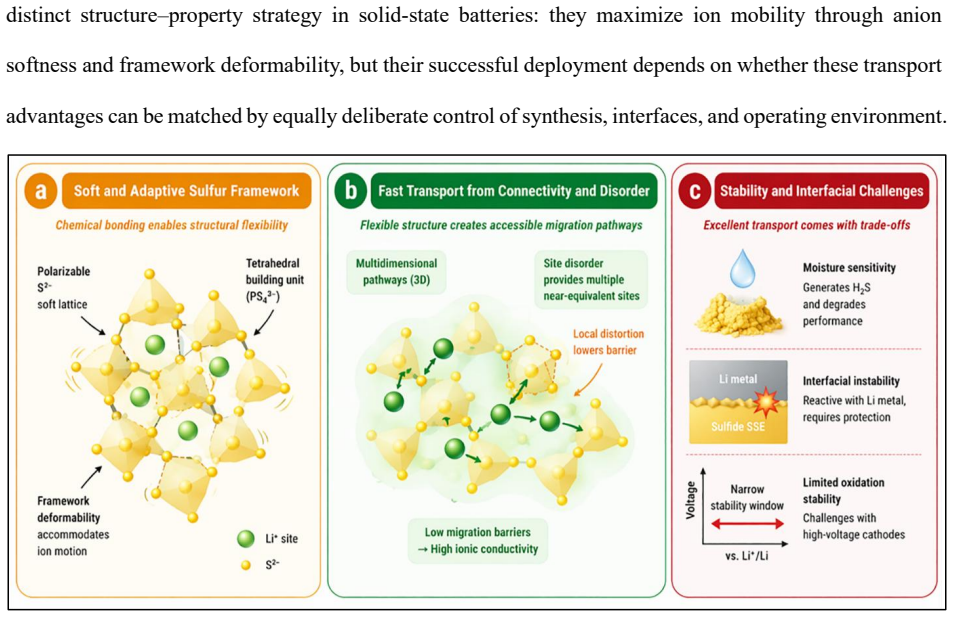
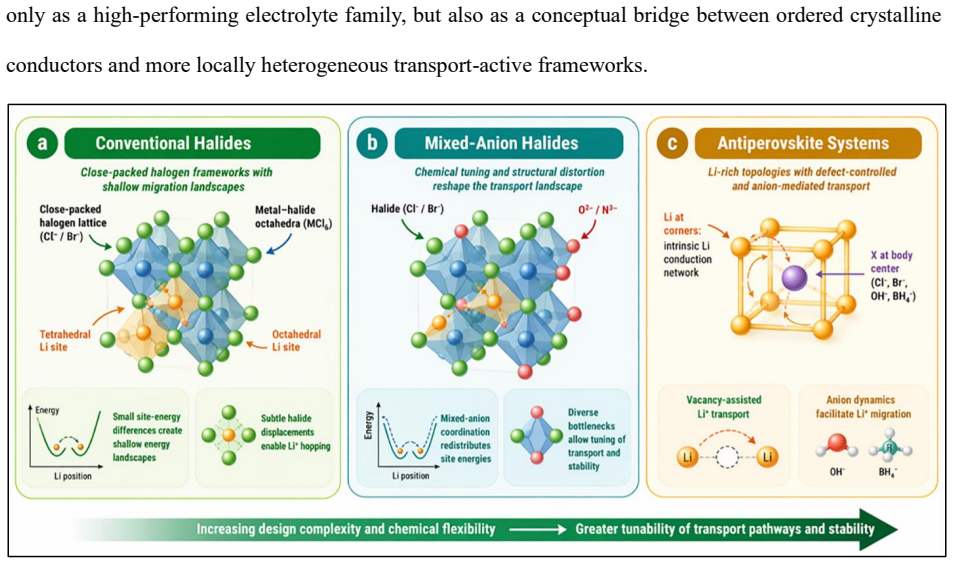
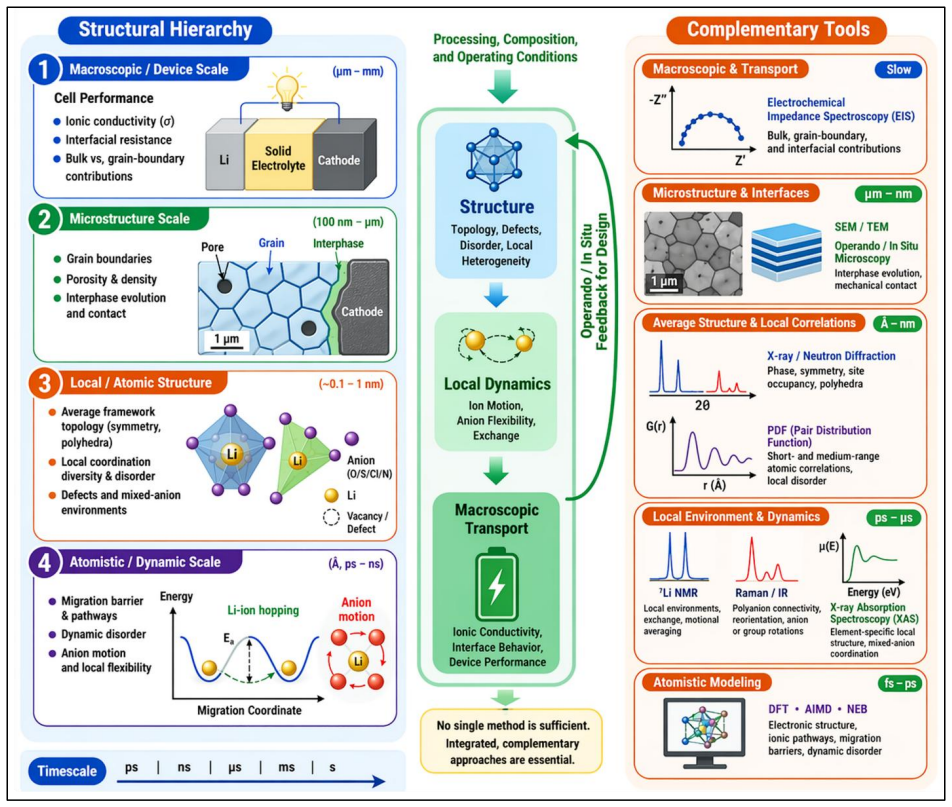
In this review, from crystallographic symmetry to amorphous local polyhedra arrangement and combinations, we examine inorganic solid state electrolytes through the lens of structure property relationships, with oxides, sulfides, and halides representing three major framework chemistries. Halide solid electrolytes and their derivatives, including mixed anion halides and antiperovskite related materials, have expanded this landscape further by introducing new ways to regulate local coordination chemistry, defect populations, and transport active frameworks. Across these families, fast ion conduction depends not simply on composition or crystallographic diffusion pathways, but on the coupled effects of framework topology, site energy distribution, defect chemistry, bottleneck response, and local anion flexibility. Oxides illustrate transport within chemically robust but geometrically constrained frameworks. Sulfides demonstrate that a soft, easily polarizable lattice can broaden the array of low energy migration pathways. Halides occupy an intermediate state, in which the closely packed anion sublattices, an approximately degenerate lithium environment, and mixed anion coordination enable effective transport while simultaneously enhancing oxidation stability and compatibility with cathodes. Building on these comparisons, we argue that long range ion transport is increasingly understood not as motion along a single idealized pathway, but as the macroscopic outcome of statistically connected low barrier local migration events distributed across the structure. We further discuss the experimental and computational approaches required to establish such multiscale structure property relationships and outline future strategies for designing transport active frameworks in which conductivity, stability, and processability are optimized together.
Editorial analysis
A structured set of objections, weighed in public.
Referee Report
Summary. This review synthesizes literature on oxide, sulfide, and halide solid electrolytes for all-solid-state batteries, examining structure-property relationships from crystallographic symmetry through local polyhedra arrangements. It compares the three framework chemistries and argues that fast ion conduction depends on coupled effects of framework topology, site energy distribution, defect chemistry, bottleneck response, and local anion flexibility. The central claim is that long-range ion transport emerges as the macroscopic outcome of statistically connected low-barrier local migration events distributed across the structure rather than motion along a single idealized pathway. The manuscript also discusses experimental and computational methods needed to establish multiscale relationships and outlines future strategies for jointly optimizing conductivity, stability, and processability.
Significance. If the synthesis accurately and comprehensively reflects the cited literature, the review provides a timely conceptual framework for the field by shifting emphasis from idealized pathways to distributed local events. The cross-chemistry comparisons highlight useful trade-offs (e.g., robustness in oxides versus polarizability in sulfides versus stability in halides) and the timely coverage of mixed-anion halides and antiperovskites adds value. The discussion of multiscale methods and design strategies could guide future work toward electrolytes that balance transport with practical requirements.
minor comments (3)
- [Abstract] Abstract: the phrase 'from crystallographic symmetry to amorphous local polyhedra arrangement and combinations' is somewhat awkward and could be rephrased for smoother readability while retaining technical precision.
- [Abstract] Abstract: 'bottleneck response' is introduced without a brief parenthetical clarification; adding one sentence would aid readers outside the immediate subfield.
- [Comparisons of framework chemistries] Throughout: ensure that quantitative examples (e.g., activation energies or conductivity values) from key papers are explicitly tied to the comparisons of topology, defects, and anion flexibility to make the distinctions between oxide, sulfide, and halide behaviors more concrete.
Simulated Author's Rebuttal
We thank the referee for their positive assessment of the manuscript and for recommending minor revision. The provided summary accurately reflects the scope and central arguments of the review, particularly the emphasis on distributed low-barrier local migration events arising from framework topology, defects, and anion flexibility rather than idealized single pathways.
Circularity Check
No significant circularity in literature synthesis
full rationale
This manuscript is a literature review synthesizing published work on oxide, sulfide, and halide solid electrolytes. It examines structure-property relationships through comparisons of framework topology, site energies, defects, bottlenecks, and anion flexibility, framing long-range transport as the statistical outcome of distributed low-barrier local events. No original derivations, equations, quantitative predictions, or fitted parameters appear; the central claim rests on external literature rather than internal self-referential loops or self-citations that carry the argument. The text is therefore self-contained as a synthesis with no reduction of outputs to inputs by construction.
Axiom & Free-Parameter Ledger
Reference graph
Works this paper leans on
-
[1]
Cross-family design principles for fast ion transport A central theme emerging across solid-state electrolyte families is that fast ion transport can no longer be understood solely in terms of a single crystallographically defined migration pathway. Such a description remains useful for highly ordered framewo rks, where long-range diffusion can often be p...
-
[2]
Tools for establishing structure–property relationships Establishing structure –property relationships in solid electrolytes necessitates more than mere identification of a nominal crystal structure. Ion transport within these materials is concurrently influenced by several factors, including average framework topology, local coordination diversity, defec...
-
[3]
Outlook The forthcoming phase of research on solid -state electrolytes is unlikely to be characterized solely by the ongoing pursuit of enhanced ionic conductivity at room temperature. For oxide, sulfide, and halide systems alike, the primary challenge has shifted from identifying fast -ion conductors in isolation to developing comprehensive design strate...
work page 2013
discussion (0)
Sign in with ORCID, Apple, or X to comment. Anyone can read and Pith papers without signing in.