Contraction and Hourglass Persistence for Learning on Graphs, Simplices, and Cells
Pith reviewed 2026-05-15 06:29 UTC · model grok-4.3
The pith
By interleaving sequences of inclusions and contractions, Hourglass Persistence produces topological descriptors more expressive and stable than those from forward persistent homology alone for graph representation learning.
A machine-rendered reading of the paper's core claim, the machinery that carries it, and where it could break.
Core claim
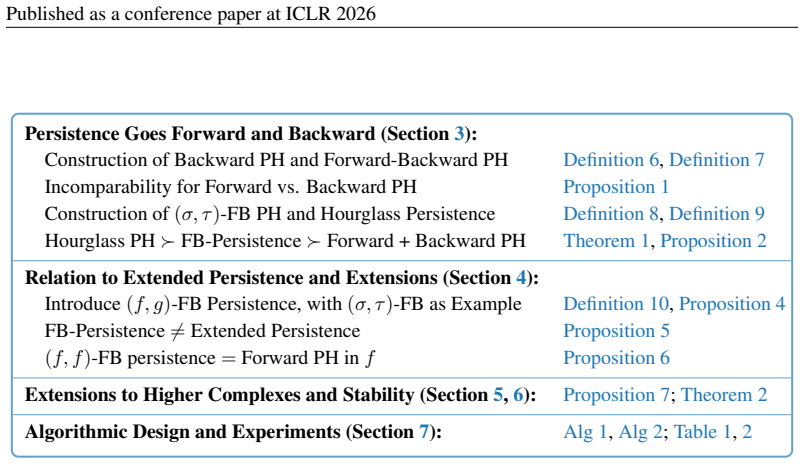
Forward persistent homology and contraction homology differ in expressivity. Interleaving inclusions and contractions yields Hourglass Persistence descriptors that boost expressivity, learnability, and stability. The approach extends to simplicial and cellular networks and supplies efficient algorithms pluggable into GNN pipelines, producing consistent empirical gains over many existing PH methods on standard real-world graph datasets.
What carries the argument
Hourglass Persistence: topological descriptors formed by interleaving a sequence of inclusions and contractions.
If this is right
- Contraction homology captures topological information distinct from forward persistent homology.
- Interleaving inclusions and contractions increases expressivity, learnability, and stability of the resulting descriptors.
- Efficient algorithms allow direct integration into end-to-end differentiable GNN pipelines.
- The framework extends directly to simplicial and cellular networks while preserving the same benefits.
- Empirical evaluations show consistent improvements over prior persistent homology methods across standard real-world graph datasets.
Where Pith is reading between the lines
- Bidirectional filtrations may prove useful for other topological data analysis tasks outside graphs, such as point clouds or meshes.
- The stability gains could translate to better robustness when graphs contain noise or missing edges.
- Task-specific interleaving schedules might further optimize performance on particular graph domains like molecular or social networks.
- Combining Hourglass Persistence with other structural encodings could compound improvements in representation quality.
Load-bearing premise
Persistence information obtained from contraction sequences is complementary to forward persistent homology and does not discard essential topological features needed for downstream learning tasks.
What would settle it
A dataset of graphs where the persistence diagrams produced by contraction sequences are identical to those from inclusion sequences, or where models augmented with Hourglass Persistence show no accuracy or stability improvement over standard PH baselines.
Figures


read the original abstract
Persistent homology (PH) encodes global information, such as cycles, and is thus increasingly integrated into graph neural networks (GNNs). PH methods in GNNs typically traverse an increasing sequence of subgraphs. In this work, we first expose limitations of this inclusion procedure. To remedy these shortcomings, we analyze contractions as a principled topological operation, in particular, for graph representation learning. We study the persistence of contraction sequences, which we call Contraction Homology (CH). We establish that forward PH and CH differ in expressivity. We then introduce Hourglass Persistence, a class of topological descriptors that interleave a sequence of inclusions and contractions to boost expressivity, learnability, and stability. We also study related families parametrized by two paradigms. We also discuss how our framework extends to simplicial and cellular networks. We further design efficient algorithms that are pluggable into end-to-end differentiable GNN pipelines, enabling consistent empirical improvements over many PH methods across standard real-world graph datasets. Code is available at \href{https://github.com/Aalto-QuML/Hourglass}{this https URL}.
Editorial analysis
A structured set of objections, weighed in public.
Referee Report
Summary. The paper introduces Contraction Homology (CH) as the persistence of contraction sequences on graphs, simplices, and cells, proves that CH differs in expressivity from standard forward persistent homology (PH), defines Hourglass Persistence by interleaving inclusion and contraction operations to improve expressivity, learnability, and stability, studies related parametrized families, supplies efficient algorithms integrable into differentiable GNN pipelines, and reports empirical gains over existing PH baselines on standard real-world graph datasets.
Significance. If the expressivity separation and complementarity claims hold, the work supplies a new family of topological descriptors that capture features orthogonal to those obtained from inclusion-based PH, with direct applicability to graph, simplicial, and cellular representation learning. The provision of pluggable algorithms and publicly available code constitutes a concrete strength for reproducibility and downstream use.
major comments (2)
- [Theoretical results on expressivity] The central claim that forward PH and CH differ in expressivity is load-bearing for the motivation of Hourglass Persistence; the manuscript should supply an explicit pair of graphs (or simplicial complexes) together with the filtration values at which the two descriptors first disagree, so that the separation can be verified independently of the general proof.
- [Experimental evaluation] Table reporting empirical results: the improvements over baseline PH methods are stated as 'consistent' but the table does not list standard deviations across random seeds or the precise train/validation/test splits used; without these the magnitude of the reported gains cannot be assessed for statistical reliability.
minor comments (2)
- [Definitions and related families] Notation for the two paradigms parametrizing the related families is introduced without a compact summary table; a single table listing the parameter ranges and the corresponding Hourglass variants would improve readability.
- [Algorithmic contributions] The extension to cellular networks is asserted but the algorithmic complexity statement for the cellular case is given only in prose; an explicit big-O expression in terms of the number of cells would clarify the scaling claim.
Simulated Author's Rebuttal
We thank the referee for the positive recommendation of minor revision and the constructive feedback. We address each major comment point by point below.
read point-by-point responses
-
Referee: [Theoretical results on expressivity] The central claim that forward PH and CH differ in expressivity is load-bearing for the motivation of Hourglass Persistence; the manuscript should supply an explicit pair of graphs (or simplicial complexes) together with the filtration values at which the two descriptors first disagree, so that the separation can be verified independently of the general proof.
Authors: We agree that an explicit example would make the expressivity separation more concrete and easier to verify. In the revised manuscript, we will add a simple counterexample consisting of two small graphs (a 4-cycle and a path of length 3) with explicit filtration values where the persistence diagrams of forward PH and CH first differ at a specific threshold, accompanied by the direct computation of both descriptors. This will complement the existing general proof. revision: yes
-
Referee: [Experimental evaluation] Table reporting empirical results: the improvements over baseline PH methods are stated as 'consistent' but the table does not list standard deviations across random seeds or the precise train/validation/test splits used; without these the magnitude of the reported gains cannot be assessed for statistical reliability.
Authors: We appreciate the emphasis on statistical reliability. In the revised version, we will update all experimental tables to report mean performance with standard deviations over 10 random seeds and will explicitly list the train/validation/test splits (including any fixed splits from prior work) for each dataset. revision: yes
Circularity Check
No significant circularity detected
full rationale
The derivation introduces Contraction Homology via contraction sequences on graphs, proves an expressivity separation from forward persistent homology, and constructs Hourglass Persistence by interleaving the two operations. These steps rely on explicit topological definitions and algorithms rather than fitting parameters to the same data or reducing via self-citation chains. The claimed complementarity and empirical gains are presented as consequences of the new descriptors, not as inputs renamed as outputs. The paper remains self-contained against external benchmarks with no load-bearing step that collapses by construction.
Axiom & Free-Parameter Ledger
axioms (1)
- standard math Standard properties of persistent homology on simplicial complexes hold under edge contractions
invented entities (2)
-
Contraction Homology
no independent evidence
-
Hourglass Persistence
no independent evidence
Lean theorems connected to this paper
-
IndisputableMonolith/Foundation/AlexanderDuality.leanalexander_duality_circle_linking echoes?
echoesECHOES: this paper passage has the same mathematical shape or conceptual pattern as the Recognition theorem, but is not a direct formal dependency.
We study the persistence of contraction sequences, which we call Contraction Homology (CH). We establish that forward PH and CH differ in expressivity. We then introduce Hourglass Persistence, a class of topological descriptors that interleave a sequence of inclusions and contractions
-
IndisputableMonolith/Foundation/AlexanderDualityProof.leanlinking_forces_d3_cert echoes?
echoesECHOES: this paper passage has the same mathematical shape or conceptual pattern as the Recognition theorem, but is not a direct formal dependency.
FB-persistence is strictly more expressive than forward and backward persistence combined... Hourglass persistence is more expressive than FB-persistence
-
IndisputableMonolith/Foundation/AbsoluteFloorClosure.leanabsolute_floor_iff_bare_distinguishability echoes?
echoesECHOES: this paper passage has the same mathematical shape or conceptual pattern as the Recognition theorem, but is not a direct formal dependency.
the sequence of contractions... G → G/IC_n(G) → ... → * ... intermediate maps are the natural quotient maps
What do these tags mean?
- matches
- The paper's claim is directly supported by a theorem in the formal canon.
- supports
- The theorem supports part of the paper's argument, but the paper may add assumptions or extra steps.
- extends
- The paper goes beyond the formal theorem; the theorem is a base layer rather than the whole result.
- uses
- The paper appears to rely on the theorem as machinery.
- contradicts
- The paper's claim conflicts with a theorem or certificate in the canon.
- unclear
- Pith found a possible connection, but the passage is too broad, indirect, or ambiguous to say the theorem truly supports the claim.
Reference graph
Works this paper leans on
-
[1]
URLhttps://arxiv.org/abs/2302.09826. Cristian Bodnar, Fabrizio Frasca, Nina Otter, Yu Guang Wang, Pietro Li `o, Guido Montufar, and Michael M. Bronstein. Weisfeiler and lehman go cellular: CW networks. In A. Beygelzimer, Y . Dauphin, P. Liang, and J. Wortman Vaughan (eds.),Advances in Neural Information Processing Systems, 2021a. URLhttps://openreview.net...
-
[2]
Advances in Mathe matics 134(1), 90–145 (1998), https://doi.org/10.1006/aima.1997.1650
ISSN 0001-8708. doi: https://doi.org/10.1006/aima.1997.1650. URLhttps://www. sciencedirect.com/science/article/pii/S0001870897916509. Robin Forman. A user’s guide to discrete morse theory.S ´eminaire Lotharingien de Combinatoire [electronic only], 48:B48c, 35 p., electronic only–B48c, 35 p., electronic only, 2002. URLhttp: //eudml.org/doc/123837. Rudolf F...
-
[3]
The GUDHI Project.GUDHI User and Reference Manual
URLhttps://proceedings.mlr.press/v235/papamarkou24a.html. The GUDHI Project.GUDHI User and Reference Manual. GUDHI Editorial Board, 3.11.0 edition,
-
[4]
Introduction to Topological Data Analysis (TDA)
URLhttps://gudhi.inria.fr/doc/3.11.0/. Bastian Rieck, Christian Bock, and Karsten Borgwardt. A Persistent Weisfeiler-Lehman Procedure for Graph Classification. In Kamalika Chaudhuri and Ruslan Salakhutdinov (eds.),Proceedings of the 36th International Conference on Machine Learning, volume 97 ofProceedings of Machine Learning Research, pp. 5448–5458. PMLR...
-
[5]
URLhttps://arxiv.org/abs/2402.16346. Manzil Zaheer, Satwik Kottur, Siamak Ravanbakhsh, Barnabas Poczos, Russ R Salakhutdinov, and Alexander J Smola. Deep sets.Advances in neural information processing systems, 30, 2017. Bingxu Zhang, Changjun Fan, Shixuan Liu, Kuihua Huang, Xiang Zhao, Jincai Huang, and Zhong Liu. The expressive power of graph neural netw...
-
[6]
In Appendix B.1, we establish a lemma that will be helpful in streamlining the proof of Proposition 6 in Appendix B.2. For completeness, we will also use a special case of this lemma to show how persistence modules can derive the usual interpretation of persistence pairs for a graph filtration. We will also introduce some concepts helpful in understanding...
-
[7]
In Appendix B.2, we prove Proposition 3, Proposition 5, and Proposition 6 (i.e., the ex- pressivity parts of the section)
-
[8]
keeping track of one vertex representative per component
In Appendix B.3, we will explain the two algorithms for Proposition 4 and prove it. B.1 KEYLEMMA AND THEUSUALPERSISTENTPAIRSINTERPRETATION FORGRAPH FILTRATIONS Before we give a proof of Proposition 6, we first note that the description of death times for con- nected components holds on an elevated generality that both the proofs of Proposition 6 and (late...
work page 2021
-
[9]
In the filtration stepX −1 →X 0, we pick 1 vertex per connected component inX 0 and mark a tuple(0,−)corresponding to that. We fix one of these vertices to be called the supernode(denoted∗), in the sense that any time we compare a vertexvwith∗to decide which one to kill off, we always kill offv
-
[10]
Fori≥0, if the stepX i →X i+1 is a filtration, then one treats this in algorithmic time as a procedure to spawn every new vertex that appears first and mark them as tuples(i,−), and then spawn edges between them. For each edge between spawned, if an edge is joined between 2 different components represented by verticesvandw, we mark the vertex born later t...
-
[11]
Fori≥0, if the stepX i →X i+1 is a contraction, say contracting a subgraphG. We loop through each connected componentX j ofG, we find the vertexv j representing the componentX j belongs in and killv j unless (1) it got killed already in some index j′ < j when looping through the Xj’sor (2) it is the supernode ∗
-
[12]
Afteri=N, for every tuple not dead yet, we mark it to die at time∞. Remark 2.Note that the statement of Lemma 1 does not requireX N to terminate with only the point∗left, so the case of hourglass persistence in Definition 9 is a special case in this lemma. A more specific case of Lemma 1 is when the maps are all inclusions. This will recover the usual pro...
work page 2026
-
[13]
We pick a non-zero vectorvofH 0(X0), and consider the sequence of linear subspaces generated by the iterated image ofvinH 0(X•)until it becomes0
-
[14]
Then we remove this sequence of linear subspaces off ofH0(X•). If there is still a non-zero vectorwinH k(X0), we pickwand repeat the process (if the linear map sendswoutside. Otherwise, we choose a non-zero vector from what is left inH k(X1)(if it exists) and look at its iterated images ahead, and so on. Let us also recall the following standard fact in a...
-
[15]
We will go from the remark and see why it is equivalent to the first itme
Remark 1 says thatCis killed if and only if the iterated image of1 C gets landed inW i. We will go from the remark and see why it is equivalent to the first itme. Based on the description of how the induced map onH 0(−)behaves, we see that1 C can land intoW i at timej ′ > jif and only if there is some0≤k≤isuch thatf j′−1 ◦...◦f j(C)andf j′−1 ◦...◦f j(Ck)r...
work page 2026
-
[16]
Att= 0, we instantiatedimH D(X0)many tuples of the form(0,∞)
-
[17]
Fort >0, we instantiedimH D(Xt)−dimH D(Xt−1)many tuples of the form(t,∞)
-
[18]
We end att=n. We first look at how Lemma 2 specializes for graphs, before proving it. WhenD= 1, a 1- dimensional cell complex is the same as a graph, and the lemma recovers the usual way to calculate 1-dimensional PH’s. Indeed,H 1(−)of a graph corresponds exactly to its list of independent cycles. For completeness, by “independent cycles”, we mean the fol...
work page 2026
-
[19]
We spectulate whether or approach can be applied with edge contractions in graph pooling
independently from persistent homology. We spectulate whether or approach can be applied with edge contractions in graph pooling. F THEUSE OFLARGELANGUAGEMODELS We used large language models to aid in the writing process of the introduction, to help check gram- mar / suggest edits for the main paper, and to double-check some algorithmic discussions arisin...
discussion (0)
Sign in with ORCID, Apple, or X to comment. Anyone can read and Pith papers without signing in.