Does Welsh media need a review? Detecting bias in Nation.Cymru's political reporting
Pith reviewed 2026-05-10 05:38 UTC · model grok-4.3
The pith
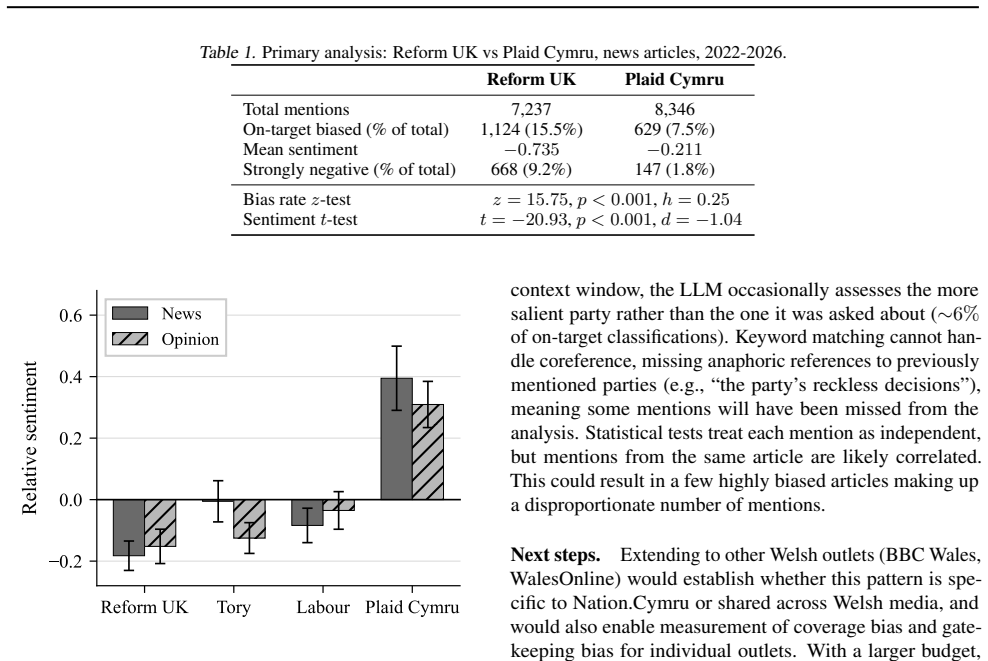
Nation.Cymru articles show Reform UK with twice the biased framing and three times the negative sentiment of Plaid Cymru.
A machine-rendered reading of the paper's core claim, the machinery that carries it, and where it could break.
Core claim
A primary analysis of 15,583 party mentions finds Reform UK attracts biased framing at twice the rate of Plaid Cymru and over three times as negative in mean sentiment. A secondary analysis across four parties shows Plaid Cymru as the outlier, receiving markedly more favourable framing than any other party. These results offer evidence of measurable differential framing in one Welsh political outlet.
What carries the argument
A two-stage NLP pipeline that first applies a RoBERTa bias detector to flag biased party mentions and then uses an LLM to classify the sentiment attached to each flagged mention.
If this is right
- Nation.Cymru exhibits measurable differences in how it frames major Welsh political parties.
- The patterns support arguments for a wider review of coverage across Welsh media.
- The same pipeline can be reused at low cost to examine other outlets or time periods.
- Opinion articles show the same party-level differences as straight news pieces.
Where Pith is reading between the lines
- Repeating the study on other Welsh outlets would show whether the observed patterns are unique to Nation.Cymru.
- If the framing gaps influence how readers evaluate parties, they could affect election coverage and public debate.
- Applying the pipeline outside Wales could test whether similar party-specific biases appear in other regional media systems.
Load-bearing premise
The RoBERTa detector and LLM classifier correctly identify political bias and sentiment in Welsh news without systematic errors from training data or domain differences.
What would settle it
A random sample of articles reviewed by humans where the pipeline's bias and sentiment labels match human judgments at a rate no better than chance.
Figures
read the original abstract
Wales' political landscape has been marked by growing accusations of bias in Welsh media. This paper takes the first computational step toward testing those claims by examining Nation.Cymru, a prominent Welsh political news outlet. I use a two-stage natural language processing (NLP) pipeline: (1) a robustly optimized BERT approach (RoBERTa) bias detector for efficient bias discovery and (2) a large language model (LLM) for target-attributed sentiment classification of bias labels from (1). A primary analysis of 15,583 party mentions across 2022-2026 news articles finds that Reform UK attracts biased framing at twice the rate of Plaid Cymru and over three times as negative in mean sentiment (p<0.001). A secondary analysis across four parties across both news and opinion articles shows that Plaid Cymru is the outlier, receiving markedly more favourable framing than any other party. These findings provide evidence of measurable differential framing in a single Welsh political media outlet, supporting calls for a broader review of Welsh media coverage. Furthermore, the two-stage pipeline offers a low-cost, replicable framework for extending this analysis to other Welsh outlets, as well as media ecosystems outside of Wales.
Editorial analysis
A structured set of objections, weighed in public.
Referee Report
Summary. The paper claims to perform the first computational analysis of bias in Nation.Cymru's political reporting via a two-stage NLP pipeline: a pre-trained RoBERTa model to detect biased framing in 15,583 party mentions across 2022-2026 news articles, followed by an LLM to perform target-attributed sentiment classification on the detected bias instances. Primary results report that Reform UK attracts biased framing at twice the rate of Plaid Cymru and over three times as negative in mean sentiment (p<0.001); a secondary analysis across news and opinion articles finds Plaid Cymru as the outlier receiving markedly more favourable framing than other parties. The work concludes that these differentials provide evidence supporting a broader review of Welsh media and positions the pipeline as a low-cost replicable framework for extension to other outlets.
Significance. If the model outputs are shown to be reliable on this domain, the quantitative evidence of differential framing would add a data-driven dimension to ongoing debates about Welsh media bias and could inform policy discussions on media review. A clear strength is the explicit framing of the two-stage pipeline as replicable and low-cost, which supplies a concrete methodological contribution that future work in computational media analysis could build upon directly.
major comments (2)
- [Abstract (two-stage NLP pipeline) and implied Methods] The primary quantitative claims (Reform UK bias rate twice that of Plaid Cymru, 3x more negative sentiment, p<0.001) rest entirely on labels produced by the RoBERTa bias detector and LLM sentiment classifier. No precision, recall, F1, inter-rater agreement, fine-tuning details, or robustness tests are supplied for either component on Nation.Cymru text or Welsh political language, leaving open the possibility of systematic domain-shift errors.
- [Results (primary analysis of 15,583 party mentions)] No controls or reporting are provided for potential confounders such as article length, topic distribution, or base rate of party mentions, any of which could produce the observed differentials in bias framing and sentiment without reflecting outlet-level bias.
Simulated Author's Rebuttal
We thank the referee for their constructive report and the opportunity to clarify and strengthen our work. We address each major comment below and will incorporate revisions as indicated.
read point-by-point responses
-
Referee: The primary quantitative claims (Reform UK bias rate twice that of Plaid Cymru, 3x more negative sentiment, p<0.001) rest entirely on labels produced by the RoBERTa bias detector and LLM sentiment classifier. No precision, recall, F1, inter-rater agreement, fine-tuning details, or robustness tests are supplied for either component on Nation.Cymru text or Welsh political language, leaving open the possibility of systematic domain-shift errors.
Authors: We agree this is a substantive gap. The manuscript applies a pre-trained RoBERTa model for bias detection and an off-the-shelf LLM for target-attributed sentiment without domain-specific fine-tuning or reported metrics on Welsh political text. In the revised manuscript we will expand the Methods section to specify exact model versions and prompts, add a dedicated validation subsection reporting precision, recall, F1, and inter-rater agreement from a manual annotation of a stratified sample of 150 party mentions, and include an explicit Limitations paragraph discussing domain-shift risks and the replicability of the pipeline. These additions will allow readers to evaluate the reliability of the reported differentials. revision: yes
-
Referee: No controls or reporting are provided for potential confounders such as article length, topic distribution, or base rate of party mentions, any of which could produce the observed differentials in bias framing and sentiment without reflecting outlet-level bias.
Authors: We accept that the primary analysis does not explicitly control for these factors. While the per-mention framing rate partially normalizes for differences in mention frequency, article length and topic distribution are not reported or controlled. The revised version will add a table of base rates of party mentions, supplementary analyses that include article length as a covariate, and a discussion of topic coverage with illustrative examples across parties. We will also include a robustness check restricting the sample to articles of comparable length. These changes will help isolate framing effects from potential confounds. revision: yes
Circularity Check
No circularity: direct empirical application of external pre-trained models
full rationale
The paper's quantitative claims derive from applying two off-the-shelf external models (RoBERTa bias detector and LLM sentiment classifier) to a new corpus of 15,583 party mentions. No parameters are fitted to the target data inside the study, no self-citations supply load-bearing uniqueness theorems or ansatzes, and no results are renamed or redefined in terms of the inputs. The pipeline is a standard forward pass; the reported rates, sentiment means, and p-values are therefore independent measurements rather than tautological restatements of any fitted component or prior self-citation.
Axiom & Free-Parameter Ledger
axioms (2)
- domain assumption RoBERTa bias detector reliably identifies political bias in Welsh news text
- domain assumption LLM sentiment classification produces accurate target-attributed bias labels
Reference graph
Works this paper leans on
- [1]
-
[2]
American Economic Review , volume =
Besley, Timothy and Prat, Andrea , title =. American Economic Review , volume =
-
[3]
Journal of Communication , volume =
D'Alessio, Dave and Allen, Mike , title =. Journal of Communication , volume =
- [4]
-
[5]
To bias or not to bias: Detecting bias in news with bias-detector.arXiv preprint arXiv:2505.13010,
Ghosh, Himanshu and Mosharafa, Ahmed and Groh, Georg , title =. arXiv:2505.13010 , year =
- [6]
- [7]
-
[8]
Rodrigo-Gin\'. A Systematic Review on Media Bias Detection: What Is Media Bias, How It Is Expressed, and How to Detect It , journal =
-
[9]
Journal of Computational Methods in Sciences and Engineering , year =
Shao, Wenliang , title =. Journal of Computational Methods in Sciences and Engineering , year =
-
[10]
Spinde, Timo and Plank, Manuel and Krieger, Jan-David and Ruas, Terry and Gipp, Bela and Aizawa, Akiko , title =. Findings of EMNLP , pages =
-
[11]
Spinde, Timo and Hinterreiter, Sven and Haak, Fabian and Ruas, Terry and Giese, Helge and Meuschke, Norman and Gipp, Bela , title =. arXiv:2312.16148 , year =
- [12]
-
[13]
Yue, Mingzhi and Zhao, Jie and Zhang, Min and Du, Liang and Yao, Ziyu , title =. Proc.\ ICLR , year =
-
[14]
Eberl, Jakob-Moritz and Boomgaarden, Hajo G. and Wagner, Markus , title =. Communication Research , volume =
discussion (0)
Sign in with ORCID, Apple, or X to comment. Anyone can read and Pith papers without signing in.