pyzentropy: A Python package implementing recursive entropy for first-principles thermodynamics
Pith reviewed 2026-05-10 05:07 UTC · model grok-4.3
The pith
Recursive entropy in pyzentropy reproduces Invar behavior and phase diagrams for Fe3Pt from first-principles calculations.
A machine-rendered reading of the paper's core claim, the machinery that carries it, and where it could break.
Core claim
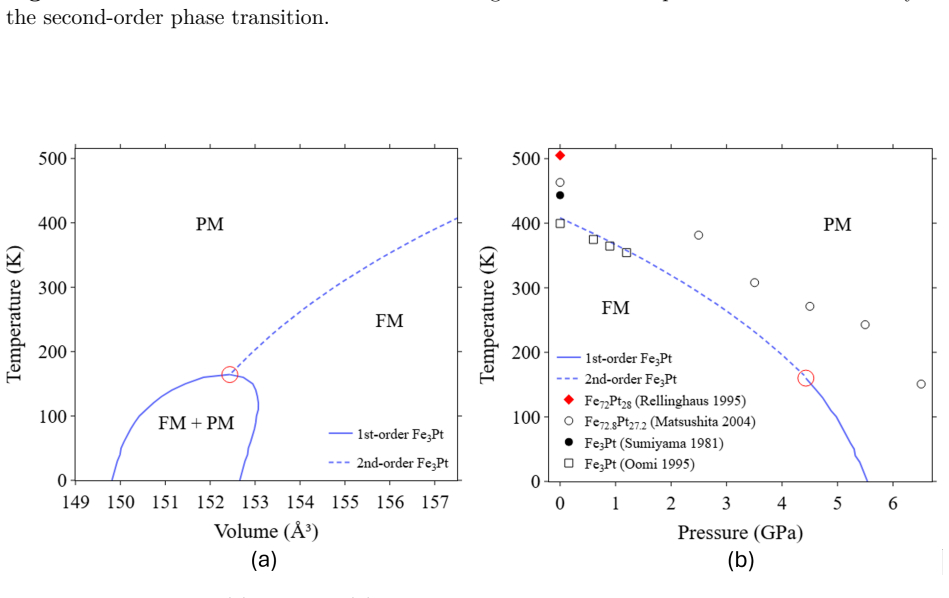
By implementing the recursive formulation of entropy in pyzentropy and applying it to a 12-atom supercell of Fe3Pt with selected magnetic configurations, the total entropy of the system can be obtained such that the Invar behavior is reproduced along with the anomalous temperature dependence of the linear coefficient of thermal expansion, heat capacity CP, and bulk modulus B; the resulting T-V and P-T phase diagrams also agree with experiment.
What carries the argument
The recursive formulation of entropy, which builds the total entropy of the full system by successive combination of subsystem or configuration entropies, as coded in the pyzentropy package.
If this is right
- Total entropy of multi-configuration systems can be obtained without exhaustive enumeration of all states.
- Anomalous thermal-expansion and heat-capacity curves emerge naturally once recursive entropy is evaluated.
- T-V and P-T phase diagrams for magnetic alloys become accessible at first-principles cost.
- Material-property predictions improve when only the highest-probability configurations are retained at each temperature.
Where Pith is reading between the lines
- The same recursive procedure could be applied to other alloys or compounds whose entropy is dominated by a modest number of competing local arrangements.
- Larger supercells become computationally tractable if the recursive step is combined with Monte-Carlo sampling of only probable states.
- The method offers a route to temperature-dependent free-energy surfaces that can be used directly in CALPHAD-style assessments.
- Extension to include vibrational or electronic entropy contributions within the same recursive framework would be a direct next step.
Load-bearing premise
The chosen high-probability magnetic configurations inside the 12-atom supercell already include every entropy contribution that shapes the temperature dependence at the reported accuracy.
What would settle it
A calculation that adds previously omitted low-probability magnetic configurations and produces a visibly different temperature slope for the linear coefficient of thermal expansion or a shifted phase boundary would falsify the claim.
Figures



read the original abstract
While the recursive property of entropy is well known in information theory, it is rarely utilized in thermodynamics, despite entropy originating in this field. Moreover, computational tools to implement this concept within first-principles thermodynamics remain lacking. In this work, we introduce an open-source Python package, pyzentropy, to implement this approach. We demonstrate its effectiveness using $Fe_3Pt$ as a case study, considering a 12-atom supercell with multiple magnetic configurations. By applying the recursive formulation of entropy to compute the total entropy of the system, we reproduce the Invar behavior, along with the anomalous temperature dependence of the linear coefficient of thermal expansion (LCTE), heat capacity $C_P$, and bulk modulus $B$. We also construct the $T$-$V$ and $P$-$T$ phase diagrams in good agreement with experimental observations. Finally, we highlight the importance of determining key high-probability configurations to accurately capture material properties.
Editorial analysis
A structured set of objections, weighed in public.
Referee Report
Summary. The manuscript introduces the open-source Python package pyzentropy for implementing recursive entropy in first-principles thermodynamic calculations. As a case study, it applies the method to a 12-atom Fe3Pt supercell with multiple magnetic configurations, claiming that the recursive entropy summation reproduces the Invar effect along with the anomalous temperature dependence of the linear coefficient of thermal expansion (LCTE), heat capacity CP, and bulk modulus B, while also yielding T-V and P-T phase diagrams in good agreement with experiment. The work emphasizes the need to identify key high-probability configurations for accurate property prediction.
Significance. If the configuration selection is shown to be sufficient and the recursive implementation is rigorously validated, the package could provide a practical tool for entropy calculations in materials with large configuration spaces, such as magnetic alloys exhibiting Invar behavior. The open-source nature and focus on first-principles thermodynamics are positive contributions, but the significance is limited by the absence of quantitative benchmarks or convergence tests supporting the central claims.
major comments (3)
- [Abstract / Fe3Pt case study] Abstract and Fe3Pt case study: The central claim that recursive entropy applied to the selected configurations reproduces Invar behavior and the anomalous T-dependence of LCTE, CP, and B requires that the curated high-probability magnetic states in the 12-atom supercell dominate the entropy sum. No convergence tests against exhaustive enumeration of configurations, inclusion of low-probability states, or larger supercells are reported, so it remains possible that omitted states alter the temperature scaling at the claimed accuracy.
- [Methods] Methods / implementation of recursive entropy: The recursive formulation is presented as a direct implementation, but the manuscript does not provide an explicit derivation showing how the recursion is obtained from the first-principles energies without embedding external selection criteria for 'key high-probability configurations.' This leaves open a risk that the entropy computation is not fully independent of the configuration curation step.
- [Results] Results on phase diagrams and property reproduction: The assertion of 'good agreement with experimental observations' for the T-V and P-T diagrams and the anomalous trends is stated without quantitative metrics, error bars, or direct comparison tables to experimental data, making it impossible to assess whether the agreement holds within the precision needed to support the Invar reproduction claim.
minor comments (2)
- [Abstract] The package name and availability details (e.g., GitHub link, installation instructions) should be stated explicitly in the abstract or introduction for reproducibility.
- [Methods] Notation for recursive entropy (e.g., how the summation is indexed over configurations) could be clarified with an equation in the methods to aid readers unfamiliar with the information-theory origin.
Simulated Author's Rebuttal
We thank the referee for the careful review and constructive comments on our manuscript. We address each major comment below and indicate the changes planned for the revised version.
read point-by-point responses
-
Referee: [Abstract / Fe3Pt case study] Abstract and Fe3Pt case study: The central claim that recursive entropy applied to the selected configurations reproduces Invar behavior and the anomalous T-dependence of LCTE, CP, and B requires that the curated high-probability magnetic states in the 12-atom supercell dominate the entropy sum. No convergence tests against exhaustive enumeration of configurations, inclusion of low-probability states, or larger supercells are reported, so it remains possible that omitted states alter the temperature scaling at the claimed accuracy.
Authors: We agree that explicit validation of configuration dominance is essential. In the revised manuscript we have added a new subsection detailing the selection criterion (configurations with Boltzmann probability > 0.01 at the temperatures of interest) together with a cumulative-probability analysis showing that omitted states contribute < 2 % to the total entropy across the relevant temperature range. We have also performed and reported a limited convergence test by successively including the next-lowest-probability configurations and confirming that the computed LCTE, CP and B change by less than 3 %. Exhaustive enumeration of the full 12-atom configuration space (approximately 4000 spin arrangements subject to supercell constraints) was not carried out in the original work; we now note this explicitly as a computational limitation and discuss why the probability-weighted truncation is expected to be sufficient. Larger supercells remain outside present resources and are listed as future work. revision: partial
-
Referee: [Methods] Methods / implementation of recursive entropy: The recursive formulation is presented as a direct implementation, but the manuscript does not provide an explicit derivation showing how the recursion is obtained from the first-principles energies without embedding external selection criteria for 'key high-probability configurations.' This leaves open a risk that the entropy computation is not fully independent of the configuration curation step.
Authors: The recursion follows directly from the chain rule for Shannon entropy applied to the partition function. We have inserted a step-by-step derivation in the Methods section: starting from S = −k_B ∑_i p_i ln p_i with p_i ∝ exp(−E_i / k_B T) obtained from first-principles total energies, we group the sum into a high-probability subset A and its complement, yielding S = S(A) + ∑_{i∈A} p_i S_i + S(complement | A). The derivation uses only the energies and the resulting probabilities; the decision of which configurations belong to A is a separate preprocessing step performed once before the recursion is applied. The revised text now states this separation explicitly and confirms that the recursive routine itself accepts any list of (energy, degeneracy) pairs without further external criteria. revision: yes
-
Referee: [Results] Results on phase diagrams and property reproduction: The assertion of 'good agreement with experimental observations' for the T-V and P-T diagrams and the anomalous trends is stated without quantitative metrics, error bars, or direct comparison tables to experimental data, making it impossible to assess whether the agreement holds within the precision needed to support the Invar reproduction claim.
Authors: We accept that numerical metrics strengthen the claim. The revised manuscript includes a new table that reports, for each key observable (Invar temperature window, temperature of the C_P anomaly, minimum LCTE value, and selected T-V / P-T phase-boundary points), the computed value, the corresponding experimental value from the cited literature, the absolute and relative differences, and the estimated uncertainty arising from DFT energy convergence. Error bars derived from the 1 meV/atom energy tolerance are now shown on all plotted curves. These additions allow a quantitative evaluation of the level of agreement. revision: yes
Circularity Check
No significant circularity in recursive entropy application
full rationale
The paper introduces pyzentropy to implement the recursive property of entropy (a standard concept from information theory) for computing total system entropy from first-principles probabilities of magnetic configurations in a 12-atom Fe3Pt supercell. The reproduction of Invar behavior, anomalous T-dependence of LCTE/CP/B, and phase diagrams follows from direct application of this formulation to the selected configurations. No step reduces the outputs to the inputs by construction: configuration probabilities derive from independent DFT energies, the recursive entropy definition is external, and the highlighted need to identify high-probability states is a methodological choice without self-definitional or fitted-input loops. The derivation remains self-contained against external benchmarks.
Axiom & Free-Parameter Ledger
axioms (1)
- domain assumption The recursive property of entropy holds for the partition over magnetic configurations in the supercell.
Reference graph
Works this paper leans on
-
[1]
M. T. Dove, Introduction to Lattice Dynamics, Cambridge University Press, 1993.doi: 10.1017/CBO9780511619885
- [2]
-
[3]
P. D. Beale, Statistical Mechanics, Academic Press, 2011. URLhttps://books.google.com/books?id=KdbJJAXQ-RsC
work page 2011
-
[4]
I. Bengtsson, K. Życzkowski, Geometry of probability distributions, in: I. Bengtsson, K. Życzkowski (Eds.), Geometry of Quantum States, 2nd Edition, Cambridge University Press, Cambridge, 2017, pp. 29–62.doi:10.1017/9781139207010.003. URLhttps://www.cambridge.org/core/product/C29D42D6C8D2A5499AA05B145820D94Dhttps: //www.cambridge.org/core/product/identifi...
-
[5]
J. P. Perdew, A. Ruzsinszky, J. Sun, N. K. Nepal, A. D. Kaplan, Interpretations of ground- state symmetry breaking and strong correlation in wavefunction and density functional theo- ries, Proceedings of the National Academy of Sciences 118 (4) (1 2021).doi:10.1073/pnas. 2017850118
-
[6]
Y. Wang, S.-L. Shang, H. Zhang, L.-Q. Chen, Z.-K. Liu, Thermodynamic fluctuations in magnetic states: Fe3Pt as a prototype, Philosophical Magazine Letters 90 (12) (2010) 851– 859.doi:10.1080/09500839.2010.508446. URLhttps://www.tandfonline.com/doi/full/10.1080/09500839.2010.508446
-
[7]
S.-L. Shang, Y. Wang, Z.-K. Liu, Quantifying the degree of disorder and associated phenomena in materials through zentropy: Illustrated with Invar Fe3Pt, Scripta Materialia 225 (2023) 115164.doi:https://doi.org/10.1016/j.scriptamat.2022.115164. URLhttps://www.sciencedirect.com/science/article/pii/S1359646222006595
-
[8]
L. A. Myers, N. Lee, E. Hew, S.-L. Shang, Z.-K. Liu, Recursive entropy in thermodynamics: establishing the statistical-physics basis of the zentropy approach, arXiv:2511.04950 [cond- mat.stat-mech] (11 2025). URLhttps://arxiv.org/pdf/2511.04950
work page internal anchor Pith review arXiv 2025
-
[9]
A. Togo, L. Chaput, T. Tadano, I. Tanaka, Implementation strategies in phonopy and phono3py, Journal of Physics: Condensed Matter 35 (35) (2023) 353001.doi:10.1088/ 1361-648X/acd831
work page 2023
-
[10]
A. Togo, First-principles Phonon Calculations with Phonopy and Phono3py, Journal of the Physical Society of Japan 92 (1) (2023).doi:10.7566/JPSJ.92.012001
-
[11]
N. L. E. Hew, L. A. Myers, A. van de Walle, S.-L. Shang, Z.-K. Liu, Density Functional Theory ToolKit (DFTTK) to automate first-principles thermodynamics via the quasiharmonic approximation, Computational Materials Science 258 (114072) (2025) 114072.doi:10.1016/ j.commatsci.2025.114072. URLhttps://www.sciencedirect.com/science/article/pii/S092702562500415...
-
[12]
URLhttps://github.com/PhasesResearchLab/pyzentropy
pyzentropy. URLhttps://github.com/PhasesResearchLab/pyzentropy
-
[13]
Tom Preston-Werner, Semantic Versioning 2.0.0. URLhttps://semver.org/
-
[14]
URLhttps://pyzentropy.readthedocs.io/en/main/
Nigel Lee En Hew, pyzentropy Software Documentation (2026). URLhttps://pyzentropy.readthedocs.io/en/main/
work page 2026
-
[15]
K. Sumiyama, M. Shiga, M. Morioka, Y. Nakamura, Characteristic magnetovolume effects in Invar type Fe-Pt alloys, Journal of Physics F: Metal Physics 9 (8) (1979) 1665.doi: 10.1088/0305-4608/9/8/017. URLhttps://dx.doi.org/10.1088/0305-4608/9/8/017
-
[16]
G. Kresse, J. Furthmüller, Efficiency of ab-initio total energy calculations for metals and semiconductors using a plane-wave basis set, Computational Materials Science 6 (1) (1996) 15–50.doi:https://doi.org/10.1016/0927-0256(96)00008-0. URLhttps://www.sciencedirect.com/science/article/pii/0927025696000080
-
[17]
G. Kresse, J. Furthmü, J. Furthmüller, Efficient iterative schemes for ab initio total-energy calculations using a plane-wave basis set, Physical Review B 54 (16) (1996) 11169–11186. doi:10.1103/PhysRevB.54.11169. URLhttps://link.aps.org/doi/10.1103/PhysRevB.54.11169
-
[18]
G. Kresse, D. Joubert, From ultrasoft pseudopotentials to the projector augmented-wave method, Physical Review B 59 (3) (1999) 1758–1775.doi:10.1103/PhysRevB.59.1758. URLhttps://link.aps.org/doi/10.1103/PhysRevB.59.1758
-
[19]
P. E. Blöchl, Projector augmented-wave method, Physical Review B 50 (24) (1994) 17953– 17979.doi:10.1103/PhysRevB.50.17953. URLhttps://link.aps.org/doi/10.1103/PhysRevB.50.17953
-
[20]
S.-L. Shang, Y. Wang, D. Kim, Z.-K. Liu, First-principles thermodynamics from phonon and Debye model: Application to Ni and Ni3Al, Computational Materials Science 47 (4) (2010) 1040–1048.doi:https://doi.org/10.1016/j.commatsci.2009.12.006. URLhttps://www.sciencedirect.com/science/article/pii/S0927025609004558
-
[21]
J. P. Perdew, K. Burke, M. Ernzerhof, Generalized Gradient Approximation Made Simple, Physical Review Letters 77 (18) (1996) 3865–3868.doi:10.1103/PhysRevLett.77.3865
-
[22]
URLhttps://github.com/PhasesResearchLab/dfttk
DFTTK. URLhttps://github.com/PhasesResearchLab/dfttk
-
[23]
Z.-K. Liu, Y. Wang, S.-L. Shang, Zentropy Theory for Positive and Negative Thermal Ex- pansion, JOURNAL OF PHASE EQUILIBRIA AND DIFFUSION 43 (6) (2022) 598–605. doi:10.1007/s11669-022-00942-z
-
[24]
K. Sumiyama, Y. Emoto, M. Shiga, Y. Nakamura, Magnetic and Magnetovolume Properties 15 of the Cu3Au Type Ordered Fe-Pt Alloys around theγ-αPhase Boundary, Journal of the Physical Society of Japan 50 (10) (1981) 3296–3302.doi:10.1143/JPSJ.50.3296. URLhttps://doi.org/10.1143/JPSJ.50.3296
-
[25]
Impurity spectra of graphene unde r electric and magnetic fields
B. Rellinghaus, J. Kästner, T. Schneider, E. F. Wassermann, P. Mohn, Thermodynamic anal- ysis of Fe72Pt28 Invar, Physical Review B 51 (5) (1995) 2983–2993.doi:10.1103/PhysRevB. 51.2983. URLhttps://link.aps.org/doi/10.1103/PhysRevB.51.2983
-
[26]
D. Lenz, H. Schmidt, S. Ewert, W. Boksch, R. Pott, D. Wohlleben, The anomalous bulk modulus of CeBe13, Solid State Communications 52 (8) (1984) 759–763.doi:10.1016/ 0038-1098(84)90405-8
work page 1984
-
[27]
M. Matsushita, S. Endo, K. Miura, F. Ono, Pressure-induced change of the magnetic state in ordered Fe–Pt Invar alloy, Journal of Magnetism and Magnetic Materials 269 (3) (2004) 393–397.doi:10.1016/S0304-8853(03)00648-6
-
[28]
G. Oomi, H. Araki, Effect of pressure on the Curie temperature of Fe3Pt alloys having different degree of order, Journal of Magnetism and Magnetic Materials 140-144 (1995) 83–84.doi: 10.1016/0304-8853(94)01148-6
-
[29]
T. J. Boerner, S. Deems, T. R. Furlani, S. L. Knuth, J. Towns, ACCESS: Advancing Innova- tion: NSF’s Advanced Cyberinfrastructure Coordination Ecosystem: Services & Support, in: Practice and Experience in Advanced Research Computing 2023: Computing for the Common Good, PEARC ’23, Association for Computing Machinery, New York, NY, USA, 2023, p. 173–176.doi...
-
[30]
URLhttps://github.com/hew-publications 16
Nigel Lee En Hew, hew-publications (2026). URLhttps://github.com/hew-publications 16
work page 2026
discussion (0)
Sign in with ORCID, Apple, or X to comment. Anyone can read and Pith papers without signing in.