Recognition: unknown
Score-Based Matching with Target Guidance for Cryo-EM Denoising
Pith reviewed 2026-05-10 05:36 UTC · model grok-4.3
The pith
Score-based denoising guided by target density improves cryo-EM particle picking and reconstruction consistency.
A machine-rendered reading of the paper's core claim, the machinery that carries it, and where it could break.
Core claim
The authors establish that training a score-based model on the clean-data score, augmented with reference-density guidance, recovers particle signals more effectively than pixel-wise or Noise2Noise objectives by reducing structured background interference, leading to measurable gains in particle picking accuracy and more consistent 3D reconstructions across multiple cryo-EM datasets.
What carries the argument
The score function estimating the gradient of the log-density of clean cryo-EM particles, combined with a target-guided matching term that incorporates reference particle densities to stabilize learning and direct denoising.
If this is right
- Particle picking on real datasets becomes more accurate because background responses are reduced.
- 3D reconstructions show higher structural consistency as fewer denoising artifacts propagate.
- 2D classification steps benefit from better-preserved particle features.
- The approach applies across varied cryo-EM datasets with different noise profiles.
Where Pith is reading between the lines
- The guidance mechanism could be adapted to other low-signal imaging tasks where approximate reference shapes are available.
- If reference densities are only approximate, the method might still aid de novo cases but risks introducing mild bias in novel structures.
- Integration into existing cryo-EM software pipelines would be a direct next test for end-to-end workflow gains.
Load-bearing premise
That learning the clean-data score plus reference-density guidance suppresses structured low-frequency background without introducing artifacts that harm downstream particle picking or classification.
What would settle it
Running the method on a cryo-EM dataset with known ground-truth particles and finding no gain in particle-picking precision or a drop in 3D reconstruction resolution relative to standard denoisers would falsify the central improvement claim.
Figures
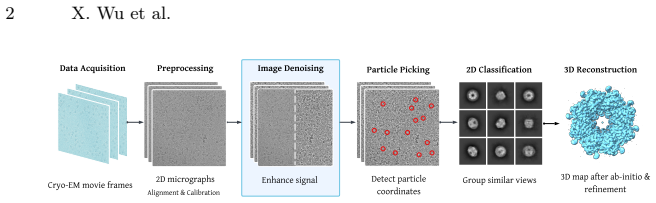


read the original abstract
Cryo-electron microscopy (cryo-EM) enables single-particle analysis of biological macromolecules under strict low-dose imaging conditions, but the resulting micrographs often exhibit extremely low signal-to-noise ratios and weak particle visibility. Image denoising is therefore an important preprocessing step for downstream cryo-EM analysis, including particle picking, 2D classification, and 3D reconstruction. Existing cryo-EM denoising methods are commonly trained with pixel-wise or Noise2Noise-style objectives, which can improve visual quality but do not explicitly account for structural consistency required by downstream analysis. In this work, we propose a score-based denoising framework for cryo-EM that learns the clean-data score to recover particle signals while better preserving structural information. Building on this formulation, we further introduce a target-guided variant that incorporates reference-density guidance to stabilize score learning under weak and ambiguous signal conditions. Rather than simply amplifying particle-like responses, our framework better suppresses structured low-frequency background, which improves particle--background separability for downstream analysis. Experiments on multiple cryo-EM datasets show that our score-based methods consistently improve downstream particle picking and produce more structure-consistent 3D reconstructions. Experiments on multiple cryo-EM datasets show that our methods improve downstream particle picking and produce more structure-consistent reconstructions.
Editorial analysis
A structured set of objections, weighed in public.
Referee Report
Summary. The manuscript proposes a score-based denoising framework for cryo-EM micrographs that learns the clean-data score function to recover particle signals while preserving structural information. It introduces a target-guided variant incorporating reference-density guidance to stabilize score estimation under weak-signal conditions, claiming this suppresses structured low-frequency background more effectively than pixel-wise or Noise2Noise objectives and yields better downstream particle picking and structure-consistent 3D reconstructions across multiple datasets.
Significance. If the improvements hold without circularity artifacts, the work offers a principled advance over conventional cryo-EM denoising by aligning the objective with downstream structural analysis needs. Score-based modeling plus domain guidance is a promising direction for low-SNR modalities, potentially raising the reliability of particle picking and FSC metrics in standard pipelines.
major comments (2)
- [Method] Method section (target-guided variant): the reference-density guidance term is not shown to be derived from an independent source; if computed via initial reconstruction or averaging on the same micrographs or particles used for evaluation, the reported gains in particle-background separability and structure consistency become partly tautological, directly undermining the central claim that the method 'better suppresses structured low-frequency background' without introducing artifacts.
- [Experiments] Experiments section: the headline claim of 'consistent improvements' in particle picking and 3D reconstructions lacks reported quantitative metrics (e.g., precision-recall curves, FSC values, or statistical tests against baselines such as Noise2Noise or existing cryo-EM denoisers), making it impossible to verify that gains exceed what would be expected from any reasonable reference-guided prior.
minor comments (1)
- [Abstract] Abstract contains a duplicated final sentence that should be removed.
Simulated Author's Rebuttal
We are grateful for the referee's thorough review and constructive feedback. We believe the suggested revisions will significantly improve the clarity and rigor of our work, and we address each major comment below.
read point-by-point responses
-
Referee: [Method] Method section (target-guided variant): the reference-density guidance term is not shown to be derived from an independent source; if computed via initial reconstruction or averaging on the same micrographs or particles used for evaluation, the reported gains in particle-background separability and structure consistency become partly tautological, directly undermining the central claim that the method 'better suppresses structured low-frequency background' without introducing artifacts.
Authors: We thank the referee for highlighting this potential issue of circularity in the target guidance. We agree that the independence of the reference density must be clearly established to avoid any perception of circularity. We will revise the Method section to provide a detailed description of how the reference density is obtained, including confirmation that it is derived from independent data sources or splits, and add supporting experiments to validate the suppression of background without artifacts. revision: yes
-
Referee: [Experiments] Experiments section: the headline claim of 'consistent improvements' in particle picking and 3D reconstructions lacks reported quantitative metrics (e.g., precision-recall curves, FSC values, or statistical tests against baselines such as Noise2Noise or existing cryo-EM denoisers), making it impossible to verify that gains exceed what would be expected from any reasonable reference-guided prior.
Authors: We acknowledge the need for more rigorous quantitative evaluation to support our claims. The current manuscript presents improvements primarily through visual comparisons and qualitative assessments of particle picking and reconstruction consistency. In the revised version, we will include quantitative metrics such as precision-recall curves for particle picking performance, FSC resolution values for 3D reconstructions, and statistical tests (e.g., paired t-tests or Wilcoxon tests) comparing our method against baselines including Noise2Noise and other standard cryo-EM denoisers on the multiple datasets used. revision: yes
Circularity Check
No significant circularity detected
full rationale
The abstract and provided excerpts describe a score-based denoising framework and a target-guided variant using reference-density guidance, with claims of improved downstream performance validated on multiple cryo-EM datasets. No equations, fitted parameters, or derivation chains are presented that reduce by construction to the inputs (e.g., no self-definitional score functions, no predictions that are statistically forced from subsets of the same data, and no load-bearing self-citations or uniqueness theorems invoked). The reference-density guidance is introduced at a conceptual level without details showing it is derived tautologically from the evaluation data. Experimental claims remain independent of any internal fitting loop described here. This is the expected honest non-finding for a high-level methods paper without visible self-referential reductions.
Axiom & Free-Parameter Ledger
Reference graph
Works this paper leans on
-
[1]
Nucleic acids research52(D1), D456– D465 (2024)
Emdb—the electron microscopy data bank. Nucleic acids research52(D1), D456– D465 (2024)
2024
-
[2]
Journal of structural biology166(2), 126–132 (2009)
Baxter, W.T., Grassucci, R.A., Gao, H., Frank, J.: Determination of signal-to- noise ratios and spectral snrs in cryo-em low-dose imaging of molecules. Journal of structural biology166(2), 126–132 (2009)
2009
-
[3]
Nature communications11(1), 5208 (2020)
Bepler, T., Kelley, K., Noble, A.J., Berger, B.: Topaz-denoise: general deep denois- ing models for cryoem and cryoet. Nature communications11(1), 5208 (2020)
2020
-
[4]
Nature methods16(11), 1153–1160 (2019)
Bepler, T., Morin, A., Rapp, M., Brasch, J., Shapiro, L., Noble, A.J., Berger, B.: Positive-unlabeled convolutional neural networks for particle picking in cryo- electron micrographs. Nature methods16(11), 1153–1160 (2019)
2019
-
[5]
Bortoli, V.D., Hutchinson, M., Wirnsberger, P., Doucet, A.: Target score matching (2024)
2024
-
[6]
Science advances6(7), eaax3157 (2020)
Burendei, B., Shinozaki, R., Watanabe, M., Terada, T., Tani, K., Fujiyoshi, Y., Oshima, A.: Cryo-em structures of undocked innexin-6 hemichannels in phospho- lipids. Science advances6(7), eaax3157 (2020)
2020
-
[7]
Protein crystallography: methods and protocols pp
Burley, S.K., Berman, H.M., Kleywegt, G.J., Markley, J.L., Nakamura, H., Ve- lankar, S.: Protein data bank (pdb): the single global macromolecular structure archive. Protein crystallography: methods and protocols pp. 627–641 (2017)
2017
-
[8]
Scientific Data10 (2023).https://doi.org/10.1038/s41597-023-02280-2
Dhakal, A., Gyawali, R., Wang, L., Cheng, J.: A large expert-curated cryo-em image dataset for machine learning protein particle picking. Scientific Data10 (2023).https://doi.org/10.1038/s41597-023-02280-2
-
[9]
Dhariwal, P., Nichol, A.: Diffusion models beat gans on image synthesis (2021), https://arxiv.org/abs/2105.05233
work page internal anchor Pith review arXiv 2021
-
[10]
Oxford University Press (2006)
Frank, J.: Three-Dimensional Electron Microscopy of Macromolecular Assemblies. Oxford University Press (2006)
2006
-
[11]
Ho, J., Jain, A., Abbeel, P.: Denoising diffusion probabilistic models (2020),https: //arxiv.org/abs/2006.11239
work page internal anchor Pith review arXiv 2020
-
[12]
Nucleic Acids Research51(D1), D1503–D1511 (2023)
Iudin, A., Korir, P.K., Somasundharam, S., Weyand, S., Cattavitello, C., Fonseca, N., Salih, O., Kleywegt, G.J., Patwardhan, A.: Empiar: the electron microscopy public image archive. Nucleic Acids Research51(D1), D1503–D1511 (2023)
2023
-
[13]
Micron p
Jiang, L., Zhu, B., Long, W., Xu, J., Wu, Y., Li, Y.W.: A review of denoising methods in single-particle cryo-em. Micron p. 103817 (2025)
2025
-
[14]
Karras,T.,Aittala,M.,Aila,T.,Laine,S.:Elucidatingthedesignspaceofdiffusion- based generative models (2022),https://arxiv.org/abs/2206.00364
work page internal anchor Pith review arXiv 2022
-
[15]
In: Proceedings of the IEEE/CVF Conference on Computer Vision and Pattern Recognition (CVPR)
Krull, A., Buchholz, T.O., Jug, F.: Noise2void: Learning denoising from single noisy images. In: Proceedings of the IEEE/CVF Conference on Computer Vision and Pattern Recognition (CVPR). pp. 2129–2137 (2019)
2019
-
[16]
Science343(6178), 1443–1444 (2014) 16 X
Kühlbrandt, W.: The resolution revolution. Science343(6178), 1443–1444 (2014) 16 X. Wu et al
2014
-
[17]
Cell168(1), 111–120 (2017)
Lee, C.H., MacKinnon, R.: Structures of the human hcn1 hyperpolarization- activated channel. Cell168(1), 111–120 (2017)
2017
-
[18]
In: Proceedings of the International Conference on Machine Learning (ICML)
Lehtinen, J., Munkberg, J., Hasselgren, J., Laine, S., Karras, T., Aittala, M., Aila, T.: Noise2noise: Learning image restoration without clean data. In: Proceedings of the International Conference on Machine Learning (ICML). pp. 2965–2974. PMLR (2018)
2018
-
[19]
Bioinformatics38(7), 2022–2029 (2022)
Li, H., Zhang, H., Wan, X., Yang, Z., Li, C., Li, J., Han, R., Zhu, P., Zhang, F.: Noise-transfer2clean: Denoising cryo-em images based on noise modeling and transfer. Bioinformatics38(7), 2022–2029 (2022)
2022
-
[20]
In: Proceedings of the 37th International Conference on Machine Learning (ICML)
Lim, J.H., Courville, A., Pal, C., Huang, C.W.: Ar-dae: Towards unbiased neural entropy gradient estimation. In: Proceedings of the 37th International Conference on Machine Learning (ICML). pp. 6061–6071. PMLR (2020)
2020
-
[21]
The FEBS Journal280(1), 28–45 (2013)
Milne, J.L., Borgnia, M.J., Bartesaghi, A., Tran, E.E., Earl, L.A., Schauder, D.M., Lengyel, J., Pierson, J., Patwardhan, A., Subramaniam, S.: Cryo-electron microscopy–a primer for the non-microscopist. The FEBS Journal280(1), 28–45 (2013)
2013
-
[22]
Nature Methods13(1), 24–27 (2016)
Nogales, E.: The development of cryo-em into a mainstream structural biology technique. Nature Methods13(1), 24–27 (2016)
2016
-
[23]
Nature methods14(3), 290–296 (2017)
Punjani, A., Rubinstein, J.L., Fleet, D.J., Brubaker, M.A.: cryosparc: algorithms for rapid unsupervised cryo-em structure determination. Nature methods14(3), 290–296 (2017)
2017
-
[24]
In: Proceedings of the IEEE/CVF Con- ference on Computer Vision and Pattern Recognition (CVPR)
Quan, Y., Chen, M., Pang, T., Ji, H.: Self2self with dropout: Learning self- supervised denoising from a single image. In: Proceedings of the IEEE/CVF Con- ference on Computer Vision and Pattern Recognition (CVPR). pp. 1887–1895 (2020)
2020
-
[25]
In: Proceedings of the Thirty- Eighth Annual Conference on Neural Information Processing Systems (NeurIPS) (2024)
Shen, Y., Dai, H., Chen, Q., Zeng, Y., Zhang, J., Pei, Y., Yu, J.: DRACO: A denoising-reconstruction autoencoder for cryo-em. In: Proceedings of the Thirty- Eighth Annual Conference on Neural Information Processing Systems (NeurIPS) (2024)
2024
-
[26]
Neural computation23(7), 1661–1674 (2011)
Vincent, P.: A connection between score matching and denoising autoencoders. Neural computation23(7), 1661–1674 (2011)
2011
-
[27]
In: Proceedings of the Thirty-Seventh International Conference on Neural Information Processing Systems (NeurIPS) (2023)
Xie, Y., Yuan, M., Dong, B., Li, Q.: Unsupervised image denoising with score function. In: Proceedings of the Thirty-Seventh International Conference on Neural Information Processing Systems (NeurIPS) (2023)
2023
-
[28]
Zhang, J., Chen, Q., Zeng, Y., Gao, W., He, X., Liu, Z., Yu, J.: Genem: Physics- informed generative cryo-electron microscopy (2023) Score-Based Matching with Target Guidance for Cryo-EM Denoising 17 A Derivations and Theoretical Details A.1 Posterior Score Identity for the Corruption Model We recall a classical identity relating the score of the noisy ob...
discussion (0)
Sign in with ORCID, Apple, or X to comment. Anyone can read and Pith papers without signing in.